
REVIEW: “Copshop” (2021)

CLICK HERE for my full review in the Arkansas Democrat-Gazette

“Copshop” is the latest abrasive crime thriller comes from director Joe Carnahan, a filmmaker known for exploring society’s gritty criminal underbelly. This particular outing may have you checking the end credits to see if Quentin Tarantino’s name is attached. That should give you a good idea of the kind of movie Carnahan is shooting for.

In reality, “Copshop” more closely resembles the B-movie schlock that often inspired Tarantino rather than an actual Tarantino movie. And that’s not necessarily a bad thing. Co-written by Carnahan and Kurt McLeod, the story feels like something pulled from a 1970’s pulp magazine and the evocation of John Carpenter’s “Assault On Precinct 13” is hard to miss.

But as movies have shown us countless times, aiming for something and hitting it are two different things. And marrying both style and substance can be tricky. At first glance “Copshop” has all the ingredients for a fun and grimy throwback exploitation flick. The cast is certainly up to the task and DP Juan Miguel Azpiroz shoots the film with a nostalgic verve that energizes the action and the setting. If only the writing was as sturdy.

Image Courtesy of Open Road Films

Carnahan’s modestly entertaining actioner is built around a nifty premise that sets us up for a number of second-half revelations. There’s also an infusion of kooky black comedy that may not always work, but it keeps things lively. And of course there’s the inevitable violent final act blow-out that packs enough carnage and mayhem to make genre fans smile.

Yet despite all of that, “Copshop” is never quite as suspenseful or engaging as it needs to be. And while the cast does a good job selling their characters, too many are your standard issue variety and all of them speak in the exact same foul-tongued pseudo tough guy vernacular found in many of Carnahan’s movies. And while the majority of the performances are on point, everyone ends up constricted by their character types.

It doesn’t take long for the story to kick into gear with most of it playing out over the course of one night at Gun Creek Police Department, a strangely remote yet noticeably modern police station (why it sits literally in the middle of nowhere is one of those glaringly obvious questions you’re not supposed to ask in a movie like this).

The first of the key players we meet is con-man and seasoned mob fixer Teddy Murretto (Frank Grillo sporting an anchor beard, a man-bun and one gaudy pair of snakeskin boots). He’s a slippery rogue who has frequently eluded death and prison. We’re introduced to him as he’s barreling down a Nevada highway in a bullet-riddled Ford Crown Victoria, the windows busted out, smoke billowing out from under the hood.

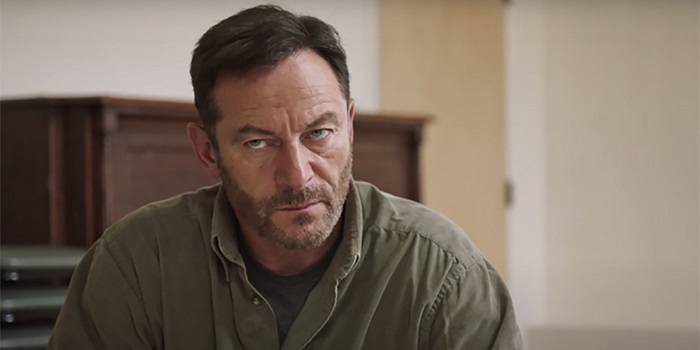
Turns out there’s a bounty on Teddy’s head and he’s running from several interested parties who are eager to cash in, among them the ruthless and notorious hitman Bob Viddick (Gerard Butler), a career killer known for his no-nonsense efficiency and penchant for violence. Viddick’s not someone you want hot on your heels so Teddy does something desperate- he punches a young deputy named Valerie (Alexis Louder) to get himself arrested. What safer place to hide out than in a jail cell at a local copshop?

Image Courtesy of Open Road Films

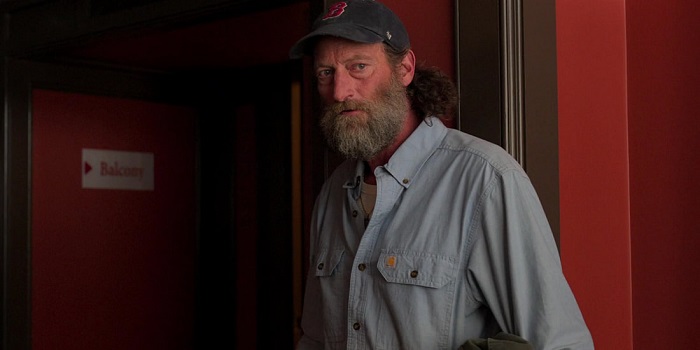
What Teddy didn’t count on was Viddick doing the same thing. Soon the assassin and the target are sitting in cells across from each other with Valerie trying to put together the pieces. Things get even crazier with the introduction of a second hitman, a psychopathic wildcard named Anthony “Tony” Lamb (Toby Huss), a wildly uneven swirl of disturbing menace and cartoonish silliness. Let the psychological chess matches between the sleazeball, the hired gun, the hero and the maniac begin.

The rest of the running time is filled with snarky interplay, chest-pounding masculinity, clichés galore, more trite cop banter than you can shake a police baton, and a slew of stereotypes. Then we get back to the humor which highlights Carnahan’s self-awareness but does more to undermine the suspense than make us laugh.

The real saving grace is the cast, especially the central trio. Butler is a nice fit and while it’s true the Scotsman has starred in his share of stinkers, it’s nice to be reminded of his legitimate acting chops. Grillo is a Carnahan regular and is right at home in the director’s grimy underworld. But the real standout is actress Alexis Louder who matches her two burly veteran co-stars barb-for-barb and bullet-for-bullet. If only the rest of the movie had her spark. “Copshop” is now showing in theaters.

VERDICT – 2.5 STARS

First Glance: “The Humans”

Screenwriter and playwright Stephen Karam makes his big screen directorial debut with “The Humans”, an upcoming adaptation of Karam’s 2016 Tony-winning Broadway production. What looks like a talky drama looks to turn into something deeper and slightly more unsettling. I like the vibe and the cast makes it even more compelling.

In the film Beanie Feldstein and her boyfriend (played by Steven Yeun) host her family for a Thanksgiving meal at her new Manhattan apartment. Her father (Richard Jenkins), mother (Jayne Houdyshell who also starred in the stage version), older sister (Amy Schumer) and grandmother (June Squibb) all show up. While it should be a festive occasion, a looming sadness hangs over their time together. Something else is clearly going on. The film debuted at the Toronto International Film Festival to positive reviews. I’m excited to give it a whirl.

“The Humans” opens November 24th in theaters and on Showtime. Check out the trailer below and let me know if you’ll be seeing it or taking a pass.

REVIEW: “Malignant” (2021)

CLICK HERE to read my full review in the Arkansas Democrat-Gazette

James Wan not only cut his teeth in the horror genre, but he’s also the man behind the camera of such franchise-launching movies as “Saw”, “Insidious” and “The Conjuring”. All three were modestly budgeted but wildly popular chillers. Wan stepped away from the spooky stuff to helm two major tentpole blockbusters, both big successes – 2015’s “Furious 7” and 2018’s “Aquaman”. Warner Bros. quickly signed him up for a second “Aquaman”, but before diving back into the big budget waters, Wan returns to his roots with “Malignant”, a devilishly creepy horror flick with a fun and nasty edge to it.

I suppose you could call me as a fan of Wan’s horror stuff. I generally like the first “Saw” but not its countless sequels, the two “Insidious” movies were fine yet nothing that ever stuck with me, and I truly love the two Wan-directed “Conjuring” films. They are what stoked my excitement for “Malignant”. But what’s best about his latest venture are the many things it does different; those things that set it apart and make it feel like something fresh (and more than a little bonkers).

Among my favorites of Wan’s many sly touches is how he teases us with an opening fifteen minutes that doesn’t feel new at all. In fact, it comes across an standard haunted house horror fare – kitchen appliances turning on by themselves, lights flickering throughout the house, the floors creaking and doors mysteriously opening. It’s all so intentionally unremarkable and (with the exception of one really cool overhead camera trick) it sees Wan retreading old ground that he himself helped make conventional.

Image Courtesy of Warner Bros.

But then “Malignant” surprises us with the first of several unexpected turns as Wan starts to show what he’s really up to. And along the way its story (conceived by Wan, his wife Ingrid Bisu, and the film’s screenwriter Akela Cooper) takes on a number of different genre-inspired forms – that of a grisly crime thriller, a murder mystery, a supernatural horror, a slasher flick and something more that I won’t dare give away (PSA – avoid spoilers at all cost).

English actress Annabelle Wallis plays Madison Mitchell, a pregnant Seattle woman who we learn has suffered three miscarriages in two years. Her understandable anxiety isn’t helped by her cruel and abusive husband Derek (Jake Abel). In an especially violent outburst, Derek slams Madison so hard against the wall it leaves her head gashed open. Later that night he gets his comeuppance at the hands of a brutal shadowy spirit.

The police chalk it up to a home invasion, but after learning of Derek’s abuse and noticing no signs of forced entry, they begin investigating Madison. In the meantime Madison begins having tormenting visions of gruesome murders as they’re happening in real-time across the city. The eerie way Wan and his effects team capture her visions is just one of several eye-popping touches you’ll find scattered throughout the movie.

Image Courtesy of Warner Bros.

I’m reluctant to share much more because “Malignant” is a movie that begs to be discovered. Part of the fun is in how the crafty storytelling lures us into thinking we have everything figured out only to prove us wrong over and over again. And as more truths are unearthed, Wallis ably navigates us through her emotionally knotty character arc, channeling terror in a way that’s more than simply screaming on cue. It’s a solid performance.

Everything comes together in a wild go-for-broke final act that you’ll never see coming. It’s as batty and gore-soaked as anything you’ll watch this year and earns every bit of the movie’s R-rating. It’s also a ton of fun. The last twenty minutes sees Wan and company gleefully letting loose with the kind of 80’s B-movie grotesquerie that once lined the horror section at your local video store.

It’s such a fitting finish for a movie that’s so proud of its influences – a movie that tips its hat to giallo and embraces camp without a moment of hesitation. It all makes ”Malignant” a movie that’s impossible to label or categorize. At the same time it’s not some cheap and messy hodgepodge of horror sub-genres. There’s a method to James Wan’s madness and he’s a nimble enough filmmaker to make it all work. What can I say, I kinda loved it. “Malignant” is now showing in theaters and on HBO Max.

VERDICT – 4 STARS

REVIEW: “Sweet Girl” (2021)

Netflix’s “Sweet Girl” starts with a bang. The very first scene sees none other than Aquaman himself Jason Momoa standing on the roof of PNC Park in Pittsburgh. The blinding spotlight from a police helicopter beams down on him while FBI agents quickly converge. “It wasn’t supposed to be like this”, he painfully utters before leaping off the ledge and plunging deep into the Allegheny River.

That harrowing opening will be revisited later in “Sweet Girl”, a fast-moving propulsive thriller from first time feature film director Brian Andrew Mendoza. The movie has a lot on its mind and is full of ambition which is something I always respect. But (of course) it’s possible to bite off more than you can chew and sometimes things look better on paper than they do on screen.

The story (co-written by Philip Eisner and Greg Hurwitz) follows its energetic opening by taking us back several years where a loving family of three unravels after the matriarch dies of cancer. To make matters worse, we learn that a generic version of a drug that could have extended her life was squashed by a wealthier and more powerful pharmaceutical company called BIOPRIME. These early scenes are some of the film’s best and they do a good job conveying the pain that drives her widow Ray (Momoa) and their daughter Rachel (Isabela Merced) through the rest of the movie.

Image Courtesy of Netflix

Six months pass and Ray is still mourning and hanging on by a string. He’s contacted by a spooked journalist with damning evidence linking the soulless and smarmy BIOPRIME CEO (Justin Bartha) to all sorts of nefarious shenanigans. Ray wants to hear more, but soon he finds himself and Rachel neck-deep in a conspiracy that very powerful people will do anything to keep quiet.

A dead body or two later and the daddy-daughter duo are on the run from the FBI, armed corporate goons, and one particularly psychopathic hitman (Manuel Garcia-Rulfo). Meanwhile big pharma and Congress buddy up and Ray learns the corruption goes a lot deep than one greedy company.

It goes without saying that “Sweet Girl” delves into a lot of relevant material worthy of exposure and critique. And does an admirable job pointing a finger at some very real issues. But that’s about all it does, and it’s surface treatment doesn’t really get to the heart of the problem much less how to fix it.

Image Courtesy of Netflix

But in the movie’s defense it’s not really going for anything like that. Instead Mendoza crafts what amounts to a throwback action thriller that allows the beefy Momoa to let loose in a number of intense and well-shot fight scenes. It’s a pretty solid performance from Momoa who’s only outdone by Merced who has a youthful innocence but also a grit and tenacity that really amps in the final act.

Aaaaand about that final act. It would be a dereliction of duty if I didn’t mention the ‘big twist’ that turns the entire movie on its head. In one sense I love the audacity and to be honest, I worked hard to try and make it work. But it’s such a wild and outrageous turn and making it fit with everything we’ve seen before is too much of a chore. A second viewing does make sense of a few things, but not enough to fully buy what the movie is trying to sell.

The film does have its share of good scenes (there’s a terrific diner scene yanked straight from Michael Mann’s “Heat”) and the action is exciting more often than not. There’s also a good father/daughter chemistry between Momoa and Merced that drives most of the story and legitimately makes us care. At least until the movie pulls the rug out from under us with a plot twist that’s far more gutsy than effective. Still, Mendoza kept me locked into his story, confused and frustrated at times, but entertained throughout. And sometimes that’s all I really need. “Sweet Girl” is now streaming on Netflix.

VERDICT – 3 STARS

First Glance: “West Side Story”

Or better put, Steven Spielberg’s “West Side Story”. The director’s long-awaited re-imagining of the Leonard Bernstein Broadway musical gave us a small tease during the last Academy Awards ceremony. Now 20th Century Studios has unveiled a bonafide trailer – a deeper look at a project that has an old-school look but with some catchy modernized touches. The movie is written by frequent Spielberg collaborator Tony Kushner (“Lincoln”, “Munich”) and is led by a spirited young cast.

The story (loosely inspired by William Shakespeare’s “Romeo & Juliet” follows two teens (played by Rachel Zegler and Ansel Elgort) who fall in love despite each having connections to rival New York City gangs. Set in the 1950’s, I’m sure the production design will be outstanding and hopefully the musical numbers are lively. On top of that, it’s super exciting to see Janusz Kamiński as cinematographer. He won two Academy Awards for Speilberg’s “Schindler’s List” and “Saving Private Ryan”. I can’t wait to see the visual style he brings to this.

“West Side Story” opens in theaters December 10th. Check out the trailer below and let me know if you’ll be seeing it or taking a pass.

REVIEW: “The Card Counter” (2021)

Following in the footsteps of the stellar “First Reformed” was never going to be easy. But filmmaker Paul Schrader’s latest “The Card Counter” is a noble effort. In fact in some ways Schrader’s new film makes for a compelling companion piece to that highly acclaimed 2018 character study.

In “First Reformed” Ethan Hawke played a tortured pastor of a small upstate New York church suffering a crisis of faith. In “The Card Counter” it’s Oscar Isaac playing a gambler haunted by his past time as an ex-military interrogator. Both characters struggle with a similar inner tension just in a different setting and with different details.

The 75-year-old Schrader writes and directs the straightforward titled “The Card Counter” which centers on a poker-faced card-sharp who goes by William Tell (Isaac). We first meet him as he’s finishing up an eight-and-a-half year prison sentence at Fort Leavenworth. He liked prison. He liked the order, the routine. It’s where he honed his skills at blackjack and card counting. In some tantalizing early narration William explains how the technique works and how a good card counter can take away the house’s advantage and use it against them.

Image Courtesy of Focus Features

William has carved out a life for himself, making a good living by traveling to small casinos across the Midwest using his skills to make a modest profit at each stop. He hasn’t just figured out the trick to winning at blackjack, he’s also figured out how to stay under the radar. He’s learned that casinos don’t pay attention if you win by counting cards. They take notice if you win too much by counting cards. So William bounces from one gaming house to another, always quitting while he’s ahead, and then moving to the next town.

Not only does William enjoy this life, but it helps him suppress and conceal the emotional turmoil inside of him. It’s what holds him together. Isaac’s performance is top-notch and it’s hard to see through his steely solemnity. But it’s obvious there so much behind William’s eyes, namely deep-rooted PTSD from his time at Abu Ghraib and his participation in the state-sanctioned ‘enhanced interrogation techniques’ under the command of the callous military contractor Major John Gordo (Willem Dafoe). A series of potent flashbacks put us into William’s head and they’re shot with an unsettling visceral style.

Things take a turn when William meets Cirk (that’s “Kirk with a C” he constantly reminds everyone), a wayward young man played by Tye Sheridan with a troubling connection to a figure from William’s military past. Sympathetic and concerned, William takes Cirk under his wing. In one sense he hopes to help the boy and steer him in a better direction. But William also discovers a new sense of purpose – something other than the blackjack table that drives him. There’s also this idea of guilt and expiation, both individually and symbolically. It’s a crucial piece to William and Cirk’s odd relationship, and it’s a theme woven throughout Schrader’s picture.

Image Courtesy of Focus Features

Then you have Tiffany Haddish’s La Linda, the third member of this ungainly traveling trio. She’s a go-between who connects gamblers with wealthy backers who then bankroll the players. Normally William wouldn’t be interested. But with Cirk in debt and needing a new start, maybe a few tournaments backed by some big investors could bring in the money the kid needs.

While Haddish doesn’t always seem in-tune with Schrader’s tone, this is one of her better performances. More subdued and bringing a welcomed warmth, this is nice reprieve from the louder and more in-your-face Haddish. It’s the same with Sheridan who sometimes feels a bit out of place. Still, his low-key character is a central piece of the story and it’s easy to overlook a few sluggish points especially considering how everything plays out.

In the end it’s Oscar Isaac who drives the movie and he’s just the right fit for Schrader’s stern Bresson-like minimalism (just like Hawke in “First Reformed”). As his character is slowly unpacked, Isaac maintains an icy and cryptic stoicism. But we do see cracks in his exterior which ends up taking the movie in an unexpected direction. At the same time, it plays out in the only way that seems fitting for a story that has a lot more on its mind than blackjack and poker tournaments. “The Card Counter” is now showing in select theaters.

VERDICT – 4 STARS