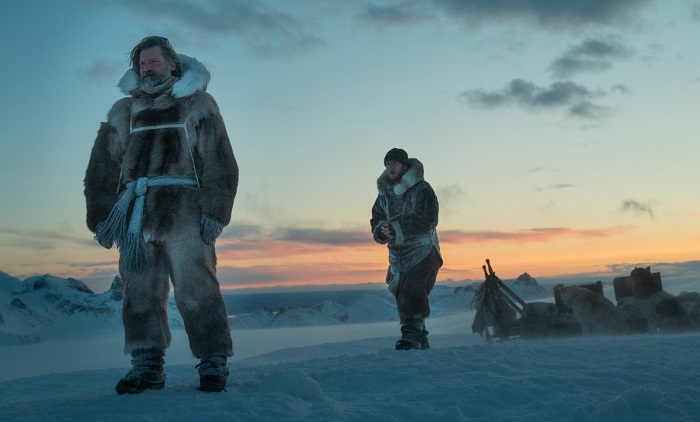
Mark this down as another movie that looks right up my alley. Danish filmmaker Peter Flinth teams with Nikolaj Coster-Waldau to give us one of those “based on an unbelievable true story” movies. In addition to its compelling historical bend, the movie also looks to be a gripping and possibly terrifying survival story. The first trailer looks great and gives us plenty to chew one.
Coster-Waldau plays Captain Ejnar Mikkelsen, a polar explorer who is tasked with retrieving the findings of a Danish expedition lost in the frozen tundra of North-Eastern Greenland. Only one man volunteers to accompany Mikkelsen on his treacherous journey – a young mechanic played by Joe Cole. Shot on location in Iceland and Greenland, the movie looks to fully embrace the dangers of its setting. I love the look of this.
“Against the Ice” premieres on Netflix March 2nd. Check out the trailer below and let me know if you’ll be seeing it or taking a pass.
The slow-boiling, atmosphere-heavy psychological horror film “The Wasteland” is among the first of Netflix’s 2022 offerings. It’s also a great way to kick off the movie year especially for horror fans. Set in 19th century Spain, the movie’s rich period setting brings with it a distinct folk horror flavor. But the psychological edge is just as potent, and it’s examination of heavy themes such as fear and isolation leave a strong impression.
Horror is a tricky thing these days. The genre can’t be narrowed down or painted with broad strokes. And while too many creepers come across as derivative and old hat, there are still filmmakers who are constantly finding new ways to use horror. “The Wasteland” certainly falls among the latter.
Image Courtesy of Netflix
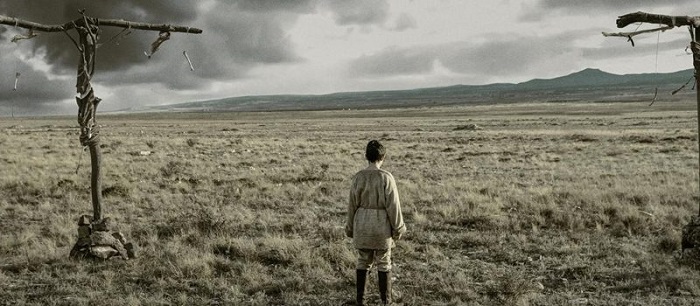
Directed by David Casademunt from a script he wrote with Fran Menchón and Martí Lucas, “The Wasteland” begins by telling us of consecutive wars in Spain that drove many people to isolate themselves in an effort to escape the “violence and madness”. We’re then immediately taken to a vast barren moor where a small stone house sits alone in the middle of nowhere. It’s where young Diego (Asier Flores) lives with his stern and rigid father, Salvador (Roberto Álamo) and his gentle and tender mother Lucia (Imma Cuesta).
Salvador is a sad and distant man, determined to prepare his son for the harshness of the outside world. There are only bad people out there, he explains to his son. He also tells of a beast which feeds on the fears of its victims. “Once you see the beast”, he ominously warns Diego, “you’re doomed forever.” Lucia scolds her husband for scaring the young boy with such tales. But Salvador’s solemn eyes and the tall posts draped in tattered cloth that he’s built around their property gives you the uncomfortable sense he believes it.
Things take a turn after a rickety boat floats up in a nearby stream. Aboard lies a man, bloody and unconscious. After the man dies (in one of the film’s more shocking moments), Salvador finds a picture in the stranger’s pocket. Its of the man and his family. It leads an already troubled Salvador to make a rash decision and take the stranger back to his family, leaving his own to fend for themselves while he’s gone.
As days turn to weeks, Diego watches as his mother begin to drift away, seeing things lurking in the shadows or behind bushes. Does she now see the beast? And as the security Diego once had in his mother starts to fade, will he too be terrorized by the fear-consuming creature?
Image Courtesy of Netflix
Casademunt poses these questions by slyly making us feel a part of this slowly deteriorating family. Through his sharp pacing, smart visual choices, and Balter Gallart’s fantastic production design, we’re able to feel the same isolation and fear they feel. It mostly comes through young Diego’s eyes whose perspective is raw, emotional, and sincere. But it also comes through the camera – the exquisite framing as well as the crafty use of focus, shadows, and angles.
There are other touches that soak us in atmosphere and sustain the film’s foreboding mood. Little details such as the eerie wood-carved toy figures or the macabre nursery rhymes and children’s songs Lucia sings to Diego. But it comes back to examining fear and feelings of lonliness and isolation. It’s a tough subject especially during this pandemic era we still find ourselves in. But Casademunt uses horror to explore it all in a way that should impress viewers whether they’re fans of the genre or not. “The Wasteland” is now showing on Netflix.
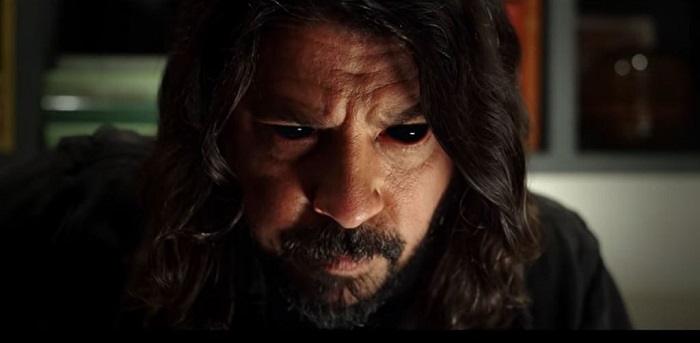
The Foo Fighters, rock-n-roll, a new album, a bloodthirsty demon-possessed David Grohl decapitating someone with a cymbal. What’s unusual about that? All of those things and more are thrown into the new trailer for “Studio 666”, a horror comedy written by Grohl and starring the members of the rock band Foo Fights. Talk about a wacky but undeniably catchy combination!
“Studio 666” sees the Foo Fighters preparing to record their 10th album. “We gotta break the mold with this one.” They pick an old country mansion to start writing and recording. But frustrations grow after each member of the band are hit with writer’s block. Even worse, the creepy old house has some pretty terrifying history. It’s all completely absurd and the movie looks to be borrowing from about ten different horror classics. But I love its self-awareness and I’m anxious to give it a shot.
“Studio 666” hits theaters February 25th. Check out the trailer below and let me know if you’ll be seeing it or taking a pass.
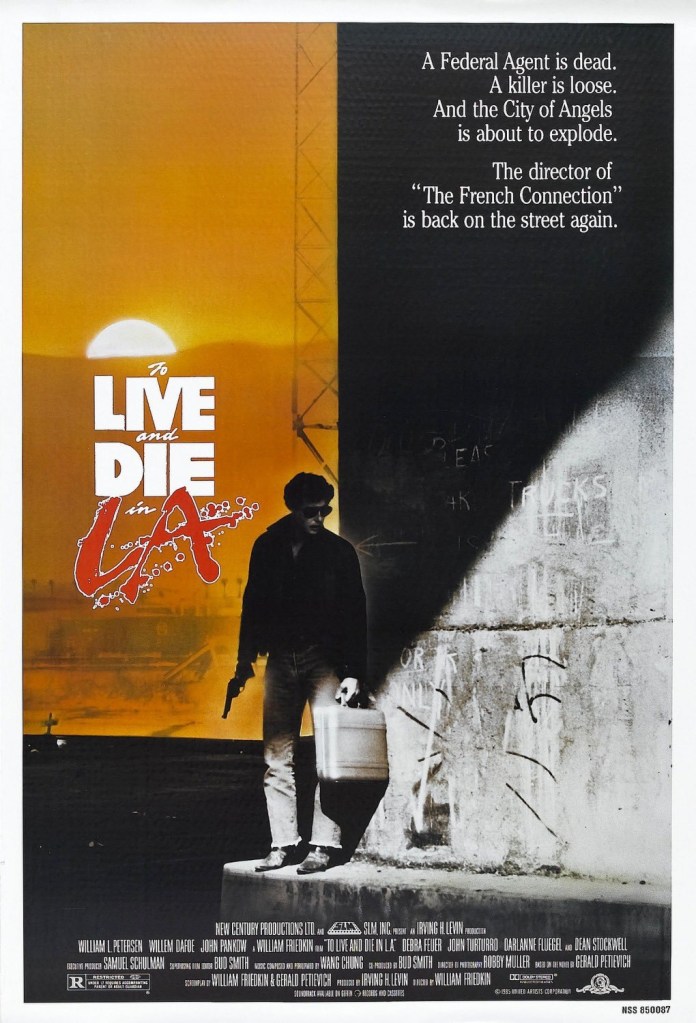
When I first started this feature my intent was to highlight classic movie posters just as much as new ones. But end of the year movies and awards season got me off track. What better way to get back on track than this beauty? When released in 1985, William Friedkin’s neo-noir thriller received mixed reviews from critics (one big exception was Roger Ebert who loved it). But since then the film has gained a hearty following. Either way, the movie’s poster is one of my favorites from the 80s. Tell me what you think.
DIRECTOR – William Friedkin
WRITER – William Friedkin, Gerald Petievich
STARRING – William Petersen, Willem Dafoe, John Pankow, Debra Feuer, John Turturro, Dean Stockwell, Robert Downey, Sr., Darlanne Fluegel, Steve James
The blue-collar Maltese drama “Luzzu” tells a story of modern industry not just encroaching on a way of life, but crushing it under its boot heel. Written, directed, edited, and produced by Alex Camilleri, “Luzzu” has a lot to say. But is doesn’t use lengthy speeches, heavy exposition or overly dramatic scenarios. Instead, it makes its points by sitting us down and showing us in the most authentic and unvarnished way possible.
Camilleri brings a documentarian’s clarity to this story of a Maltese fisherman being pushed out of the only business he knows. It’s hard to miss the Italian neo-realism influence all over the film, and fans of Belgian filmmakers the Dardenne brothers will be drawn to Camilleri’s real-world grit. And much like his inspirations, Camilleri uses non-professional actors to great effect. It’s one of many touches that helps the movie shine a heartbreaking yet honest light on a struggling lifestyle and a dying tradition.
Image Courtesy of Kino Lorber
The story revolves around a fisherman named Jesmark (played by an actual Maltese fisherman named Jesmark Scicluna). We first see him out on his luzzu – a small twelve-foot fishing boat that has been in his family for generations. He mans his vessel with a workmanlike efficiency, navigating the seas, pulling nets, icing down his catch. But the fish are becoming more scarce in large part due to a huge container port that’s crowding the harbor. And strict EU regulations have inexplicably made certain fish seasonal, limiting fisherman even more.
It’s even worse at the dock where increasingly harsh standards are enforced by harbor inspectors. And then you have the fish auctions where ruthless black marketeers undercut the smaller sellers, forcing them to try and sell their fish to local restaurants and merchants while their catch is still fresh. It’s no wonder some of Jesmark’s friends have made deals with the government to decommission their boats for a meager buyout.
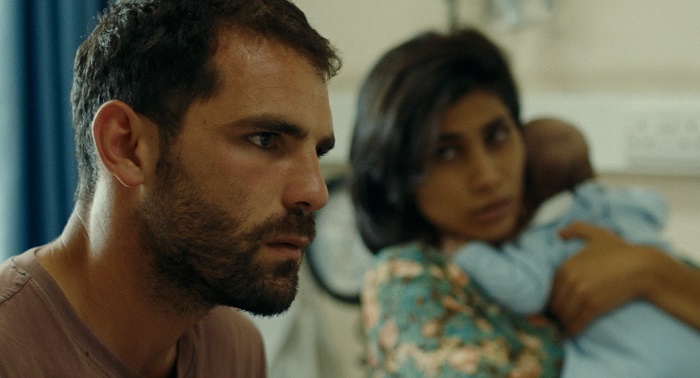
Camilleri lays all of this out with a clear-eyed sincerity, putting us on the boats, around the docks, and in the warehouses. At the same time, there is a poignant dramatic angle that adds an extra layer of realism. Jesmark and his wife Denise (a terrific Michela Farrugia) learn that their infant son “isn’t growing properly“. He needs to see a specialist, but that costs more money than the young couple can afford.
Denise wants to get help from her overbearing mother while Jesmark is determined to take care of his family. But it seems the deck is stacked against him, especially after he learns his luzzu has hull damage and needs immediate repairs. With no means of bringing in money, he gets in with a shady smuggler (Stephen Buhagiar) which adds more stress on his already fraying marriage.
Image Courtesy of Kino Lorber
A key to the movie’s success is its authentic sense of place. Camilleri’s unwavering focus on grounding his audience in reality plays a big part. It’s also helped tremendously by cinematographer Léo Lefèvre’s immersive camerawork. The sun-soaked Mediterranean, the electric bustle of the city, the vibrant rainbow array of colors that coat Jesmark’s luzzu – it’s all shot in a way that helps us to feel a part of this rich and textured world.
Even more, “Luzzu” is full of graceful touches that bring even more emotional heft to the story. Scenes like older local fisherman reminiscing about simpler times. Or the soul-shattering way Jesmark lovingly looks upon his son (the raw truth in Scicluna’s eyes during these moments is powerful stuff). All of this adds a tenderness to the world of “Luzzu”. But there is still a tragic element to the story – one that lingers for the duration of this captivating and heartfelt drama.
Tilda Swinton is haunted by a mysterious sound in the otherwise quiet and meditative “Memoria”, the evocative new drama from director, writer, and producer Apichatpong Weerasethakul. This is Weerasethakul’s first movie made outside his native Thailand, but those familiar with his work will almost instantly notice his distinct style of storytelling.
I was fortunate enough to see “Memoria” thanks to NEON’s awards season screener bundle. Otherwise it’s going to be a tough movie to catch. From what I understand, Weerasethakul has no plan for a physical home release or even a conventional theater run. Instead he’s taking his film on the road for a long run of week-long engagements at different stops across the country. It’s an unusual release strategy and one that’s certain to cost him some viewers. But at the same time, “Memoria” isn’t the kind of movie aimed at large crowds.
Image Courtesy of NEON
“Memoria” is a movie that defies definition. You could consider it a sensory journey that isn’t interested in plot as much as experience. Weerasethakul wants his audience to feel. But to do so will require viewers to get on his unique and unconventional wavelength. Admittedly, at first I found that to be a challenge. But once I was in tune with his patient and observant rhythm, “Memoria” turned into something I wasn’t expecting. Soon I found myself swept up by feelings of fascination, bewilderment, curiosity and full-on admiration.
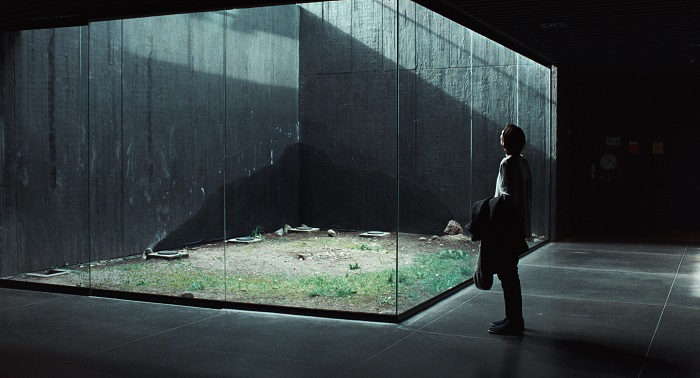
You could also consider it slow cinema. Some will be quick to assert that often “nothing happens”, a perspective that Weerasethakul’s style partially contributes to. In many cases his scenes aren’t simply long takes, but they extend to well after the scene’s action has finished. Rather than cutting, Weerasethakul keeps his camera locked in place, allowing his audience time to soak up every detail of the frame. And as we do, not only are he pulled deeper into the film’s beguiling mystery, but Weerasethakul slyly put us into a similar headspace as the film’s central character, Jessica (Tilda Swinton).
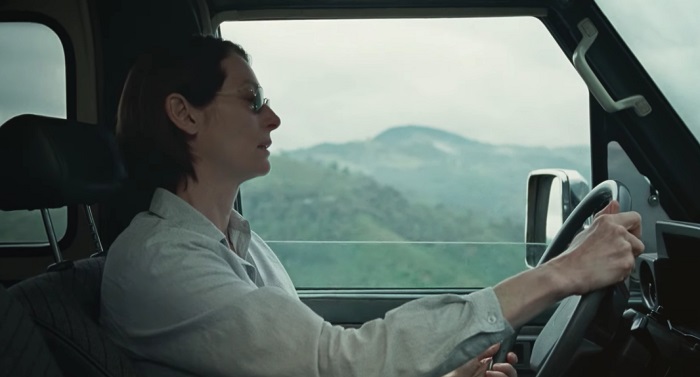
I’m not sure any actress could be more fitting for this role than Swinton. She is perfectly tuned into Weerasethakul’s enigmatic frequency and she effectively channels the very apprehension and incertitude that we the audience also feel. Interestingly, everything about her character Jessica feels out of place. First, she’s a Scottish botanist living in Medellín, Columbia (the movie’s most overt sign of displacement). But she comes across as more than a foreigner in a new country. She conveys this perpetual sense of lostness, like someone trying to get a hold of the world she’s in.
The movie opens with Jessica shaken from her sleep by a jolting boom in the middle of the night. It’s a mysterious sound that she later describes as “a big ball of concrete that falls into a metal wall which is surrounded by seawater“. She travels to Bogotá to visit her sister Karen (Agnes Brekke) who is hospitalized with a sudden illness. While there she hears the sound again and realizes that only she can hear it. Later Jessica is shaken again by the sound as she sits in an otherwise quiet park at night.
Image Courtesy of NEON
Not only do the mystifying whomps startle Jessica, but they jar us as well thanks to the film’s exquisite sound design. Soon the film’s gaunt, soft-spoken, and curious protagonist sets out (with us in tow) to determine the source of the assaultive sound in her head. A music professor friend connects her with Hernán (Juan Pablo Urrego), a sound engineer who tries to recreate the sound for Jessica. He succeeds but it doesn’t get us any closer to the sound’s source. “I think I’m going crazy,” she tells a friend.
As Jessica continues her search we’re fed very little in the form of answers. That’ll come as no surprise to those familiar with Weerasethakul’s work. But that doesn’t mean Jessica’s journey is empty or meaningless. Quite the opposite. It gets back to what I mentioned above – this is more about experiencing. There is an answer to the big question in the final few shots (an answer that I’m still chewing on days after seeing the film). But ultimately it’s about getting to that point. It’s about joining Jessica on her lonely melancholy peregrination. But to do so you have to still your mind, watch and listen. That’s where the real joy of Weerasethakul’s entrancing film is to be found.