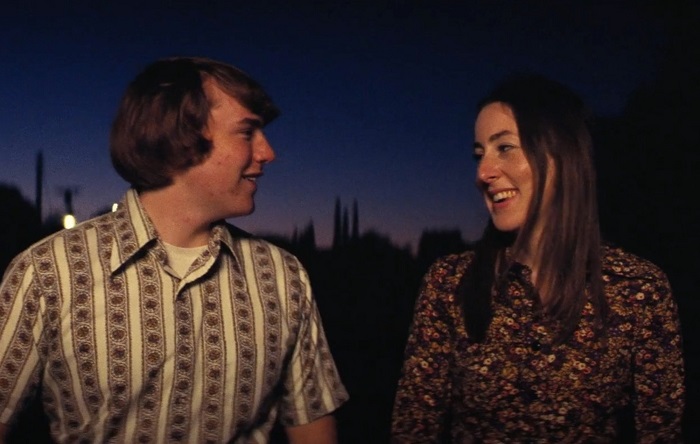
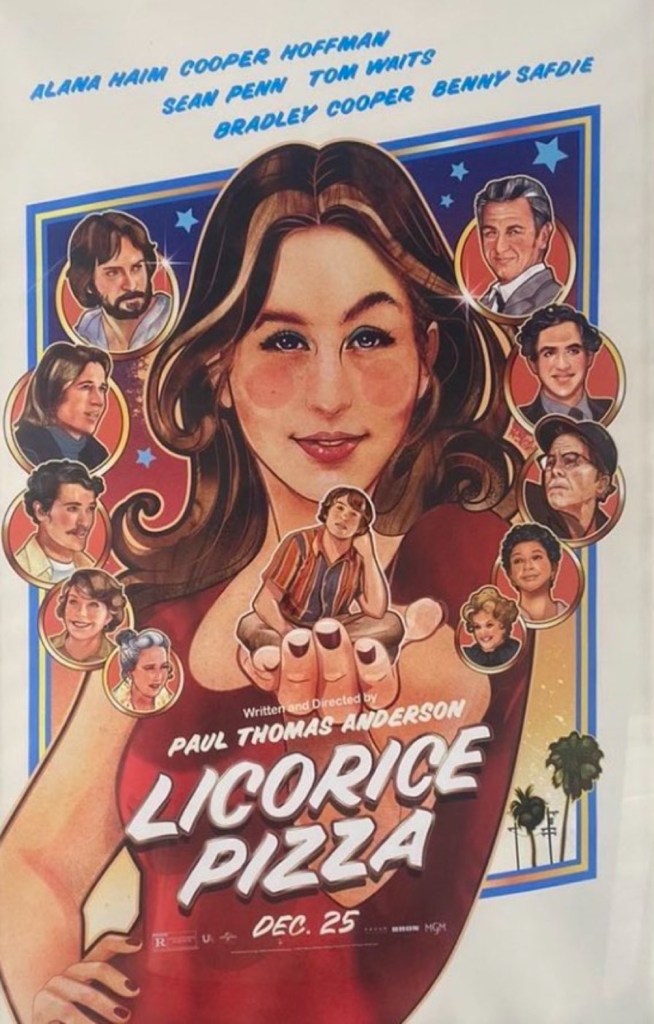
Paul Thomas Anderson fans rejoiced following the release of the long awaited trailer for his next movie “Licorice Pizza”. Despite being the filmmaker behind two movies I adore (“There Will Be Blood”, “Phantom Thread”), I’m a little lukewarm on much of Anderson’s other stuff. But it was hard not to be won over by the first look at his latest. To make things even better, they’ve dropped a terrific new poster that features the same throwback vibes as the trailer. Check it out and tell me what you think.
DIRECTOR – Paul Thomas Anderson
WRITER – Paul Thomas Anderson
STARRING – Alana Haim, Cooper Hoffman, Tom Waits, Sean Penn, Bradley Cooper, Benny Safdie, Maya Rudolph, John C. Reilly
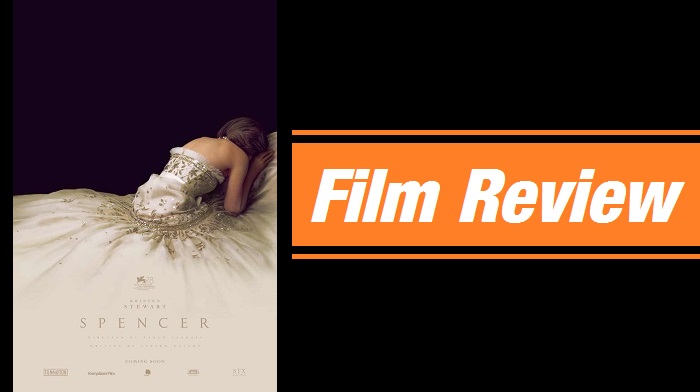
Kristen Stewart meets Diana, Princess of Wales in Pablo Larraín’s strange yet hypnotic “Spencer”, a hard to define psychological drama that describes itself as “A fable from a true tragedy.” In essence “Spencer” is a dark and sometimes gnarly fantasy taken as much from the imagination of a filmmaker as from the real-life history of one Britain’s most beloved yet troubled members of Royal Family.
With millions watching around the world, Diana Frances Spencer and Charles, Prince of Wales were married in 1981 at London’s St. Paul’s Cathedral. But after only a few short years the cracks in their marriage began to show largely due to the couple’s incompatibility along with their extramarital affairs. The press inevitably got wind of their strained relationship leading to them separating in 1992.
Larraín and screenwriter Steven Knight set their story in 1991, mere months before Charles and Diana’s highly publicized split. It’s Christmas time and the Royal Family are gathering at the Queen’s sprawling Sandringham House in Norfolk to celebrate the holiday in their own starchy and suffocatingly formal way. What Larraín gives us is a speculative imagining of what might have happened during that chilly three-day weekend.
Image Courtesy of NEON
Told almost entirely from Diana’s point-of-view, “Spencer” bucks the restraints of facts and uses its liberty to burrow into the murky psychology of the dispirited Princess. It has a lot in common with Larraín’s “Jackie” from 2016, another film about a prominent woman caught in the gears of a high-pressure machine. Here the storytelling uses everything from twisted dream sequences to blunt metaphors to the brooding and mannered Stewart in its efforts to get inside Diana’s head.
The movie opens with a series of spectacular shots of the Sandringham property, each bathed in a radiant dreamlike glow and accompanied by a cacophony of warped melodies from composer Jonny Greenwood. We watch as a convoy of military trucks loaded with what looks like weapons crates arrive on Christmas Eve. Soldiers march the crates to the kitchen where head chef Darren McGrady (Sean Harris) awaits. Inside them aren’t automatic rifles or explosives. Rather they’re full of exquisite edibles – iced-down lobster, fresh vegetables, exotic fruits. As the soldiers march out, McGrady’s brigade of cooks march in to begin preparations.
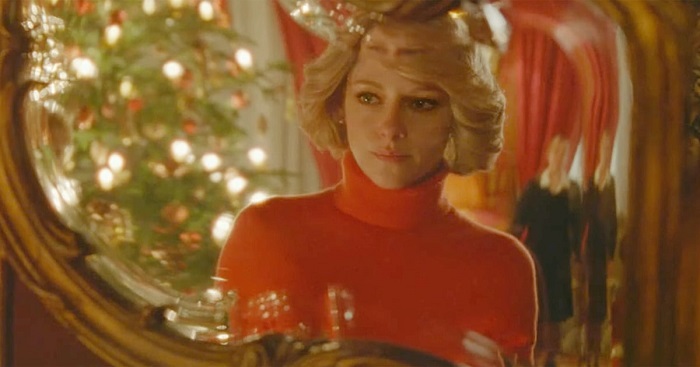
A short scene later, all the Royals have arrived with one exception. Diane zips along a country road in her black convertible, lost in an area that she should know well. It’s where she grew up as a child, only minutes away from Sandringham. She pulls into a small roadside cafe and steps out of the car. Her well-known face, stylish blonde bob and chic runway-ready wardrobe are dead giveaways. The Princess of Wales steps inside the meager establishment and casually asks the stunned patrons, “Where am I?”
The opening ten minutes give a good taste of the figurative language and dashes of absurdity sprinkled throughout “Spencer”. But it’s when Diane finally arrives at the Windsor estate that we get a better grip on what the movie is going for. Larraín’s camera stalks the unraveling Lady Di as she roams the long halls and shuffles from room to room (each adorned in stunning yet gaudy opulence by production designer Guy Hendrix Dyas). Diana skulks around to avoid the demanding first family, snapping at the unfortunate servants who come calling.
Image Courtesy of NEON
The stuffy unapproachable Royals are more story pieces than fleshed out characters. Charles (Jack Farthing) is portrayed as a leering unsupportive prig while Queen Elizabeth (Stella Gonet) is an imposing presence who speaks volumes with a look and a few words. But “Spencer” isn’t their story, it’s Diana’s. And the film takes aim at the Windsor’s haughty insulated existence every chance it gets. Only in the moments with her sons William (Jack Nielen) and Harry (Freddie Spry) do we see Diane happy, not as a princess but as a mother.
As the movie progresses it may seem like nothing’s going on, but eventually things come into focus. Larraín and Knight paint a vivid picture of a woman pushed to the brink by a smothering, oppressive aristocratic machine. Uncomfortable scenes revealing depression, self-harm, and bulimia highlight the depths of her decline. But then there’s a shift as Diana begins to take control of her life. And as the title suggests, she’ll need to look to her past before she can move forward.
The metaphors can get too obvious and not all of Larraín’s liberties work (most notably a peculiar and underdeveloped friendship between Diana and her fictional dresser played by Sally Hawkins). Yet it’s hard not to be sucked into this deliciously irreverent spin on British Royalty that won’t win any fans within the House of Windsor, but should win over any remaining Kristen Stewart skeptics. It’s the performance of her career and one that you’re going to hear a lot about this awards season. “Spencer” is out now in theaters.
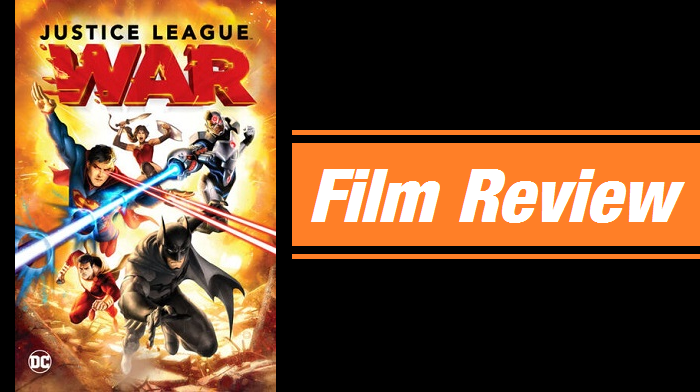
In 2013, “Justice League: The Flashpoint Paradox” ended with the revelation (sorta) of a new alternative DC timeline. This cracked the door to the DC Animated Movie Universe, a shared-world series of feature-length films taking place within the new timeline. The first to fully explore this new space was “Justice League: War”, an action-fueled animated movie that essentially tells the story of the formation of this world’s Justice League.
“Justice League: War” is an adaptation of the 2011 “Justice League: Origin” comic book storyline from writer Geoff John’s and penciller Jim Lee. It told the rebooted origin story of the Justice League of America following the events of “Flashpoint” which reset the entire DC Universe. In the same way, “War” sets out to define this new world while also introducing the major players in DC’s superhero catalogue. Much like “The Flashpoint Paradox”, this is a tall order that proves to be a little more than an under 80-minute movie can cover. But “War” manages the wealth of material in a surprisingly fun and agile way.
Image Courtesy of Warner Home Video
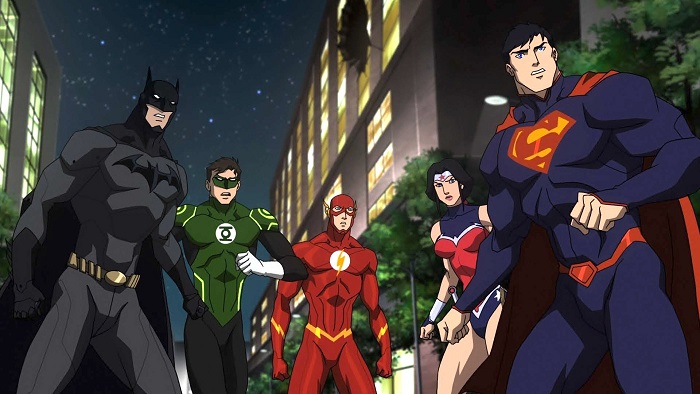
The story begins with Batman (Jason O’Mara) looking into a series of abductions around Gotham City. During his investigation he crosses paths with a wisecracking Hal Jordan aka Green Lantern (Justin Kirk). The two don’t necessarily hit it off but join up to fight a Parademon who leads them into into the sewer where the creature activates a mysterious device called a Mother Box. Unsure of what they’re dealing with, Batman and Green Lantern head to Metropolis to seek the help of a powerful meta-human named (you guessed it) Superman (Alan Tudyk). After a not-so-friendly first encounter, the three join forces to fight the waves of Parademons overtaking the city.
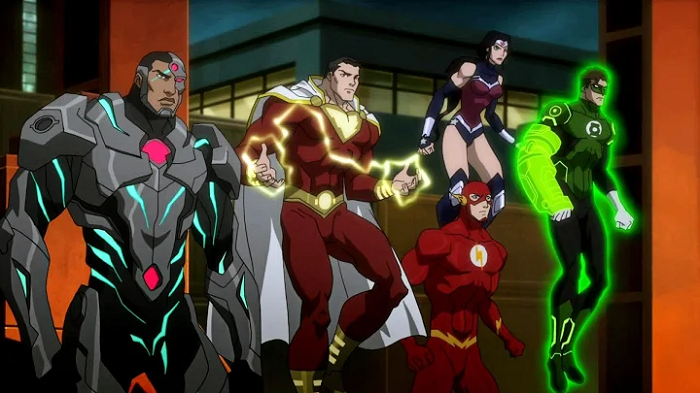
Elsewhere another Mother Box is being studied at S.T.A.R. Labs in Central City by scientist Silas Stone (Rocky Stone). This introduces both Cyborg (Shemar Moore) and Flash (Christopher Gorham) into the story. In Washington DC, Wonder Woman (Michelle Monaghan), serving as a political envoy, arrives to meet with the President of the United States but is greeted by a sea of protesters. Meanwhile a young delinquent foster child Billy Batson (Zach Callison) witnesses a Parademon and transforms into the mythical powerhouse Shazam (Sean Astin). These burgeoning superheroes from dramatically different backgrounds will have to come together once the threat behind the Parademons, Darkseid (Steve Blum) reveals himself.
Image Courtesy of Warner Home Video
Director Jay Oliva and screenwriter Heath Corson zip through the story with an action-packed pacing that can be both exhilarating and a bit numbing. The big set pieces are well choreographed and nicely animated but eat up so much of the running time, especially in the last 20 minutes or so. And as with many of these films, the action ends up taking precedent over any emotional stakes. The character models are top-notch – a nice combination of classic style and the newer look inspired by Jim Lee’s “Origin” design. The voice work is mostly good especially from O’Mara, Moore, and Gorham (not so good from Astin). But the biggest surprise is the humor. Corson’s script has some unexpectedly well-timed jabs and witty one-liners that land well and aren’t overpowering.
But not everything lands as well. Wonder Woman shines in the action sequences but her cringe-worthy introduction is tough to watch. The movie goes for some wacky fish-out-of-water vibe that makes her more oafish that heroic. Thankfully Oliva and Corson steer away from that in the later scenes. And I can’t help but wish the story took a more intimate look at its characters. As it is, only Cyborg’s story is given a personal touch; Batson/Shazam to a degree. Still, “Justice League: War” is a fun early entry into the DC Animated Movie Universe and serves as a pretty interesting introduction to a world with lots of potential. It’s available to stream on HBO Max.
Mahershala Ali stars in the interesting new drama “Swan Song”. It comes from writer-director Benjamin Cleary and is set to release later this year on AppleTV+. Showing off a nice supporting cast and an eye-catching style, the first trailer does a good job setting up this heartbreaking moral tale.
Ali plays Cameron, a loving husband and new father who’s keeping a painful secret from his wife (Naomie Harris) – he’s dying. Rather than leave his family alone, Cameron sees a doctor (Glen Close) about a controversial new cloning practice. A fascinating array of questions follow. Is it ethical? Is it fair to his wife and child? Is he doing it for his wife or is it more for himself? Awkwafina also stars in this compelling and thought-provoking film.
“Swan Song” premieres December 17th on AppleTV+. Check out the trailer below and let me know if you’ll be seeing it or taking a pass.
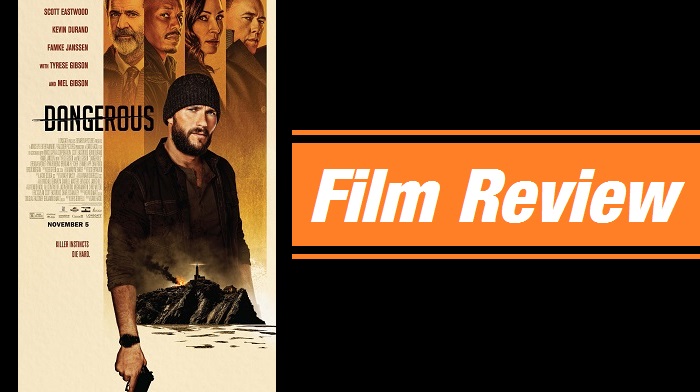
Production designer turned director David Hackl helms the new film “Dangerous”, a kooky action thriller that starts with some real promise. But the story (written by Chris Borrelli) quickly comes unglued and ventures into territory too silly to take seriously. It takes an appealing cast and gives them unappealing characters, leaving them with the unenviable task of moving the audience to actually care about what we’re seeing. Sadly, we never do.
Scott Eastwood plays Dylan Forrester, a former Navy SEAL on parole for murder. He’s also a sociopath who pops lithium like TicTacs and frequently calls his lush of a therapist Dr. Alderwood (Mel Gibson) to talk him through his unwholesome urges. Eastwood borrows his legendary father’s cold and terse screen delivery to portray a character unable to feel emotion or have empathy. And while his meds keep his impulses (mostly) under control, Dylan’s non-existent social skills stick out like a sore thumb during any conversation.
The story is one that hinges on a number of contrivances. It gets underway after Dylan learns his brother Sean, who was opening a bed-and-breakfast on Guardian Island off the coast of Washington, has died. Supposedly it was the result of an accident on some scaffolding, but an unwelcome visitor to Dylan’s apartment says otherwise. So he breaks parole and heads to his brother’s place to pay his respects.
Image Courtesy of Lionsgate
Dylan arrives at his Sean’s wake and is immediately greeted by his estranged mother Linda (Brenda Bazinet), a toxic one-note curmudgeon who’s quick to share her disdain for her living son while praising her saintly dead one. A cautious but more hospitable Susan (Leanne Lapp), Sean’s wife, breaks the ice by welcoming Dylan as does her son Freddy (Atlee Smallman). Also at the wake is Sean’s old college buddy Massey (Brendan Fletcher) and the scowling super-serious Sheriff McCoy (Tyrese Gibson in a glorified cameo).
But if family tension wasn’t enough, a well-armed mercenary named Cole (Kevin Durand) and his generic goon squad arrives on the island and lays siege on Sean’s B&B. There’s something in the house that he wants, but no one seems to know what it is. Meanwhile FBI Special Agent Shaughnessy (played by a seemingly uninterested Famke Janssen) tracks the parole-hopping Dylan to Guardian Island. It all leads to a predictable showdown where the gunplay (much like the eventual revelations) is as underwhelming as it is uninspired.
Eastwood does what he can with a role that more or less demands a cold detached performance. Mel Gibson steals a handful of scenes while Durand hams it up as the film’s bland baddie. Janssen seems as bored as we are and Tyrese Gibson isn’t on screen long enough to leave an impression. In other words, a nice cast gets lost in a movie that feature more cliches than thrills. I do think there’s a way to turn this fairly conventional idea into something fun and entertaining. But what we get with “Dangerous” ends up being the exact opposite. “Dangerous” is now available on VOD.
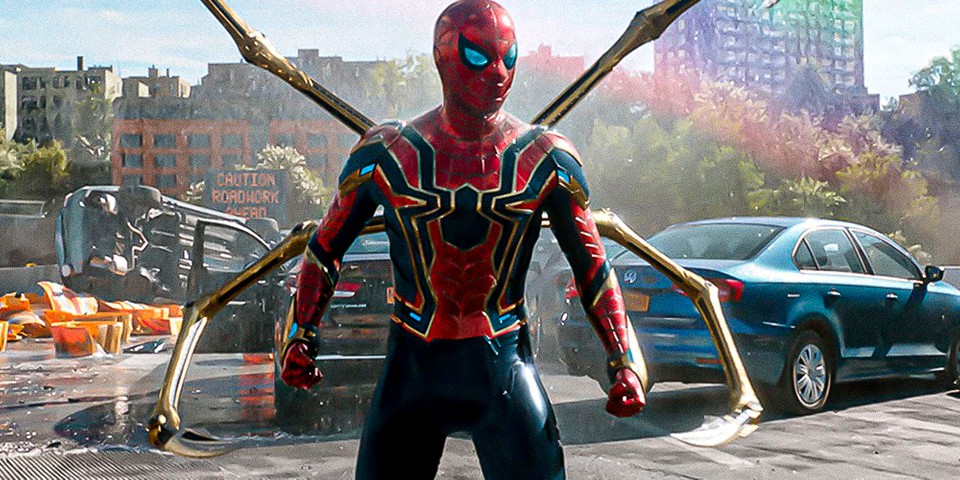
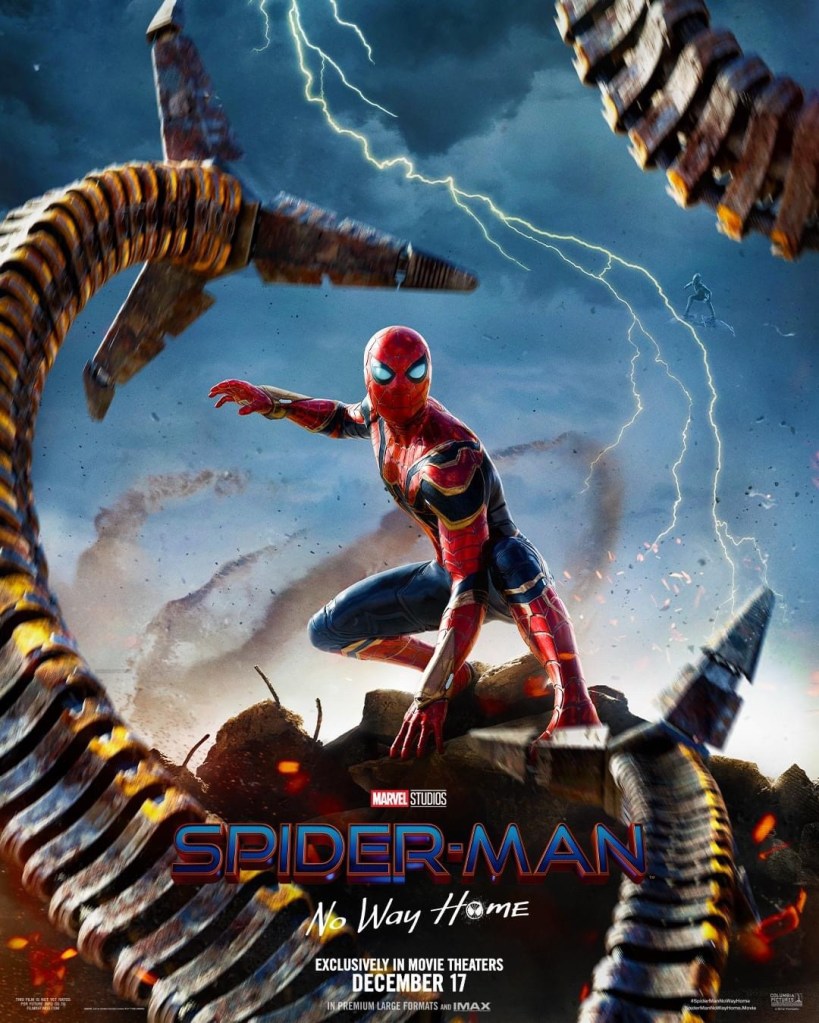
Marvel Cinematic Universe fans have their eyes set on December 17th. That’s when their next big lucrative superhero installment hits theaters. And while some of their more recent films came with their own reasons for caution, the MCU’s third Spider-Man movie has fans pretty thrilled with what they’ve teased so far. The new poster adds to the excitement by showing the web-slinger surrounded by hints of the villains he’ll apparently be facing. Check it out and tell me what you think.
DIRECTOR – Jon Watts
WRITERS – Chris McKenna, Erik Sommers
STARRING – Tom Holland, Zendaya, Benedict Cumberbatch, Jacob Batalon, Jon Favereau, Marisa Tomei, J.B. Smoove, Benedict Wong