Guy Ritchie’s latest star-studded action-adventure cocktail is “In the Grey”, a film that has the same energy as the director’s 2024 film “The Ministry of Ungentlemanly Warfare”. At least that’s the impression we get from its first trailer that just released yesterday. It’s a rip-roaring first look that shows off a nice cast, some good laughs, and (of course) plenty of action. There’s still a lot to the story that we don’t yet know. But that’s a good thing.
“In the Grey” is strengthened by a compelling ensemble that includes Jake Gyllenhaal, Henry Cavill, Eiza González, and Rosamund Pike. Gyllenhaal and Cavill play two covert operatives led by their handler (Gonzalez) to steal back billions of dollars from a ruthless tyrant. Of course they’ll have to use all of their skills if they’re going to take on the despot’s “reasonably experienced” private army. This looks right up Ritchie’s alley, and if the movie plays as good as the trailer, we might be in for a treat.
“In the Grey” hits theaters May 15th. Check out the trailer below and let me know if you’ll be seeing it or taking a pass.
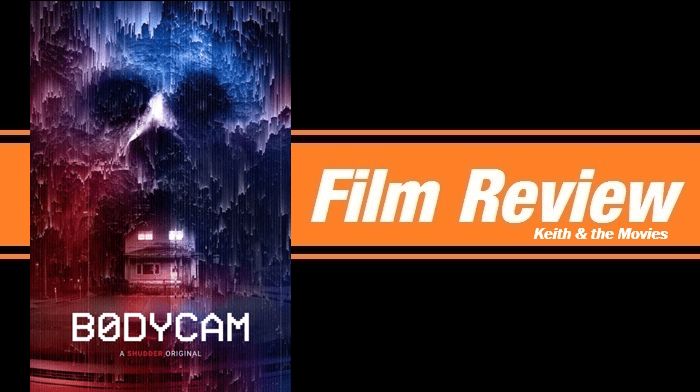
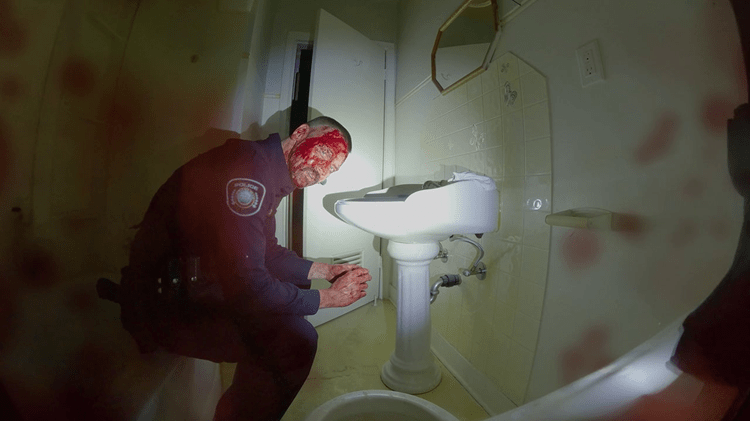
The found-footage craze ran its course with me some time ago. But credit to director Brandon Christensen for finding a fresh and clever use of it in his new horror film “Bodycam”. As its rather obvious title reveals, the film tells its entire story through the bodycams of two police officers, with some occasional shots coming from the dashcam of their patrol car. But rather than feeling like a gimmick (which it kinda is), there’s an authenticity here that gives the found-footage choice purpose.
Even more, Christensen’s use of foot-footage succeeds in doing what the best movies of its kind does. It immerses us in the moment while blurring our perception of what’s real and what isn’t. Unfortunately it also comes with the obligatory shaky cams, especially when things intensify, and the overuse of first-person perspective shots as the characters feel their way through the dark. But for the most part Christensen keeps us involved and often on the edges of our seats.
Image Courtesy of Shudder
The story follows two policemen, Officer Bryce Anderson (Sean Rogerson) and Officer Jerome Jackson (Jaime M. Callica), who are dispatched to a seedy part of town to investigate a possible late-night domestic dispute. They arrive at the house which sits in a rundown neighborhood populated with wandering locals they call “tweakers”. Anderson and Jackson approach the home but get no answer at the door. After hearing a scream for help, they enter with flashlights on and guns drawn. They’ll soon wish they hadn’t.
As the officers search the house they make several chilling discoveries. One leads to an encounter where a frightened Bryce reactively guns down a man who lunges at him from out of the shadows. Jerome immediately wants to call it in to headquarters. But fearing they will be crucified by the press and the public, Bryce stops him and begins throwing together a cover story.
An immediate tension forms between Bryce’s fear and Jerome’s conviction. But far more threatening is the sinister force that latches onto them and won’t let go. “You take something from him, he takes something from you,” mutters the gathering tweakers. It’s here that Christensen turns his police procedural into a terrifying mix of the supernatural and the occult.
Image Courtesy of Shudder
A handful of other characters pop in including Bryce’s pregnant wife Michelle (Elizabeth Longshaw), an underground tech whiz named Esposita (Angel Prater), and Jerome’s mother Ally (Catherine Lough Haggquist) who seems to know more about what’s going on than anyone else. But the two officers remain the centerpiece and their story takes some dark, twisted turns. And while it’s a horror story through and through, it dabbles in several themes including police accountability and more metaphorically the controlling grip of addiction.
Like nearly every found-footage movie out there, its effect begins to wear off the longer it goes on. But Christensen smartly winds things down at 75 minutes before his film overstays its welcome. It’s a move that not only keeps the style choice respectably fresh, but it keeps the story wound tight and constantly pushing forward. Overall, “Bodycam” is a tense and eerie Shudder Original that breathes some much-needed new life into the found-footage formula.
Maybe it’s just me, but movies like “War Machine” don’t seem to come around very often these days. There has never been a notable shortage of genre films in movie theaters, direct to video store shelves, and now via streaming. But rarely are we treated to movies from the cool military sci-fi sub-genre. I’m talking about movies in the vein of “Predator”, “Starship Troopers”, or even the lesser yet underappreciated “Battle: Los Angeles”.
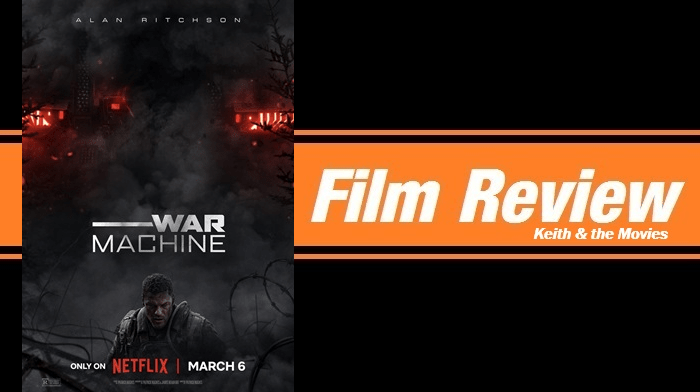
Enter “War Machine”, an unashamed and unapologetic slice of military sci-fi that openly wears its influences like badges of honor. The film routinely calls back to great movies that inspired it including the aforementioned “Predator”, James Cameron’s “Aliens”, and even “Top Gun”. Director Patrick Hughes keenly and confidently corrals all of these inspirations, fusing them together with visceral action sequences and jaw-dropping set pieces.
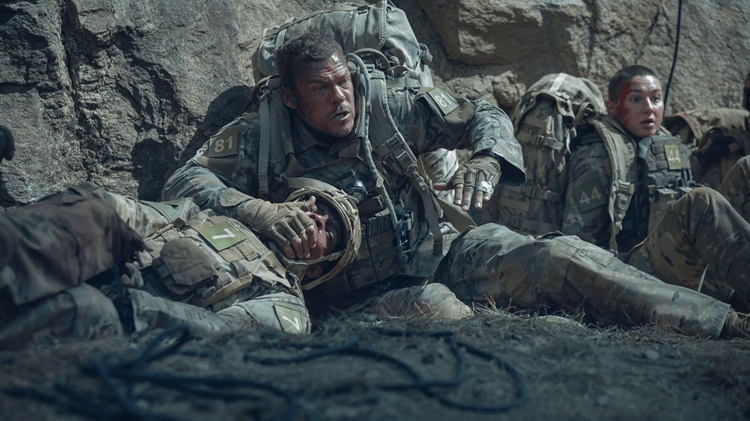
Image Courtesy of Netflix
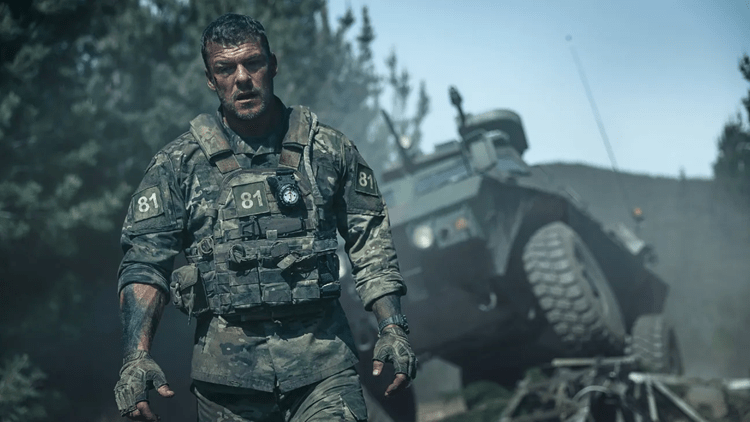
Alan Ritchson plays a soldier who has entered the Army’s Ranger Assessment Selection Program. It’s eight weeks of arduous testing, ending with a handpicked chosen few joining the ranks of the elite Army Rangers. Designated with the number 81, becoming a Ranger has a deeply personal meaning for him. While serving in Kandahar, Afghanistan, 81 witnessed his kid brother die during a Taliban attack. Guiltridden over his inability to save his brother, 81 sets out to keep their pledge to become Rangers.
Despite the concerns of his superior officers Sheridan (Dennis Quaid) and Torres (Esai Morales), 81 makes it to the final challenge, which is a recon and rescue simulation. He and his team are dropped high in the Rocky Mountains by two Blackhawks and given 24 hours to complete their mission. If they cross the finish line in time, they will be given their Ranger scroll. 81 reluctantly takes the role of team leader and leads the soldiers towards their objective.
Their military exercise turns into a fight for survival after the squad stumbles upon a strange metal wreckage. Believing it to be part of their mission, the team investigates. But in the process they awaken a massive mechanized monstrosity that is the size of a building and is armed to the teeth with out-of-this-world weaponry. Suddenly the soldiers find themselves under attack and hunted by the killer mech with ineffective weapons, jammed comms, and compasses going haywire.
Hughes (who co-wrote the script with James Beaufort) keeps the story simple, focusing most on the team’s fight for survival. You can’t miss the steady flow of familiar tropes. But Hughes cleverly integrates them rather than rely on them. And he smartly avoids bogging his movie down in some otherworldly backstory. Instead he leaves much of the mech, its origins, and its motivations a mystery. Also, it maintains a needed human element, mostly through 81’s emotional struggles with lingering trauma.
Image Courtesy of Netflix
Ultimately it’s the spectacular action that drives “War Machine”. It’s intense, visually astounding, and at times shockingly gory. The effects are an impressive mix of digital and practical, while New Zealand and Australia (filling in for the Colorado Rockies) provide a perfectly rugged setting that’s both breathtaking and treacherous. As for Ritchson, he more than holds his own. He obviously has the imposing build and raw physicality. But he commits to every scene, whether he’s squaring off against a galactic threat or quietly wrestling with painful memories.
Those hoping for a more fleshed-out science-fiction deep dive might leave “War Machine” disappointed. It’s only at the very end that we get any significant world-building. But thats not this movie’s focus. Hughes wants to put us in the soldiers’ shoes as they navigate fear, isolation, and the unknown while facing overwhelming odds. Admittedly it does leave us with several questions along the way. And we get more cornball one-liners than answers. But I never felt shortchanged, narratively or cinematically. I was having too much fun, glued to my seat and anxious to see what Hughes was going to hit us with next.
It was only a few weeks ago that Prime Video released “The Wrecking Crew”, a straight-to-streaming action comedy that seemed custom made for theaters. Now a month later they’ve released another streaming feature that I imagine would have played extremely well on the big screen. While it’s a bummer for those of us who love that experience, the movies look to be big successes on their platforms meaning this trend is likely to continue.
“The Bluff” is a pulpy action-packed swashbuckler that takes the fun of other high seas pirate adventures and laces it with the brutal and bloody action of an old-time B-movie. It turns out to be an interesting combination as director Frank E. Flowers removes the playful, romanticized buccaneer veneer to make a high-energy, no-nonsense foray into a genre we rarely see these days.
Image Courtesy of Amazon MGM Studios
Co-written by Flowers and Joe Ballarini, “The Bluff” is set 1846 as the era of the pirates sailing the Caribbean Sea is coming to its end. Only the most brutal marauders remain, such as the notorious Captain Francisco Connor (played by a devilishly fun Karl Urban). In the film’s brief prologue we see Connor’s massive galleon overtake a smaller brigantine. His pirates ransack the ship and kill the crew, sparing only one man, T.H. Bodden (Ismael Cruz Córdova), who possesses a gold bar bearing Connor’s mark.
After studying the ship’s logs, the determined Connor orders his dutiful quartermaster (Temuera Morrison) to set sail for the tiny island of Cayman Brac where he believes T.H. has hidden the rest of his gold. Cayman Brac is an emancipated British colony with a small, tight-knit community living a quiet and peaceful life. Among them is T.H.’s wife, Ercell (Chopra Jonas) who eagerly awaits the return of her husband along with their son Isaac (Vedanten Naidoo) and her sister-in-law Elizabeth (Safia Oakley-Green).
But when Connor and his raiders arrive instead, the island is plunged into violent chaos. “No one leaves this island until I collect my property,” he bellows. Yet when Connor’s siege brings his pirates to Ercell’s front door, it unleashes a dark past that she has worked hard to bury. What follows is a blood-soaked battle across the island as Ercell tries to protect those dearest to her while settling some old scores with a ruthless enemy.
Image Courtesy of Amazon MGM Studios
Zoe Saldaña was originally cast to play Ercell, but Chopra Jones more than fills those shoes. She makes Ercell her own, with a convincing physicality and stunning ferocity. The action scenes are impeccably choreographed and shot, often fueled by a brutality that adds to the intensity. Chopra Jones excels throughout, whether she’s throwing fists or wielding a cutlass. Meanwhile Urban savors every surly second, giving the film a straightforward but wickedly entertaining antagonist.
While “The Bluff” brims with thrilling action and electric set pieces, the story remains pretty bare-bones. Yet it’s littered with great faces, rich period detail, and scenic vistas (with the Gold Coast in Queensland filling in for the Cayman Islands). And despite not having a lot of meat on its bones, the script is constantly propelling itself forward without ever bogging down or feeling repetitive. Altogether it makes for an surprisingly visceral experience that is enjoyable from start to finish.
Sony Pictures Home Entertainment is bringing “The Patriot” to home video in an exciting new limited edition steelbook. Originally released in 2000, “The Patriot” remains an absorbing and entertaining Revolutionary War epic directed by Roland Emmerich and starring Mel Gibson as conflicted veteran Benjamin Martin. It also features a great turn by a young Heath Ledger, the always dependable Tom Wilkinson, and a deliciously vile villain role for Jason Isaacs. “The Patriot” would go on to be a box office success and eventually earn three Academy Award nominations.
“The Patriot” will be available in this special 4K Ultra HD steelbook edition on June 9th. See below for a full synopsis of the film as well as release information including a list of special features.
About the Film:
Year: 2000
Runtime: 165 Minutes & 175 Minutes
Director: Roland Emmerich
Screenwriters: Robert Rodat
Cast: Mel Gibson, Heath Ledger, Jason Isaacs, Tom Wilkinson, Chris Cooper, Joely Richardson, Rene Auberjonois, Gregory Smith, Trevor Morgan, Bryan Chafin, Mika Boorem, Logan Lerman, Skye McCole Bartusiak, Tcheky Karyo, Lisa Brenner
Rating: R for Strong War Violence
In 1776 South Carolina, widower and legendary war hero Benjamin Martin (Mel Gibson) finds himself thrust into the midst of the American Revolutionary War as he helplessly watches his family torn apart by the savage forces of the British Redcoats. Unable to remain silent, he recruits a band of reluctant volunteers, including his idealistic patriot son, Gabriel (Heath Ledger), to take up arms against the British. Fighting to protect his family’s freedom and his country’s independence, Martin discovers the pain of betrayal, the redemption of revenge and the passion of love.
Special Features:
DISC DETAILS & BONUS MATERIALS4K ULTRA HD DISC 1
165-minute Theatrical version of the film presented in 4K resolution with Dolby Vision
English Dolby Atmos + English 5.1
Special Features:
Director & Producer Commentary
The Art of War Featurette
The True Patriots Featurette
Theatrical Trailer
4K ULTRA HD DISC 2
175-minute Unrated version of the film presented in 4K resolution with Dolby Vision
Michel Franco has never been one to shy away from challenging his audiences with provocative subject matter. He attempts it again with his latest film, “Dreams”, a strangely confounding psychodrama that seems to have several things it wants to say but no firm grasp on how to say them. It’s cold, sometimes aimless, and borderline absurd at times in its attempts to find a steady pulse.
“Dreams” sees Franco reuniting with his star, Jessica Chastain. The two first collaborated in 2023’s superior “Memory”, a deeply affecting adult drama that saw Chastain give one of her best performances to date. She’s certainly the highlight of “Dreams”, although neither her character or her character’s journey carry the same dramatic or emotional weight.
“Dreams” opens with a young Mexican dancer named Fernando (a somewhat dry Isaac Hernández) being smuggled into the United States in the back of a sweltering semi-trailer. After finally being released by cartel traffickers, Fernando makes the long, arduous journey from San Antonio to San Francisco where he surprises his older and wealthier former lover, Jennifer (Chastain). With practically no build-up whatsoever, the two instantly pick up where they (apparently) left off.
Jennifer’s feelings for Fernando remain murky for the duration of the movie. She is the daughter of a prominent philanthropist named Michael McCarthy (Marshall Bell) and helps run her father’s thriving foundation with her brother Jake (Rupert Friend). Her privileged and pampered life is in stark contrast to Fernando’s which sometimes seeps through when they’re together. At times she treats him like her pet, scratching him behind his ear and saying things like “I want to take care of you.”
Yet Jennifer is also obsessed with him in a way that goes beyond mere entitlement. This intensifies after Fernando grows tired of keeping their affair secret and leaves her. As he finds his independence she sinks into despair, eventually shadowing him with the voracity of a stalker. It ends up steering the movie away from its themes of immigration and class disparity and towards a story about power dynamics within an unconvincing couple.
Despite being handed a character who never feels fully formed, Chastain carries the movie on her back via a committed performance that elevates the material. But she can only do so much. The film’s Achilles’ heel is the central relationship which never comes off as authentic or rooted in anything other than unabated lust. And any swing at something weightier is muddled in the film’s jarring final twenty minutes that pulls a wild twist out of the air. It’s meant to shock us. But it’s too contrived and abrupt to have the impact Franco clearly wants. Kinda like his movie as a whole.