REVIEW: “Nomadland” (2020)

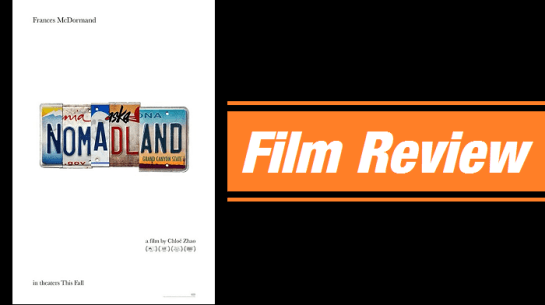
NOMADposter

With only three feature films under her belt, Chloé Zhao has already proven herself to be an essential filmmaker of our time. Her first two films “Songs My Brothers Taught Me” and “The Rider” were both honest and heartfelt blends of real life and fiction that focused on people living on the fringes of modern society. Her latest “Nomadland” is cut from the same deeply human cloth and the three films together play like a slice-of-life trilogy set in the American West.

“Nomadland” has been a hit on the festival circuit since premiering in September, taking home top honors in both Venice and Toronto. The film is based on the nonfiction book “Nomadland: Surviving America in the Twenty-First Century” by Jessica Bruder which explores the lives of Americans travelling from place to place doing seasonal work while living out of their vans and RVs. Zhao (who serves as writer, director, and editor) doesn’t set out to adapt the book as much as capture the spirit of these free-wandering van-dwellers.

In true immersive nomadic fashion Zhao, her star Frances McDormand, and many from the crew lived out of vans for much of the four month shoot. And as with her previous works Zhao populates her film with real people playing versions of themselves. It’s a Bressonian touch that strips away any artifice or bravura for the sake of raw, unvarnished authenticity. And what better professional actress to meld into that deep-rooted setting than McDormand. This is easily the Oscar winner’s most subtle and unmannered performance, brilliantly coating her character in these unique real-world sensibilities.

NOMAD2

Image Courtesy of Searchlight Pictures

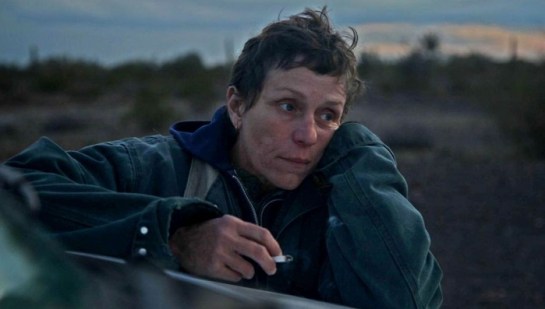
McDormand plays Fern, a widow in her early 60’s originally from Empire, Nevada who lost what what seemed like a happy life. Following her husband’s death Empire’s lifeblood, a gypsum plant, closed and the town itself soon followed. People were forced to move away in search of work and within six months the town’s zip code had been eliminated. It’s a vivid reality that may be lost on some but will be painfully real for many in small-town rural America.

Now Fern lives an itinerant life, looking for work and living out of her customized van which she has affectionately named Vanguard. At first you get the sense that Fern isn’t looking to be a nomad. It’s a matter of necessity. She doesn’t consider herself homeless. “I’m not homeless, I’m just houseless,” she explains to a former pupil. “Not the same thing, right?” Over time, especially after befriending new people along her journey, the alone and quietly mourning Fern begins to embrace the life of a wanderer, seeing it as the one place someone like her can carve out an existence.

Through Zhao’s neo-realist lens, Fern’s journey is realized with aching detail, moving along with a near lyrical style that makes the mundane and routine flow with narrative and emotional meaning. Whether she’s working at an Amazon fulfillment center during their Christmas rush, cleaning bathrooms at an RV park, or watching a Nevada sunset from a lawn chair. Seemingly simple things matter and when threaded together by Zhao’s mesmerizing storytelling, it’s hard not to be moved.
NOMAD1

Image Courtesy of Searchlight Pictures

And the people Fern meets along the way are just as important. The story features several real-life nomads – nonprofessional actors who are as essential to the film’s setting as any location. Salt-of-the-Earth people who bring their unconventional lifestyles into focus. Linda May and Swankie are two friends and mentors who take Fern under their wings while Bob runs Rubber Tramp Rendezvous, a traveling training and support group for van-dwellers. The lone seasoned actor she meets is the always reliable David Strathairn. He plays a fellow nomad who takes a liking to Fern. But while her wandering journey is just beginning, his appears to be approaching its end.

Zhao’s careful casting means so much to the story, but the visual language is equally vital. It’s easy to get lost in cinematographer Joshua James Richards stunning gaze. Whether he’s capturing a picturesque ocean sunset or a vast arid valley lined with snow-capped mountains. It’s the same for the deeply humanizing ways he frames the characters. When brought together through Zhao’s Oscar-worthy editing, it’s like postcards of America’s natural beauty built around a story of grief, introspection, and self-discovery. Then add in the soul-stirring score by Ludovico Einaudi whose mix of piano chords and strings are as evocative as they are lovely. It’s easily one of my favorite scores of the year.

From a Nevada desert through the South Dakota Badlands to the Pacific coast, “Nomadland” is a work of visual poetry, but it’s the human element at its core that gives it such an emotional pull. In one sense observing the freedom felt by van-dwellers is inspiring and heartwarming. But the steady undercurrent of loneliness and uncertainty is a solemn reminder of the day-to-day reality for those who have fallen through America’s economic cracks. “Nomadland” is set for a one-week virtual screening December 4th before opening in theaters February 19, 2021.

VERDICT – 4.5 STARS

4-5-stars

REVIEW: “The Decline” (2020)

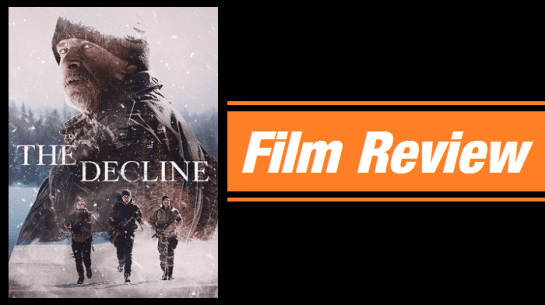
DECLINEposter

Netflix continues the trend of adding international flavor to its movie portfolio with the French-Canadian action-thriller “The Decline”, the feature film debut for director Patrice Laliberté. He crafts a smart and competently made picture that may not have a big blow-you-away element that sets it apart, but it does manage to keep you locked in from start to finish.

The film opens with Antoine (Guillaume Laurin) leading his wife and daughter in a late-night emergency evacuation drill. This first scene hints at a pre-dystopian setting but it’s actually set in modern day Quebec. Antoine is convinced an environmental catastrophe is imminent so he leads his family in survival preparation. That includes watching YouTube videos of a middle-aged survival expert named Alain (Réal Bossé) who teaches things like storing food rations and other basic end-of-the-world stuff.

DECLINE1

Photo Courtesy of Netflix

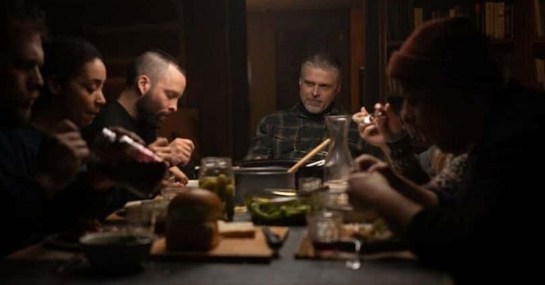
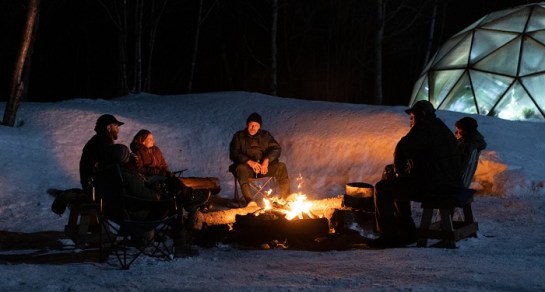
Thanks to a last-minute cancellation Antoine gets a coveted spot at Alain’s survivalist training camp. Over several days Alain will teach Antoine and five other survivalists the need-to-know essentials of self-sustainability once society inevitably crumbles. His exercises include planting crops, hunting, firearm training and (gulp) pipe bomb making. It all takes place around Alain’s isolated compound deep within his 500 acres of snowy wooded property.

Antoine and his fellow trainees get along great and all bring with them their own paranoia of choice – an economic collapse, environmental disaster, foreign invasion, (yikes) a global pandemic. They’re all pretty inconsequential because the movie doesn’t have much to say about any of it. Instead it’s much more interested in human nature and the qualities inside of us that we can’t isolate from. This comes vividly (and violently) into focus when a training drill goes terribly wrong leaving one person dead and two camps of thought on how to deal with it.

Jusqu'au Declin

Photo Courtesy of Netflix

The second half of the lean 83-minute runtime is pure survival thriller territory with two sides squaring off across the threatening snowscape. Outside of Alain and Antoine, few of characters have much to offer. An ex-soldier named Rachel (Marie-Evelyne Lessard) is interesting and the unhinged militant David (Marc Beaupré) offers some wild-eyed menace. The others get a bit lost in the second-half chaos. But director Laliberté keeps us glued to the screen by ratcheting up the tension and making great use of his snowy setting.

An ambiguous title like “The Decline” may leave you wondering what to expect. The story (written by the trio of Laliberté, Charles Dionne, and Nicholas Krief) doesn’t offer much clarity. Instead the film uses its small sample-size of humanity to show that we can’t isolate ourselves from what’s inside of us. And what’s buried inside is often pretty ugly. All of that is wrapped inside of a compelling idea which turns into a fairly stock thriller. “The Decline” is now streaming on Netflix.

VERDICT – 3 STARS

3-stars

Happy Thanksgiving…

I love Thanksgiving! It’s a wonderful time to be with those we love, to eat great food, and be thankful for the many blessings we have. Whether you celebrate Thanksgiving or not, whether you’re here in the States or abroad, I just want to say thank YOU. Thank you for reading my stuff and following my site. Thank you for the many likes, comments, and discussions over the past year. You may not realize it, but every one of you who has spent time here have been encouragements and have helped make this thing truly fulfilling.

So once again thank you and all the best to you and your families.

First Glance: “Our Friend”

FRIEND1

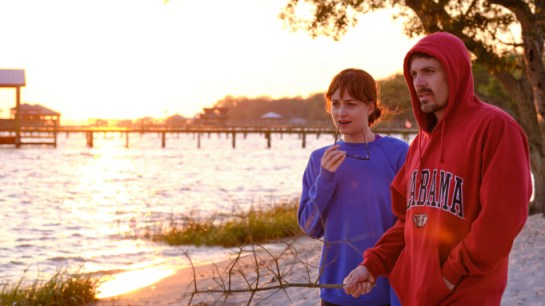
Jason Segel, Dakota Johnson, and Casey Affleck star in the upcoming dramedy (I really hate that word) “Our Friend”. The film is from director Gabriela Cowperthwaite best known for her critically-acclaimed documentary “Blackfish” and is written by Brad Ingelsby who earlier this wrote the terrific “The Way Back’.

In “Our Friend” Dane (Segel) puts his life on hold in order to help his two best friends Matt and Nicole (Affleck and Johnson) after she is diagnosed with terminal cancer. Dane’s experience with his friends and their two young daughters turns into a heartbreaking yet life-changing experience. The film is based on a true story and originally premiered at the 2019 Toronto Independent Film Festival. The first trailer makes good use of its high-profile cast and its emotionally meaty material has loads of potential.

“Our Friend” is set to release January 22, 2021. Check out the trailer below and let me know if you’ll be seeing it or taking a pass.

REVIEW: “The Glorias” (2020)

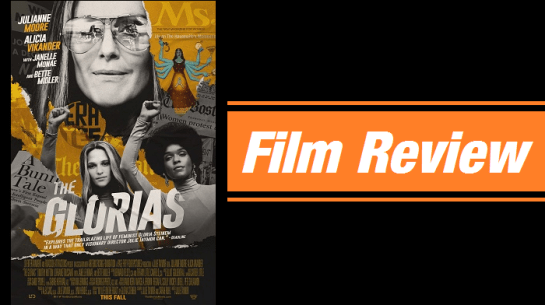
GLORIASposterr

“The Glorias” has all the ingredients for a really good biopic: a provocative personality as its subject, a stellar female-driven cast, and plenty of historical ground to cover. So it’s disappointing to find Amazon’s new Gloria Steinem biography to be such a slow, hard to connect with grind. Despite its admirable efforts the movie gets too creative for its own good, bouncing us back-and-forth along Steinem’s timeline, never allowing us to get firmly planted in her character or her story.

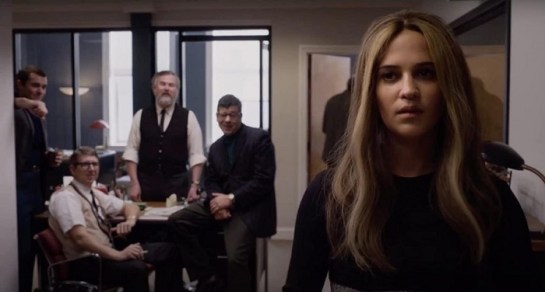
The movie is directed by Julie Taymor from a screenplay she co-wrote with Sarah Ruhl. It’s really hard to identify their goal mainly because their movie is so scattered and unfocused. Even worse, so much time is spent checking off boxes from her political activist résumé that we never get to know her personally. Most of the personal bits are just patched in and then left with practically no emotional detail whatsoever. This is especially true for the film’s second half which is kinda like reading Steinem’s Wikipedia page.

GLORIA2

Photo Courtesy of Amazon Studios

The first half of the movie is all over the map, trying to cover Steinem’s childhood, her teenage years with her mother in Toledo, even her sabbatical in India. There are few times where it bolts ahead to her later political work but only briefly. While these points in Steinem’s life are touched on, they aren’t covered in a way that gives them weight. The closest we get are the early scenes where we see the connection between a young Gloria (played by Ryan Kiera Armstrong and later by Lulu Wilson) and her kind but cash-strapped father (Timothy Hutton).

Alicia Vikander plays Gloria through her twenties and thirties. Her part of the story attempts to cover the most ground, from the wobbly scenes in India to the more pointed moments highlighting the sexism she faced as a young journalist. She begins dipping her toes in feminism, meeting and befriending several interesting people along the way who help shape her future activism. While her accent is a little shaky, Vikander does her best trying to bring something personal to scenes which never allow her stay in one place very long. It’s a tough assignment.

THE_GLORIAS_DM_02-12-2019-00128.arw

Photo Courtesy of Amazon Studios

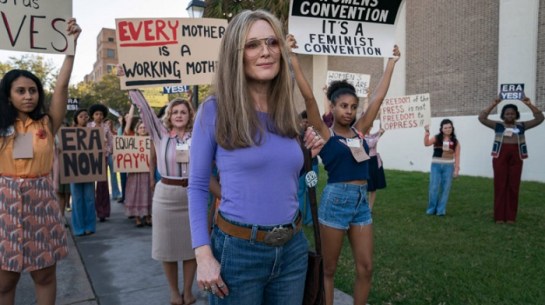
Then out of the blue the entire movie settles in on Julianne Moore’s older Gloria. These scenes tease us with a handful of quieter moments where Gloria wrestles with her status and the expectations of others. But it too falls into the trap of checking boxes and moving from one career moment to another. Even the supporting characters are undersold. Take Bette Midler who quite literally shows up out of nowhere with practically no introduction whatsoever. She plays Bella Abzug and you better know who she is before watching the film. It all ends in a messy final act that throws so much stuff at the screen but to little effect.

“The Glorias” turns out be a frustrating misfire. It’s a shame considering the sizable talent of the cast and a meaty life it has to explore. There are some bold choices by the filmmakers such as a reoccurring bus ride where the Glorias from different eras talk among themselves. They make for the occasionally good segue from one time period to the next. But the film ends up being so interested in showing Steinem’s days as a feminist icon that it often forgets the human element. And it stays away from any of her complexities and controversies leaving us with a fairly one-dimensional portrayal. “The Glorias” is now streaming on Amazon Prime.

VERDICT- 2 STARS

2-stars

REVIEW: “A Rainy Day in New York” (2020)

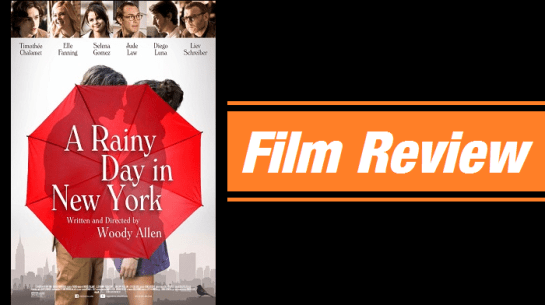
RAINYposterr

Even if you question Dylan Farrow’s accusations, you have to admit Woody Allen’s personal life has been suspect and that’s putting it nicely (many would say repugnant is more accurate). In the wake of #MeToo few have seen their careers take a hit quite like his. Despite his fervent denials, Allen has been shunned by many in the film community. As a result he was released from his contract with Amazon Studios and his latest film pulled from their release schedule.

Allen has since acquired the film rights from Amazon and has slowly been releasing “A Rainy Day in New York” across the globe. It’s now out in the States and within minutes of watching I had spotted practically all of Allen’s most recognizable signatures: the neurotic and insecure narration, a strong sense of location, classic piano chords dancing in the background, the cloud of melancholy hanging over numerous characters. And while several of Allen’s later efforts feel like exercises in rinse-and-repeat, I still find his movies effortlessly watchable, this one included.

“A Rainy Day in New York” certainly won’t fall among Allen’s very best works. It’s a movie that gets off on the right foot and for the first 45 minutes or so I was enamored with it despite some noticeable flaws. But then the few threads of plot begin to unravel leading to a messy final act full of thinly sketched characters and underdeveloped ideas. It doesn’t completely undo the film, but it highlights an unfortunate lack of depth and focus.

RAINY1

Photo Courtesy of Signature Entertainment

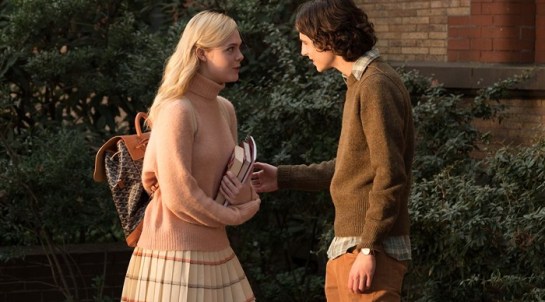
This time around Allen’s avatar is Timothée Chalamet. He plays Gatsby Welles, the eccentric son of stuffy upper-crusters and boyfriend to Ashleigh (Elle Fanning), a sweet and flighty girl from Tucson. The two attend Yardley University, a small liberal arts college in upstate New York. Ashleigh enjoys school and is a reporter for the university’s newspaper. Gatsby doesn’t have much interest in grades, class or anything else school related. Instead he’d rather be lounging at a Manhattan piano bar or buying into a high-stakes poker game. When asked about his plans for the future he quickly replies “floundering“.

Ashleigh lands a big interview with tortured indie director Roland Pollard (Liev Shreiber) in (where else?) New York City. Gatsby jumps at the chance to return to the Big Apple and immediately starts planning their time together. But his plans get shot down when Ashleigh’s one-on-one interview turns into a madcap caper of sorts as three highfalutin movie men strangely vie for her affections.

RAINY2

Photo Courtesy of Signature Entertainment

The men – the brooding Pollard, his nervy screenwriter Ted Davidoff (Jude Law) who suspects his wife Connie (Rebecca Hall in little more than a cameo) is having an affair, and a heartthrob actor (and easily the most shallow of the three) Francisco Vega played by Diego Luna – shuttle Ashleigh from one scenario to the next eventually stranding her character at a frustrating narrative dead-end. Fanning deserves credit for charming her way through scene after scene, but ultimately she’s let down by a storyline that gives her no meaningful place to go.

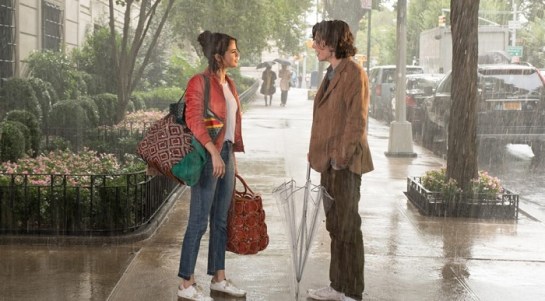
That leaves Gatsby to mope around the rainy city in his tweed jacket and unruly mop, waiting for Ashleigh to call and offering up sardonic musings whenever the script calls for it. While strolling he bumps into Chan (Selena Gomez), the snarky younger sister of an old girlfriend and they decide to kill some time together. It’s clear the two are supposed to have some kind of spark, but the chemistry between Chalamet and Gomez is inconsistent at best. Still, there is some fun and witty chatter between them that may not sound like anything real college kids would actually say yet it feels right at home in a Woody Allen movie.

WA17_09.28_0287.ARW

Photo Courtesy of Signature Entertainment

As an out-of-her-element Ashleigh rubs noses with the entertainment elite, Gatsby goes to the Metropolitan with Chan, visits his buffoonish brother who wants out of his upcoming wedding due to his fiance’s “fatal laugh“, sits in on a big-money poker game, and meets a call girl named Terry (Kelly Rohrbach) in a dive bar. All of this while trying to avoid his aristocratic parents who are throwing a lavish party for their friends in the 1%. Both of the dual storylines are a bit scattered but have their own quirky Allen-esque allure. That is until the aforementioned final half-hour when Allen throws all of the characters at the screen before limping to the finish line.

And that leads to my other issue, one that I just couldn’t shake – Chalamet. For starters he seems way too young for the role Allen has penned. That’s not so much his fault as it is the writing and/or casting. There’s also an inconsistency with his delivery. There are plenty of times where Chalamet could pass for an authentic person. But there are far too many instances where it looks as if he’s doing an impression of a traditional Woody Allen character. It’s difficult to put into words, but in these scenes you can see Chalamet straining to fit in a mold.

It’s hard to watch “A Rainy Day in New York” and not feel like it’s something you’ve seen before. Simply put, Allen doesn’t have much new to say in this, his 48th movie. Yet there are times when the film pulsates with the same satisfying energy of Allen’s past work. Its soaked with familiar feelings of nostalgia, from its anachronistic lead character unwittingly channeling a bygone era to more personal Allen obsessions that spring up throughout. It may not paint the most modern portrait, but in many ways I think that’s the point. Allen has often dabbled in real-world fantasy as a way of wrestling with ideas and longing for the past. It’s no different here, just a bit messier.

VERDICT – 3 STARS

3-stars