REVIEW: “Borat Subsequent Moviefilm” (2020)

BORATposter

Whether you call it “Borat Subsequent Moviefilm”, “Borat 2”, or go by its official title “Borat: Gift of Pornographic Monkey to Vice Premiere Mikhael Pence to Make Benefit Recently Diminished Nation of Kazakhstan” (and that’ll be the only time I’ll type it in its entirety), Sacha Baron Cohen finally got around to doing a follow-up to his 2006 box office smash. The first Borat movie was better at creating hilarious YouTube clips than actually gelling as a feature length movie. But people loved it and I’m sure many will fall for its sequel.

Yet there is something about “Borat 2” that has felt a little icky from the start. Purchased by Amazon mere weeks ago, rushed to their streaming platform ahead of the 2020 election, now getting loads of free publicity via major news outlets. It makes sense considering how politically motivated this film is compared to its predecessor (it even ends with the tag “Now Vote, or You Will Be Execute“). The first film offered a more rounded cultural, political, and social critique by holding up a mirror to American society. Cohen’s agenda-driven latest feels about 80% politics which doesn’t leave a lot of time for much else.

Obviously there is nothing wrong with having an agenda. Throughout cinema history there have been great movies built on agendas, many of them political. But “Borat 2” is what happens when your agenda becomes too transparent and it screams so loudly that it drowns out anything else your movie may want to say. Clearly in a country this bitterly divided Cohen’s film is sure to be candy for some. That doesn’t make it any less frustrating, especially when you see glimmers of the first film’s strengths.
Borat2

Photo Courtesy of Amazon Studios

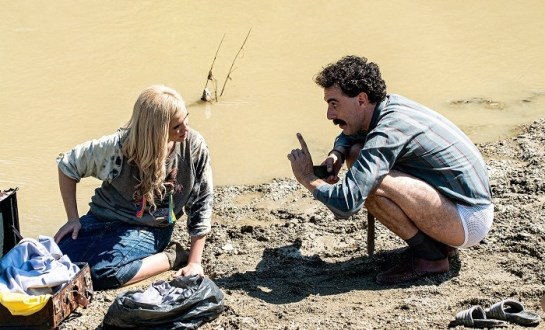
The movie opens with Cohen’s Borat Sagdiyev in a Kazakhstan gulag serving a life sentence for humiliating his homeland with his first film. The country’s new Premier summons Borat and offers him a chance at redemption. Since he knows America, Borat is tasked with delivering a gift to Vice President Mike Pence in an effort to redeem Kazakhstan’s tarnished image. That gift – Johnny the Monkey, Minister of Culture and the country’s top pornstar (don’t ask). So Borat sets out on a cargo ship and 22 days later arrives in Galveston, Texas.

Once back in the States Borat quickly learns he has become a celebrity. Wishing to keep a low profile, he buys several costumes at a local Halloween thrift shop and then sets out to do his patriotic duty. In a twist too stupid to waste time on, Johnny the Monkey doesn’t survive the trip from Kazakhstan. Instead Borat discovers his 15-year-old daughter Tutar (played by 24-year-old Bulgarian actress Maria Bakalova) stowed away in the monkey’s crate. Borat scrabbles and comes up with a new plan. He’ll give his daughter as a gift to America’s Vice Premier. This thrills Tutar who has long dreamed of belonging to a powerful man much like her idol Queen Melania. Yep.

This sets in motion a number of ‘encounters’ with unsuspecting victims as Borat prepares his daughter for her new “owner”. They include trips to a dress shop, a hair salon, and getting tips from an Instagramming “sugar baby”. Actually Cohen and Bakalova’s best moments are when it’s just them and the half-baked mockumentary gives way to the daddy/daughter story. But these movies are all about fooling unaware people and capturing it on camera. This time these supposedly unscripted scenes (and some are quite dubious) don’t land nearly as well as they did in the first film and some fall completely flat.

Borat Subsequent Moviefilm

Photo Courtesy of Amazon Studios

Take one of the movie’s biggest scenes where Cohen, dressed in a fat suit and a Trump mask, throws Bakalova over his shoulder (or is it a doll) and barges into an arena interrupting Mike Pence’s CPAC speech. It could have been memorable, but it’s too poorly shot and ends with an uneventful thud. Then you get a scene like the debutante ball which starts out funny but ends with a disgusting gross-out menstruation gag. It’s not the only low-brow shock jock ‘humor’ we’re forced to endure. Whether it’s Cohen’s lazy fixation on genital jokes or him running around in his underwear. He’s constantly repackaging and rehashing the same crass material.

And again, it’s frustrating because there are laughs that can be mined out of “Borat Subsequent Moviefilm”. There’s also a pieced-together semi-inspiring story of Tutar’s self-liberation that begs for more attention. You also have to admire Cohen’s ability to lure people into exposing their own bigotries through some of the most ridiculous conversations and interactions, his boldness in infiltrating a den of alt-right conspiracy theorists, and his crafty commentary on the COVID-19 pandemic.

Of course most people are talking about the film’s finale featuring a prominent politician in compromising position, a scene made more salacious by what may be some rather strategic editing. Unfortunately there’s isn’t much else worth talking about. When in comes down to it “Borat 2” just can’t get out of its own way. Cohen’s work at exposing racism and misogyny is too often undercut by his insistence on overusing juvenile crudity. And this time around everything feels far more manufactured than with the first film. Ultimately you can’t help but wonder how many of the people on screen are actually in on the joke. “Borat Subsequent Moviefilm” is now streaming on Amazon Prime”.

VERDICT – 2 STARS

2-stars

First Glance: “News of the World”

NEWS2

Tom Hanks meets the Western genre – what a combination! Few things excite me more than seeing this almost perfect union which we’ll be getting in “News of the World”. Another interesting tidbit – the film will reunite Hanks with director Paul Greengrass. The two previously worked together in 2013’s “Captain Phillips”. And wouldn’t you know it Hanks plays another Captain in their new film. So many cool connections!

Hanks plays a traveling newsman telling real-world stories in towns all across the west. He encounters a traumatized 10-year-old girl (Helena Zengel) who’s lost and all alone. The Captain decides to make the trek across the treacherous frontier to return the young girl to her family. But it won’t be easy in a land full of violence, conflict, and peril. The new trailer strikes all the right chords and it has the potential to really shake up awards season.

“News of the World” is set for a Christmas theater release. Check out the trailer below and let me know if you’ll be seeing it or taking a pass.

REVIEW: “Jacinta” (2020)

JACINTAposter

There have been countless movies, both documentaries and feature fiction, that have spoke to the issue of drug addiction. Few have packed the same raw and visceral punch as Jessica Earnshaw’s “Jacinta”, the winner for Best U.S. Feature at this year’s Hot Springs Documentary Film Festival. With its crushingly intimate and unflinching perspective, “Jacinta” spares nothing in its depiction of dependency, capturing a painful reality that’s all too familiar for many Americans.

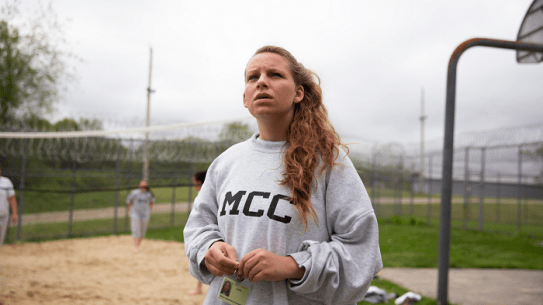
From the very start you can’t help but recognize the unprecedented access Earnshaw was given. Her film starts inside the walls of the Maine Correctional Center. There we meet 26-year-old Jacinta who’s serving the final days of a nine month sentence. We learn a lot about this young woman through her own words. She has been in and out of prison since she was 15. At 16 she had her darling daughter Caylynn. Jacinta is bright, spirited, and engaging. She’s also a heroin addict, the result of a deeply troubled upbringing.

During the early prison scenes we’re introduced to Jacinta’s mother Rosemary who’s serving a much longer sentence in the same facility. She has lived a hard life and many of her daughter’s problems can be traced back to her. Yet the two remain intensely close. We learn that Rosemary was pregnant at 14 and had three children by the time she was 18. An addict herself, she too has been in and out of prison, but it’s her vices within her family that are the most unsettling.

Jacinta and Rosemary at Maine Correctional Center, 2016. Photo © Jessica Earnshaw.

Photo Courtesy of Jessica Earnshaw.

Over the course of the film revelations come to light concerning Rosemary’s relationships with her children. Earnshaw doesn’t set out to paint her as the villain. Everything we learn comes from the people on screen and we are allowed to come to our own conclusions. One thing is certain, Rosemary loves her daughter in her own unhealthy way. But their codependent mother/daughter dynamic proves to have devastating effects especially for Jacinta, a young mother herself who is already at a dangerous crossroads.

After an emotional good-bye to her mother, an anxious Jacinta is released from prison. Earnshaw’s camera follows her as she’s greeted by her compassionate father Rick who helps her get settled in a sober house. There is an air of hope throughout these scenes especially when Jacinta reunites with 10-year-old Caylynn. The two spend a wonderful day together, connecting as if they had never been apart. All the pieces seem to be in place for an uplifting redemption story.

But we quickly learn that happiness is a brittle thing for an addict, and the lure of old hometown acquaintances is palpable. In one of the film’s most devastating scenes Jacinta tells her daughter she’s leaving the halfway home. Caylynn earnestly replies, “What if the sober house is the only thing that’s keeping you going where you’re supposed to?” Sometimes it’s kids who see things the clearest.

JACINTA1

Photo Courtesy of Jessica Earnshaw

Within 90 minutes of dropping off Caylynn (who lives with her paternal grandparents in New Hampshire) Jacinta is high and the feelings of hope evaporate right on our screen. It’s one of several uneasy situations for Earnshaw who also serves as the film’s cinematographer. No stranger to a camera, Earnshaw shoots each of these moments up close and with brutal honesty. Take when Jacinta is picked up by her friend at a shopping mall immediately after shoplifting a laptop. Earnshaw sits in the backseat filming as the two young women up front discuss the crime. Before they’re out of the parking lot Jacinta pulls out a syringe and shoots heroin. It’s harrowing and heartbreaking.

But nothing is as shattering as pre-teen Caylynn, mature beyond her years and acutely aware of her mother’s condition. Seeing her wrestling with her feelings and trying to understand her mom is hard to watch. Seeing her later resign to the belief that she has lost her mother for good is even harder. Like the bond between Jacinta and Rosemary (but in a much different light) it again highlights the intense bond between a mother and daughter. It also leaves us praying for the cycle of addiction to be broken and for Caylynn to have the life she’s longing for.

Despite all of her faults, there is never a moment we don’t root for Jacinta. The film never condones her actions, but it does offer perspective by plowing deep into her family history. Ultimately what the film provides is a raw, real-world observation of a young mother in the throes of addiction, her face often overtaken with sadness and defeat, yet yearning to be the mother she never had. It’s far from easy viewing, but it’s sure to open a lot of eyes. And many will be left thinking about Jacinta and her family for days afterwards. “Jacinta” is appearing in several film festivals across the country.

VERDICT- 4.5 STARS

4-5-stars

First Glance: “All My Life”

LIFE

I think I’m becoming a Jessica Rothe fan. The 33-year-old Denver, Colorado native has brought energy to nearly every movie I’ve seen her in. She had a small but sparkling roll in “La La Land” contributing to one of my favorite musical numbers in the film. She was a lot of fun and showed her range in the two “Happy Death Day” films. And earlier this year she once again showed off her singing chops in the flawed but enjoyable “Valley Girl”. Now she’s set to star in “All My Life”, a film that’s one part mushy romance, the other part terminal illness drama. Hmm.

Rothe stars as a young woman named Jenn who meets and falls for Solomon (Harry Shum Jr.) Over time the two grow more and more in love and want to spend their lives together. But when Solomon finds out he has cancer, it (as you can imagine) dramatically challenges their plans for the future. The first trailer gives equal time to both sides of their story, and while I’m anxious to see Rothe, this looks a little iffy. Could be sweet and heartwarming. Could be sappy and cheese-filled.

“All My Life” opens later this year. Check out the trailer below and let me know if you’ll be seeing it or taking a pass.

REVIEW: “Mamakrom” (2020)

mama111

Sitting upon the endless red clay of northern Ghana is the village of Mamakrom and a school built on the very foundation of hope and compassion. The new documentary, understandably titled “Mamakrom”, is made with the same passion and solicitude as its namesake. Filmmakers Joseph Pelegreen and Matt Lang have put together something anchored by a heartfelt love for a struggling region and a genuine desire to see true and meaningful change.

“Mamakrom” showed at this year’s Hot Springs Documentary Film Festival and competed in the International Features category. The film is clearly a passion project and is imbued with the empathy and aspiration of its makers. It’s an eye-opening doc inspired by a decade’s worth of first-hand observation and experience. From the opening frames it’s clear this is something near and dear to hearts of those in front of and behind the cameras.

Mamakrom2

You could say “Mamakrom” is as educational as it is inspirational. Pelegreen (who serves as the film’s director) puts a lot of time into developing the setting and situation for his viewers. Through evocative imagery and the words of local workers for change, the film vividly captures the region’s abject poverty. It talks about famine and drought. It highlights the dangers of malaria and waterborne diseases in a place with limited access to healthcare. This directly connects to the most heartbreaking reality – the high mortality rate specifically among children.

With a clear-eyed perspective Pelegreen and Lang highlight the region’s most critical needs: health, development, and (the film’s biggest focus) education. “Educate a child and you’ll change his life forever.” But doing so in northern Ghana comes with its own set of intense challenges. The lack of infrastructure, the poor quality of the schoolhouses, the inability to find and maintain teachers – all of these things combined with the deeper health and quality of life struggles puts any aspiration of a burgeoning education system instantly behind the proverbial eight ball.

Mamakrom1

But one of the joys of “Mamakrom” is that it offers hope that even obstacles which seem insurmountable can be overcome by those willing to commit themselves and answer the call to action. This is embodied in the missions-based ESI Foundation (an acronym for Every Souls Important). The group has been a steady presence in Marakrom pouring time, money, and love into the children and their future. The film shows the fruits of the ESI’s investments – the construction of new school buildings, a library, and teachers quarters. More importantly, we get a taste of the impact they are having on the lives of the students. It’s all working towards building a better future for the people of Ghana, not through dependability but self-sustainability.

The film makes several other insightful observations, such as how the the aforementioned high mortality rate actually leads to a higher birth rate as families painfully try and compensate for the children they will inevitably lose. Or how the influx of used clothing and imported produce, though well-intended, has adverse effects on local markets. But while the health crisis is heartbreaking and the region’s economic complexities are compelling, the film always comes back to its faith-fueled hope of a better future for Ghanaians. “Mamakrom” doesn’t hide its intentions. It wants to open eyes and move people to action. And what better way to do that than by showing that such actions are not in vain.

“Mamakrom” is scheduled to show at several upcoming film festivals and it’s currently fielding offers for distribution.

VERDICT – 4 STARS

4-stars

First Glance: “Ma Rainey’s Black Bottom”

MA1

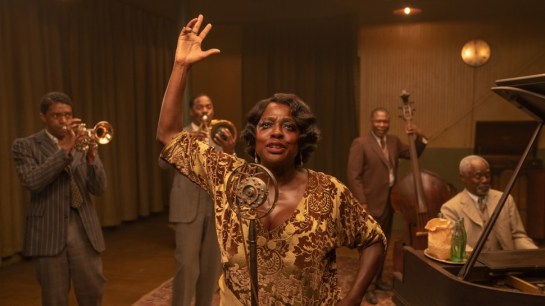
Streaming giant Netflix is hoping to add yet another Oscar contender from their 2020 movie Catalog with “Ma Rainey’s Black Bottom”. The attention-getting title comes from the August Wilson play of the same name about legendary Blues singer Ma Rainey. Touting Denzel Washington as a producer, Viola Davis as its star, and featuring the final film appearance by the late Chadwick Boseman, the film sports a lot of exciting big name recognition.

Director George C. Wolfe teams with screenwriter Ruben Santiago-Hudson to tell the story of a tense recording session in 1927 Chicago. At the center is Ma Rainey herself, the “Mother of Blues”, the “Songbird of the South”. She begins butting heads with her white manager and record executives. Meanwhile Chadwick’s Levee is a troubled yet ambitious trumpeter hungry to make his own mark in the bustling blues world. The movie looks full of period style, great music, and loads of charisma.

“Ma Rainey’s Black Bottom” premieres December 18th on Netflix. Check out the trailer below and let me know if you’ll be seeing it or taking a pass.