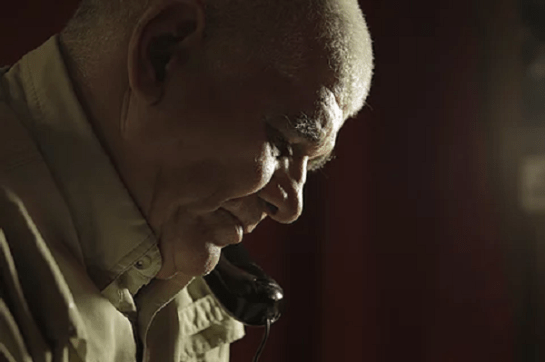
REVIEW: “MLK/FBI” (2020)

MLKsmall

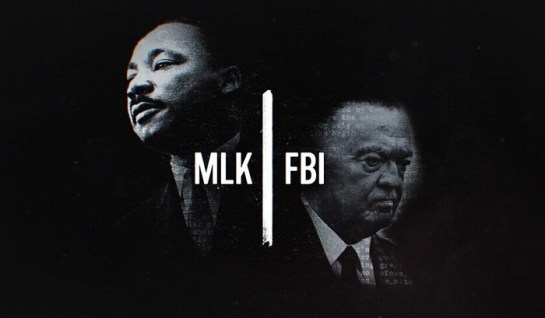
The dark and troubling relationship between Martin Luther King, Jr. and J. Edgar Hoover’s FBI is well known and has been well documented. But I’m not sure it has ever been as thoughtfully considered as it is in Sam Pollard’s new documentary “MLK/FBI”. I had the opportunity to see the film at this year’s Hot Springs Documentary Film Festival and it has been on my mind ever since.

Pollard’s film is timely considering the country’s current conversations about race relations and social justice. It’s equally fitting that it comes out during a time when the FBI is under scrutiny and face accusations of (once again) abusing their powers. I’m sure Pollard is aware of his film’s relevance, but he wisely lets it come through naturally, covering his subject from a clear-eyed historical perspective.

MLK1

“MLK/FBI” uses two parallel but frequently intersecting timelines in its effort to chronicle Hoover’s evolving FBI and King’s rise as a civil rights leader. Pollard uses a fascinating collection of archived footage, audio recordings, and news feeds accompanied by insightful narration from a handful of authors, historians, former FBI agents, as well as a friend and speechwriter for Dr. King.

J. Edgar Hoover was the very first director of the Federal Bureau of Investigation and ran the organization for 37 years until his death in 1972. He served through a total of eight presidencies from Coolidge to Nixon. Under Hoover one of the the FBI’s chief undertakings was rooting out and exposing communists. Stanley Levison was a New York attorney with communist connections. He was also an advisor and friend to Dr. King which led Hoover to put his sights on the civil rights movement.

King was steadily growing in popularity and influence. His words of equality resonated with African-Americans across the country culminating with the famous March on Washington in August 28, 1963. Two days later the FBI’s head of domestic intelligence would deem King “the most dangerous Negro in the future of this nation from the standpoint of communism.” A year later and with the permission of Attorney General Bobby Kennedy, Hoover began wiretapping King, compiling countless tapes of private conversations and uncovering numerous adulterous affairs. While his actions were morally repugnant, King did nothing illegal so the Bureau put together a smear campaign aimed at staining the leader’s reputation.

Pollard’s examination isn’t exhaustive nor can it be considering the tapes connecting King and the FBI are sealed in a National Archives vault until February 2027. But what he does do is construct a strong moral case against the FBI’s targeting of King while also using the flimsiness of their communist ties claims to reveal far more troubling motivations. Hoover’s cooperation with the Kennedy’s and Lyndon Johnson adds an even darker shade to their political power and influence.

MLK2

But at the same time Pollard doesn’t sugarcoat King’s transgressions. If the FBI was eager to create their own smoking gun, King’s extra-marital affairs provided them with the bullet. “MLK/FBI” challenges the almost saintly mythos surrounding Dr. King today while still showing him as the victim of a concentrated effort by the government’s principal law enforcement agency to discredit and silence not only him, but the entire civil rights movement. The film ends by posing a thought-provoking question – does an individual’s personal sins negate their work as a leader and their voice for change?

With “MLK/FBI” Sam Pollard merges history with cinema to reconstruct the often contentious relationship between the United States government and one of nation’s most iconic leaders. For better or for worse the film’s clinical, just-the-facts approach can feel a lot like a history lesson. And it does veer ever so slightly into conspiracy theory territory when speaking of King’s assassination. But Pollard doesn’t linger on the unknown. His film is about examining what we do know, highlighting the abuse of federal power to thwart a powerful national movement. The rest will have to wait until 2027.

“MLK/FBI” is appearing in several North American festivals before its scheduled release in January 2021.

VERDICT – 4 STARS

4-stars

REVIEW: “Missing in Brooks County” (2020)

MISSINGposter

I had the honor of serving as a juror at this year’s Hot Springs Documentary Film Festival and once again the festival’s program featured a wealth of talented filmmakers presenting their work. One of the most gripping documentaries I had the opportunity to see was “Missing in Brooks County”, a thoughtful and immersive look at the lingering US/Mexico border crisis.

The film comes from documentarians Lisa Molomot and Jeff Bemiss. The two directed, filmed and produced this affecting examination of a critical issue that has in many ways been lost in the noise of battling bureaucracies and political parties. As is obvious from the title, the film is set within Brooks County, Texas, much of it in and around the small town of Falfurrias.

For a little history, during Bill Clinton’s presidency measures were taken by his administration to address the increasing flow of illegal migrant traffic crossing the southern border. The idea was to strengthen border security in order to funnel migrant traffic to the most dangerous areas. While some casualties were expected, the hope was to discourage illegal crossers from attempting the long, arduous journey. Predictably that’s not at all what happened.

MISSING1

In Brooks County, some 70 miles from the US/Mexico border, migrants are brought in by coyotes who gave them a jug of water and directions around the checkpoints. The groups then walk for miles across hot, dry, privately owned ranch land. Many never make it to their destination, losing their way and dying due to the harsh and rugged elements. It’s believed that since 2008 an estimated 2,000 migrants have died in their attempt at making the dangerous trek. Yet considering how many are never found, the total could be considerably higher.

Molomot and Bemiss begin by introducing us to Eddie Canales, a 70-year-old advocate running the South Texas Human Rights Center. With limited resources but maximum heart and effort, Eddie works to help families looking for missing relatives. He also works with willing ranchers to place water stations on their property in hopes of reducing the number of migrant deaths. But not everyone sees this as noble work. We hear from some who question Eddie’s motivations, even theorizing that he is involved with smuggling people past the checkpoints. It creates a local tension that exacerbates the problem more than helps.

There is also a real-life mystery element as we follow two different families trying to find their loved ones who attempted to cross Brooks County but have never been heard from since. We also feel the pulse of others directly affected by the crisis including the border patrol, human rights workers, and the understaffed local sheriff’s department who is tasked with covering approximately 900,000 square acres of jurisdiction.

MISSING2

Through them all Molomot and Bemiss vividly capture the complexity and the far-reaching effects of the situation. To the film’s credit it doesn’t pretend to have a perfect solution. Instead it’s aim is to focus on the humanity, something often lost in today’s black-and-white politicization of the issue. Outside of a few overt political pop-shots, the movie keeps us at the epicenter by concentrating solely on the viewpoints of those directly impacted. It’s the essential ingredient to the film’s potency.

Another strength is the cinematography which places us close to the people on the ground and offers us an effective emotional connection to them and their circumstances. It also does a great job presenting the south Texas territory whether on foot or through soaring high-resolution drone footage. Both reveal the sparse foreboding landscape consisting of thousands of acres with few distinguishable landmarks. The vast ominous sameness is striking. This strong sense of setting adds a sharp visual clarity to the issues Molomot and Bemiss are exploring.

“Missing in Brooks County” is a clear-eyed exposé of a troubling situation that isn’t as simple as “opening our borders” or “building a wall”. The documentary shows that the situation in this poor South Texas county is far more complicated and personal. Again the film doesn’t pretend to have the answers nor does it get lost in the inflammatory rhetoric and political posturing that surrounds this important issue today. Instead the film’s interests are in the human costs and in challenging its audience to look past the surface-level nonsense in order to understand the real stakes at the heart of the crisis.

“Missing in Brooks County” made its world premiere at the Hot Springs Documentary Film Festival where it won for Best Southern Feature. Look for it to be expanding to other festivals in the near future.

VERDICT – 4.5 STARS

4-5-stars

First Glance: “Monster Hunter”

MONSTER

A few days ago Sony Pictures teased us with a first look at “Monster Hunter”. Wednesday they released the full trailer for their upcoming action-adventure film starring Milla Jovovich. This part fantasy, part creature-feature is inspired by Capcom’s popular video game series and is directed by Paul W. S. Anderson who’s no stranger to adapting video games into movies.

From what we see it looks like Jovovich leads a military unit searching for a team of missing soldiers. In the process they are sucked into an ancient gateway that transports them to a land inhabited by massive dinosaur-like monsters. And all of the creatures seem to have their claws out for the human visitors. “I’m getting us all home.” Aside from Jovovich, some of the performances look a little cringy and it is made by a self-proclaimed “populist filmmaker”. Still the effects look pretty cool and there could be enough here for a fun popcorn movie escape.

“Monster Hunter” releases December 30th. Check out the trailer below and let me know if you’ll be seeing it or taking a pass.

REVIEW: “You Cannot Kill David Arquette” (2020)

KILLposer1

Documentaries come in every shape, size, or form. They can be about any person, place, issue, or topic under the sun. Case in point: “You Cannot Kill David Arquette”, an unusual film telling an unusual story about an unusual man. It comes from co-directors David Darg and Price James and highlights the once starbound Arquette’s journey to regain respect, not in Hollywood, but in the world of professional wrestling.

A little backstory. David Arquette once seemed destined for superstardom. He was considered among the biggest rising stars, even appearing on a 1996 Vanity Fair cover with the likes of Matthew McConaughey, Leonardo DiCaprio, and Will Smith (in fairness it also featured Skeet Ulrich). Also in 1996 Arquette was cast in Wes Craven’s slasher film “Scream” playing the good-hearted but dim-witted Deputy Dewey. It would become his most recognized role, but it also led to him being typecast and his career never took off as expected.

Jump ahead to the year 2000. While doing publicity for his new film “Ready to Rumble”, Arquette partnered with World Championship Wrestling. In the ill-advised cross-promotion it was decided that Arquette would actually win the esteemed WCW Heavyweight Title. The storyline enraged wrestling fans who felt it cheapened the title. Much of the outrage fell on Arquette, a true wrestling fan who loved the business but was quickly considered persona non grata in the wrestling world.

KILL1

Photo Courtesy of Super LTD

“You Cannot Kill David Arquette” finds its subject lost in the cracks of Hollywood and wrestling, two forms of entertainment he loves, neither of which takes him seriously. “I’m sick of being a joke,” he laments. In one sense it’s hard to feel bad for Arquette. He has a beautiful family and a swanky California home. And while he talks about his promising acting career turning into “ten years of rejection“, a quick gander at his IMDB page shows that’s not entirely true. In reality he has been steadily working, just not in caliber of movies he would like.

On the other hand, we can’t help but sympathize once the film digs into more personal soil. Darg and James put their camera on Arquette and allow him and his family to reveal anything they want about the actor/wrestler’s rollercoaster journey. We learn of depression, anxiety, and self-destructive hard living. At one point Arquette describes himself as a “functioning alcoholic”. Then he has an epiphany of sorts. Despite his physical and psychological problems, Arquette decides to get back into wrestling, starting at the bottom and working his way up in an effort to win over the fans who have shunned him. “I don’t care about being a champ. I care about respect.”

The majority of the documentary follows Arquette’s quest to rid himself of the undeserved shame and earn the respect of the die-hard wrestling community. Not the smartest move for a 46-year-old out of shape guy with health concerns, but admirable and inspiring in its own weird way. It’s not an easy journey. Arquette starts by doing backyard matches in makeshift rings where he’s slammed on thumbtacks and has fluorescent light bulbs shattered across his back. He works his way up to the independent wrestling circuit where he begins to get back in shape. He even travels to Tijuana to train with luchadors.

KILL2

Photo Courtesy of Super LTD

Some of what we see is fun, even exciting and you can’t help but root for the underdog. Other scenes are uncomfortable to watch, most notably a brutally violent and bloody “death match” against a wrestler named Nicolas Gage that ends in a near life-threatening injury. It leaves you questioning whether the potential sense of accomplishment and purpose Arquette hopes to gain is worth the ultimate cost. The film wants us to wrestle with that quandary even though Arquette doesn’t. He’s resolute and unwavering in his goal.

Along the way we get welcomed perspectives from David’s family including his wife Christina, sisters Patricia and Rosanna, and his ex-wife Courtney Cox. We even get a brief yet touching scene with the late Luke Perry (blink and you may miss it). We also get insight from several recognizable faces from within the professional wrestling sphere including Ric Flair, Jerry “The King” Lawler, and Diamond Dallas Page. All of these contributions are invaluable and they add points-of-view that helps ground the film (something it really needs from time to time).

It may be tempting to view the entire movie as nothing more than a vanity project. Certainly there are elements of that which are hard to get around. But reducing it to such a linear reading means missing its biggest strengths. As cliché as it may sound, “You Cannot Kill David Arquette” is a documentary of self-discovery. It’s about a broken, wayward man-child longing for acceptance and a sense of self-worth. In one of the more subtly sad details, the only way he feels he can get it is to re-enter an industry that views him with bitter contempt. Yes, there are scenes in the doc where it looks like Arquette is putting on a show. And who knows, maybe the whole thing is a ruse. But his pain and yearning feel deeply personal and they set him on a journey that is silly, heartbreaking, endearing, and violent, often all at the same time. “You Cannot Kill David Arquette” is streaming now on VOD.

VERDICT – 3.5 STARS

3-5-stars

REVIEW: “Rebecca” (2020)

REBECCAposter1

Daphne du Maurier’s classic 1938 novel “Rebecca” is no stranger to the stage or screen. Perhaps the most celebrated adaptation is Alfred Hitchcock’s 1940 Academy Award Best Picture winner. It was Hitchcock’s very first American production and the first film in his rather bumpy seven-year deal with film producer and studio executive David O. Selznick.

Director Ben Wheatley is the latest to take a stab at this alluring romantic thriller working from a script written by the team of Jane Goldman, John Shrapnel, and Anna Waterhouse. This new Netflix Original stars the vastly underrated Lily James, the busy Armie Hammer, and the always great Kristen Scott Thomas. It gets off to a strong start, smartly and smoothly manages its significant shift in tone, and then brings everything to light in a satisfying but hurried finale.

REBECCA

Photo Courtesy of Netflix

In “Rebecca” James plays a young woman working as an assistant to a wealthy and pompous crow named Mrs. Van Hopper (Ann Dowd). Much like in Daphne du Maurier’s popular novel, James’ character is given no name yet we learn all we need to know about her through the unfolding story. We learn she comes from a meager background. She lost her parents two years earlier. She’s smart, loves sketching, and dreams of traveling which is why she works for the globetrotting Mrs. Van Hopper. “Everything I know is from books. I haven’t really experienced anything yet.” Oh how that is about to change.

The story gets going in Monte Carlo with the young woman and Mrs. Van Hopper settled in at the posh Hotel Regina. It’s the first of several instances where the movie explores the subject of class and upper-crust snobbery. The assistant is repeatedly reminded of her role as “staff” or “help”. She’s verbally belittled by her employer, denied dining privileges, and given those haughty, dismissive glances from the rich pampered guests. This is a theme that the film revisits later on.

While running errands for her boss the young woman repeatedly crosses paths with the tall, dashing aristocrat Maxim de Winter (Hammer). Against all odds, the two hit it off and begin a simmering summer romance. She is swept away by the charming yet mysterious Maxim, a recent widower who brushes aside any questions about his late wife Rebecca.

After a spur of the moment proposal, the two marry, have a brief honeymoon, and then settle into Maxim’s huge Manderley estate. It’s an almost mythological family property that has been passed from fathers to sons for generations. A beautiful and lavish mansion, Manderley resembles something plucked right out of a new bride’s storybook dream. But the new Mrs. de Winter quickly learns that her husband has his secrets and the memories of Rebecca haunt every room and every hall. To make matters worse she quickly finds herself at odds with the cold and devious Mrs. Danvers (Kristen Scott Thomas), the chief housekeeper with an uneasy attachment to Mandeley.

REBECCA2

Photo Courtesy of Netflix

“Rebecca” may surprise those unfamiliar with its story. It turns a simply-looking romance built around naïveté and secrets into an unexpectedly empowering story driven by three very different women. The delightfully expressive Lily James makes an enchanting lead. Thomas imbues Mrs. Danvers with an unsettling menace. And the third woman, Rebecca herself, is someone we never really see. Yet the film does a terrific job showing the grip she maintains on Manderley well after her death. And the chilling echoes of her influence haunts her husband, their home, and really anyone close to her.

My biggest beef is with the last act. Wheatley flies through the final twenty minutes or so, covering so much ground in an effort to wrangle together the story’s numerous moving parts. It all comes together neatly enough, but you’ll need to be focused and locked in to keep it all together. Still, there’s so much to admire about this latest “Rebecca”. It maintains a wonderful period feel thanks to Julian Day’s costumes and Katie Spencer’s set design. Laurie Rose’s stellar cinematography vividly captures the beautiful sun-soaked Monte Carlo as well as the gloomy, atmospheric Mandeley. It’s anchored by a wonderful cast and a story that still has the same kick it’s had for 80+ years. “Rebecca” premieres October 21st on Netflix.

VERDICT – 4 STARS

4-stars

REVIEW: “Ava” (2020)

AVAposter1

In case you didn’t know it, Jessica Chastain is a bonafide movie star. Case in point, take a look at her latest film “Ava”, a mixed bag of a movie made considerably better by Chastain’s terrific lead turn. Star-powered performances can often (but not always) carry a movie and elevate it beyond what it would have been otherwise. Chastain does just that with “Ava”, driving the film with killer charisma and intense commitment.

As you probably guessed, Chastain plays the title character Ava Faulkner, a globetrotting assassin doing jobs for a shadow organization simply known as “management”. Sound familiar? That’s because writer Matthew Newton borrows a lot from the action genre he’s playing in. Newton was also slated to direct the film but bowed out amid assault and domestic violence allegations. Tate Taylor was hired as a replacement, directing Newton’s script but bringing nothing particularly new to the film. Instead he puts the bulk of the load onto his able cast, specifically Chastain.

AVA1

Photo Courtesy of Vertical Entertainment

Ava is one of the organization’s best assassins but she comes with some baggage. She’s a recovering alcoholic slowly losing her grip on sobriety. She’s also having bouts with her conscience. In hopes of justifying her actions, Ava begins questioning her “subjects” about their sins before offing them. That’s a big no-no in her line of work and “management” starts to worry. Thankfully she has Duke (John Malkovich), her handler for the organization and proverbial father figure, a welcomed replacement for the slug of a dad she had growing up. Duke works to convince his boss Simon (Colin Farrell) that Ava is stable and still an asset. MmmHmm.

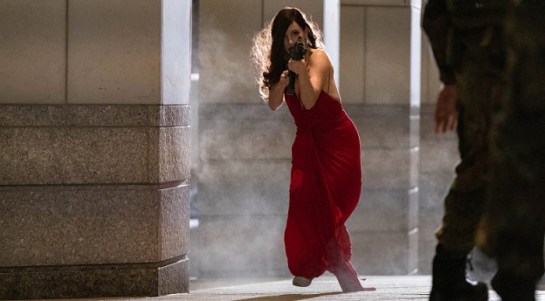
That’s all one side of the story. We get the flipside once Ava returns home to Boston. Surprisingly, the movie spends a ton of its running time on this part of Ava’s story. In one sense the filmmakers should be applauded for bringing depth to its lead character. They do so by digging into her dysfunctional family history with her sharp-tongued mother (Geena Davis) and her embittered sister Judy (Jess Weixler). Toss in the presence of Ava’s ex-fiancée Michael (a painfully wooden Common) who’s now engaged to Judy. Talk about throwing gas on an already raging family fire.

Chastain shines in both sides of Ava’s story. She’s a tough, physical force and makes for a thoroughly believable action movie lead. And she brings strong and relatable emotion to the family drama half of “Ava”. The problem is the two sides of the story are at odds with each other. You watch and wait for their inevitable convergence but oddly they never come together (at least not in a truly meaningful way). Instead they both kinda play out, connecting superficially rather than substantively.

AVA2

Photo Courtesy of Vertical Entertainment

Strangely both of the movie’s two halves work good on their own but they don’t gel together in the way they need to. Sadly it’s the action stuff that gets shortchanged the most. Chastain brings intensity and physicality to the shoot-outs and fight scenes while Bear McCreary’s pulsing score amps up the energy. But ultimately it all needs more time and setup.

While “Ava” may not come together to form the most cohesive movie, it has enough meat on its bones to make for an entertaining escape. It’s also sure to catch a lot of people off guard, especially those expecting a more straightforward action flick. Instead “Ava” is just as much a tough dysfunctional family drama. If only the two parts melded together to make a better whole. So we’re left with a movie that teases franchise ambitions but will probably end up as a one-and-done. It’s a shame because I wouldn’t mind following Chastain’s Ava on the next leg of her journey. “Ava” is now available on VOD.

VERDICT – 3 STARS

3-stars