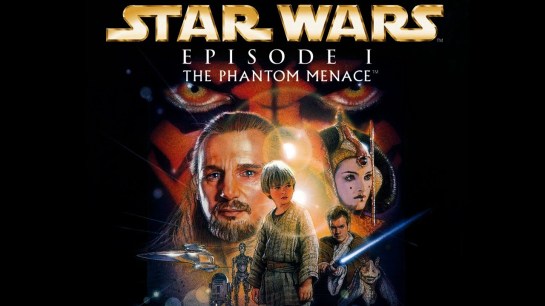
REVIEW: “Star Wars: Episode I – The Phantom Menace”

PHANTOM POSTER

It’s the 20th anniversary of the first film in the Star Wars prequel trilogy. It landed in theaters on May 19, 1999 and fans still debate them today. What better time than now to rewatch and finally review these three fascinating movies.

There is perhaps no better monument to geekdom than the Star Wars franchise. Sure, Marvel’s MCU may have something to say about that, but it was George Lucas’ sprawling epic and personal cash cow that first leapt outside the bounds of movies and into television, novels, comic book series, and tons more. That doesn’t even count the loads of money brought in through toys and other merchandise. You don’t have to be a Star Wars fan to appreciated Lucas’ monumental accomplishment starting back in 1977. “A New Hope” was ground-breaking in regards to its visual style and special effects. The film spawned two intensely popular sequels, “The Empire Strikes Back” and “The Return of the Jedi”. But you already know that.

A jolt hit the Star Wars community in 1993 when Lucas announced he would be making a new trilogy, a prequel to the original three films. They would connect directly to the original trilogy and complete Lucas’ vision for the saga. In 1999, “Star Wars Episode I: The Phantom Menace” was released and I’m not sure any movie has ever released featuring more hype and scrutiny. Fanboys and critics alike looked for cracks and flaws in characterizations and continuity. And rarely did it escape comparisons to the original trilogy. This made judging Episode 1 on its own merits nearly impossible. But Episode 1 had a lot on its plate and while it may be among the weaker Star Wars pictures, after revisiting it yet again I found myself once again caught up in this universe I have always loved.

PHANTOM2

Since Lucas’ intent was to connect the two trilogies into one cohesive saga, I was always curious to see how he would begin his tale. In Episode I, Lucas sets everything in motion by focusing on (of all things) politics as the biggest weapon of manipulation. It’s politics that is first used to kickstart the tragic events that we all know will unfold. Lucas also showcases the Jedi in their prime. We spend most of the time with Jedi Master Qui-Gon Jinn (Liam Neeson) and his apprentice Obi-Wan Kenobi (Ewan McGregor) as they go from political negotiators to planet liberators. A young Natalie Portman plays a Naboo queen who has a major impact on future events. Another key part of the film is the introduction to Anakin Skywalker (played by Jake Lloyd), a young child slave on Tatooine who we know later becomes Darth Vader. Lucas’ focus on Anakin in the first three films ends up reshaping the actual focus of the overall saga, and for my money in a good way.

As a whole, the structure of “The Phantom Menace” is pretty impressive. It was a daunting task to make three films that could directly connect to the beloved original trilogy and do so in a way that’s cohesive and that survives the mythological scrutiny from fans. Episode I does a nice job of putting its key characters in place while only occasionally getting bogged down in its first half table-setting. Rewatching it I was surprised by the narrative layers and interesting world-building. I like the political unpinning and see it as often undervalued and underappreciated.
PHANTOM3

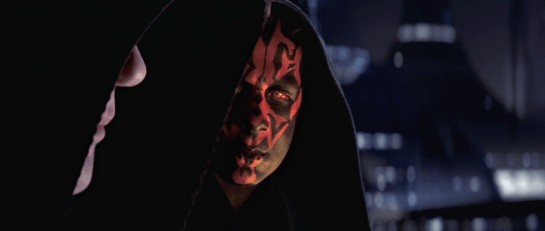
To no surprise several new characters are introduced. Some of them work really well while others, not so much. The dislike of Jar Jar Binks (Ahmed Best) has been well documented and understandable. Lucas overplays his hand by making the character nothing more than comic relief. Every scene and every line of dialogue seems aimed at nothing more than generating silly laughs. The result is an annoying and often distracting presence. On the flip side is the sinister Darth Maul, physically played by Ray Park and voiced by Peter Serafinowicz. Not only is he one of the coolest and most fercious looking Star Wars characters ever but his lightsaber fight with Obi-Wan and Qui-Gon remains a highlight for the entire franchise.

With “The Phantom Menace” Lucas clearly wanted to show off the benefits of the new technology available to him. In many ways it’s a good thing but in other ways it works against the film. There are instances where the movie becomes a barrage of “watch this” CGI moments. There are several scenes that could have easily been left out and the film would have been better for it. But there are also scenes where the special effects present Star Wars in a dazzling new light. The pod race on Tatooine is breath-taking and the space sequences are amazing. Most of the CGI characters share the space well with human actors and fit flawlessly into their environments. It’s certainly a visual step up in many regards but at times a bit overkill (something that becomes clearer in the next film).

Phantom1

And you can’t talk Episode I without mentioning the return of composer John Williams. He delivers yet another incredible score full of call-backs to the original trilogy and with new music that blends beautifully with the old.

“The Phantom Menace” has always been a satisfying Star Wars installment for me and nothing changed during my rewatch. It opens itself up to criticism through some shaky creative choices while other popular gripes don’t hold water (sorry, but I still don’t find Jake Lloyd insufferable). Most importantly it lays some intriguing groundwork, sparks more conversation between the Star Wars faithful, and offers a return to the magical universe I’ve loved since childhood. It may be flawed but it does what’s most important – it looks, sounds, and feels like a Star Wars picture.

VERDICT – 4 STARS

4-stars

REVIEW: “Kodachrome”

kodachrome

For those who aren’t photography enthusiasts or who weren’t around when taking photos was more refined than simply whipping out our phones, Kodachrome was first introduced in 1935 and became one of the earliest color films to be commercially successful. It quickly became the preferred choice for both still photography and cinematography before succumbing to digital in 2010.

So why am I talking about photography? It happens to be a key plot device in the father/son road trip drama “Kodachrome”. In this Netflix Original film Ed Harris plays Benjamin Ryder an accomplished photographer who is dying of cancer. His last wish is to carry some of his recently discovered early film to Parsons, Kansas where the last Kodachrome development lab in the world is preparing to shut its doors. His health doesn’t permit him to fly so he sends his nurse/assistant Zooey (Elizabeth Olsen) to recruit his estranged son Matt (Jason Sudeikis) to drive him.

Kodachrome

That quickly proves to be easier said than done. Matt, a struggling record company executive and recent divorcee, has nothing but disdain for his father who ran out on him and his now deceased mother. But he is eventually persuaded by Ben’s manager (Dennis Haysbert) to make the uncomfortable and at times toxic 2,000 mile trip with his dad and Zooey.

This is writer Jonathan Tropper’s second feature film script (his first being 2014’s “This is Where I Leave You”). He works with director Mark Raso to build a deeply character-centered story around a very familiar premise. The pair lean heavily on their actors, the always reliable Harris and Olsen and the surprisingly strong Sudeikis. The performances are genuine and the writing so sincere that it’s easy to look past the fact that we know where things are heading.

KODA2

Predictably the film deals with the themes of death and reconciliation, but it doesn’t plow a straight and easy row. Ben doesn’t allow much room for sympathy and the story doesn’t provide him with an easy way out of how we (the audience) perceive him. Look no further than his toxic and often bruising back-and-forths with Matt. This is perhaps best realized when they make an unannounced stop to see Ben’s (also estranged) brother and sister-in-law (played really well by Bruce Greenwood and Wendy Crewson). Let’s just say it unearths yet another unflattering side of Ben.

I think some have mislabeled “Kodachrome” by considering it a comedy when I found it to be far from that. It’s equal parts family drama and character study with maybe a pinch of black comedy. From the very start the familiar story structure appears routine and the movie never quite shakes that feeling. But with three well developed central characters and top-notch performances behind them, “Kodachrome” is able to do the single most essential thing in a movie like this – make us care.

VERDICT – 3.5 STARS

3-5-stars

YOUR VOICES: On the Movie Theater Experience

YOUR VOICES

Your Voices is a simple concept created to encourage conversation and opinions between movie lovers. It works like this: I throw out a certain topic. After that I’ll make my case or share my opinions. Then it’s time for Your Voices. Head to the comments section and let me and fellow moviegoers know your thoughts on the topic for that day!

MOVIE THEATER

Today’s topic fascinates me and I’m really curious to read the responses. Steven Spielberg made a few headlines after his latest shot fired at Netflix and movie streaming in general. At the very core of his concern is that streaming is killing the movie theater experience. I wrote a commentary on it that you can check it out HERE.

Since then I’ve been thinking about what we refer to as the ‘movie theater experience’. Since Spielberg’s comments several have shared their positions with me and I was surprised at the amount of apathy towards seeing movies on the big screen. Their takes weren’t without merit. Convenience, cost, location – it all played into some people’s take-it-or-leave-it approach.

While I still don’t side with Spielberg in his push against Netflix, I do agree that there is something special (for me) about the movie theater experience. I love seeing films on the big screen with a great sound system. I love seeing movies in a theater full of strangers but I equally enjoy a lonely matinee screening. For me it still feels very different than watching at home. I’m still pro-streaming for reasons shared in my piece, but I can’t and won’t deny the pull of seeing movies on the big screen.

But now it’s time for Your Voices. Please hit the comments section to share your thoughts.

YOUR VOICESWhat are your feelings about the importance of the movie theater experience?

First Glance: “Midsommar”

MIDsommar

Writer-director Ari Aster grabbed a ton of attention following his fine feature film debut “Hereditary”. It was a stunning jolt of energy for the horror genre. Now we get his much anticipated follow-up and it looks just as creepy but in a much different way. The movie is called “Midsommar” and its full of eerie imagery and a skin-crawling vibe.

The first good move Aster makes is casting the fabulous Florence Pugh. She plays a a young woman named Dani who shares a troubled relationship with her boyfriend played by Jack Reynor. We get hints of mental illness, something “Hereditary” explored deeply. Dani travels with her boyfriend and his loud-mouthed friends to Sweden to attend a folksy, flower-power festival that happens once every 90 years. As you can guess things get pretty….macabre.

“Midsommar” hits theaters July 3rd. Check out the trailer below and let me know if you’ll be seeing it or giving it a pass.

REVIEW: “Extremely Wicked, Shockingly Evil and Vile”

WICKEDposterSMALL

No movie title could better describe Theadore Robert Bundy, a brutal American serial killer and rapist whose vicious crimes spanned seven states throughout the 1970’s. His victims of choice, young females who were drawn to his charisma and good looks. He would eventually confess to thirty murders but the true number could be even higher. The title is a quote from Judge Edward Cowart (portrayed here by John Malkovich) who stated it while sentencing Bundy to death.

Director Joe Berlinger and screenwriter Michael Werwie base their film on The Phantom Prince: My Life with Ted Bundy, the memoir of Bundy’s former girlfriend and fiancé Elizabeth Kendall (played by Lily Collins). It’s set up to be told from Kendall’s perspective and early on the film does a good job of that. But she’s all but lost in the second half, tossed aside as Berlinger’s documentarian roots take over. The finale tries to justify her absence by giving her a ‘moment’, but it’s a little too late.

WICKED1

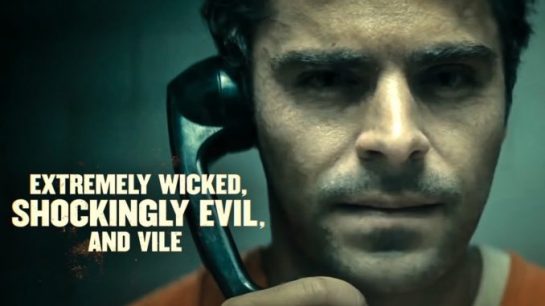
Zac Efron as Bundy was an inspired choice and he manages to deliver a career-best turn. He’s both charming and chilling but the effectiveness of the performance may depend on how much you already know about Ted Bundy. Why do I say that? The film doesn’t dig deep into his crimes like you would expect. With the exception of one quick scene at the end, we never experience the violence. Instead the bulk of the story deals with the accusations, arrests, and courtroom drama. If you know nothing about Ted Bundy it would be easy to see the film as slightly sympathetic in its portrayal.

But that perspective changes if you know the true story of Bundy’s vile, deranged, and grotesque madness. That’s when Efron’s performance shines brightest. He exudes the manipulative charms that attracted young women who would soon be his prey. And it’s those same charms that kept a nation fixated on their television newscasts. And knowing the seductive nature of those charms is what makes Efron (like Bundy) so chilling. It’s only later that the film conveys the true depths of his delusion.

WICKED2

Bundy spent years denying the mounting evidence as a fascinated country watched through an equally obsessed news media. A huge part of the film is Bundy’s constant declarations of his innocence and his quest to win the court of public opinion. He frequently uses his law student savvy to dig himself out of holes with authorities and with Liz. And speaking of Liz, one thing this film does well is showing her as a lost victim of Bundy’s crimes. As news breaks her world is shattered resulting in a descent into alcoholism and depression. It’s a compelling story which is why it’s such a shame when she takes such a noticeable back seat.

This is Joe Berlinger’s second Ted Bundy related project for Netflix this year. The first was the exceptional 4-episode docu-series “Conversations with a Killer: The Ted Bundy Tapes”. Do yourself a favor and see it before watching “Extremely Wicked, Shockingly Evil and Vile”. It will give you the important perspective the latter film has a hard time establishing. And when you have that perspective “Extremely Wicked” is a pretty chilling experience. But without it, I can see people being left scratching their heads.

VERDICT – 3 STARS

3-stars

REVIEW: “The Intruder”


INTRUDERBIG

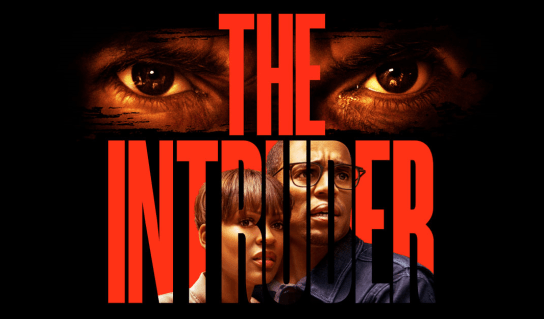
I willingly admit to first being drawn to “The Intruder” for no other reason than watching a wild-eyed, crazy Dennis Quaid. He did a great job selling a nutty, unhinged madman in the trailer. He turns out to be even more convincing (and as a result more fun) in the movie itself.

“The Intruder” is a psychological thriller in the strictest of terms. It doesn’t try to be anything more and it never strays from its genre path. Director Deon Taylor moves the story at a slow boil, moseying his way towards the climax that we all know is coming. Taylor doesn’t try to be too clever or overthink. On one hand that keeps things focused and streamlined. On the other hand it leaves very little room for surprise.

INTRUDER1

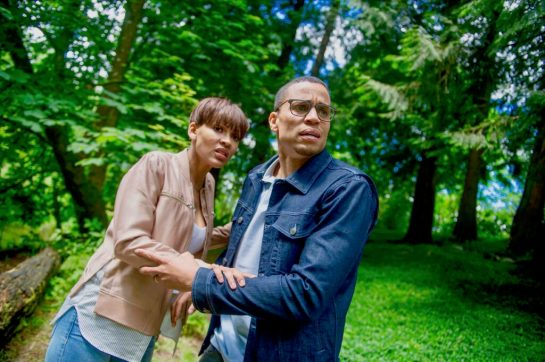
Michael Ealy and Meagan Goode play Scott and Annie Howard, a well-to-do San Francisco couple who buy a palatial estate in rural Napa Valley. The previous owner Charlie (Quaid) reluctantly sells the house despite it being the only home he’s ever none. But following the death of his wife to cancer he puts the house on the market and prepares to move to Florida to be with his daughter.

Scott and Annie’s hopes of leaving the city and finding a quite place to start a family runs into a snag. Charlie just can’t seem to let go of the house. He begins popping up uninvited and takes a particularly creepy liking to Annie. Scott, a bit of a big city snoot, quickly senses something is off with Charlie. Annie, more empathetic and in this case absurdly naïve, feels sorry for Charlie and sees him as sad and harmless.

You can probably see where things are heading. Charlie’s behavior gets weirder and more intrusive, Annie remains oblivious while Scott gets angrier. It all leads to a third act climax that can be fun but predictable.

Meagan Good (Finalized);Michael Ealy (Finalized)

The story is written by David Loughery. Interestingly Loughery’s first screenplay was for “Dreamscape”, a 1984 sci-fi thriller also starring Quaid. Here his script works best when he’s giving the actors room to perform. Quaid benefits the most and he knocks it out of the park. He’s peculiar, eerie and at times uncomfortably convincing. Without question he is given the best material (minus some weird and on-the-nose gun and hunting commentary).

I can see “The Intruder” moving too slow for some audiences and not taking enough chances for some critics. I didn’t have a problem with either. Instead its biggest problem is its utter lack of surprise. Nothing will catch you off guard. Nothing will feel new or fresh. Yet it still manages to be reasonably fun in large part due to Quaid and a role he really sinks his teeth into. The question is will he be enough to win over enough moviegoers?

VERDICT – 3 STARS

3-stars