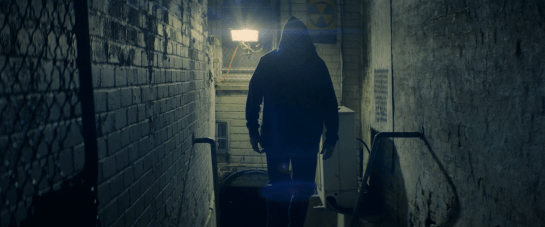
5 Phenomenal Cold Weather Movies

I don’t know about where you are, but August heat in the deep south can be pretty brutal. Maybe that’s why I’ve been thinking about (and in some cases yearning for) cold weather. And since I’ve been behind on Phenomenal 5 lists what better summer topic than cold weather movies? I shouldn’t need to say that the number of worthy movies is large. To narrow it down I’ve focused on films where the cold weather plays a significant part. Also no Christmas movies. Now with so many candidates I wouldn’t call this the definitive list. But there is no denying that these five cold weather movies are most certainly phenomenal.

#5 – “Snowpiercer”
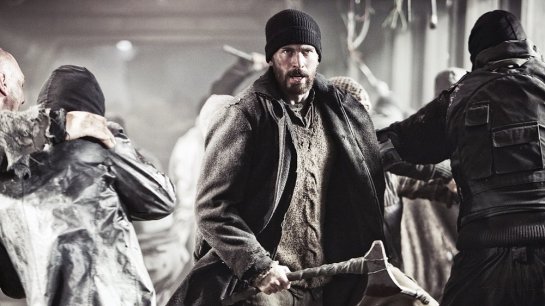
Snowpiercer

In Bong Joon-ho’s dystopian science-fiction thriller “Snowpiercer” cold weather has a rather huge effect. An attempt to end global warming has turned the planet into a uninhabitable frozen wasteland. As a result the remains of humanity are trapped inside a non-stop globe-trotting train. It sounds silly but the themes it wrestles with and the visual style of the auteur behind it make it an easy choice for this list.

#4 – “The Shining”

Shining

It’s kinda hard to imagine this list even existing without including Stanley Kubrick’s beloved “The Shining”. The film’s iconic setting needs little introduction – The Overlook Hotel high up in the Colorado Rockies. Off-season caretaker and struggling writer Jack Nicholson burrows in for the winter, but as he spirals towards insanity his wife and son are trapped inside with him by the frigid elements. And to say things get a little chilly for Jack in the final act is an understatement.

#3 – “Alive”

Alive

Frank Marshall’s 1993 survival drama “Alive” was based on the true story of a Uraguayan rugby team’s fight to survive following their plane crashing high in the Andes Mountains. Isolated and with no ability to communicate, no food and amid brutally cold conditions, the group was pushed to their limits and the life-or-death decisions they made changed them forever.

#2 – “The Thing”

thing

I adore John Carpenter’s 1982 sci-fi horror classic “The Thing” and cold weather definitely has a role to play. Kurt Russell and his team trudge through snow and sub-zero temperatures to uncover answers to a violent encounter at a research base in Antarctica. Parasitic monsters and paranoia take center stage, but the harsh weather is an ever-present threat that makes for the ideal setting.

#1 – “Fargo”

Fargo

When it comes to the #1 pick how could it be anything other than this Coen Brothers gem. “Fargo” is a movie that encapsulates everything that makes the Coens both unique and extraordinary. This bizarrely delicious crime comedy spans from icy Minneapolis, Minnesota to icier Fargo, North Dakota. And while “Fargo” is all about the characters, the cold weather supplies the perfect backdrop.

Now it’s your turn. How about my choices? See something I missed? Please let me hear your picks in the comments section below.

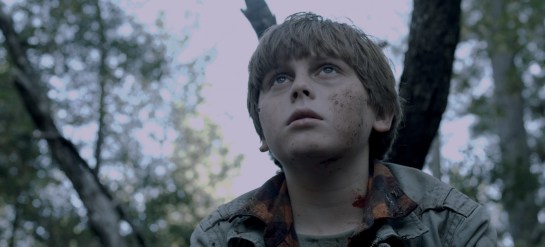
REVIEW: “Come Morning”

COME poster

The very existence of “Come Morning” is a testimony to a love of cinema that transcends the routine Hollywood formula. It’s the same deep appreciation for film and process that independent filmmakers have been showcasing for decades as they plow their own paths to tell their own stories. For writer, director, cinematographer, and editor Derrick Sims that love for the form oozes out of every frame of his movie.

The film’s production is an inspiring story in itself. It was shot in just twelve days and with a crew of only ten people, many of whom tackled multiple roles. Sims shot on location near his childhood home of Kingsland, Arkansas during a chilly early winter and with the bulk of the scenes taking place at night. Yet despite the limitations of an extremely tight budget, Sims never allows for himself to be handcuffed creatively.

COME1

This Deep South suspense thriller is set in 1973 rural Arkansas. Frank (Michael Ray Davis) prepares to take his grandson D (Thor Wahlestedt) out for an afternoon hunt amid the cryptic protests of his concerned wife (Elise Rovinsky). It’s clear to us that her worries are rooted in something deeper than an old man and a young boy going hunting. But Sims doesn’t tell us everything. Instead he wisely allows up to pick up bits of information along the way.

As we stubborn men tend to do, Frank ignores the pleas of his wife and takes D to their spot in the woods. Believing they have shot a deer, the pair discover they have accidentally killed Marion Mitchell (Thomas Moore), a trespassing neighbor with the volatile history with Frank’s family. D wants to call the police, but Frank decides to hide the body deeper into the woods, one of several complex moral decisions with hefty consequences.

As the story pulls Frank and D further from home a sense of dread settles over the film. We know things are not going to go well. As with before, Sims doesn’t spell everything out for us. Instead the backstory takes form through small pieces of conversations and a handful of flashbacks, some more effective than others. And as things steadily grow darker, we watch young D’s innocence being chiseled away in one scene after another.

Come2

Adding to our overall unease is how Sims deftly creates atmosphere and tension. Much of it is through the arresting cinematography. Again, the bulk of the film takes place at night yet despite that potential hurdle Sims is able to create a convincing sense of place. It is especially seen in the landscapes which are visualized in such a way as to be both beautiful and foreboding. And when accompanied by Justin Slaughter’s striking and understated score, it’s all the more effective.

“Come Morning” tells a simple yet compelling story while pulling us into a place shrewdly realized through Sims’ camera. And despite being patient with its reveals, the film maintains a crisp and economical pace throughout within its taut 80 minute frame. There are instances where the money constraints can be felt, but the film shows that even miniscule budgets can’t overthrow a good story especially when it lies in the hands of a confident filmmaker with a clear vision.

“Come Morning” is available on Amazon Prime. Give it a look and tell me what you think.

VERDICT – 4 STARS

4-stars

REVIEW: “Eighth Grade” (2018)

EightPoster

As I prepared to see “Eighth Grade” a sense of terror coursed throughout my body. I was genuinely excited to see the widely adored teen drama while at the same time dreading the very thought. Why all the tension you ask? I’m a father of a wonderful young daughter who is about to enter…you guessed it…the eighth grade. And if the testimonies of the film’s bruising authenticity were true, I knew it would hit close to home.

This is the first feature film for writer-director Bo Burnham. At the risk of exposing my glaring ignorance of modern pop media, I had to do a search to find out more about him. Turns out Burnham has had an interesting rise to fame. He first “went viral” on YouTube in 2006 and his popularity quickly skyrocketed. Now in addition to being a musician, comedian, and actor, Burnham is an intriguing young filmmaker worth keeping your eye on.

eIGHT2

“Eighth Grade” is a striking debut that reveals an astute perspective on middle school life. It’s a movie that I can see speaking to different people in a variety of ways. I can see it profoundly effecting those who find themselves in the lead character’s shoes. I can see it enlightening other groups to the struggles of fellow students. I can see it opening the eyes of parents to the complexities of their kid’s point of view while also giving kids a window into the heartfelt struggles of their parents.

The beating heart at the center of “Eighth Grade” is 15-year-old actress Elsie Fisher. While she did voice work in the first two “Despicable Me” movies, this is Fisher’s first big role but you would never guess it. She tailors a performance that is true and organic in every detail. Each insecurity and anxiety feels strikingly authentic. She’s truly a marvel, even a bit daring in her unflinching commitment to the role.

Fisher plays Kayla Day, a young teen navigating the final week of eighth grade. Middle school was tough, not near what she hoped it would be, but with a timid optimism she looks forward to the next stage in her life. Much to the chagrin of her patient and well-meaning single father (played by Josh Hamilton in just the right key), Kayla soaks her herself and her problems in the world of social media. She fills her follower-less YouTube channel with self-help advice videos in part because of her inherent kindness but also as a subconscious means of self-motivation.

Burnham keenly has his finger on the pulse of the weird middle school years where teens see everything changing both inside and out. It’s even tougher for a kid like Kayla who doesn’t fit neatly within the crude and often ugly social structure we have allowed and have often reinforced. She consistently rejects her own advice to “just be yourself” with awkward attempts to buddy up with the popular crowd. We know it won’t go well. On the flip-side is her relationship with her hapless father, unshakably loving but ill-equipped to handle his daughter’s swirl of emotions. The father/daughter tensions are portrayed with a clear-eyed honesty.

eighth1

I was also drawn to Burnham’s use of perspective. You could be tempted to see his camera as mean-spirited and unsympathetic. It routinely highlights the droop of Kayla’s shoulders, the small rolls around her belly, her scattered acne which clashes with the pristine complexions of the in-girls. But that’s not what’s happening here. The bulk of the film is seen through Kayla’s eyes and often reflects how she sees herself as well as others. Take when she gets an adoring ‘puppy love’ glimpse of the class bad boy (Luke Prael). A hysterical bang of musical chords accompanies his studly slow motion strut across camera. But as with many things, that perspective changes over time.

“Eighth Grade” doesn’t pave an easy path for its lead character. Kayla’s struggles are realistic, relatable and heartbreaking. You could almost call it relentless if not for the welcomed moments of levity strategically sprinkled throughout. At the same time, Burnham offers an insightful critique of social media and internet identity, the very thing that launched his career. Yet beyond the slew of Snapchat and selfies is a strong message about believing in yourself and moving forward. That’s something I think we all need to hear.

VERDICT – 4.5 STARS

4-5-stars

REVIEW: “The 12th Man” (2018)

12poster

Some brief opening text lays out the setting for director Harald Zwart’s astounding “The 12th Man”. Nazi Germany occupied Norway on April 9, 1940. Three years later in Scotland British forces trained Norwegian soldiers to carry out sabotage missions in their homeland. On March 24, 1943 twelve Norwegian resistance fighters were sent to target German airfields in Operation Martin Red. Only one would come back alive.

This Norwegian historical thriller is based on the extraordinary true story of Jan Baalsrud, the lone survivor of that doomed operation. The film is based on a biography by Tore Haug and Astrid Karlsen Scott. It’s not the first movie based on a book of Baalsrud’s life. The 1957 drama “Nine Lives” received an Oscar nomination and remains a highly regarded picture.

12one

The grueling role of Baalsrud is played by Thomas Gullestad. Zwart starts quickly with Baalsrud and his team crawling out of the icy arctic waters onto the northern shores of Norway amid a hail of bullets. We learn that a costly mistake blew their cover and a German vessel attacks as they approach the mainland. Forced to scuttle their shot-up fishing boat, the twelve struggle ashore where German troops await them. Eleven are captured, Baalsrud escapes.

One of the first things I noticed was Zwart and cinematographer Geir Hartly Andreassen’s striking perspectives. Their camera placements and the fluidity of its movements offer one penetrating visual after another. Then you have the shots of the stunning Norwegian landscapes which in context are both beautiful and ominous. These images add a menacing dimension as the wounded and battered Baalsrud trudges through the frigid snow and ice.

“The 12th Man” spotlights Jan Baalsrud’s resilience as he makes his way towards neutral Sweden’s border, fighting treacherous terrain, excruciating cold and the doggedly determined Gestapo. But as he slowly succumbs to snowblindness, hypothermia, and gangrene the true crux of the story comes into focus. The film is just as much about the people he meets throughout his harrowing journey. Jan’s strength and heroism is matched, often exceeded, only by the Norwegian patriots helping him at every step – civilians routinely risking their lives to save his. In many ways they form the emotional core of the movie.

12two

Equally fascinating is when the movie shifts focus to that of a Gestapo officer named Kurt Stage (played by Jonathan Rhys Meyers). No one has ever escaped Stage’s pursuit and he takes Baalsrud’s flight personally. He persistently hunts Jan rejecting the skepticism and needling of an ambitious fellow officer (Martin Kiefer). Myers offers a charismatic antagonist pushed more by ego and obsession than duty.

Some may say the film’s biggest surprise is in Harald Zwart’s direction. Perhaps known more for his misfires (“Agent Cody Banks”, “The Pink Panther 2”, “The Karate Kid” remake), but don’t let that dissuade you for a second. His portrayal of this unbelievable true story is riveting both visually and narratively. Whether he is capturing Jan Baalsrud’s intense and sometimes brutal attempts at survival or creating genuine moments of levity with the men and women risking everything to aid him. It makes for truly inspirational cinema.

VERDICT – 4.5 STARS

4-5-stars

REVIEW: “Chappaquiddick”

ChappPoster

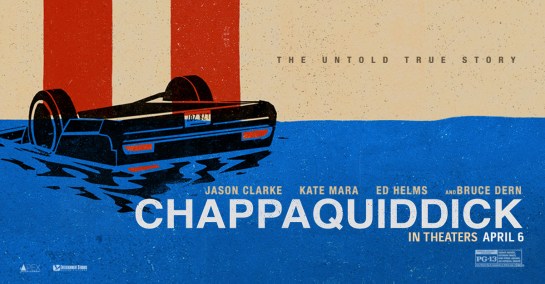
On July 18, 1969, Massachusetts Senator Edward “Ted” Kennedy left a party on  Chappaquiddick Island with Mary Jo Kopechne. A short time later Kennedy drove his mother’s 1967 Oldsmobile off Dike Bridge and into Poucha Pond. Kennedy escaped but Kopechne was trapped in the submerged vehicle. Kennedy would leave the scene and not report the accident until the next morning after the car and Kopechne’s dead body had been discovered.

“Chappaquiddick” from director John Curran is the latest look into the scandal that was forever a stain on the legacy of Ted Kennedy. Writers Taylor Allen and Tyler Logan scoured over transcripts featuring key players including Kennedy himself speaking under oath. Leaning heavily on court records and testimonies along with the indisputable facts of the case allowed for their script to be more than conspiracy theories and character assassination as a few have claimed.

Chapp1

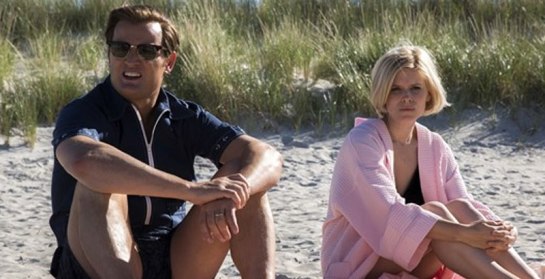
Jason Clarke gives not only one of the best performances of the year but one of the most surprising as Ted Kennedy. You immediately notice how distinctly in tune he is with his character. He manages a very measured performance, playing Kennedy in a way that never projects judgement. He portrays Kennedy as a complex man. At times immature and naive. Other times self-serving and calculated. But in the few moments where he is forced to emotionally reckon with what’s happened Clarke doesn’t spell out the genuineness of the remorse.

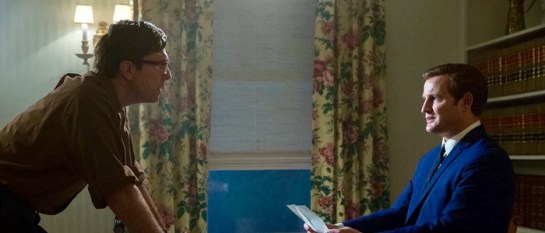
Curran moves the story along at a good pace, quickly getting to the infamous Chappaquiddick incident then navigating the decisions that immediately followed. You could call Ed Helms the moral conscious of the film. He plays Kennedy’s cousin Joe Gargan who along with US Attorney General and Kennedy confident Joe Markham (Jim Gaffigan) are the first people Teddy contacts after the wreck. They push Kennedy to report the accident to authorities, something history informs us never happened until the next day.

A big hunk of the film focuses on the aftermath, specifically political damage control. As Kennedy wages an internal struggle with telling the truth, or at least their “version of it”, an entourage of lawyers and analysts diligently work to quell any public outrage and protect the family name. There are some really good scenes as they hammer out strategies and navigating Kennedy’s sketchy timeline of events.

Chapp2

Attempts at empathy can be found in the few scenes of Kennedy family drama but unfortunately these are easily the movie’s weakest moments. Bruce Dern dials it up as Kennedy patriarch Joseph P. Kennedy Sr. who was paralyzed and wheelchair bound following a severe stroke. The filmmakers leave no ambiguity in Kennedy Sr’s lack of confidence in his son and they present the strained relationship as a heavy weight Teddy’s neck. But where most of the film comes across as strikingly authentic, the handful of scenes between Clarke and Dern feel too contrived. One line early in the film is broader but more effective at conveying the tension. An interviewer asks Ted “What’s it like walking in a shadow?” He promptly ends the interview and walks away.

The true cleverness of “Chappaquiddick” is seen in how it moves with Kennedy’s evolving story in a way that by the end of the film we are still unclear on what’s the truth. It also presents a slice of the Kennedy mystique within American culture. When the partygoers on Chappaquiddick Island are told about the accident the next morning and about the death of their friend and colleague, the first words of response are “What do we need to do now? What do we need to do to help the Senator?” It’s as if Mary Jo Kopechne lost out to the Kennedy family name. In a very perceptive way this movie finally gives her a voice.

VERDICT – 4 STARS

4-stars

REVIEW: “You Were Never Really Here”

NEVERposter

With “You Were Never Really Here” writer-director Lynne Ramsay (“We Need to Talk About Kevin”) makes a forceful statement. Not just to her own individual talents as a filmmaker, but to the female perspective and the powerful jolt it can give a genre. By genre, I would call her latest film an action/revenge thriller although even giving it a label feels like a disservice to Ramsay and the plethora of cool ideas she is working with.

Ramsay adapts “You Were Never Really Here” from Jonathan Ames’ 2013 noir novella. At only 95 pages, the novella is both brisk and brutal, an equally fitting description of Ramsay’s movie. Not a second of the taut, economical 90 minutes is wasted and within its framework is a level of craftsmanship and unique storytelling prowess that leans heavily on mood and immersing us through our senses.

NEVER1

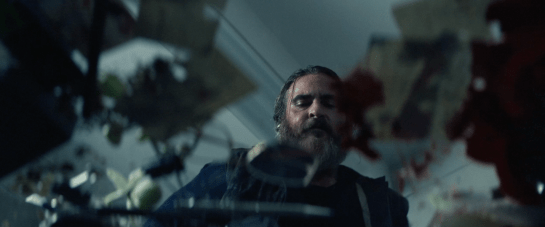
Look no further than the opening scene, a tightly edited collage of sound and images that introduces us to Joe (a burly and bearded Joaquin Phoenix). We learn he is a hired gun who specializes in retrieving the young daughters of wealthy, prominent parents from sex trafficking rings. He works off the grid and in his own moral mélange of brutality and compassion. Ramsay only feeds us bits but Joe’s scar-riddled body and glazy worn eyes speak volumes.

When not embedded in New York’s sordid underbelly, Joe cares for his elderly dementia-stricken mother (played by Judith Roberts). Phoenix, the definition of committed and uncompromising, seamlessly moves back-and-forth between these two contrasting worlds. In one scene he’s wiping off a blood-soaked hammer and shortly after polishing silverware and singing a song with his mother. And when Ramsay pushes us deeper into Joe’s head we witness suicidal impulses and traumatic flashbacks to his childhood and military service. They come in startling quick bursts making them all the more unsettling.

Things get even uglier when Joe takes a job to find a State Senator’s daughter (Ekaterina Samsonov) only to run face-first into unexpectedly deeper levels of depravity and corruption. The story grows darker (there is rarely any light to begin with) and the bloodshed amps up. But Ramsay doesn’t revel in the violence nor exploit it for effect. Joe, her principle subject, is a child of violence and his dark psychological journey is often defined by it. While at times graphic, most of the killing happens just off camera or from strategic perspectives – a cracked mirror on a ceiling or through surveillance cameras. It certainly doesn’t mute the savagery.

Never2

Ramsay’s style of filmmaking has a fascinating synergy with this material. She often tells her stories through vivid imagery and pulsing sound design instead of a more traditional narrative structure. This is what keeps “You Were Never Really Here” from falling in with more conventional genre pictures. Her camera works like a gritty kaleidoscope, creating and maintaining an essential mood and intensity. Jonny Greenwood’s menacing score is filled with eerie strings and synthesized chords as if pulled from the cracked psyche of its lead character. It all works together in a twisted hypnotic harmony.

At the 2017 Cannes Film Festival “You Were Never Really Here” received a seven-minute standing ovation. Awards went to both Ramsay (Best Screenplay) and Phoenix (Best Actor). I understood why after first seeing it. But it was my second viewing that I was able to fall in with the film’s unique rhythms. And while Joe isn’t necessarily a character you want to spend time with nor is this a comfortable world to be in, Lynne Ramsay keeps our eyes glued to every frame.

VERDICT – 4.5 STARS