

Krzysztof Kieślowski was at a pivotal point in his life while making his renowned Three Colors trilogy. He had determined that these would be his last movies and at the conclusion of his trilogy he announced it to the world. It was 1994 and Kieślowski was at the pinnacle of his career. Yet he stepped away from filmmaking with the intent of sitting at home and smoking while never ever visiting a cinema again. Sadly, Kieślowski would die two years later at the age 54. A true artist driven by his own creative rules right to the end.
Kieślowski’s Three Colors trilogy couldn’t be a better send off – a testament to a visionary’s passion for creating movies that burrow deep into the human elements that connect us. Kieślowski once said he preferred “touching on subject matters and situations which link people, and not those that divide people.” While he often spoke to the social and political climates of his times, they were too divisive and they were rarely his focus. He later said “Feelings are what link people together.” That very idea permeates ever frame of his Three Colors movies.
The trilogy’s name is taken from the three colors of the French flag – blue, white, and red. Each of the flag’s colors represent a particular ideal. Blue stands for liberty, white for equality, and red for fraternity. Each movie represents one of these ideals but on a human level and never within a political framework. Politics tend to divide and that was of no interest to Kieślowski. He sought to examine these principles within the confines of individual lives and all of the love, sorrow, pain, and humor that comes with living. These are feelings and emotions that we all know and can connect to. All three films, while able to stand on their own, do connect in subtle and sometimes surprising ways.

For much of the film it can be difficult to find the liberty in “Blue”, the first movie of Kieślowski’s Three Colors trilogy. In fact much of the film seems to be exploring a form of bondage – to grief, to pain, to the past. But I suppose it’s true what they say – liberty/freedom is much sweeter once you’ve tasted bondage. In “Blue” liberty as a theme is present, but much more as a desire than a reality.
The entire trilogy was written by Kieślowski and trusted collaborator Krzysztof Piesiewicz. Their first film focuses on a woman named Julie (played by the sublime Juliette Binoche) who is dealing with the death of her famous composer husband and young daughter from a car accident. Weighed down by the burden of her grief, Julie seeks to cut all ties with her past. She puts the family home up for sale, disconnects from the people they knew, and even destroys her husband’s final unfinished commissioned score. The only thing she keeps is her daughter’s sparkling blue mobile.
Julie wants to live as someone with no past. She rents an apartment in a corner of Paris with hopes of living in anonymity. But every unintended new human connection inevitably brings her closer to the past she is trying to escape. It’s here that Julie must decide whether to burrow deeper into her hole of isolation or unearth her sorrow and pain in hopes of breaking free from their hold on her. Kieślowski doesn’t make this an easy decision. It becomes even more complicated when secrets of her husband’s past surface.
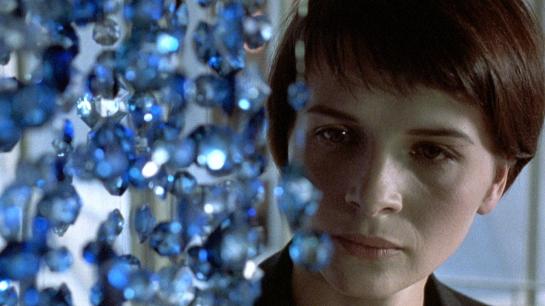
The cinematography was handled by Sławomir Idziak who shot most of Kieślowski’s early work. As you can guess Idziak finds many ways to incorporate the color blue into his shots but they never feel meaningless. Like skillful craftsmen he and Kieślowski use the tones to great effect to accentuate feeling and highlight mood. It’s both beautiful and evocative. You will also notice a plethora of other crafty visual techniques that are constantly adding new perspective.
Kieślowski was all about examining human nature and no detail was too small or without meaning. “Blue” moves steadily and confidently, traits that are no doubt reflections of its director. It’s an intimate meditation centered by a bold, piercing performance from Binoche who speaks little but tells much through her revealing outward expression. As we observe the unfolding emotional layers of “Blue” we are given plenty to soak in. And it doesn’t take long before Kieślowski has us invested in his main character and the compelling themes finally brought to the surface most notably the aforementioned idea of liberty.
VERDICT – 4.5 STARS














 Keith & the Movies