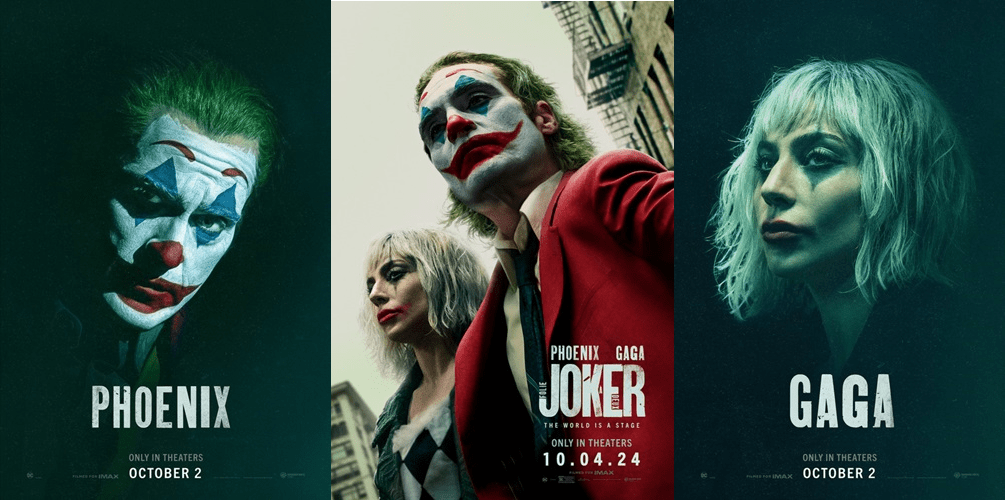
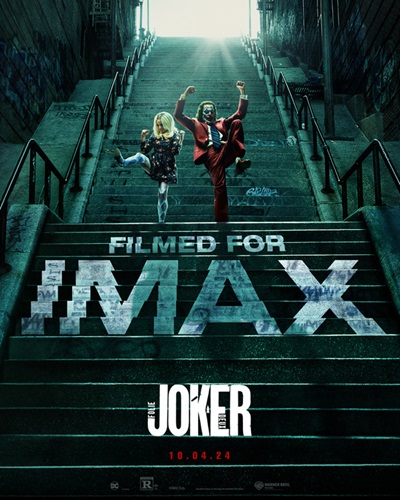
“Joker: Folie à Deux” is only a couple days away and it looks to be at least as polarizing as the first film. Director Todd Phillips reunites with star Joaquin Phoenix in this direct follow-up to the wildly successful first film. Lots of questions have been asked from people wondering what to expect. Wherever you are with the movie, the film’s promotion has been pretty great, especially the series of posters released over the past year.
Below are some of the best posters from Warner Bros. Pictures. Check them out and let me know what you think.
“Joker: Folie à Deux” premiered last month at the Venice International Film Festival. It opens everywhere Friday, October 4th exclusively in theaters.
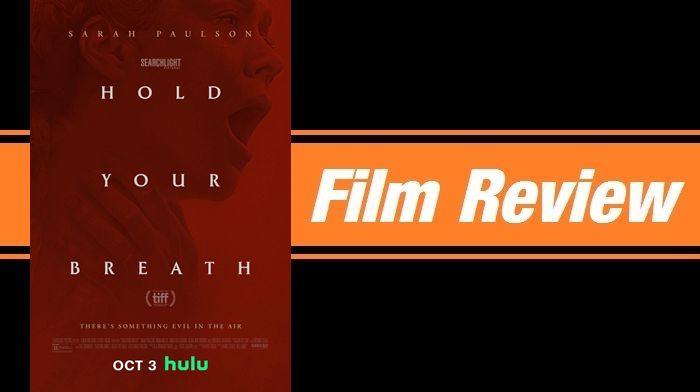
The directing duo of Karrie Crouse and Will Joines make impressive feature film debuts with “Hold Your Breath”, a psychological horror-thriller set during the devastating Dust Bowl of the 1930s. Anchored by a wrenching Sarah Paulson lead performance, “Hold Your Breath” combines devastating elements from American history with familiar genre tropes to form a well-made and thematically rich movie. It’s a little too ambitious, but I appreciate its big swings.
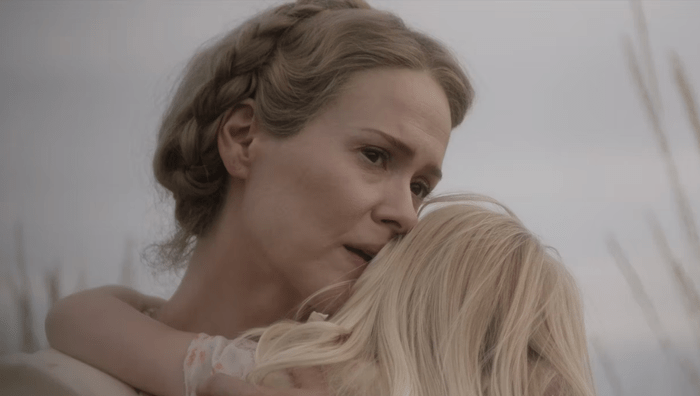
Set in 1933, Paulson plays Margaret, a mother with two daughters struggling to get by in the dust-ravaged Oklahoma panhandle. With their farmland decimated, Margaret’s husband Henry has been forced to take a far-away job in hopes of earning money to send back home. That leaves Margaret, her oldest daughter Rose (Amiah Miller), and her hearing-impaired youngest, Ollie (Alona Jane Robbins) to scrape by with one old cow, no crops, and no way to leave their situation.
Image Courtesy of Searchlight Pictures
Margaret loves her daughters and does everything in her power to protect and provide for them. She’s also seen as a stabilizing presence in their small rural community. But deep down she has issues of her own that torment her. She’s been haunted by the same reoccurring dream since losing their first child to Scarlet Fever. And as their circumstances get worse, Margaret begins to lose her grip on reality. Or is there something else at work – something malevolent and sinister.
That burning question drives much of “Hold Your Breath”. There’s a lot going on in the story (written by Crouse) narratively, thematically, and psychologically. There are constant threats – some real and others imagined. There are the howling dust storms, children getting sick, potential starvation, and even the sudden appearance of a mysterious preacher named Wallace (Ebon Moss-Bachrach) who claims to be a friend of Henry’s. It all leads to an intensifying sense paranoia that culminates in a harrowing and heart-rending final act.
A key strength of the film is found in its recreation of the Dust Bowl era. Crouse and Joines shot in several locations around New Mexico in order to capture the stark barren landscapes of 1933 Oklahoma. They’re just as attentive when it comes to conveying the punishing conditions. The dust storms are ferocious and you can almost taste the grit in your mouth and feel the wind-blown sand stinging your eyes.
Image Courtesy of Searchlight Pictures
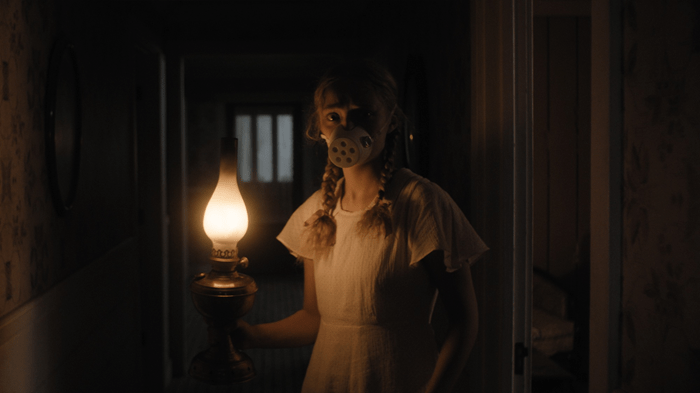
Then you have the film’s meticulous attention to details. It’s seen most in the terrific costume and production designs. But also in seemingly small things, such as Margaret using strips of fabric to seal their house from the sand. Or the masks they sometimes wear outside that are plucked directly from old archived photos. It all adds a heavy layer of realism to a movie than (especially in the second half) leans heavy on the psychological.
Thematically, “Hold Your Breath” has a lot it’s trying to say. Motherhood, grief, societal pressure, and isolation are just some of the topics that Crouse and Joines touch on. Some of them are more present than others but none are deeply explored – a side-effect of having too much on their minds. But the movie has some notably tense and unsettling moments, most seasoned by the eerie tones of composer Colin Stetson. And the committed performances from Paulson and Miller add a resonance that gives the movie its emotional kick. “Hold Your Breath” premieres October 3rd on Hulu.
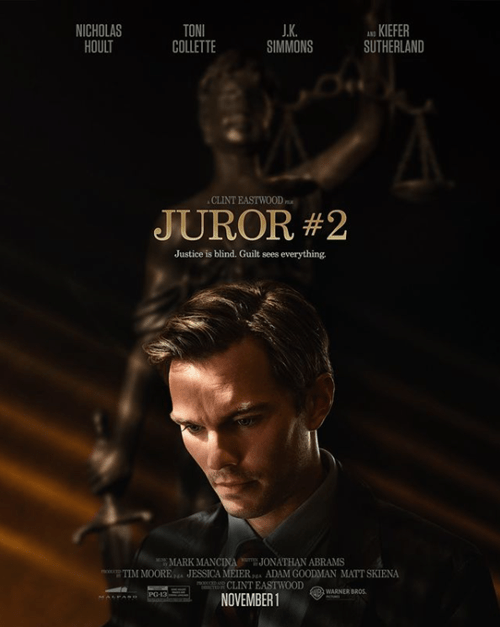
Motion picture icon Clint Eastwood returns with his highly anticipated thriller “Juror #2”. His incredible career has seen him star in countless big screen classics. But he’s also flourished behind the camera. “Juror #2” marks the 40th film directed by the 94-year-old legend. Written by Jonathan Abrams and featuring a terrific cast, Eastwood’s latest has the look of a potential awards season contender. It would be a fitting result for what is rumored to be the final film of his storied career.
The new trailer offers us a tantalizing taste of what we’re in for. The film stars Nicholas Hoult playing a family man caught in a fascinating moral dilemma. He’s been chosen as a juror for a high-profile murder trial but quickly discovers that he may have more of a connection to the case than he imagined. Toni Collette, J.K. Simmons, Zoey Deutch, Chris Messina, Kiefer Sutherland, Cedric Yarbrough, and Leslie Bibb round out the sterling cast in what has quickly turned into one of my most anticipated movies of the year.
“Juror #2” premieres at AFI Fest on October 27th and will open in select theaters on November 1st. Check out the trailer below and let me know if you’ll be seeing it or taking a pass.
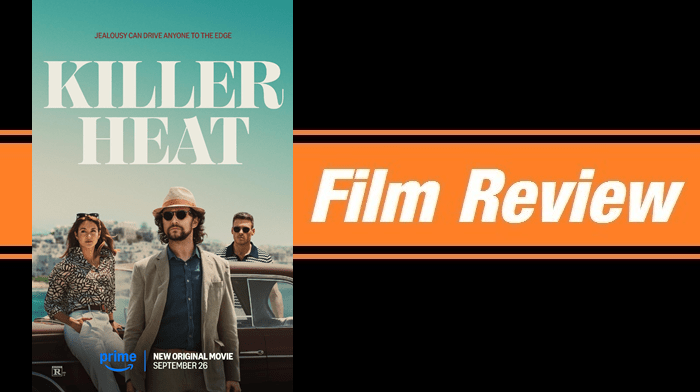
With “Killer Heat”, director Philippe Lacôte takes crime novelist Jo Nesbø’s short story, “The Jealousy Man” and spins it into a old-fashioned film noir complete with a hard-boiled private investigator, a mysterious femme fatale, cynical voiceover, moral ambiguity, and of course a possible murder. This decent adaptation from screenwriters Roberto Bentivegna and Matt Charman doesn’t add anything new to the classic noir formula. But it does capture much of what makes these movies so appealing.
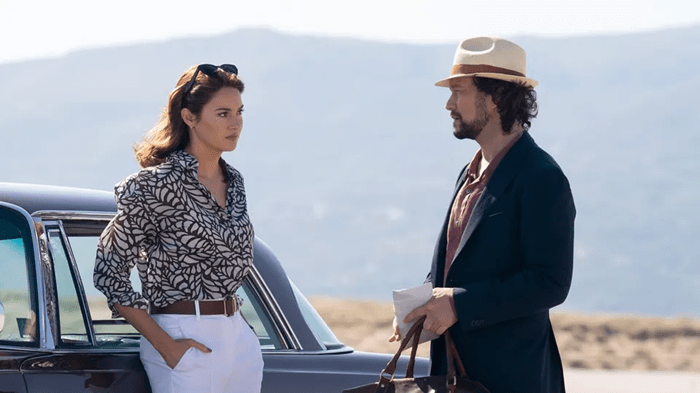
“Killer Heat” features Joseph Gordon-Levitt playing Nick Bali (a very film noir appropriate name). He’s our down-on-his-luck private eye with a curly mop of hair packed under a tan Panama hat. Nick is a bit unkept and you can imagine the smell of booze that enters every room before he does. But he has keen instincts, a photographic memory, and is a stickler for details. It’s what makes him a good detective in spite of his flaws.
Image Courtesy of Amazon Prime Video
Nick arrives on the island of Crete at the request of Penelope Vardakis (Shailene Woodley), a member of a wealthy and powerful family who run the island through violence and corruption. Just recently Penelope’s brother-in-law Leo (Richard Madden) was killed while free solo climbing an area cliff. The local police (who are on the Vardakis family payroll) were quick to rule it an accident. But Penelope isn’t convinced. So she secretly hires Nick to determine what really happened.
It doesn’t take long before we’re introduced to some of the key players in the mystery via Nick’s investigation. First is Elias (also Richard Madden), Penelope’s husband and the late Leo’s twin brother. There’s Audrey (Clare Holman), the Vardakis family matriarch. And there’s a local cop named Georges (Babou Ceesay) who may or may not be trustworthy. Of course there are several other pieces to the puzzle that I won’t spoil, but they’re nicely woven into Bentivegna and Charman’s script.
The mystery itself throws enough curveballs to keep things interesting while the pacing ensures that we never slow down enough to overthink things. Lacôte does a good job mixing in some clarifying flashbacks. They shed some much-needed light on the icky pasts of the Vardakis clan while also revealing Nick’s own rocky history. Put together, all of it gels into a fairly lively crime story but not a particularly inventive one. When the revelations eventually come, none really catch us by surprise.
Image Courtesy of Amazon Prime Video
“Killer Heat” certainly has the look with Lacôte and DP Andrew Dunn shooting on location around sun-soaked Crete. It also has the cast, with Gordon-Levitt managing to be a serviceable gumshoe and Woodley a suitable femme fatale. The people they play resemble types more than well-rounded characters which strips them of any nuance or intrigue. Nevertheless the performances are solid all around.
What this old-fashioned noir lacks most is old-fashioned tension. We gets hints of it here and there, especially as Nick begins to wear out his welcome. But the heat never gets above room temperature nor does the mystery grip us the way it needs to. And Nesbø’s underlying theme of jealousy gets lost in all the dot-connecting and box-checking. Still, the film holds our interest throughout its fleet-footed 90 minutes, and you could do a lot worse than hanging out in the Greek Isles with JGL. “Killer Heat” is now streaming exclusively on Prime Video.
George C. Scott stars and makes his big screen directorial debut in “Rage”, a film inspired by true events known as the Dugway Sheep Incident. In the real-life account which took place in 1968, over six thousand sheep were killed on ranches near the U.S. Army’s Dugway Proving Ground in Utah. Dugway was a military facility established in 1942 to test chemical and biological weapons. Many believe a nerve agent escaped Dugway resulting in the sheep deaths. Clear culpability was never established but sweeping changes came in the aftermath.
“Rage” pulls from the true account and creates a gripping thriller built around the growing middle class distrust towards the United States government. It tells a smart, incisive, and cutting story that pulls no punches in its indictment of military and medical collusion and corruption. Meanwhile Scott’s direction is patient yet laser-focused, leaving no doubts about his convictions and keeping us honed in from the movie’s heartfelt start straight through to its violent finish where the film really earns its title.
Image Courtesy of Warner Bros. Pictures
By 1972 Scott had already established himself as a terrific actor. In fact he was just coming off of back-to-back Academy Award nominations for 1970’s “Patton” and 1971’s “The Hospital” (he won for “Patton” but infamously refused to accept it). “Rage” featured yet another of the grounded and organic performance the commanding Scott was known for. In it he plays Dan Logan, a widowed sheep rancher in rural Wyoming.
One afternoon Dan decides to take his 12-year-old son Chris (Nicolas Beauvy) camping near the edge of his property. While setting up their tents they notice a helicopter flying low to the ground. It’s a bit out of place – enough to grab Dan’s attention but not enough to worry him. After a great evening of father-son bonding the two call it a night. But the next morning, Dan wakes up to find Chris unconscious with a nose bleed. Understandably shaken, Dan picks up his boy and makes a mad run to his truck, passing several dead sheep on the way.
At the hospital Chris is put in quarantine while Dan is admitted for testing despite feeling fine. Their longtime family physician and friend, Dr. Caldwell (Richard Basehart) refers them to a young medical specialist named Dr. Holliford (Martin Sheen) who seems to recognize Chris’ symptoms but doesn’t offer many answers. Over time the doctors go from keeping news of Chris’ worsening condition from Dan to straight-up lying about it altogether.
Image Courtesy of Warner Bros. Pictures
The movie doesn’t make any effort to hide the truth behind what’s actually happening. In fact an early scene lays everything out. In it we see military leaders at a nearby base secretly discussing what went wrong during their recent test of a new nerve agent. They assess the potential damage done in the neighboring communities and immediately begin planning damage control. At the same time, they shamelessly see Dan and Chris as guinea pigs and their chance to study the nerve agent’s effects on humans.
The film’s third act sees the proverbial pot boil over as the deceit, misinformation, and posturing push Dan over the edge. It’s here that the movie takes a dramatic turn, but Scott (the director and actor) doesn’t overcook the ending. And he manages to retain our sympathies even as his character crosses one line after another. It’s a good punctuation mark for a movie that is essentially a lacerating critique wrapped inside a smart slow-burning thriller.
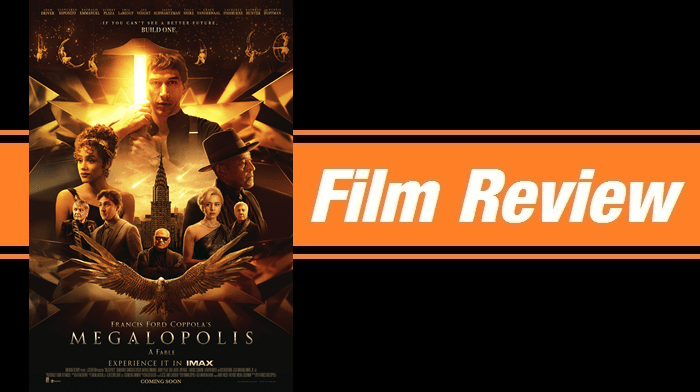
It looks as if the most polarizing movie of 2024 may be from one of the greatest American filmmakers of all-time. Five-time Academy Award winner and New Hollywood legend Frances Ford Coppola lets his cinematic imagination run wild in “Megalopolis”, a hard to categorize but altogether captivating experience that is sure to be unlike anything else you’ll encounter in a movie theater this year.
Coppola’s initial idea for “Megalopolis” had its genesis way back in 1977. Six years later he began putting together a script. By 1989 Coppola was scouting locations and planning shoots. But the film was eventually shelved. It was revived in 2001 with Coppola going as far as doing table reads with potential actors. But after the 9/11 terror attacks, the movie was once again put on hold. During the years that followed, Coppola determined to self-finance his movie. In 2019 he put up $120 million of his own money and after navigating the COVID-19 pandemic, production finally began in 2021.
“Megalopolis” is as demanding as it is rewarding. It’s a movie that doesn’t allow itself to be easily consumed like the usual big screen product. There is nothing routine about its style, structure, or story. Rather it’s made to be experienced, absorbed, considered, and reconsidered. It’s meant to sweep you away with its audacity and grandiosity while provoking you to wander outside of your ideological comfort zone. It means to impress you with its extravagance, perplex you with its incoherence, yet stimulate you with its artistic fervor and deep-rooted convictions.
Image Courtesy of Lionsgate
It’s vital that you don’t venture into “Megalopolis” expecting conceptual precision or even narrative cohesion. Don’t look for an involving plot, well-defined stakes, or even one singular vision. It’s a movie that thrusts us into the mind of its creator where we witness a plethora of profoundly personal ideas that bounce off each other in fits of indulgent madness. Coppola knows all of this and apparently foreknew the responses. It’s probably why he later added the subtitle “A Fable” – to help shape expectations and curb misconceptions.
At the same time, “Megalopolis” is very much an imaginative tour de force that sees Coppola working free of anyone’s rules, including his own. It’s an operatic tale full of pseudo-Shakespearean prose designed to be Coppola’s direct voice to us. Through his characters (some avatars and some metaphors) he shares his fears, pleads his cases, issues dire warnings, and plants seeds of hope. Meanwhile his astounding visual language reveals someone who is just as concerned with saving cinema as he is with saving civilization.
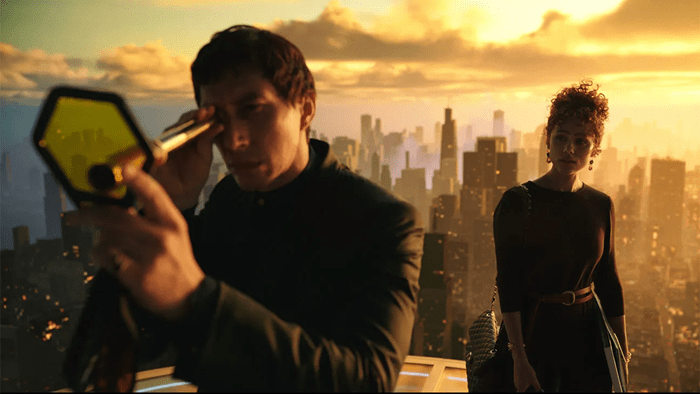
Coppola’s story is set in the collapsing metropolis of New Rome, a fascinating retro-futurist fusion of New York City with ancient Rome. It’s a sprawling place where poverty, crime, and corruption has crushed a once thriving city. Visionary architect Cesar Catilina (played by a spellbinding Adam Driver) is called upon to reimagine and transform a huge segment of New Rome. He calls his audacious city-within-the-city Megalopolis. It’s envisioned as a prosperous state-of-the-art utopia; a pure architectural and technological wonder, unmatched in its beauty and abundance.
Image Courtesy of Lionsgate
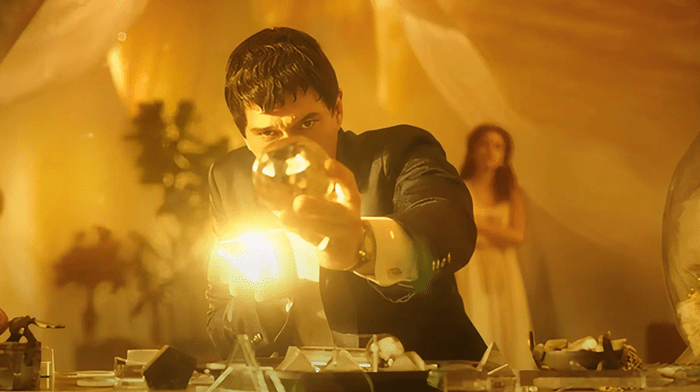
To realize his vision, Cesar has discovered a powerful and imperishable material called Megalon. Its source is a mysterious story all its own, but it grants Cesar the ability to manipulate space and time. There are those who understandably fear its power. But Cesar has learned how to harness it in ways that allow him to bring to life the magnificent constructs from his mind.
But Cesar immediately gets pushback from New Rome’s mayor, Franklyn Cicero (Giancarlo Esposito) who is perfectly content with the status quo. Franklyn vehemently opposes what he perceives to be Cesar’s vanity project, preferring more practical means of renewal such as building a new casino (because that’s sure to put a spiraling city back on its feet). The power struggle between Cesar and Franklyn sets up a central conflict that drives much of the drama.
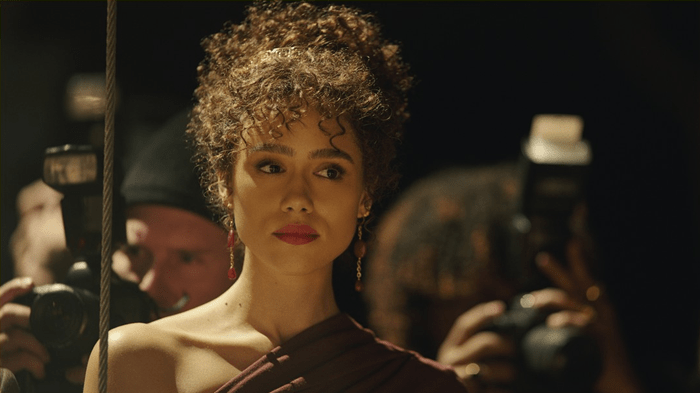
Things get even more complicated for the bitter rivals after Cesar falls in love with Julia (a luminous Nathalie Emmanuel), a pampered but well-centered socialite who happens to be the mayor’s daughter. She finds herself torn between the two men she loves and their competing visions. Emmanuel is both a radiant and grounding presence, often serving as our window into Coppola’s world.
Image Courtesy of Lionsgate
Meanwhile a colorful cadre of supporting players help complete Coppola’s opus. Aubrey Plaza plays Wow Platinum, a television news personality whose lust for power trumps any desire for a good story. Soured by rejection from Cesar, she sets her sights on the rich and much older bank executive, Hamilton Crassus III (Jon Voight). Then you have Shia LaBeouf as the envious and depraved Clodio Pulche, a lewd deviant turned populist power-player driven by his disdain for his cousin, Cesar. Laurence Fishburne plays Cesar’s loyal assistant, driver, and personal historian while Dustin Hoffman plays Franklyn’s reliable fixer.
While most of the performances are top-notch, Plaza and LaBeouf prove to be problematic. They both veer wildly over-the-top, often seeming as if they’re working in an entirely different movie. Without question, their characters are inherently hedonistic and flamboyant, and Coppola lets his two stars off their leashes to leave no question about their debauchery. But they go too big, leaving them feeling out of place, even in a movie that’s big on theatrics.
The sheer range of techniques employed by DP Mihai Mălaimare Jr. give “Megalopolis” a dreamlike quality that’s fitting for a movie of such cosmic ambition. Detailed compositions melding long lens and digital backdrops, soul-baring closeups, classic iris shots, kaleidoscopic effects – they’re all used to immerse us but also to inform. For example, the visuals are sometimes noticeably gaudy – an intentional choice used to emphasize the gold-plated facades of the rich and pampered whose hollow lives are marked by privilege and excess.
Image Courtesy of Lionsgate
As his central theme of crumbling empires takes form, Coppola surrounds it with stories of love of all kinds: love of family, love of self; love of art, love of power; love of advancement, love of decadence; love for creating, love for destroying. In the process he offers us a daring perspective on our modern world through an experience conceived from heartfelt concern, shaped by classical influences, and delivered with unflinching earnestness. It’s a broad and bulky endeavor, at times almost buckling under its own creative weight. But it never collapses due to Coppola’s belief in his message and his go-anywhere willingness when it comes to sharing it.
I’ve heard it said that art shouldn’t aim to satisfy the masses, but to express the heart of the artist. Obviously there’s a fine line when it comes to movies, and for my money Coppola walks it like a tightrope. His “Megalopolis” is as breathtaking as it is bewildering; as compelling as it is confounding. It doesn’t hold hands or pander. Nor does it submit to expectations. Yes, at times it’s erratic and untethered. It takes wild swings, some of which miss their marks. But it is undeniably the work of a man’s heart and soul, and you feel it in every trenchant soliloquy and every eye-catching image.
I feel it goes without saying, but “Megalopolis” won’t be for everyone. While the movie has its champions, it has just as many vocal detractors who have wasted no time tearing it apart. Interestingly, people said similar things about Coppola’s “Apocalypse Now” when it first released. But since then, time has spoken much differently. I’m not calling “Megalopolis” the new “Apocalypse Now”, but could it have the same fate? Call me crazy, but I wouldn’t be surprised. “Megalopolis” is in theaters now.











 Keith & the Movies