REVIEW: “Saturday Night” (2024)

Live from New York, it’s Saturday Night!” Those words have echoed down the halls of comedy since they were first uttered by Chevy Chase on October 11, 1975. That’s when the immensely popular and long-running sketch comedy show Saturday Night Live (then called NBC’s Saturday Night) made its small screen debut. And as they say, the rest is late-night television history.

With the aptly titled “Saturday Night”, director Jason Reitman attempts to recreate the chaotic 90 minutes leading up to SNL’s 1975 live debut. Reitman puts together a mammoth ensemble and tasks them with portraying an equally mammoth array of SNL cast members, show writers, NBC executives, comedians, musicians, and personalities.

The origin story of Saturday Night Live is a fascinating one. NBC was in the middle of an contract squabble with the king of light-night TV Johnny Carson. Since 1965, the network had been running re-runs of Carson’s mega-popular The Tonight Show on Saturday and Sunday nights. After nearly ten years, Carson requested they be pulled so that he could use them during the week allowing the host more time off. Much to the chagrin of several affiliates, NBC puts a young Lorne Michaels in charge of creating a show to fill the Saturday night time slot.

Image Courtesy if Sony Pictures Releasing

Reitman (who also co-wrote the script with Gil Kenan) begins his movie 90 minutes before the show is set to go live. On the 17th floor of NBC Studios at Rockefeller Plaza, creator and producer Lorne Michaels (played by Gabriel LaBelle) scrambles to get everyone and everything ready to go. But that’s easier said than done. His rambunctious cast of relatively unknown twenty-somethings are impossible to corral. Scripts for sketches remain unwritten. There are constant technical difficulties. And he still can’t give away enough free tickets to fill a studio audience.

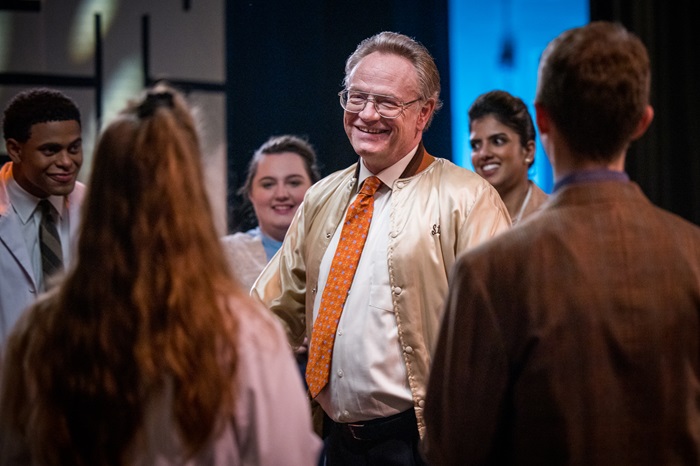
But worst of all, he has network executives breathing down his neck, most notably NBC’s Vice President of Talent Relations David Tebet (played by a terrific Willem Dafoe). Tebet is anxious to pull the plug on Lorne’s show and continue pumping out Carson re-runs. But Lorne has an ally in Dick Ebersol (Cooper Hoffman), the Director of Weekend Late Night Programming. Dick works as a middle-man between the network and Lorne, deflecting a lot of the heat and doing what he can to save the show. It’s work that Lorne doesn’t immediately appreciate.

Reitman plunges us headfirst into the moment-to-moment chaos, leaning on a beat-the-clock tension and even incorporating a reoccurring clock to remind us that time is the biggest enemy. Obviously we know how it ultimately ends. And considering that the entire movie is about the mayhem, the film’s big final moment comes together a little too neatly. But Reitman’s crisp dialogue and swift pacing keeps us on our toes and genuinely invested in what’s at stake.

But it’s the wealth of talent behind the supporting cast that gives the movie its energy. With so many involved, no one outside of LaBelle gets a ton of screen time. But that works in the film’s favor. There’s no overexposure and it allows Reitman to bounce back-and-forth across the studio and highlight the overwhelming stress and sheer pandemonium.

Image Courtesy of Sony Pictures Releasing

The acting is strong throughout and there are some uncanny physical likenesses that only enhance the performances. The SNL cast members are especially good with Cory Michael Smith playing Chevy Chase, Dylan O’Brien as Dan Aykroyd, Ella Hunt as Gilda Radner, Kim Matula playing Jane Curtin, Matt Wood as John Belushi, Lamorne Morris as Garrett Morris, and Emily Fairn as Laraine Newman.

And that’s just a small sample of the people we meet. Rachel Sennott is outstanding as Rosie Shuster. Nicholas Braun is a lot of fun playing both Jim Henson and Andy Kaufman. Tommy Dewey lets loose as Lorne’s pompous and abrasive head writer Michael O’Donoghue. Jon Batiste gets some good scenes playing Billy Preston while also composing the movie’s score. And J. K. Simmons is a blast as Milton Berle.

As “Saturday Night” blitzes forward we’re treated to a number of nostalgic callbacks that SNL enthusiasts will love. And sprinkled throughout are some pretty big laughs, most of which are organically generated by the show’s anarchic spirit. It still only feels like we’re getting a sketch of the behind-the-scenes experience. Reitman conflates and exaggerates while offering practically no buildup to his fairly skimpy plot. But none of that keeps us from being swept up in the creative madness, the revolving door of characters, and the sheer force of will that birthed a revolutionary show that’s still going today. “Saturday Night” is in theaters now.

VERDICT – 3.5 STARS

REVIEW: “Terrifier” (2016)

Whether or not you’re a fan of horror movies, and more specifically its splatter film subgenre, it’s hard not to be both impressed and inspired by what the Terrifier movies have accomplished. This truly is an independent film success story. With hardly any money but a big and bloody vision, Terrifier has become a full-fledged franchise. And it was born from the twisted but ingenious mind of its creator, Damien Leone.

Released in 2016, “Terrifier” was a stand-alone feature written and directed by Leone. It focused on a character Leone highlighted in his 2013 anthology film “All Hallows’ Eve”. It’s been said that he made “Terrifier” as a way of showcasing his work in practical effects. He also saw it as a means of introducing more people to his maniacal antagonist Art the Clown.

Image Courtesy of Dread Central

“Terrifier” is a remarkable achievement especially when considering it was made on a shoestring budget of just over $35,000. Leone took on the duties of director, writer, producer, editor, and effects supervisor. It took time, but the film eventually earned a strong cult following which opened the door for a sequel that released in 2022. And now we’re only days away from a third installment hitting select theaters.

With “Terrifier”, Leone meets every splatter film expectation. You can almost sense the grindhouse giddiness as he bathes his audience in blood and gore, often doing things to the human body that will shock some and repulse others. At the same time, it’s often so outlandish that you can’t help but have fun. Art (gleefully played by David Howard Thornton) is a big reason why. Part mime and part party clown, the demented murderer stabs, shoots, saws, stomps, clubs, gouges, dismembers and disembowels with a childlike elation.

Though wacky in its excess, the film still generates some legitimate chills. Once he establishes Art as a genuine threat, Leone creates some unnerving tension as his terrified cast sneaks, crawls, runs, but mostly succumbs to an assortment of grisly deaths. Several other details add to the experience from the exploitation era film grain to the killer score from composer Paul Wiley.

Where the movie falls short is in its bare-bones story and shallow characters. Basically two intoxicated friends, Tara (Jenna Kanell) and Dawn (Catherine Corcoran) leave a late-night Halloween party and stop at a pizzeria to sober up. They’re followed inside by Art the Clown who is quickly kicked out by the restaurant owner for creeping out Tara. The girls decide to leave but discover the tires slashed on Dawn’s car. Still too drunk to drive, Tara calls her sister Victoria (Samantha Scaffidi) to come pick them up. But as they wait, Art reappears and the terrorizing begins.

Image Courtesy of Dread Central

The rest of the movie is literally Art stalking Tara and an assortment of disposable human characters who exist solely as fodder for a madman and to show off Leone’s insanely imaginative effects work. It’s bookended by a couple of scenes that tease us with an interesting twist. But for the most part, neither the story or the people in it (outside of Art the Clown) will leave an impression on you.

But that doesn’t keep “Terrifier” from being a blood-drenched blast. It’s pure and unbridled sub-genre filmmaking and a testimony to the possibilities offered by independent cinema. It is most certainly not for those with an aversion to gore. Nor will it impress those who are unable to look past its obvious limitations. But for others, Leone’s passion and craftsmanship come together to make an effectively eerie, occasionally shocking, and surprisingly funny splatter film that set the table for the unlikely franchise that we have today.

VERDICT – 3.5 STARS

New on Home Video: “A Nightmare on Elm Street” on 4K Ultra HD + Digital

Warner Brothers Home Entertainment is celebrating the 40th anniversary of “A Nightmare on Elm Street” by bringing the film to 4K Ultra HD for the very first time. Wes Craven’s 1984 horror classic was a hallmark of its decade and the movie’s iconic antagonist, Freddy Krueger found a permanent place in pop culture. This critically acclaimed supernatural slasher spawned a franchise of nine feature films and a television series along with several comic books and novels.

This killer new 4K Ultra HD edition of “A Nightmare on Elm Street” includes a digital copy of the film and will be available to purchase on October 15th. See below for a full synopsis and release information including special features.

About the Film:

Year: 1984

Runtime: 91 Minutes

Directors: Wes Craven

Screenwriters: Wes Craven

Cast: Heather Langenkamp, Robert Englund, Johnny Depp, John Saxon, Ronee Blakley, Amanda Wyss, Nick Corri, Leslie Hoffman, Joseph Whipp, Charles Fleischer, Lin Shaye

Rating: R

Can your nightmares be fatal? In this classic of the horror film genre that launched a movie franchise, a hideously scarred man who was murdered by a lynch mob returns years later in the terrifying nightmares of his killer’s teenage children… and the dreaming teenagers are starting to die in their sleep.

Special Features:

“A Nightmare on Elm Street” Digital release and 4K Ultra HD Blu-ray disc contain the following previously released special features:

  • Ready Freddy Focus Points
  • Commentary with Wes Craven, Robert Englund, Heather Langenkamp, Ronnie Blakely, Robert Shaye, and Sara Risher.
  • Commentary with Wes Craven, Heather Langenkamp, John Saxon, and Jacques Haitkin.
  • Alternate endings
  • The House that Freddy Built: The Legacy of New Line Horror
  • Never Sleep Again: A Nightmare on Elm Street
  • Night Terrors: The Origins of Wes Craven’s Nightmares

REVIEW: “Apartment 7A” (2024)

With “Apartment 7A”, director Natalie Erika James makes an ambitious attempt at delivering a prequel to Roman Polanski’s highly regarded “Rosemary’s Baby”. This psychological horror thriller takes an interesting approach to the 1968 film and Ira Levin’s original 1967 novel. It works best as a compelling appendix that fills in holes rather than expand the lore. And it does more to pay homage to Polanski’s classic than plow new ground.

Those familiar with “Rosemary’s Baby” may have a good idea of what to expect after hearing one name – Terry Gionoffrio. She’s a young woman who has a small but memorable role in Polanski’s earlier film and is the centerpiece of James’ prequel. Set in 1965, Terry (capably played by Julia Garner), is an aspiring dancer who came to New York City from Nebraska with big dreams of one day seeing her name in lights. Her career seems to be taking off, but she has a gruesome setback after breaking her ankle during a live performance.

Image Courtesy of Paramount Pictures

Terry is forced to endure a lengthy and painful recovery leading her to start popping pain meds. She attends several casting calls but loses out due to her noticeably weak ankle. But good fortune (or misfortune) comes her way after Terry meets the kindly Castevets, Minnie (Dianne Wiest) and Roman (Kevin McNally). They’re a wealthy elderly couple who live in The Bramford, a Renaissance Revival apartment building in Manhattan.

The Castevets explain to Terry that they have no children of their own. They like to help struggling young people get on their feet, so they offer to let her stay rent-free in their neighboring apartment. Things immediately start turning around for Terry. One of her new neighbors, Mrs. Gardenia (Tina Gray) gives her an herbal home remedy that fully heals her ankle. And after a blurry evening with another tenant, Alan Marchand (Jim Sturgess), she’s hired to be on the chorus line of a musical he’s producing.

But Terry soon learns that her big breaks are too good to be true. The Castevets go from sweet to weird to all-out intrusive. Strange sores begin to appear on her body. And more questions arise about her night with Alan. Of course with this being a direct prequel, the first film has already set the table and served the full meal. That ends up stripping “Apartment 7A” of its mystery and suspense. We know where things are going and have a good idea of how they get there.

Image Courtesy of Paramount Pictures

Yet James makes several good choices and adds her own unique touches that keeps us interested. Thematically she maintains a fascinating balance in depicting a young woman’s obsession with fame. Terry may have put herself in a bad position, but she’s unquestionably a victim. Garner artfully manages these tricky tensions, showing us ambition that leads to regret and later vulnerability that gives way to resilience.

Among James’ creative flourishes are two dramatically different but equally potent dance scenes. One is an elaborately staged musical number and the other a more intimate and calculated dance sequence. Both come from very different places and have significantly different purposes. But they’re part of what energizes this unavoidably predictable yet well-made, well-paced, and well-acted “Rosemary’s Baby” companion piece. “Apartment 7A” is now streaming on Paramount+.

VERDICT – 3.5 STARS

REVIEW: “The Wait” (2024)

Written and directed by F. Javier Gutierrez, “The Wait” (also known by its Spanish title (“La espera”) is a transfixing fusion of folk horror and Greek tragedy. It’s laced with elements from classic Westerns and dark fantasy. At times it resembles an absorbing morality tale and at other times a gritty revenge thriller. What’s impressive is how seamlessly its pieces fit together. And all because of Gutierrez’s meticulous craftsmanship and laser focus.

Set in 1970, the story follows a family man named Eladio (Victor Clavijo) who moves his wife Marcia (Ruth Diaz) and 10-year-old son Floren (Moisés Ruiz) to the parched Andalusian countryside after taking a job tending a hunting estate owned by the wealthy and powerful Don Francisco (Pedro Casablanc). Three years pass and Eladio begins preparing Floren to take on more responsibilities around the place. But things aren’t as agreeable with the disillusioned Marcia who misses her life in the city.

One day Eladio is approached by a local named Don Carlos (Manuel Morőn) who organizes area hunts for his wealthy clientele. Don Carlos is in a pickle. He has overbooked an upcoming hunt and wants Eladio to add three additional hunting stands to the property, raising the total to thirteen. But that would go against Don Francisco’s strict orders. So Eladio turns down a generous bribe and sticks to his principles. But Don Carlos secretly pays Marcia a visit and tells her of his offer. She immediately begins pressuring her husband, even calling him a coward for not taking the money.

Against his better judgment, Eladio gives in to Marcia and accepts Don Carlos’ offer. From the very moment he does we know he’s going to regret it. Almost immediately a sense of dread creeps in, and after a tragic chain of events, Eladio loses the two things he holds dearest – his wife and son. It leaves him all alone on the property, overcome with sorrow, haunted by visions, and tormented by guilt.

Gutierrez pushes Eladio to the brink of madness and the stoic Clavijo captures his descent with startling clarity. His searing performance conveys volumes, mostly through expression and physicality rather than dialogue. The pride and confidence that once filled his eyes is replaced by a cold emptiness. Grief fuels his anguish, but it’s a fit of drunken rage and its ensuing violence that sends him careening over a psychological edge.

The movie’s wicked second half takes a near primal turn as Gutierrez leans heavily on his film’s folk horror element. It ventures into the macabre and surrealistic to the point that we often question what’s on screen. Are the things we see real or are they grim manifestations from a troubled mind? Thankfully Gutierrez never allows Eladio to fully lose his grasp of reality. He’s kept grounded by clues that point to a mystery he’s determined to solve. It’s a mystery that drives the movie to its allegorically rich and painfully potent ending.

“The Wait” is a movie that truly earns its title. It’s a slow-burn in the best of ways, patiently plowing its themes and examining its main character’s psyche. The rugged rural landscapes form a fittingly harsh backdrop while intense close-ups makes even the everyday minutia a means to immerse us in this unforgiving world. It all works together in harmony to make this dark and twisted genre-bender worth every second of our investment. “The Wait” is out now on VOD.

VERDICT – 4 STARS

REVIEW: “Joker: Folie à Deux” (2024)

The road to the big screen has been interesting for “Joker: Folie à Deux”. The highly anticipated sequel to the 2019 box office juggernaut “Joker” puzzled many when it was first announced as a musical. Since then the studio has dialed back its emphasis on ‘Joker the Musical’ and has since promoted it in a more traditional manner. Yet fans of the first film (a group I’m happy to be a part of) remained a little hesitant and unsure of what to expect.

That kind of subversion of expectations can be a good thing, especially if your movie ultimately delivers. “Joker: Folie à Deux” delivers to a degree, but expect the reactions to be all over the map. Much like its predecessor, you can count on some being predisposed to disliking it. But it’s the diehard fans who will almost certainly end up split. That’s because “Folie à Deux” takes some wild creative risks, some of which pay off and others that frankly drag the movie down.

Todd Phillips returns to direct, produce, and co-write, this time with a budget that ballooned to nearly $200 million. Phillips reteams with several collaborators from the first film including his co-writer Scott Silver, his cinematographer Lawrence Sher, his editor Jeff Groth, and his Oscar-winning composer Hildur Guðnadóttir. But the most essential returning piece is Joaquin Phoenix, reprising the title role which earned him a Best Actor Oscar.

“Folie à Deux” (translated shared madness or madness for two) doesn’t play like a fully realized sequel. It’s more akin to an extended epilogue that follows the events from “Joker”. But the differences between the two films are significant and somewhat confounding. “Folie à Deux” splits its time between being a courtroom drama and a prison drama with Phillips injecting the dark edginess of the first film into both. But the movie eventually gets caught in a frustrating cycle that keeps bouncing us back-and-forth between the two without much happening in-between.

Image Courtesy of Warner Bros. Pictures

Phoenix is once again spellbinding as he follows the continued dark descent of Arthur Fleck, a part-time party clown and aspiring stand-up comedian who killed six people in the first film including a popular talk show host on live television. Arthur’s unhinged antics and vigilante Joker persona inspired a mob of disillusioned and (in some cases) equally deranged citizens to unleash a wave of violence and chaos across Gotham.

As he awaits his trial, Arthur remains locked up in Arkham State Hospital where he’s kept heavily medicated while swapping bad jokes for cigarettes with a semi-sympathetic guard named Jackie (Brendan Gleeson). Nothing much happens in these scenes other than a miserable Arthur trudging down cold drab hallways, escorted to and from to his cell, and occasionally let out in the prison yard. But he does find a spark of life after he meets and falls for a fellow inmate, Harleen “Lee” Quinzel (Lady Gaga).

With Arthur deemed competent to stand trial, his lawyer, Maryanne Stewart (Catherine Keener) gets busy preparing their case. She intends to argue that the Joker persona doesn’t represent the real Arthur. She contends that Joker is another personality – a manifestation brought on by years of abuse and neglect. Her claims that Arthur was an unwilling participant and a victim angers his many fans who see Joker as the catalyst for their twisted cause. It also frustrates Lee who encourages Arthur to embrace his true Joker self and take charge.

As with the Arkham drama, the courtroom scenes have a tough time gaining traction. In several ways they seem inspired by the trial of serial killer Ted Bundy. It’s a full-blown media circus. It’s being televised live. And like Bundy, Arthur gives into his Joker persona and decides to represent himself in court. It’s a scenario so full of potential but much of it is never fully realized. That’s because any dramatic momentum is routinely interrupted by trips back to Arkham or by an untimely musical number.

Image Courtesy of Warner Bros. Pictures

As for the musical numbers, they do play a big part in “Folie à Deux”. They represent an inspired and even bold approach to telling Arthur’s story. But their quality and execution are very much a mixed bag. On the positive side, they are designed as expressions of Arthur’s emotional turmoil and inner fantasies. The songs are a collection of covers, many rooted in Arthur’s past while others convey whatever feeling is overwhelming him in that moment.

Unfortunately the numbers grow burdensome over time. They become more intrusive than enlightening – taking screen time that could’ve been better spent developing a more involving story. The songs themselves aren’t likely to stick with you due to the calculated choice to sing them badly (as Phoenix confirmed to People magazine). Narratively it makes perfect sense. Neither Arthur or Lee are talented singers so why make them sound like Sinatra and Fitzgerald? But that doesn’t necessarily make for enjoyable listening, especially by the fifth of sixth tune.

Yet despite its frustrations and flaws, there’s something incredibly admirable about the movie’s audacity. In an era where we’ve been trained to expect very specific things from comic book movies, I love that Phillips and company have dared to make one that doesn’t abide by any established rules. Phoenix is once again intensely committed and hauntingly grim. And Gaga makes the most of her sparse screen time, taking an underdeveloped character and making her somewhat interesting.

At one point in the 2019’s “Joker”, Arthur says “I used to think my life was a tragedy, but now I realize it’s a comedy.” Those words are given a powerful new meaning in “Folie à Deux”, as are several other things from the first film. If only the two movies had more in common. Phillips puts aside the raw and incisive storytelling of “Joker” for something that’s more experimental but with less to say. And he tops it all off with a sour ending that may be fitting in some regards, but that feels like Phillips and Phoenix wiping their hands clean. I’m afraid that’s what “Joker” fans will want to do after seeing this ambitious but disappointing gamble. “Joker: Folie à Deux” is in theaters now.

VERDICT – 2.5 STARS