

“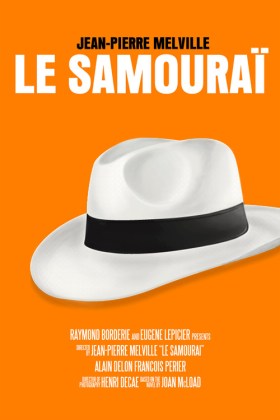 Le Samourai” begins with a perfect tone-setting scene. As the opening credits flash by we are treated to a wide still shot of an old meager apartment saturated in dark and gloomy grays. At the center of the shot is a bird hopping around in its cage. And almost unnoticeable is a man laying on his bed blowing gentle bursts of smoke from his cigarette. He blends in perfectly with his shadowy, unassuming abode. This scene, like the entire movie, could be descibed as spellbinding. It captures our attention and keeps us absorbed through its quiet and meticulous artistry. It’s the perfect opening.
After the final opening credit the man rises from his bed fully clothed. He walks to the door of his apartment stopping only to put on his khaki overcoat and to carefully place and adjust his gray fedora on his nicely combed black hair. We immediately sense that he was waiting for a specific time and that he has something important to attend to. His name is Jef Costello (Alain Delon) and he’s a pretty tough cookie. We quickly learn that he is a hired killer and he’s very good at his job. There’s a precise and proven procedure that he follows and he takes us through it step by step.
He leaves his apartment building and moves through the streets of Paris before furtively stealing a car. He gets the plates changed, new papers, and a weapon. After that he gets his alibi in order by visiting the beautiful Jane (played by Alain’s real life wife Nathalie Delon). After that he’s ready for what should be a quick and clean contract. He heads to Marty’s nightclub where his target is located but this turns out to be a tougher job than he anticipated. A police roundup, double-crossing, and a ton of heat tests Jef like never before.
“Le Samourai” was directed by the great Jean-Pierre Melville. Melville, who would only make three more films after “Le Samourai” due to his untimely death at age 55, was a lover of 1930’s and 1940’s American crime pictures and you can see those influences in much of his work. But Melville would add his own stylistic twist to his storytelling which would go on to influence new generations of filmmakers. Melville was also a fan of Alain Delon and he used him in his films whenever the opportunity presented itself.
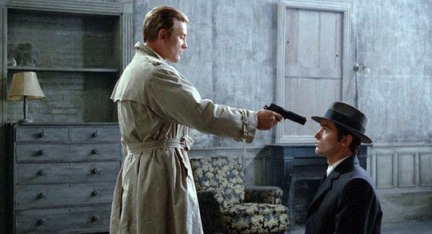
Delon is perfectly cast as Jef Costello. Delon was a handsome and popular actor whose stone-faced expression and scarred chin gave him the look the part needed. In fact he never smiles throughout the entire film. He’s all business. Delon was born in a suburb of Paris and was an unruly fellow through his childhood and even into his French military service. That changed when he was finally discovered by a talent scout while on a trip to Cannes. I can’t help but think that his past may have contributed to his sleek and tempered performance.
There are so many great touches and techniques in Melville’s direction and he gives us several unforgettable scenes. For me none are better than a fascinating sequence on the Paris Metro. The police decide to tighten the screws on Jef by monitoring his every movement. Jef who knows the Metro like the back of his hand heads underneath the city in an attempt to lose his tail. But undercover officers are everywhere relaying his movements from train to train. Jef struggles between awareness and paranoia as he tries to decipher who is tailing him as he skips from one Metro stop to another. It’s a brilliantly conceived and constructed sequence.
It was hard for me not to be enthralled with “Le Samourai”. The sparse dialogue is carefully reserved for specific scenes and the camera tells a lot of the story. I can see where that approach may lose some people but for me it was clever and effective. It took me a while to get around to seeing this film and that’s a shame. It’s a stylish yet classic cinema piece that has had it’s share of imitators since its 1967 release. If you haven’t seen it, don’t wait as long as I did.
 Terrence Malick’s directing career has spanned four decades. Now that can be a bit misleading since he’s only made six films during that time. Still, that small body of work has been enough to make him one of my favorite directors. For me, a Malick movie is an experience. He’s an auteur who plays by no other rules other than his own and the quality of his films are always at a high level. There are also several thematic and visual distinctions that course through every Terrence Malick picture, stylistically and narratively differentiating them from most other movies.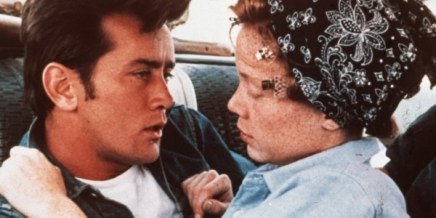

 I think it would be safe to say that the Marx Brothers had a brand of humor that was uniquely their own. In a variety of ways Groucho, Harpo, Chico, and Zeppo Marx influenced the comedy genre like no others. Their chaotic and anarchic comedy is centered around rapid-fire quips and ingenious slapstick that’s as well choreographed as any fine dance or ballet. Some of today’s audiences haven’t had the same appreciation for the Marx Brothers and many moviegoers raised by modern cinema may be tempted to dismiss their style of humor. But I stand with the many who believe that the brothers were some of the greatest comic geniuses ever to grace the big screen.


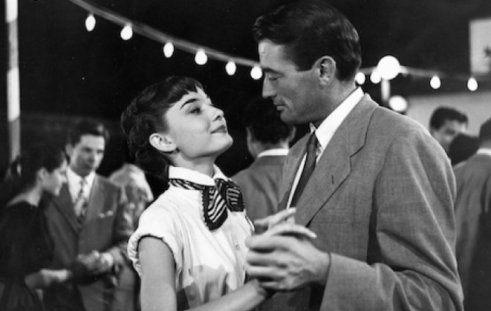
 I don’t mean to be repetitive. But at the risk of sounding like a broken record, they just don’t make romantic comedies like this anymore. This 1953 classic from director William Wyler is a beautiful blueprint for a genre that seems to struggle with making quality movies these days. “Roman Holiday” brings together the always good Gregory Peck and the adorable Audrey Hepburn in a film that could almost be considered a fairy tale story. But while the film embraces some of the elements that make a good romantic comedy, it dodges a few of the conventions which have become all too familiar.
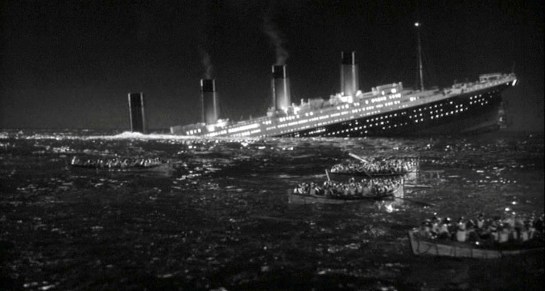
 When mentioning “Titanic” and the movies most people today instantly think of James Cameron’s 1997 blockbuster epic. But there have actually been several movies centered around that ill-fated voyage in 1912. One of the best of these films came out in 1953 and like Cameron’s movie, this film was simply titled “Titanic”. It featured a fine cast and special effects that were considered pretty cutting edge for that time. Of course being a 1953 picture it didn’t depend on its special effects as heavily as Cameron’s. Instead the true strength of this version lies in the characters and their stories which unfold before us on the ship prior to the collision which would eventually sink the vessel.


 Keith & the Movies