REVIEW: “Anchorman 2: The Legend Continues”

ANCHOR POSTER

I’ve never shared in the enthusiasm or admiration for “Anchorman: The Legend of Ron Burgundy”. The 2004 comedy was a box office success but it gained most of its following in the subsequent years. To my surprise the film has a legion of devoted fans who adore these characters and can quote line after line. For me the first “Anchorman” film had its moments but ultimately it milked its gimmick dry and it grew old fast.

Surprisingly it took almost 10 years for a second installment to hit theaters. That’s unheard of in this modern movie era of churning out cash grab sequels by the gross. This time around we get more of the same familiar gimmick, many of the same gags, and the same wild sporadic storytelling. This is probably good news for fans of the first film, but for me it was another mediocre experience with even less laughs than the first movie. To make matters worse it’s almost 30 minutes longer making it a grinding endurance test for those not smitten with its humor.
ANHCOR 1

Seven years have passed since the events of the first film. Ron Burgundy (Will Ferrell) and Veronica Corningstone (Christina Applegate) are married and living in New York City. Both are successful co-anchors at a popular local news station, at least until Veronica is offered a prominent evening news position and Ron is fired. Ron’s ego takes over and he gives her an ultimatum – the job or him. The couple separate and Ron takes up petty jobs and heavy drinking.

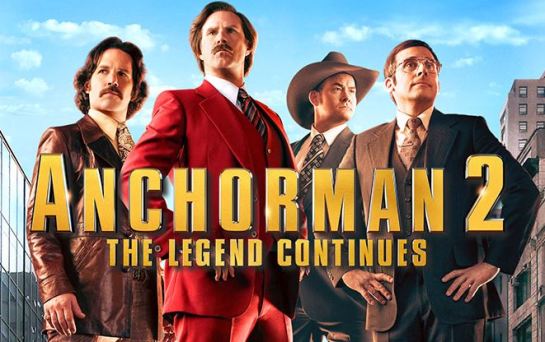
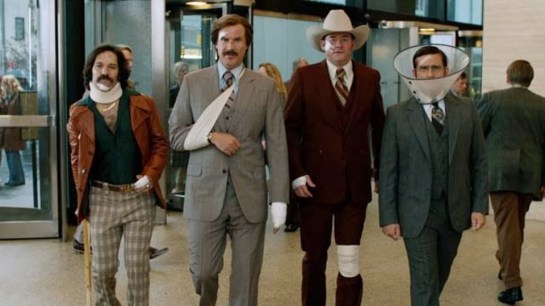
But opportunity knocks when Ron is approached by Freddie Shapp (Dylan Baker). He offers Ron a job at the first ever 24-hour news network. Ron searches out his old news team of Champ Kind (David Koechner), Brian Fantana (Paul Rudd), and Brick Tamland (Steve Carrell). The four get back to work and turn things upside down with their barrage of juvenile, racist, and sexist stupidity. Some of these moments do provide some good laughs. But honestly there are so many back-to-back jokes that some were bound to land. Eventually they all but disappear and the movie seems to repeat variations of the same gags over and over and over and over.
ANCHOR2

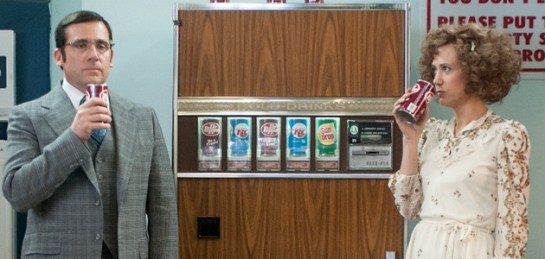
Ferrell is certainly comfortable playing Burgundy and he has never been ashamed to make himself look ridiculous in order to get a laugh. Often times it’s the sheer earnestness of his idiocy that is the most effective. But after a while I just wanted him to go away. Rudd and Koechner are the same – funny for a spell but then they sputter. My personal favorite character is Steve Carrell’s Brick. He’s a lovable imbecile whose humor mainly consists of spontaneous statements that make no sense whatsoever. Carrell is so good in the role but even he eventually becomes repetitive and tiresome.

“Anchorman 2” has the expected surprise cameos (most of them crammed within one small sequence) and a couple of intentionally absurd musical numbers. None of these can save this overly long and monotonous sequel. Eventually I had had enough of the toilet humor, body part gags, and rehashed jokes. Ferrell and frequent collaborator Adam McKay have had plenty of success putting things like this together and this film certainly registered with the “Anchorman” faithful. Personally I wouldn’t be sad if I never saw Ron Burgundy again.
VERDICT – 2 STARS

REVIEW: “Automata”

AUTO poster

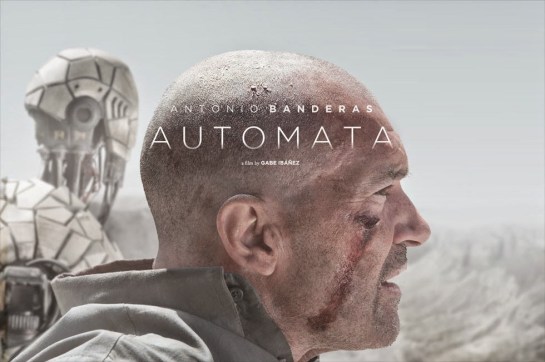
The year is 2044. Solar storms have turned the Earth’s surface into a radioactive desert causing 99% the world’s population to die. With only 21 million people remaining, a desperate humanity create primitive robots who build walls around their last remaining cities and atmospheres to protect them from the radioactivity and harsh elements. Millions of robots are manufactured by a corporation called ROC and safety protocols are put in place to keep the robots from harming any life form and to keep them from altering themselves. The ultimate purpose of the protocols is to protect humanity at all costs.

This is world of the 2014 science fiction film “Automata” from director Gabe Ibanez. It stars Antonio Banderas as Jacq Vaucan, an insurance investigator for ROC. Jacq is sent to investigate the claims of a cop who says a robot he shot was altering itself. In order for that to happen someone (termed the “clocksmith”) must be modifying the robots by bypassing the protocols and therefore endangering mankind. The case leads Jacq down a trail of police and corporate corruption, murder, deception, and ultimately revelation.

AUTO1

Banderas is good as the burnt out and worn down Jacq. His friend and boss Robert (Robert Forster) recognizes his plight but needs him on the case. His very pregnant wife Rachel (Birgitte Hjort Sørensen) is concerned with his state of mind and ability to protect them. Banderas seems to be in a perpetual state of exhaustion, but it works here mainly because he doesn’t play a standard, action movie prototype. He’s not the ex-special forces type or the bulked-up one-man army. He’s about what you would expect an ‘insurance inspector’ to be.

The movie sports some nice visuals especially when revealing its dystopian landscapes. The robots’ primitive looks and movements are nice fits for the story being told. Everything from a visual perspective works in “Automata”. But in the end it’s the storytelling that ultimately lets the movie down. There are a host of clever ideas and interesting concepts that the film plays with, but it never sees any of them through. Instead it employs several sci-fi movie and character cliches that undermine the story’s potential. In a nutshell, the film leaves you with the impression that it’s going someplace smart and possibly profound. Sadly it’s only an impression.

It could also be said that “Automata” is missing that cool creative spark we see in good science fiction. It certainly looks the part, but it never engages its audience or challenges them in any way. That’s not to say it isn’t entertaining. Banderas gives a solid performance and Ibanez shows a definite skill with his camera and in moving his story along. But it’s the story itself that lets them down. There is a strong premise at its core and there several themes begging to be expanded on. That’s why I found “Automata” to be a decent but a slightly unfulfilling experience.

VERDICT – 2.5 STARS

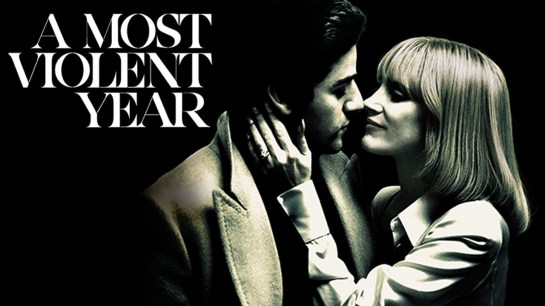
REVIEW: “A Most Violent Year”

VIOLENT POSTER

Writer and director J.C. Chandor’s young filmmaking career has offered us two diametrically opposed films. His first movie was the wearisome, heavy-handed Wall Street critique “Margin Call”. His second film was the gripping, solitary survival drama “All is Lost”. “Margin Call” was a talky, dialogue-heavy film while “All is Lost” had only a few spoken words. “Margin Call” featured a huge impressive cast while “All is Lost” featured only Robert Redford. Two very different movies in terms of story and filmmaking approach, but two films that had me very interested in what Chandor would do next.

His third feature is “A Most Violent Year”, an unorthodox organized crime movie with a very deceptive title. This isn’t a prototypical gangster action flick. It’s a slow-burning drama set in 1981 New York City. As evident by Chandor’s other films, he is most interested in telling his stories through layered and well-defined characters. We may get that through copious dialogue or revealing observations, but his characters are his predominate storytelling tool.

VIOLENT1

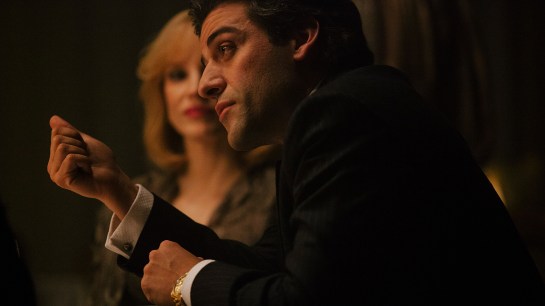
In “A Most Violent Year” our main character of focus is Abel Morales (Oscar Isaac), a dedicated and hard-working owner of a heating oil company. It’s a tough business environment but Abel has managed to grow his company mostly through legal means. We get hints that there are organized crime influences not only within the heating oil business but also in Abel’s family. Yet despite possible connections, Abel seeks to do things the right way, in hopes of avoiding any possible conflict with crime bosses or the law.

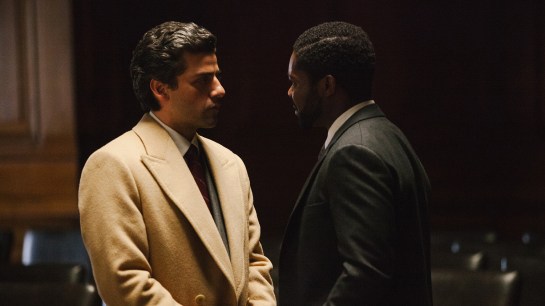
That goal becomes more difficult after his trucks begin to be hijacked during delivery runs. This creates a number of problems for Abel. The oil being stolen is taking a financial toll on his company. His firecracker wife Anna (Jessica Chastain) urges him to fight violence with violence. A local Teamsters head pressures Abel to break the law and arm his drivers. And to make matters worse, an ambitious Assistant District Attorney (David Oyelowo) is investigating Abel’s company which threatens to derail a vital business acquisition.

Chandor slow-cooks all of these ingredients, meticulously building his tension at a deliberate but effective pace. There is a very strategic flow to the story and I can see where some may long for more action or a quicker tempo. But I think that would undo much of what Chandor is going for. This film isn’t about gunfights and physical violence. It’s about a man desperate to avoid all of that even though it lingers in the background and around every corner.

VIOLENT2

There is something to be said about sitting back and watching good actors work. That is one of this film’s great pleasures. Oscar Isaac, with his well-groomed appearance and camel-hair coat, is wonderfully convincing selling us on Abel’s shaky confidence and good intentions. Chastain is also very good although there were moments when she came across as a little too big and showy. And I also have to mention Albert Brooks. Simply put he is just flawless playing Abel’s attorney who always seems to know more than he lets on. And while it is a relatively small part, David Oyelowo is always a delight.

“A Most Violent Year” is a very focused film that incorporates some of the tricks from J.C. Chandor’s other movies while also setting itself apart from them. The early 80s setting is impressively realized and the cold, wintry hues help relay the needed tone. The dialogue is sharp and intelligent. The performances are precise and confident. Most importantly the story itself pulled me in and what others may see as languid storytelling I see as uniquely fresh. Chandor’s third effort is a rich and gritty character-driven thriller that proves him to be one of the filmmakers that demands to be noticed.

VERDICT – 4.5 STARS

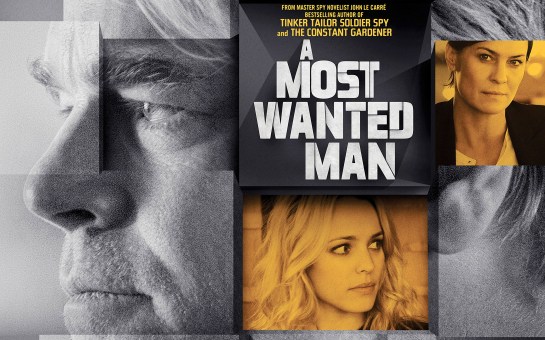
REVIEW: “A Most Wanted Man”

WANTED POSTER

Anton Corbijn’s brooding espionage-thriller “A Most Wanted Man” doesn’t follow any popular spy movie blueprint or formula and the movie is better for it. It won’t take audiences long to notice the intentionally deliberate pacing, dialogue-driven suspense, and strong character focus. All of these elements create a very grounded and methodical procedural that relies heavily on great performances and a strong screenplay from Andrew Bovell.

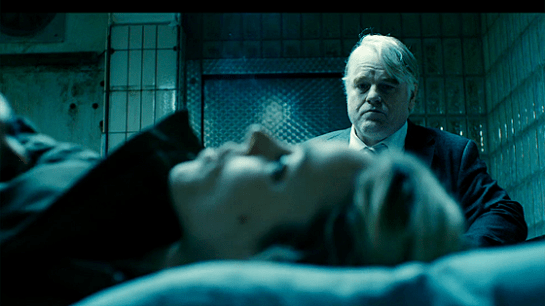
“A Most Wanted Man” isn’t just a unique thriller. It also has the sad distinction of being Phillip Seymour Hoffman’s final performance. He plays Günther Bachmann, the head of a German anti-terrorist group. He’s a heavy smoker, drinks a lot, and often times looks unkept. In fact, in an unfortunate case or art imitating reality, he looks terribly unhealthy. But Hoffman takes whatever personal struggles he may have been going through and injects them into this character creating someone full of raw authenticity.

WANTED2

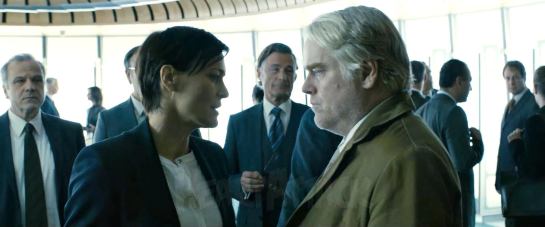
When a Chechen Muslim on Interpol’s radar illegally enters Hamburg Günther and his team begin tracking him down in hopes of catching bigger fish in a potential terrorist ring. Complicating things is a German security official (Rainer Bock) who wants to apprehend the Chechen instead of using him. Then there is an American intelligence agent named Sullivan (played with fascinating mystery by Robin Wright). No one knows her intent and Günther doesn’t trust her from the start.

The story spins in several different directions and we are kept on our toes by some interesting twists and character developments. It becomes a movie of ‘who is a terrorist and who isn’t’ and ‘who can I trust’. Watching Hoffman navigate through this maze of clues and information is half the fun. Willem Dafoe shows up as a banker with a very shady past and Rachel McAdams has a hefty role as a human rights attorney who latches on to the Chechen suspect’s case. Both characters play key roles in the unfolding story.

WANTED1

When you’re working with this type of material you have to trust your cast and they are all good here. I still find myself drawn to Wright’s performance and the unshakable confidence she brings to her character. Dafoe is also spot-on and many of the film’s great scenes have him in them. McAdams
is good although she often has trouble keeping her accent. But this is truly Hoffman’s film and he strips away every shred of showmanship in portraying this sad and weary soul whose life revolves around his work. He is obsessive to a fault, but that’s also what helps to make him such a compelling character.

“A Most Wanted Man” may not be for everyone and that’s a shame. It’s a slow burn meticulously built around nuggets of information we glean from conversations, interviews, and observations. It’s compelling stuff – crisp and razor sharp. There was a moment or two where I wasn’t sure what was being discussed and there are a couple of lulls. But even in those moments there is still Hoffman’s sublime performance. If there had to be a final performance this a fitting one – conscientious, complex, and forceful. It’s a clear reminder of the natural ability this man had as an actor.

VERDICT – 4 STARS

2015 Blind Spot Series – “Au Hasard Balthazar”

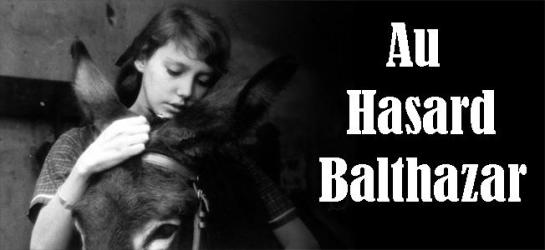
Anne Wiazemsky as Marie in Robert Bresson’s AU HASARD BALTHAZA

The brilliant auteur Robert Bresson has been called the father of French cinema. Many of the greats from France’s New Wave movement considered Bresson their chief influence. Other filmmakers from around the world often pointed to Bresson’s work as effecting the shape and form of cinema for generations. He was known for his unconventional style and techniques which found their roots in his own unique philosophies behind the art of cinema.

Bresson had an intriguing filmography and one of his best pictures is his 1966 drama “Au Hasard Balthazar”. His films often focused on lead characters weighed down by or struggling with their circumstances or their inner-self. The conflicts and turmoils they faced often left them physically or emotionally broken. Bresson’s films are not for those looking for a lighthearted affair. They are thought-provoking examinations of humanity that refuse to shy away from our crueler and harsher sides. “Au Hasard Balthazar” is a stirring example of this approach.

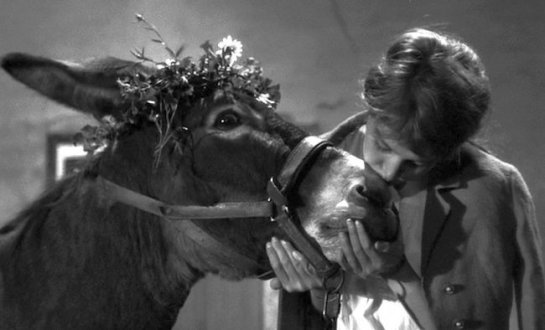
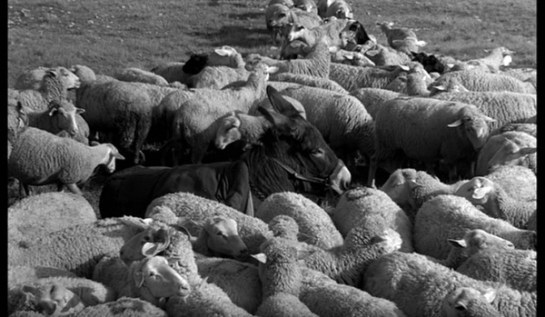
The film follows a donkey named Balthazar who encounters a wide assortment of deeply flawed people during his life. We first see him right after birth living on a small rural farm. Over the film’s quick 95 minutes Balthazar changes hands several times . Many of his owners and handlers abuse him often physically but sometimes out of sheer neglect. But Bresson doesn’t take a cheap way out. Balthazar isn’t a miracle animal. He doesn’t speak or come up with clever ways to repay his abusers. No, he’s just a donkey. Simple, innocent, and true to his nature. He knows what donkeys know, feels what donkeys feel, and acts as donkeys act.

AU1

Why is that so important? Because it puts the spotlight on humanity. Balthazar is doing what he should be doing. It’s the people he endures along the way who show their very flawed and sometimes wicked sides. It’s an indictment on the reality of how things are. When speaking on the movie the great filmmaker and one-time critic Jean-Luc Godard called it “the world in an hour and a half”. It’s a sad picture that is sometimes hard to look at. And despite his limitations Balthazar is still intensely sympathetic and able to touch our emotions.

But Bresson doesn’t just follow Balthazar around everywhere. He also tells us the stories of several characters who play roles in the donkey’s life. The main one is Marie (Anne Wiazemsky). She lives on the farm where Balthazar is born and shows love towards him. But in another instance of straying from the conventional, Marie also sits idly by while a group of young thugs led by the slimy Gerard (François Lafarge) beats Balthazar. Marie becomes an emotionless hollow soul, in some ways like Balthazar – a victim of her circumstances. But she loses herself in a much darker place.

AU2

Gerard ends up with Balthazar on a couple of occasions and his cruelty towards the animal is unsettling. Gerard is a thug, a thief, and is shown to possibly be a lot worse. There are parts of his story that didn’t make sense to me, but Gerard’s brand of sadistic evil is felt by man and beast. Balthazar also spends time with a baker, a traveling circus, and a local drunk. We see all of these people through the clearest and most honest eyes possible – Balthazar’s.

Several of Bresson’s signature style choices are clearly seen in the film. Most obvious is his penchant for using non-professional actors in his roles. You will rarely find room for big movie stars in a Bresson movie. The director would hire unknowns and then train them specifically for their part. He didn’t want an ounce of theatrics from his actors and he was known to film a scene over and over until every hint of performance was removed. Even more, Bresson didn’t refer to his performers as actors. He called them “models” and they offered a raw and reserved take unlike what you see in the mainstream. When watching “Au Hasard Balthazar” this can be a challenge especially for those not accustomed to Bresson’s work. The characters can appear cold and indifferent, but that also causes us to look at them in a very unique way.

“Au Hasard Balthazar” can be a difficult film to take in. Its narrative can be a bit challenging but once you connect with Bresson’s greater message everything falls into place. It’s visceral and heartbreaking. At the same time it holds a mirror up to the world we live in. And while this film was made in 1966, the reflection it casts is just as piercing today as it was then. Godard’s description of the film is spot on. Bresson shows us the world. The question becomes how are we going to change it? Even more, can we change it?

VERDICT – 4.5 STARS

AU finish

To see my full 2015 Blind Spot Lineup click HERE…

REVIEW: “Amador”

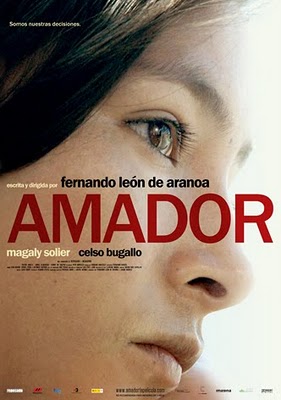
AMADOR POSTERThere’s an intriguing, poignant, and fairly bizarre idea at the center of the 2010 Spanish drama “Amador”. Marcela (Magaly Solier) is a woman struggling to find an ounce of happiness in her life. Her husband Nelson (Pietro Sibille) has promised her the world including owning her own flower shop. But he seems content with running a second-hand flower business out of their tiny apartment. He sends out cheap laborers to get discarded flowers from dumpsters. He then picks out the salvageable ones, prunes them, sprays them with floral air freshener, then sells them on the street. It’s quite a concept but its far from what Marcela wants.

One day Marcela packs her suitcase and leaves a note for Nelson telling him she’s leaving. But while waiting at the bus stop she collapses. It turns out she’s pregnant. Knowing she can’t handle a baby on her own, she heads back home before Nelson arrives. She never tells Nelson her initial plans and even more, she doesn’t tell him she’s pregnant. This gets into one aspect of this movie that drove me crazy. Marcela never tells anyone anything! This leads to several predicaments that could have been avoided with better judgement and better communication.

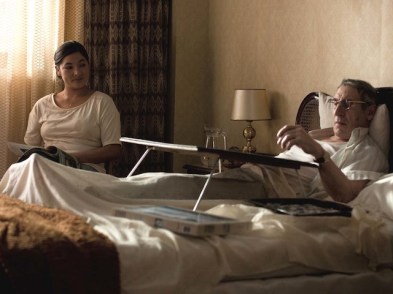
Things get tougher when the couple’s refrigerator goes out leaving them with no way to refrigerate their flowers. With no money for a new one, Marcela is forced to take on another job as a caregiver for a sick, bedridden elderly man named Amador (Celso Bugallo). She’s hired by Amador’s daughter who seems to see her father as a burden. She leaves a phone number and medication instructions then leaves. Marcela cooks Amador’s meals, gives him his pills, does his laundry, and eventually forms a connection with him, something he grows to appreciate. But Amador’s declining health soon leads to several decisions that carry all sorts of moral implications.

AMADOR

There are many things that this film does right. Unfortunately there are several stumbling blocks that keeps me from being able to fully embrace it. It’s hard to get into one of my problems without wandering into spoiler territory. I’m not going to do that, but let me just say there are some breaks from logic that were tough for me to get past. There’s a big turning point midway through the movie that effects the rest of the story and adds an interesting dynamic to what we’ve seen so far. But with it comes some head-scratching questions that the film tries to but never adequately deals with. I spent a lot of the second half of the film focusing more on these gaping illogical holes than on the actual story.

Another problem is with the handling of the Marcela character from writer and director Fernando León de Aranoa. She is incredibly passive when it comes to her situations and decision making. It’s another movie example of how a little communication could solve a lot of the problems that come her way. We also spend a lot of time just watching Marcela think, stare, and look concerned. And trust me, I mean A LOT of time and it ends up bogging the movie down a tad. Now I can’t really fault Solier’s performance. She’s very good here. But de Aranoa chooses to keep his camera in her face for long stretches and directs her to be slow and deliberate with almost everything she does. This did eventually slow things down a little too much for me.

If you can wade through the intentional deliberate pacing and forgive a couple of obvious plot holes, there is a lot to like with “Amador”. There’s such a great concept at the heart of this stor. I also think Marcela is a fascinating character and I particularly enjoyed her candid and often times amusing conversations with Amador. With a little better direction and a sharper script it could have been even better.

VERDICT – 3 STARS