REVIEW: “Amador”

AMADOR POSTERThere’s an intriguing, poignant, and fairly bizarre idea at the center of the 2010 Spanish drama “Amador”. Marcela (Magaly Solier) is a woman struggling to find an ounce of happiness in her life. Her husband Nelson (Pietro Sibille) has promised her the world including owning her own flower shop. But he seems content with running a second-hand flower business out of their tiny apartment. He sends out cheap laborers to get discarded flowers from dumpsters. He then picks out the salvageable ones, prunes them, sprays them with floral air freshener, then sells them on the street. It’s quite a concept but its far from what Marcela wants.

One day Marcela packs her suitcase and leaves a note for Nelson telling him she’s leaving. But while waiting at the bus stop she collapses. It turns out she’s pregnant. Knowing she can’t handle a baby on her own, she heads back home before Nelson arrives. She never tells Nelson her initial plans and even more, she doesn’t tell him she’s pregnant. This gets into one aspect of this movie that drove me crazy. Marcela never tells anyone anything! This leads to several predicaments that could have been avoided with better judgement and better communication.

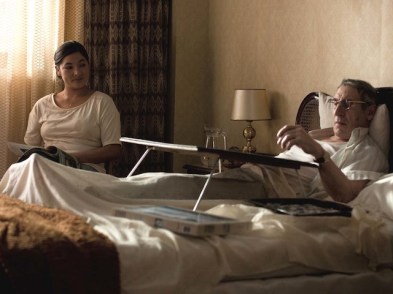
Things get tougher when the couple’s refrigerator goes out leaving them with no way to refrigerate their flowers. With no money for a new one, Marcela is forced to take on another job as a caregiver for a sick, bedridden elderly man named Amador (Celso Bugallo). She’s hired by Amador’s daughter who seems to see her father as a burden. She leaves a phone number and medication instructions then leaves. Marcela cooks Amador’s meals, gives him his pills, does his laundry, and eventually forms a connection with him, something he grows to appreciate. But Amador’s declining health soon leads to several decisions that carry all sorts of moral implications.

AMADOR

There are many things that this film does right. Unfortunately there are several stumbling blocks that keeps me from being able to fully embrace it. It’s hard to get into one of my problems without wandering into spoiler territory. I’m not going to do that, but let me just say there are some breaks from logic that were tough for me to get past. There’s a big turning point midway through the movie that effects the rest of the story and adds an interesting dynamic to what we’ve seen so far. But with it comes some head-scratching questions that the film tries to but never adequately deals with. I spent a lot of the second half of the film focusing more on these gaping illogical holes than on the actual story.

Another problem is with the handling of the Marcela character from writer and director Fernando León de Aranoa. She is incredibly passive when it comes to her situations and decision making. It’s another movie example of how a little communication could solve a lot of the problems that come her way. We also spend a lot of time just watching Marcela think, stare, and look concerned. And trust me, I mean A LOT of time and it ends up bogging the movie down a tad. Now I can’t really fault Solier’s performance. She’s very good here. But de Aranoa chooses to keep his camera in her face for long stretches and directs her to be slow and deliberate with almost everything she does. This did eventually slow things down a little too much for me.

If you can wade through the intentional deliberate pacing and forgive a couple of obvious plot holes, there is a lot to like with “Amador”. There’s such a great concept at the heart of this stor. I also think Marcela is a fascinating character and I particularly enjoyed her candid and often times amusing conversations with Amador. With a little better direction and a sharper script it could have been even better.

VERDICT – 3 STARS

REVIEW: “The Amazing Spider-Man 2”

SPIDEY POSTER

While it certainly wasn’t a bad film, I can’t say that I was amazed by “The Amazing Spider-Man”. Maybe it was just too soon after the previous trilogy and a rebooted origin story simply felt too familiar. I liked the movie but it didn’t stay with me. As you would expect in today’s modern Hollywood, a big budget sequel was already in the works and it arrives only two years later in the form of “The Amazing Spider-Man 2”. It is director Marc Webb’s $250 million continuation of the web-slinging superhero’s story, at least this version of it.

Spider-Man is probably the most popular superhero in the Marvel Comics universe and he has been box office gold for Sony Pictures. That trend has proven to continue. This film has already raked in over $350 million worldwide only one week into its United States release. People flock to Spider-Man pictures. But are they flocking to a good movie? Quite honestly the trailers for this film did little to excite me. Still, I’m a comic book guy so any chance to visit these great characters piques my interest at least to some degree.

SPIDEY2

Andrew Garfield returns to play Peter Parker and Emma Stone is back as Gwen Stacy. It’s high school graduation and the two are still romantically involved although Peter still struggles with a promise he made to keep her out of his dangerous crime-fighting life. He’s also still haunted by the truth surrounding the disappearance of his parents many years earlier. We are also introduced to Harry Osborn (Dane DeHaan) who returns to Manhattan to see his dying father Norman (Chris Cooper). We also meet a lonely, unassuming man named Max Dillon (Jamie Foxx). He works as an engineer for OsCorp and he has a longing to be needed and noticed. All of these characters plus more find their way into this busy story.

“The Amazing Spider-Man 2” is the perfect definition of a mixed bag. Several of the film’s components work really well while others drag the film down or hinder the storytelling. Perhaps the biggest problem is that the movie tries to cram in too much story and too many characters. This results in some characters who are thin and who feel terribly underdeveloped. More importantly there are significant story angles that are never given the time they need to build. This makes certain parts of the story feel forced and shortchanged which ultimately waters down their effect.

On the flip-side, the movie does shine in the more human emotional moments. Garfield and Stone create a strong and truly believable romance hindered by the complications their lives have brought. The two have really good chemistry and they share several fantastic non-superhero scenes together. I do miss the changes made to the Peter Parker character. Gone is the nerdy awkwardness that has always been a defining quality. There are also some good scenes between Peter and his Aunt May (Sally Field) as well as one particular good scene where Peter catches up with his old high school buddy Harry. The movie was at its best when focusing on the human elements.

SPIDEY1

But this is a superhero movie so naturally you look for and expect certain things. First off, Garfield is very good behind the mask. He has a lot of personality and I found several of his quips to be quite funny. Of course the majority of his fighting is presented through CGI. Sometimes it looks good, other times the animation is obvious. But even he suffers due to the film’s lack of a bankable villain. Jamie Foxx’s Electro is a huge stretch from the comic book inspiration and frankly this version is not that interesting. I’ve never been sold on Foxx as an actor and he is very dull and uninspired here. But it’s hard to put the blame squarely on him. He’s given flimsy material and he doesn’t have the chops to rise above it. I also didn’t care for DeHaan’s Harry Osborn. He barely resembled this important character in Spidey lore and there were times when he was just painfully bad. The movie needed these characters to work and I didn’t buy into either of them.

So basically this movie works on the human level but only occasionally where it needed to the most as a superhero movie. It’s a cramped and underdeveloped story which is surprising considering the film is a long 2 hours 20 minutes. There are so many plot lines that feel shoehorned in and that barely contribute to the movie as a whole. There isn’t a good villainous presence and the rebooted series has yet to find itself an identity. It does have its moments, but in the end it doesn’t feel like the movie that this character and his great history deserves. Despite its scattered good scenes, I still felt Spider-Man deserved better.

VERDICT – 2 STARS

REVIEW: “A Streetcar Named Desire”

STREETPOSTER

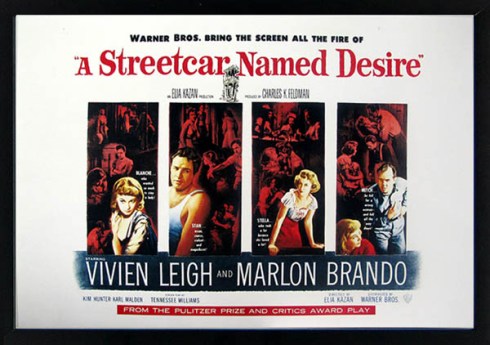
Tennessee Williams first took Broadway by storm in 1947 with his Pulitzer Prize winning stage production “A Streetcar Named Desire”. His dark and dysfunctional story was ripe for a film version and it came in 1951. In order to recapture the success of the play, Warner Brothers brought over several key players from the stage show including Williams to help with the screenplay, the director Elia Kazan, and cast members including Marlon Brando, Kim Hunter, and Karl Malden. The one big change came in the lead role. Jessica Tandy starred in the Broadway show but the studio didn’t consider her a big enough name. Vivien Leigh, who had been working on the London stage version, was brought in to round out the cast.

Leigh plays a southern belle named Blanche DuBois from Auriol, Mississippi. She arrives in New Orleans’ French Quarter to visit her pregnant sister Stella (Hunter) and brother-in-law Stanley (Brando). Stella is happy to see her sister but begins noticing several peculiar things about her. Blanche clings to fantasies of past luxury and prosperity. She still sees herself as a beautiful woman of prominence and stature. But we quickly see it to be a facade that she mixes with heavy drinking in order to deal with deeper buried secrets.

STREETCAR1

Stanley doesn’t like Blanche from the start and suspects her of holding out an inheritance from the sisters’ homeplace which was meant for both of them. He is brutish and his hot-temper often shows itself in fits of rage. His relationship with Stella is volatile and his physical and emotional abuse is startling. Stella just takes the treatment and keeps coming back to him which her sister doesn’t like. But Blanche has problems of her own which are seeded in some deep emotional baggage and psychological scars. The personality clashes and conflicts between these people is the driving force of the story.

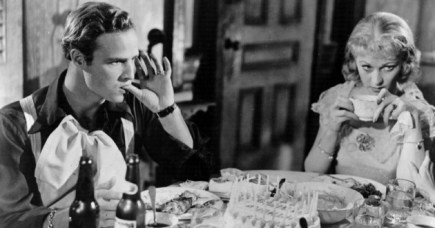
In almost every way “Streetcar” is more theatrical than cinematic. Its Broadway roots show themselves in nearly every facet of the production. It’s a very talky picture that focuses heavily on the actors and their performances. The vast majority of the film takes place in and around a cramped apartment building – a confinement that also resembles a stage production. But these parts are integral components to a story that doesn’t require lavish production designs or location shoots. The well conceived Hollywood studio sets are perfect for creating claustrophobic living spaces that force these characters to deal with one another. Add to it Kazan’s sweat-soaked depiction of the New Orleans heat and you have a grimy and uncomfortable environment that fits the narrative.

“A Streetcar Named Desire” was an Academy Award magnet earning twelve Oscar nominations and winning four of them. Most notably three of the wins were in the acting categories, a first at the time. Vivien Leigh won for her twisted and tormented depiction of Blanche. She was the only one of the main cast members who had not worked together on Broadway. Kazan urged her to use that lack of connection in her performance. Kim Hunter and Karl Malden also won Oscars for their supporting performances. Malden plays a unassuming fellow who desperately wants to love Blanche.

STREET2

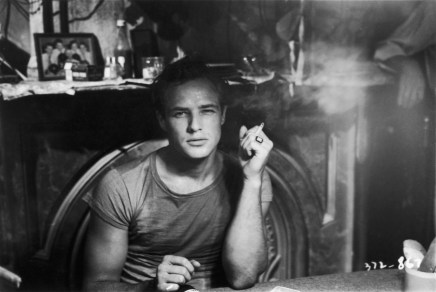
Marlon Brando was nominated for Best Actor but lost out to Humphrey Bogart who won his one and only Oscar for “The African Queen”. What’s interesting is that Brando’s performance is the one that has had the greater impact. This was his second feature film and it introduced his unique and tenacious method acting to a wider audience. Just look at the differences between the acting styles of Brando and Leigh often in the same scene. His performance as Stanley Kowalski displayed an instinctual prowess that would be present throughout his career. He brings such a vivid range of emotions to every scene he’s in. It’s raw but calculated work. Whenever the question is raised about Marlon Brando’s place among the best actors in cinema history, I point people to this performance.

Often heralded as a classic, “A Streetcar Named Deserve” earns its accolades. The Tennessee Williams story mixed with Elia Kazan’s sharp eye and some unforgettable performances cement “Streetcar” as one of the most focused and well made productions you will find. It’s rough, depressing, and unstarched, but it is so potent because of the characters. They are overflowing with energy and life and it is impossible not to be mesmerized by them despite their dysfunction. “Streetcar” made an indelible mark on cinema and it introduced the world to Marlon Brando. How can it not be considered a genuine classic?

VERDICT – 4.5 STARS

REVIEW: “The Act of Killing”

KILLING POSTER

A film like “The Act of Killing” is almost indescribable. It is strikingly unique and it certainly can’t be labeled or put in a box. Director Joshua Oppenheimer calls his film a “documentary of the imagination”. It’s bizarre, unsettling, and at times impossible to comprehend. It’s horrifying, repulsive, and unflinching in its focus. It’s an overused statement but “The Act of Killing” is unlike anything you have seen before and digesting what we are fed isn’t all that easy.

To understand this documentary you must first look back to 1965 in North Sumatra, Indonesia. A splinter group’s failed coup d’état led to a military takeover of the government. The new leadership blamed the Indonesian Communist Party (PKI) and soon sanctioned the wholesale massacre of communists across the region. But the killings weren’t restricted to alleged communists. There were also brutal mass murders rooted in racism and religion. It is said the killings have been overlooked in most Indonesian history books and by the international community, yet a CIA report called them “one of the worst mass murders of the 20th century”.

killing1

With that historical backdrop in place, the film spotlights some of the authors of the murders and we are told of their atrocities from the men themselves. Anwar Congo and Adi Zulkadry went from movie theater ticket scalpers to heads of military death squads responsible for thousands of brutal killings in 1965 and 1966. Even more appalling, they have never been punished or even found guilty of any crime. In many ways they are celebrated among the ignorant or sympathetic. These are the men we spend two hours with in “The Act of Killing”. Their words, their candor, their lack of remorse, their impunity. These men openly discuss their parts in the anti-communist purge in uncomfortable detail and often with smiles on their faces.

These men also have an unusual infatuation with western cinema which finds its way into the movie on several occasions. They constantly refer to themselves as ‘gangsters’, a term stemming from their love of American gangster movies. But it also seems that some of their real-life killings were patterned after these films. Anwar especially seems to treat the title of gangster as a badge of honor.

Killing2

But their love for movies also plays into the stories they tell. Throughout the documentary we listen in on pointed and detailed recollections of some purely evil murders. But these men also tell their stories through dramatic reenactments for the cameras intended to glorify their atrocities. Their scenes borrow from their favorite mob movies, westerns, and musicals. It’s these uneasy sequences of boastful self-aggrandizement that reveal the true evil dwelling within these people. As we get deeper into the movie the reenactments become more bizarre and surreal possibly a result of Anwar’s desire to squash any feeling of guilt that may be surfacing.

It took Joshua Oppenheimer over five years to make “The Act of Killing” and during that time he accumulated 1200 hours of footage. The result is a potent exposé that unveils one of the darker secrets of our world. I knew nothing of this horror which made the film all the more enlightening and disturbing. At times I did feel disconnected from the more absurd and unintelligible mini-productions from Anwar and company. But there are far more times where I sat in silent shock due to what I was watching. This is audacious filmmaking and there are several scenes carved into my memories. I would be surprised if others didn’t have that same experience.

VERDICT – 4 STARS

REVIEW: “August: Osage County”

AUGUST POSTER

“August: Osage County” is a hard pill to swallow. It’s based on a Pulitzer Prize-winning play of the same name and could be categorized as a dysfunctional family drama with pinches of dark comedy. It features a star-studded cast led by Meryl Streep and Julia Roberts and a premise that may have a lot of appeal to some audiences. But underneath all of the big acting from big stars lies a coarse and abrasive film that never knows when to pull back the reins. It ends up being a movie I could never wrap my arms around.

Tracy Letts (who also penned the play) writes the screenplay and John Wells (better known for his television work) directs the film. It’s set in Osage County, Oklahoma during a sweltering hot August. Violet (Streep) is a mean and contentious women suffering from mouth cancer and a heavy addiction to pain pills. Her husband Beverly (Sam Shepard) is a calmer sort who seeks refuge in his books and liquor. One day Beverly hires a caretaker for his wife and soon after disappears.

AUGUST1

Distraught over her husband’s disappearance, Violet calls in her family and a parade of family dysfunction follows. First to arrive is her sister Mattie Fae (Margo Martindale) and her husband Charles (Chris Cooper). Shortly after, Violet’s three daughters come. Barbara (Julia Roberts) is a shrill carbon copy of her mother. She’s at odds with her mom for leaving home and moving to Colorado. Karen (Juliette Lewis) is the spacy middle daughter who hasn’t been home in years. And there is Ivy (Julianne Nicholson), the youngest daughter and the only one who lives close to home. Each of these characters have a wheelbarrow full of flaws and baggage that all comes into play as the film moves along.

But if that assortment of maladjusted individuals wasn’t enough, we also have Barbara’s husband Bill (Ewan McGregor) who apparently has an eye for younger women and their daughter Jean (Abigail Breslin) who is bearing the fruits of their horrible parenting. Then there is Karen’s fiance Steve (Dermot Mulroney), a phoney and moral-free Florida businessman. Oh and then there is Charles and Mattie Fae’s awkward son Little Charles (Benedict Cumberbatch) who may have a weird little secret.

It’s almost impossible to like any of these people. With the exception of the caregiver, practically every character reveals an appalling secret, spits out hateful insults, or does something vile. And the film is relentless. It bludgeons you to death with one dysfunctional family scene after another. I found it to be smothering. The story never allows any breathing room or provides any variation with its characters. And the constant barrage of bad behavior and disgraceful revelations is a bit ridiculous. It’s as if Letts wants to trump one disgraceful act or insult with another. And so on and so on…

AUGUST2

Again, the cast is a laundry list of big names and the performances are good. However many of the scenes are so big and the characters so loud that it can be difficult to really appreciate the performances. It’s one of those cases where the material hurts what the actors are doing. Streep is fine as the venom-tongued Violet but she is so big and brash. It’s definitely how the character is written but Streep does her share of scene chewing. Julia Roberts has been applauded for her work but it too is a loud and showy performance. Roberts is never overmatched by the character and she shows brilliance in some scenes. But the character is crassly written and some of her dialogue is so over the top. The other performances aren’t getting the same attention, but they’re generally good when the screenplay allows them to be.

I’ve heard that the stage version of “August: Osage County” is very good. Sadly I don’t think it has translated well to the big screen. This is a crude and unyielding adaptation that has a powerful and potent potential. The idea is appealing and every so often we get glimpses of what I hoped the film to be. Unfortunately I was put off by these characters, their endless dysfunction, and their profane spite. This was a tiresome watch and tough movie to endure. It’s a shame because with this much talent I was expecting more.

VERDICT – 2 STARS

REVIEW: “American Hustle”

HUSTLE POSTER

I may not be a card-carrying member of the David O. Russell fan club, but there are several things you have to give him. He has a knack for creating and developing raw and thoroughly engaging characters. He is also able to put together incredible ensemble casts perfectly in tune with his characters. Both of these strengths are the key reasons why Russell’s new film “American Hustle” works. The movie has several of his same indulgences that don’t always work for me but it’s the characters and performances that makes this film so intriguing.

The movie is set in 1978 and is loosely based on the FBI’s ABSCAM operation. It’s a time of good music, big collars, and really bad hair. Irving Rosenfeld (Christian Bale) is a con artist who joins up with and falls for Sydney Prosser (Amy Adams). The two run a small time but controlled loan scam that is bringing in some nice cash. Things are going well until they are caught up with by an ambitious FBI agent named Richie Di Maso (Bradley Cooper). But Richie doesn’t want small time cons. He wants the career-boosting big fish. So he forces Irving and Sydney to work for him and entrap bigger targets, namely politicians and government officials.

HUSTLE1

Irving doesn’t like his circumstances at all. He likes things small and low-key. He also doesn’t like Richie and his constant changing of the rules. He feels that going too big will jeopardize the whole operation. But the biggest threat to their plans may be Irving’s loose cannon wife Rosalyn (Jennifer Lawrence). She’s loud, volatile, and she knows Irving has a thing for Sydney. That’s a pretty lethal cocktail. Another complication comes in the form of a New Jersey mayor named Carmine Polito (Jeremy Renner). He’s a popular and seemingly well-meaning guy who develops a friendship with Irving. The trouble is he becomes one of Richie’s prime targets.

This interwoven web of ‘who’s conning who’ could have been an utter mess but it actually plays out in an entertaining and fairly cohesive way. Much of that is due to the sharp script penned by Russell and Eric Warren Singer. It’s not perfect. There are lulls along the way and I couldn’t help but feel that they stretched the story to its limits. There are also a few glaring questions that remain unanswered. They don’t cripple the story the way major plot holes do, but they did stand out to me. Still, in terms of delivering a slick and stylish story, Russell and Singer pull it off.

But getting back to a previous thought, neither the direction nor the script are the film’s strongest point. The movie’s true success lies in the performances. It starts with Christian Bale. Armed with pretty much the same voice that he used playing Dicky in “The Fighter”, Bale was the most compelling character of the bunch. While he may sound like Dicky his physical appearance was quite different. In “The Fighter” Bale lost over 30 pounds to convincing depict a crack addict. In “American Hustle” he gained nearly 50 pounds which we get a good look at in the film’s opening scene. But Bale delivers much more than just a physical transformation. He gives us a character who is funny, selfish, crooked, pitiful, sympathetic – all encapsulated within a wonderful performance.

HUSTLE2

I also liked Bradley Cooper, an actor who has gotten surprisingly better over time. His character is a little hard to gauge at first but as the story unfolds so does Richie’s personality and ambitions. Cooper gives an hearty performance that does at times get a tad too big but is still impressive. And speaking of big, Jennifer Lawrence is also good as the powder keg Rosalyn. She has already raked in a ton of critical acclaim but I wouldn’t call this her best work. The character is loud and abrasive by design so the performance has to be big. But it isn’t until later in the film that Lawrence is actually allowed to show her range. On the other hand Amy Adams (goofy split-up-the-front blouses aside) is fantastic. Her character isn’t a ‘take home to meet the parents’ kind of girl, but there is a sad and needy underlying thread to her. Adams never misses a beat. And I can’t forget Jeremy Renner who has a smaller role but to me was just as good as anyone else.

I can’t say that “American Hustle” has any kind of staying power and I don’t think I’ll remember it as one of the great films. But there is something about these generally unlikable characters that draws you to the screen. In typical David O. Russell fashion they are a little too abrasive for my taste. But each is fascinating in their own right and each truly desires something more: Irving – to be a more successful con, Richie – an FBI superstar, Sydney – British royalty, Rosalyn – a loved and appreciated wife, Carmine – a legendary mayor. Most of the credit for this goes to the performances. “American Hustle” is more of a showcase of great actors than it is great storytelling, but it still keeps you glued to the screen as you watch them do their work.

VERDICT – 4 STARS