REVIEW: “Blackhat”

HAT POSTER

Michael Mann is a director that usually catches my attention. The 71-year old Mann has made several films over the years that I deeply love – movies like “The Last of the Mohicans” and “Heat”. It’s my strong affection for his good films that enables me to overlook his bad ones like “Miami Vice” and “The Keep”. The big question for me is which kind of movie is “Blackhat”? Does Mann give us another signature rock-solid thriller, or does this film qualify as a disappointing clunker?

So far it hasn’t been a good ride for “Blackhat”. Very few critics have given the film high marks and it’s already been considered a box office bomb. Unfortunately the criticisms have merit and it doesn’t take long to understand why the film was dumped in the January movie release graveyard. The most disappointing thing is that the film has a very timely and relevant concept. But that concept drowns in vast chasms of monotony and lethargy.

HAT1

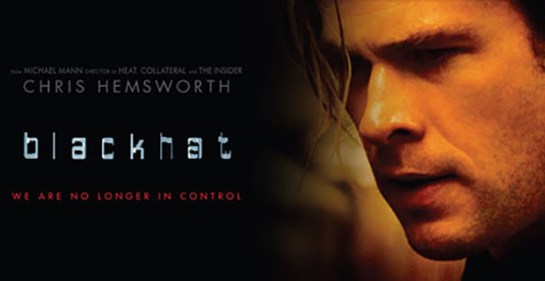
Chris Hemsworth steps back from his popular Marvel superhero persona to play an incarcerated computer hacker named Nick Hathaway. After a cyberterrorist triggers an explosion at a Chinese nuclear power plant, Hathaway agrees to help the FBI and the Chinese government catch the perpetrator in exchange for having his sentence commuted. After about two lines of political wrangling and negotiations Nick is out of jail and the internet manhunt begins.

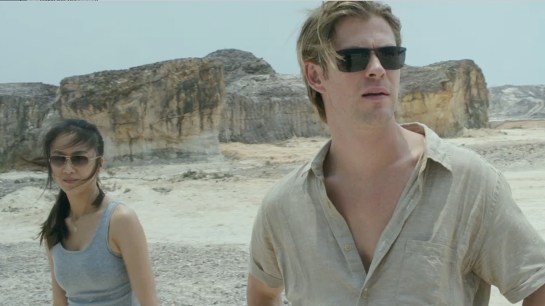
Hathaway (who looks like he’s been at a GQ photo shoot instead of a penitentiary) is joined by an old friend and Chinese cyber officer named Chen Dawai (Leehom Wang), FBI Agent Carol Barrett (Viola Davis), and Dawai’s sister Lien (Tang Wei) who out of the blue becomes Hathaway’s lover. The group tracks their target from the United States to China to Malaysia. Mann knows how to shoot locations and some of the film’s best moments involve his camera sweeping over a landscape or tracking down tight alleys. It’s certainly a better alternative than the constant shots of people staring at computer screens.

Speaking of that, we get plenty of scrolling digits and keyboard tapping. Computers obviously play a key role in the story, but it seems like we spend an eternity logging in, logging out, typing in the code, and so on and so on. I’m sure a lot of it is realistic. In fact Wired magazine reported that hackers and security experts both commended the movie for its accurate portrayals. But honestly, after a while I didn’t care. There was just too much of it for me and sometimes it would grind the movie to a halt.
HAT2

No such thing could be said about the action. Mann has always had an incredible eye for action sequences and it is no different here. And at times the action scenes actually jolted me back into the movie. Mann’s camera movements, his strategic angles, his intense use of sound and of his surroundings – all of these create some truly spectacular action scenes. Without question, the action is the star of the movie and I wish we had gotten more of it and less of the plodding story.

“Blackhat” is a movie built around a good idea and strengthened by some fantastic pulse-pounding action. But ultimately it sinks due to its tiresome, long-winded story. Even the ever likable Chris Hemsworth can’t help it. He seems completely out of character, struggling with whatever kind of weird accent he’s going for, and I never felt a charismatic spark from him. His performance will undoubtedly have people questioning his abilities in roles outside of the superhero genre. I don’t know, chances are he was simply bored like I was through a lot of this movie.
VERDICT – 2 STARS

REVIEW: “Birdman”

BIRDPOSTER

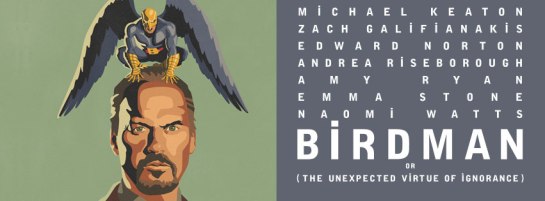
Boy it’s nice to see Michael Keaton finally getting a meaty starring role. He was a favorite of mine in the 1980s and early 90s but after that his career hit a significant lull. In “Birdman” he gets a chance to spread his wings (abysmal pun intended) and dive into a layered and complex role. He’s up to the task as evident by the slew of rave reviews and awards nominations. But while Keaton is fantastic, what about “Birdman” the movie? Is the movie itself as good as the performance of its star?

“Birdman” is a bit of a change for director Alejandro González Iñárritu. His previous films are known to be gloomy and emotionally heavy dramas. “Birdman” maintains the gloom and it tinkers with several emotionally heavy subjects, but at its core it’s really a black comedy. It dabbles in a number of things including strained family dysfunction, the stresses of the creative process, and satirizing the blockbuster movie culture. As with Iñárritu’s other films, some of these concepts work better than others, but he still manages to put together a strikingly unique and incisive film.

BIRD1

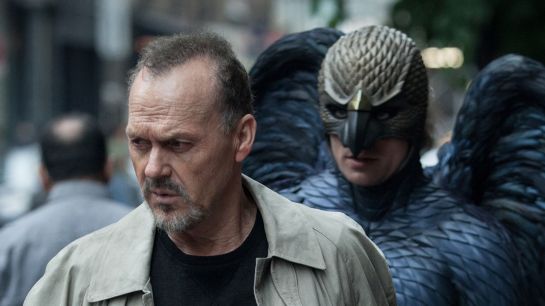
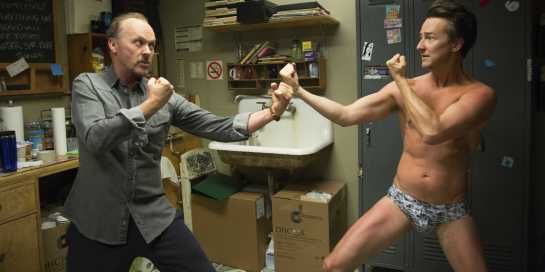
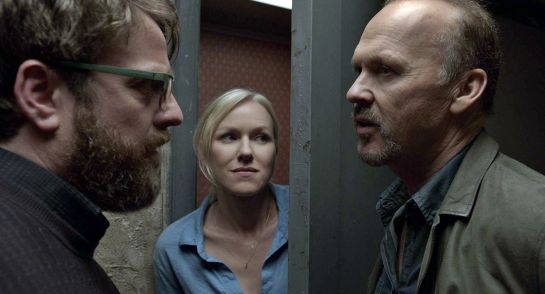
Riggan Thomson (Keaton) plays a once popular Hollywood star who made his name playing a character named Birdman in a series of popular superhero blockbusters. In an effort to revitalize his floundering career Riggan is writing, directing, and starring in a Broadway adaption of a Raymond Carver short story. But Riggan doesn’t really have an environment conducive to success. One of his lead actors is out of commission after a stage accident. His replacement is a pompous, explosive but accomplished method actor named Mike (Edward Norton). His lead actress Lesley (Naomi Watts) is a nervous first-time Broadway performer. His lawyer and agent (Zach Galifianakis) is panicky and always on edge.

But there are also a series of relationship issues that make things even more difficult for Riggan. His estranged daughter Sam (Emma Stone) is fresh out of rehab and serves as his assistant. He has a tense relationship with his ex-wife and Sam’s mother Sylvia (Amy Ryan). And then there are a number of complications with his current girlfriend and co-star Laura (Andrea Riseborough). Riggan also has internal struggles. He is constantly searching for affirmations of importance, relevance, and self-worth. In his head the gravelly voice of Birdman constantly insults him and showers him with expectations of failure.

bird2

Needless to say Michael Keaton is brilliant and his Riggan character is the most compelling of the bunch. Keaton has always had panache and “Birdman” gives him a chance to flaunt it. Riggan is such a wild card – a swirling ball of emotional chaos. He’s constantly on edge and you get a sense that his Broadway production has become his own private hell. It, and him for that matter, seem to be careening towards disaster. Keaton manages all of this with a manic tenacity, yet he always gives us convincing quiet moments. Keaton gives us so many layers to his character. Is he a raging egotist? Is he having a mental breakdown? Is he a bit of both? All of the supporting work is good, but for me it all comes back to Keaton.

Another attention getter is the kinetic cinematography from the great Emmanuel Lubezki. Most of the film visually presents itself in one long continuous state of motion. The camera snakes down hallways, prowls behind characters, hovers and rotates during conversations. It’s all done with some pretty clever bits of trickery which gives the illusion of a long unending take. The ever-moving camera feels in tune with the hectic, turbulent atmosphere, and I loved how it made every nook and cranny of St. James Theatre familiar to us. But at the same time I was happy when the camera would just stop, be still, and just let us focus on the actors.

bird3

There is no denying the technique and smarts behind “Birdman”, but despite its bold and fresh appearance, in terms of narrative is it doing anything we haven’t seen before? And I don’t think all of Iñárritu’s satire works. His shots at entertainment media and criticism, his look at entertainment versus art, none of it really clicks. I also found it pointlessly crass at times and surprisingly low on humor even during the scenes where it’s really trying to be funny. Perhaps the funniest thing about “Birdman” is having Michael Keaton, an actor whose career went downhill after playing Batman, play Riggan.

“Birdman” is an interesting entry into Alejandro González Iñárritu’s filmography. It’s not quite as miserable and tragedy-driven as his past films and that’s refreshing. But Iñárritu is still a director who can suffocate his story with his style and high concepts. In this film I think his technique is one of the strong points. It’s clever, well implemented, and it feeds the frantic chaos of the wonderful setting. And while the film is a bit smug at times and the story is stuffed to the gills, I still found myself hooked. As I said, there’s something hypnotic about “Birdman”. Oh, and did I mention Michael Keaton?

VERDICT – 3.5 STARS

REVIEW: “Big Eyes”

BIG EYES POSTER

At one time director Tim Burton was on top of the world and his ghoulishly gothic style seemed fresh and unique. But recently his career has been marred by several flops and people seem to be growing tired of his darker approach and constant Johnny Depp collaborations. Personally I had been off the Burton bandwagon for a while, but his 2012 animated gem “Frankenweenie” won me back a bit. His latest film is “Big Eyes” and Burton is one step closer to having me back in his corner.

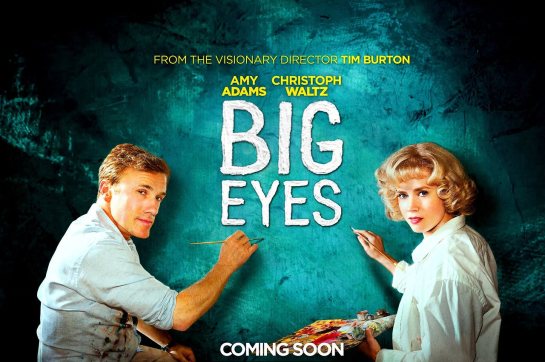
“Big Eyes” is a biographical drama that tells the story of American artist Margaret Keane and her husband Walter. Margaret (played by Amy Adams) was a talented sketcher and painter whose work came to prominence during the 1950s through the 1960s. It was a time when little thought or consideration was given to “lady art” (as her husband so insensitively puts it in one scene). Her art style was uniquely her own and featured children with big, wide eyes.

BIG2

The film begins with Margaret leaving her first husband and moving to San Francisco with her young daughter Jane. We see Margaret as timid and unsure of herself. She finds her one true emotional release in her art. Enter Walter played by the always fascinating Christoph Waltz. He too is an artist and he woos Margaret with his charisma and exotic tales of his time spent in Paris. The vulnerable Margaret, needing a whole filled in her life, marries Walter.

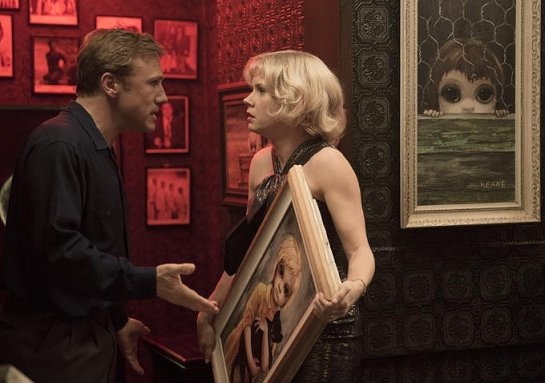
At first their life together is fun and free, but we see the first ripple when Walter sells one of Margaret’s paintings as his own work. What followed was a 10 year ruse that saw Walter taking the credit for the paintings while a guilt-ridden Margaret did all of the work behind closed doors. Her naïve and timid personality was no match for Walter’s manipulative and shameless character. In essence he was a snake oil salesman both as an art dealer and a husband. The popularity of the art grew and grew, but behind the scenes a much more personal struggle was taking place.

This is truly a strange and compelling story and I love the way Burton and screenwriters Scott Alexander and Larry Karaszewski tell it. It’s written in a way that allows its two top-tier stars to form these characters through their performances. Interestingly enough Adams and Waltz have two very different approaches. Adams is quiet, serious, and reserved. Waltz is big, energetic, and hyper-charismatic. It may sound like the performances clash, but that’s not the case because they are perfectly in tune with the characters. Margaret is subdued and unassuming. Walter is a showman and a salesman.

BIG1

And I tip my hat to Tim Burton for stepping outside of his routine and showing nuance in his filmmaking. A sensibility and thoughtfulness takes the place of his normal macabre style. It’s a much lighter touch yet there are still a number of subtle Burton signatures. Quirky bits a humor shake the tone up a bit and Burton does several things with his camera that hearkens back to some of his earlier films. But overall it’s a refreshing turn from a filmmaker who a short time ago had found himself in a rut.

I can see people having problems with “Big Eyes”. I can see people bothered by the shifts in tone and what they perceive as clashes between the two lead performances. Not me. I was locked into the story from the start, I appreciated the visual representation of the 1950s and 1960s, and I loved the performances. Reese Witherspoon and Ryan Reynolds were first attached to the film, but it’s hard to imagine anyone doing better than Adams and Waltz. Add in a much different Tim Burton approach and you have a very entertaining film that tells a truly surreal story.

VERDICT – 4 STARS

REVIEW: “The Babadook”

BABDOOK POSTER

You could say there are two very different stories being told in “The Babadook”. But over time you’ll notice that the two are cleverly and shrewdly interwoven giving us something well beyond a run-of-the-mill horror film. It’s an intelligent film made with a tiny $2 million budget and actually completed thanks to a Kickstarter campaign. The end result turned heads at Sundance and it is finally getting deserved respect from a wider audience.

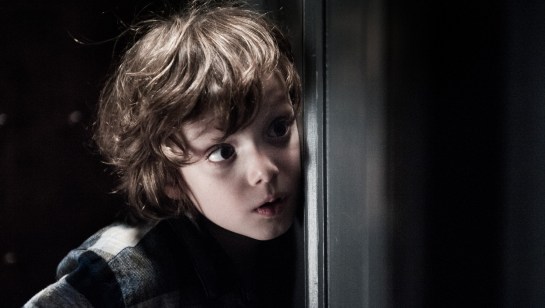
The film was written and directed by Jennifer Kent and found its roots in a short film Kent made in 2005. The story follows a widowed single mother named Amelia (Essie Davis) and her young son Samuel (Noah Wiseman). The two have been alone since the death of her husband and his father. Samuel hasn’t adapted well to his fatherless home. He’s a lonely boy with a number of behavioral issues which cause problems at school and home. On top of that Samuel is haunted by dreams of a terrifying monster and his belief in it causes his behavior to be even more erratic and troubling.

BABA1

But it could be said the film is more about Amelia. She is an earnest and loving mother who struggles to conceal her own sorrows and burdens for the sake of her son. Kent’s vision and Davis’ performance create a disconsolate portrayal of a woman drowning in her circumstances. We get close looks at how her situation effects every social and potentially romantic relationship she has. We easily sympathize with Amelia which makes the sharp turns in the second half of the film all the more devastating.

One night things take an even worse turn. Samuel asks Amelia to read him a pop-up children’s book titled “Mr. Babadook”. It’s a grisly story about a creature who consumes those made aware of his existence. Samuel is convinced Babadook is real leading to even more troubling behavior. A series of creepy events begin happening around their house which Amelia first attributes to her son. But soon she too comes face-to-face with the question of Babadook’s existence. It’s here that the lines between reality and the supernatural are blurred.

“The Babadook” is a creepy movie but not in the conventional sense. Jennifer Kent pointed to movies like “The Shining”, “Texas Chainsaw Massacre”, and even “Nosferatu” as influences and you can see them in her technique and presentation. And “The Babadook” does indeed employ several familiar horror film devices. But she uses such a careful and strategic blend of classic haunted house scares, boogie man frights, and the film’s most potent element – psychological horror. It all works to near perfection. Adding to the movie’s uniqueness is the wonderfully eerie use of sound and the minimalist approach to special effects. These things are vital to giving the film its own satisfying aesthetic.

BABA2

But the main reason that the horror works is because of the characters. The first half of the film sets them up and connects them to the audience. By the second half we are so invested in Amelia and Samuel and their deteriorating circumstances that we are desperately rooting for a happy resolution. It’s this connection with the characters that so many horror films fail to establish. Davis gives an inspired performance and conveys such motherly authenticity through her character. Young Noah Wiseman is heartbreaking and deserves a lot of credit. His character transforms over time and he manages it so well in his performance. These two are the lifeblood of the film.

In the end I found myself smitten with “The Babadook’s” smarts and craftiness. The story is rich with raw emotion and a genuine eeriness. There is always a tinge of uncertainty which constantly has you questioning what you’re seeing. I like that kind of interpretive challenge. This isn’t the type of film that will ever be considered a classic, but it’s well written and well made which I believe earns Jennifer Kent attention as a filmmaker to keep your eye on. She certainly has a winner with this film.

VERDICT – 4 STARS

REVIEW: “Boyhood”

BOYHOOD POSTER

“Ambitious” is an adjective that is probably overused by many when reviewing movies. As a result many well-known and prominent movie critics steer clear of the word and often view it as a negative description of the film. Their idea is that many people excuse a film’s faults by hiding them under ambition. That may sometimes be true, but I’ve never prescribed to that reasoning nor do I avoid using the word when it accurately describes a film. There are plenty of examples of movies that have combined great ambition and great storytelling. “Boyhood” is one such example.

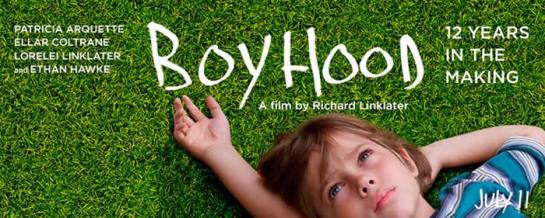
Let’s talk about the film’s ambition. Writer and director Richard Linklater has shown himself to be one of the great modern American filmmakers. In “Boyhood” he gives us a coming-of-age drama unlike any you’ve seen before. Filming spanned twelve years starting in 2002 and the same cast was used the entire time. They were brought back to shoot scenes periodically throughout those twelve years in hopes of capturing an accurate physical representation of aging. It also allowed the cast to grow with their characters making the film’s time transitions all the more realistic. This is an extremely ambitious project.


BOYHOOD1

But it isn’t just the clever and innovative approach that makes this a good film. It’s Linklater’s simple but beautifully conceptualized vision for presenting a young boy’s life from preadolescence to early adulthood. There is no distinct streamlined plot. Instead we are introduced to a young boy named Mason and we experience his complicated, topsy-turvy boyhood with him. Linklater doesn’t ask us to dissect or wrestle with the material. Instead he seeks to show us the complexities and minutia of real life. He wants us to invest in Mason and let his circumstances strike an emotional chord. We laugh with him. We fear for him. We worry about him. Essentially we grow up with him.

Mason is played by Ellar Coltrane, a relatively unknown actor who was 7-years old when filming began. Coltrane has a quiet reservation about him that we consistently see in every stage of Mason’s life. It’s an acting quality that gels nicely with Linklater’s vision for the character. When we first meet young Mason he is living in Texas with his older sister Samantha (played by Richard Linklater’s own daughter Lorelei) and his single mother Olivia (Patricia Arquette). His father Mason, Sr. (Ethan Hawke) reappears after over a year doing his own thing in Alaska.

Mason’s life has its share of obstacles and it starts with his parents. His mother works hard to provide for Mason and Samantha. She moves them to Houston where she finishes her degree and gets a good job. But her loneliness leads to bad choices which effect her children. Mason, Sr. is a flaky and irresponsible father who won’t get a job and doesn’t always provide a mature fatherly influence during his time with his kids. In a sense Mason and Samantha’s time with their father is an escape. Mason, Sr. clearly hasn’t been a good father, but he loves his kids and they recognize his good intentions. As the film harmoniously moves along we learn more and more about these characters and we watch them and their circumstances evolve.

BOYHOOD2

At times “Boyhood” feels like a series of random moments sewn together to form a beautiful whole. We often move from scene to scene without any narrative connection between them. But that’s okay because the film is about the journey. We literally watch Mason (and Coltrane) grow up before our eyes. One minute we see a young boy laying on the couch asking his father about the existence of magic and elves. An hour later we watch a 16-year old get into his Toyota pickup. It’s such a visually satisfying trip through time brought to life through Linklater’s brilliant approach, Sandra Adair’s impeccable editing, and the cast’s unquestioned commitment.

Speaking of the cast, I’ve talked about Coltrane being a great fit as Mason and he only gets better as he transforms from a first-grader to a college freshman. But Patricia Arquette is the one getting a ton of attention and rightly so. This is a such a strong and honest performance , significantly better than when I first saw her years ago in “A Nightmare on Elm Street 3”. She doesn’t offer an ounce of pretense and she never overplays her scenes. And as you would expect Ethan Hawke is really good and you never doubt the truth he brings to his character.

BOYHOOD3

The only performance I struggled with came from Lorelei Linklater. In her defense she is considerably better by the end of the film but by that time we rarely see her. Prior to that I felt she was forcing her performance and she looked like a young actress who was having every line, every look, and every expression drawn out by the director. I also struggled with these odd and sometimes clunky political sequences that pop up several times. At first they feel like a natural extension of a particular character. Later the politics and characterizations seem forced and very heavy-handed. This stands out mainly because Linklater is such an instinctive and precise writer.

Those things aside, what is it that great movies do? They challenge us. They cause us to reflect. They cause us to appreciate. They cause us to feel. “Boyhood” did all of that for me but not in a casual sense. It is a coming-of-age story but it also looks at other things like parenting – the sacrifices of good parenting and the consequences of bad parenting. As a father, that hit home for me. The film had me looking back on my own childhood, but also thinking about my 13-year old son and the life he is living. Walking out of the theater I wanted to hurry home, give him a hug, and tell him that I loved him. Some may call that corny. I call it being moved by a very good movie.

VERDICT – 4.5 STARS

(Fun observation for “Dazed and Confused” fans: Pay close attention to the brief scene in the liquor store. The clerk is played by none other than David Blackwell. He played a very similar convenience store clerk in “Dazed”)

REVIEW: “Blue Ruin”

BLUE RUIN POSTER

I’ve come to realize that I’m attracted to movies that employ a more visual form of filmmaking. By that I mean movies that rely heavily on the camera to tell their stories. These types of films often feature sparse dialogue, revealing imagery, and very unique performances from their leads. They tend to speak to many of our senses as an audience and I like that. We get a lot of this in “Blue Ruin’, a deeply engrossing revenge thriller from Jeremy Saulnier. Revenge movies are a dime a dozen which is why “Blue Ruin” is so refreshing and satisfying.

Saulnier is a cinematographer at heart, but he has one other feature film to his credit – 2007’s casually titled “Murder Party”. In “Blue Ruin” he takes a much different approach and the result is a film worthy of attention and consideration. Saulnier serves as writer, director, and cinematographer, and he gained funding after a successful Kickstarter campaign. The movie turned some heads at the Cannes Film Festival and soon found a distributor and a limited theatrical release. Thank goodness for that because “Blue Ruin” is a fantastic film.

BLUE RUIN1

The story centers around a man named Dwight (Macon Blair). He’s a vagrant living out of his beat-up Pontiac Bonneville in a northeastern beach town. Through a series of informative scenes we see him finding meals out of dumpsters and breaking into homes to bathe. But sprinkled in are tiny clues that seem to indicate that Dwight’s situation wasn’t always this bad. Things take a dramatic turn when he learns that a double murderer is being released from prison as part of a plea deal. There are clear connections between the two which sends the movie down a tense, violent, revenge-fueled path.

To reveal anything more about the story would be to strip it of one of its greatest assets – unpredictability. One of the best things about “Blue Ruin” is that you never know where things are heading. Dwight isn’t a tough guy by any stretch and most of his actions seem spontaneous and compulsive. And since we literally spend the entire movie with him, we’re always uncertain and constantly on edge. You never get a sense that Dwight has thought beyond the moment and the film never tips its hand to the audience. Therefore our journey is dictated by every action the capricious lead character makes.

Another of the film’s strengths is the unquenchable tension and suspense. Much of it is credited to the above mentioned air of uncertainty that permeates the entire story. It is also due to Saulnier’s great work with the camera. When watching the film there is no doubt that he is a filmmaker who knows the artistry behind good cinematography. His strategic handling of imagery, the use of northeastern landscapes, and the framing of numerous shots not only serves his visual style, but it amps up the suspense. Regardless of whether he is shooting a closeup of an expressive face or one of the film’s few sudden bursts of violence, the movie looks great.

Blue-Ruin2

Then there is the performance from Macon Blair, an actor with only a handful of credits to his name. I recently listened to a discussion about whether a better known and more experienced actor could have added to this character and movie. Personally I think that would have overthrown everything the film was going for. Blair’s tepid and reserved performance is an absolute perfect fit for what the character needs. The supporting cast is small but very good. Even Jan Brady herself, Eve Plumb makes an almost unrecognizable appearance.

“Blue Ruin” is a small-budget film that does more things on the screen to enthrall an audience than most blockbusters. Jeremy Saulnier is a revelation as both a filmmaker and storytelling, and Macon Blair has me interested in what he will do next. I love being taken for a ride and not knowing what lies ahead, especially in a movie centered around deep, moody suspense. “Blue Ruin” took me for that ride and I was completely invested until the very end.

VERDICT – 4.5 STARS