REVIEW: “Clean” (2022)

(CLICK HERE to read my full review in the Arkansas Democrat-Gazette)

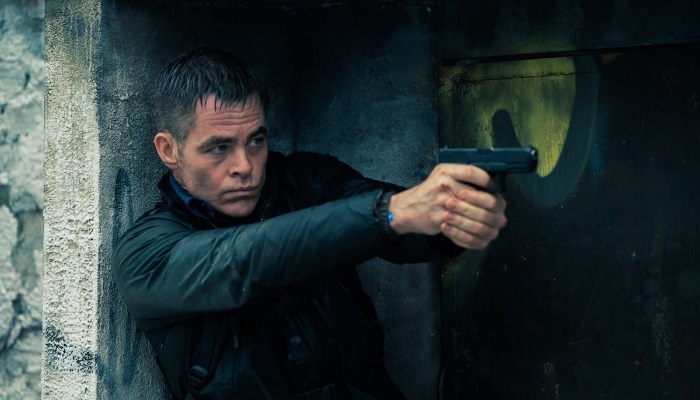
Adrien Brody plays a garbage man with an ax to grind in director Paul Solet’s dour and abrasive crime drama “Clean”. Co-written and co-produced by Brody, “Clean” has a lot in common with other movies of its kind. You have the quiet and brooding loner with the dark and mysterious past. There’s the longing for and vain attempt at some semblance of a normal life. Then (of course) there’s that one event that provides the catalyst for the movie’s big violent finish.

All of those story beats may ring familiar, but Solet and Brody approach their material in a way that almost gives the illusion of something fresh. It’s found in their strangely slow and pensive pacing. “Clean” takes its time unpacking its main character, giving just as much attention to his psychology as his more “savage” physical abilities. It even begins with grim yet hammy philosophical narration that features lines like “I’m still looking for answers. I just don’t know the questions anymore.“

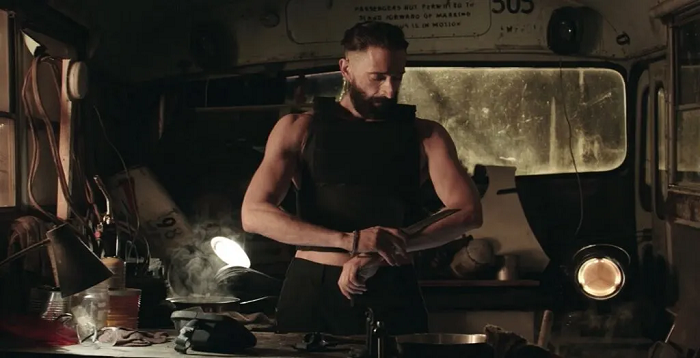
With his pale complexion, tired eyes, thick black beard and a gravelly snarl, Brody plays a man called Clean. He drives a trash truck route around the outskirts of New York City, collecting old scrap for himself along the way. At home, in a dried-up forgotten part of town, he uses the scrap to fix up old junked appliances which he sells to a local pawn shop owner (RZA) for cash. When he’s not running his truck, he’s repainting abandoned neighborhood houses. It’s a mundane ritual, but it keeps him focused on something other than his dark impulses.

Image Courtesy of IFC Films

The one shimmer of light in his otherwise gloomy life is a young girl from his neighborhood named Dianda (Chandler DuPont). Each day Clean fixes her lunch and drops it off before she heads to school. It’s a sense of paternalism that stems from a traumatic bond the two share. Dianda lost both of her parents and now lives with her grandmother. Clean is tortured by a particularly devastating tragedy from his past (as these character types usually are). He lost his daughter, a victim of a lifestyle he brought into their home. Helping Dianda is his self-imposed act of penance.

The film’s big baddie comes in the form of a local drug kingpin named Michael (Glenn Fleshler). He’s your standard issue movie hood – part gangster, part sociopath. He operates out of a local fish market where he runs a tight ship. The one thorn in his side is his apathetic son Mikey (Richie Merritt) who would rather hang out with his friends smoking weed and listening to hip-hop than learning the family business.

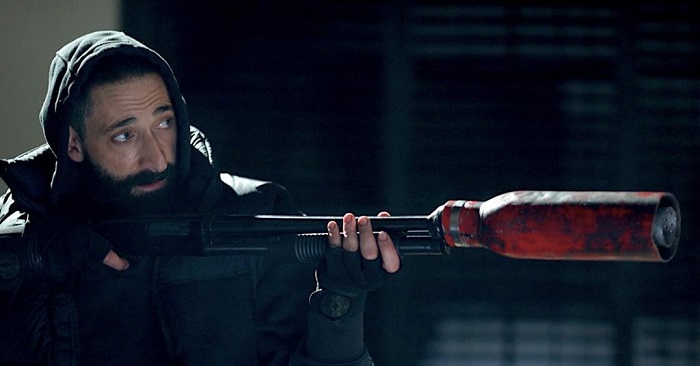
Without getting into the details (not that they matter much), Dianda gets sucked in by some local hooligans which quickly turns Clean from good shepherd to avenging angel. It begins a violent chain of events, eventually putting Clean in Michael’s crosshairs. From there it careens towards its inevitable climax – one that’s brutally exhilarating to a point, but with little in terms of originality. Think of it as a dialed-down “John Wick” minus the style. Or maybe “Taxi Driver” but with a grittiness that often feels manufactured rather than inherent to the storytelling.

Image Courtesy of IFC Films

The movie is also helped by a really strong Adrien Brody performance. Considering some of his more recent roles, it may be easy for some to forget how good of an actor he really is. To the 48-year-old’s credit, he pours himself into the character, fully committed and fittingly stoic. He brings a hard-edged physicality to the action scenes, but he’s also good in the quieter moments. For example he shares some strong scenes with Mykelti Williamson who plays Clean’s sponsor. Their barbershop therapy sessions are when the film feels its most honest.

Despite Brody’s best efforts, there is still something undeniably derivative about “Clean”. The performances are solid, the setting is authentic, the bursts of gruesome violence are well shot and have a basis in the story. There are even moments of real sincerity and pathos. Yet at its core there’s really nothing here we haven’t seen many times before. It’s a nagging reality that I never could shake and that zaps the movie of its urgency.

It’s unfortunate really because this is clearly a passion project for Brody. But at this point, if you’re going to do ‘the moody guy seeking redemption for his violent past’ story you need to bring something fresh to the story. The film’s early patience teases that. But in the end it’s hard to find anything particularly new or surprising.

VERDICT – 2 STARS

REVIEW: “C’mon C’mon” (2021)

The ever enigmatic yet insanely talented Joaquin Phoenix follows up his Oscar-winning turn in “Joker” with a dramatically different performance in a much different movie. “C’mon C’mon”, written and directed by Mike Mills, is a surprisingly sweet and heartfelt drama that may look familiar on the surface, but that avoids many of the snares that often accompany films in this vein.

A warm and gentle Phoenix is once again in nomination worthy form in “C’mon C’mon”. He plays a single middle-aged documentarian named Johnny who travels around the country with his tiny production team interviewing kids about their views of the world and their dreams for the future. He asks these questions to a diverse group of children from a variety of backgrounds. Sometimes the answers he gets denotes hope and optimism. But often the responses are rooted in fear, uncertainty, and skepticism.

Image Courtesy of A24

While working in Detroit he gets a call from his sister Viv (Gaby Hoffmann) in Los Angeles who he hasn’t seen since their mother died a year earlier (Mills comes back to their old baggage at different points in the film, unpacking it delicately and truthfully). Viv tells Johnny her bipolar and estranged husband Paul (Scoot McNairy) is in a bad way in Oakland and needs her help. But she can’t find anyone to watch her eccentric nine-year-old Jesse (Woody Norman).

So Johnny flies out to LA, a little nervous about taking care of an energetic youngster on his own, but its only for a few days. “Are you ready for this?”, Viv asks. It’s a question you could also ask the audience. Because what follows isn’t a sudsy melodrama or a kiddie comedy. Much like the scenes with Johnny interviewing children, this is a movie about listening and connecting. Everything Mills does (the gorgeous black-and-white cinematography, the eclectic score) works towards that purpose. He wants his audience to listen and feel as his characters listen and feel.

Image Courtesy of A24

Just as essential as Mills’ honest and heartfelt touch are the three wonderfully nuanced central performances. Phoenix brings a quiet and earnest sincerity to Johnny which really comes out in his scenes with young Norman. The two have a sparkling chemistry which only gets stronger as the story takes them from LA to New York. Norman is terrific in a year full of terrific child performances. Meanwhile Hoffmann doesn’t get as many scenes, but she does a great job visualizing Viv’s buried pain and frustration.

“C’mon C’mon” moves at its own subtle harmonious pace, muting any sense of showiness or sentimentality in order to keep us focused on the relationships at the core of its story. There are some good laughs, some genuine emotions, and a depth to its characters that makes us care about them and their efforts to reconnect. The movie does require patience, because (much like in real world) life often happens at its own pace. We feel that during our time with Johnny, Jesse, and Viv. It’s part of the film’s beauty and charm. “C’mon C’mon” is now showing in select theaters.

VERDICT – 4 STARS

REVIEW: “Cry Macho” (2021)

(CLICK HERE to read my full review in the Arkansas Democrat-Gazette.)

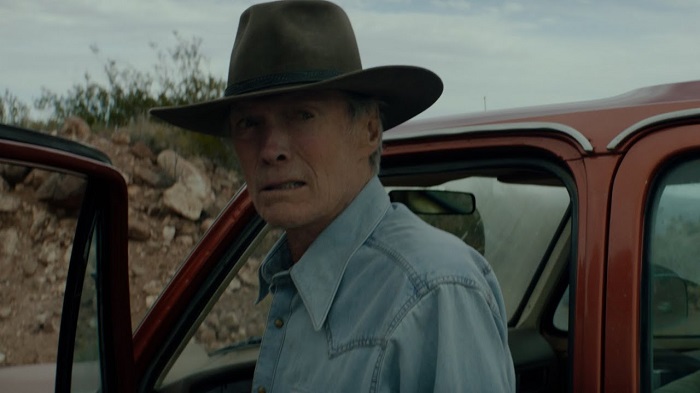
One thing about Clint Eastwood, even at 91-years-old the seasoned and often surly actor, director and producer still plays by his own rules. His notorious and staunch independence is what led him to turn down an offer to play James Bond and pass on the lead role in Francis Ford Coppola’s “Apocalypse Now”.

Yet that same self-reliance also drove many of the choices that led to his screen-legend status. And when it’s all said and done, few will be able to claim a more impressive or prolific career than the man with the steely squint and gravelly snarl.

For over six decades Eastwood has been a poster boy for stoic masculinity in movies. From his iconic Man with No Name role in Sergio Leone’s trio of spaghetti westerns to his gnarly San Francisco police officer “Dirty” Harry Callahan to his crusty intolerant curmudgeon in “Gran Torino”. I mention that because his latest film “Cry Macho” offers Eastwood a chance to look back on a long career often defined by its tough machismo-soaked roles.

Image Courtesy of Warner Bros.

“Cry Macho” won’t go down as one of Eastwood’s best films nor is it the kind of movie that will change any minds about his work. Yet it’s the type of stripped-down and straightforward story that’s perfect for this stage in Clint’s career. It’s an endearing reflection wrapped in an overly simplified story that gets by, not because of the character on the screen, but because of the legend who fills his shoes. Then again, so much of Eastwood is packed into the character that you could call them inseparable.

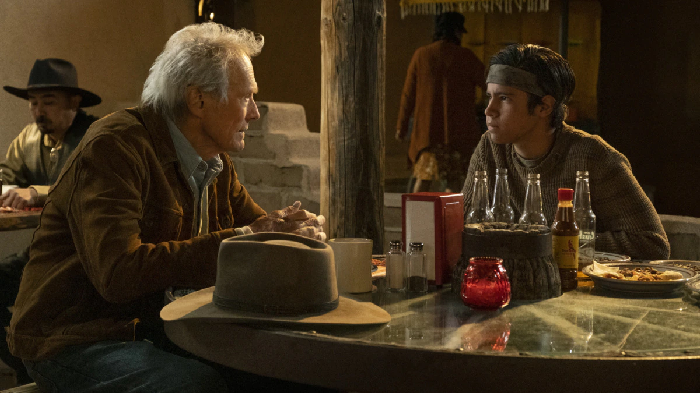
Set in 1979, Clint plays Mike Milo, a worn-down former rodeo champion working as a horse trainer for a wealthy rancher named Howard Polk (Dwight Yoakam). We first meet the unapologetically gruff Mike as he shuffles in late for work (again) prompting a fed up Howard to fire his crusty ranch hand. But before doing so Howard unloads with an exposition-heavy rebuke that only exists to lay out Mike’s troubled backstory – his crippling rodeo accident, the addiction to pills and booze, the crushing family tragedy.

This hurried and awkward opening continues “one year later” when Howard shows up needing help. He wants Mike to go to Mexico City and bring back his estranged 13-year-old son, Rafo (Eduardo Minett) who lives with his wild and neglectful mother, Leta (Fernanda Urrejola). “You owe me Mike,” he reminds the old cowboy. “Yeah, I owe ya,” Mike replies honoring an old-fashioned code that believes a man’s word means something.

The story then heads south of the border where Mike finds young Rafo at a back-alley cockfight. The two don’t exactly hit it off, but predictably over time a bond develops between the old man, the young boy, and a rooster named Macho. Their road-trip has its hazards – car thieves, the federales, Leta’s goons. At the same time, the absurdity of it all isn’t lost on Eastwood who never misses a chance to squeeze out some pretty good laughs.

Image Courtesy of Warner Bros.

Despite all of its neo-western dressing, “Cry Macho” is actually pretty mellow and is much more interested in the two lost wandering souls than its low-key thriller elements. This becomes clearer when the movie takes a sudden detour eventually settling down in a small Mexican village. There Rafo gets his first feel of stability while Mike’s leathery exterior begins to soften thanks to the kindness of a local cantina owner (Natalia Traven). This is where the movie really hits its free and easy stride.

The aggressively simple story has its obvious conveniences and missing details which Eastwood has no interest in exploring. But that’s consistent with Clint’s signature efficiency and clear-minded classicism. It’s the emotional and even spiritual undercurrent that ends up driving the movie. It’s Eastwood’s critical self-analysis and reflection mixed with a healthy dose of irony. It’s the unexpected sweetness, warmth, and compassion.

Ultimately the mileage you get out out of “Cry Macho” may hinge on your connection with its legendary star and director. If you’ve been with him for decades, this film will be a graceful extension of that journey. And while the his latest won’t be for everyone, it reminds me of how glad I am that Clint Eastwood is still making movies.

VERDICT – 3.5 STARS

REVIEW: “Copshop” (2021)

CLICK HERE for my full review in the Arkansas Democrat-Gazette

“Copshop” is the latest abrasive crime thriller comes from director Joe Carnahan, a filmmaker known for exploring society’s gritty criminal underbelly. This particular outing may have you checking the end credits to see if Quentin Tarantino’s name is attached. That should give you a good idea of the kind of movie Carnahan is shooting for.

In reality, “Copshop” more closely resembles the B-movie schlock that often inspired Tarantino rather than an actual Tarantino movie. And that’s not necessarily a bad thing. Co-written by Carnahan and Kurt McLeod, the story feels like something pulled from a 1970’s pulp magazine and the evocation of John Carpenter’s “Assault On Precinct 13” is hard to miss.

But as movies have shown us countless times, aiming for something and hitting it are two different things. And marrying both style and substance can be tricky. At first glance “Copshop” has all the ingredients for a fun and grimy throwback exploitation flick. The cast is certainly up to the task and DP Juan Miguel Azpiroz shoots the film with a nostalgic verve that energizes the action and the setting. If only the writing was as sturdy.

Image Courtesy of Open Road Films

Carnahan’s modestly entertaining actioner is built around a nifty premise that sets us up for a number of second-half revelations. There’s also an infusion of kooky black comedy that may not always work, but it keeps things lively. And of course there’s the inevitable violent final act blow-out that packs enough carnage and mayhem to make genre fans smile.

Yet despite all of that, “Copshop” is never quite as suspenseful or engaging as it needs to be. And while the cast does a good job selling their characters, too many are your standard issue variety and all of them speak in the exact same foul-tongued pseudo tough guy vernacular found in many of Carnahan’s movies. And while the majority of the performances are on point, everyone ends up constricted by their character types.

It doesn’t take long for the story to kick into gear with most of it playing out over the course of one night at Gun Creek Police Department, a strangely remote yet noticeably modern police station (why it sits literally in the middle of nowhere is one of those glaringly obvious questions you’re not supposed to ask in a movie like this).

The first of the key players we meet is con-man and seasoned mob fixer Teddy Murretto (Frank Grillo sporting an anchor beard, a man-bun and one gaudy pair of snakeskin boots). He’s a slippery rogue who has frequently eluded death and prison. We’re introduced to him as he’s barreling down a Nevada highway in a bullet-riddled Ford Crown Victoria, the windows busted out, smoke billowing out from under the hood.

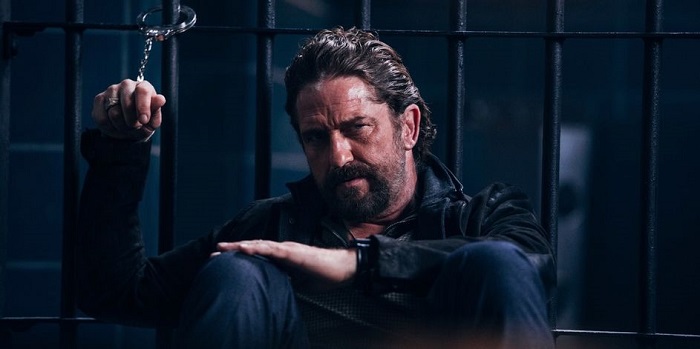
Turns out there’s a bounty on Teddy’s head and he’s running from several interested parties who are eager to cash in, among them the ruthless and notorious hitman Bob Viddick (Gerard Butler), a career killer known for his no-nonsense efficiency and penchant for violence. Viddick’s not someone you want hot on your heels so Teddy does something desperate- he punches a young deputy named Valerie (Alexis Louder) to get himself arrested. What safer place to hide out than in a jail cell at a local copshop?

Image Courtesy of Open Road Films

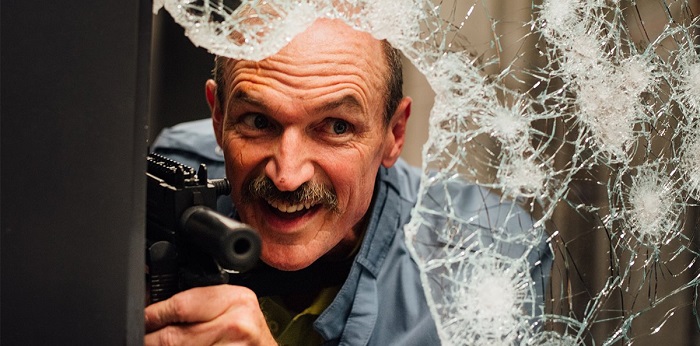
What Teddy didn’t count on was Viddick doing the same thing. Soon the assassin and the target are sitting in cells across from each other with Valerie trying to put together the pieces. Things get even crazier with the introduction of a second hitman, a psychopathic wildcard named Anthony “Tony” Lamb (Toby Huss), a wildly uneven swirl of disturbing menace and cartoonish silliness. Let the psychological chess matches between the sleazeball, the hired gun, the hero and the maniac begin.

The rest of the running time is filled with snarky interplay, chest-pounding masculinity, clichés galore, more trite cop banter than you can shake a police baton, and a slew of stereotypes. Then we get back to the humor which highlights Carnahan’s self-awareness but does more to undermine the suspense than make us laugh.

The real saving grace is the cast, especially the central trio. Butler is a nice fit and while it’s true the Scotsman has starred in his share of stinkers, it’s nice to be reminded of his legitimate acting chops. Grillo is a Carnahan regular and is right at home in the director’s grimy underworld. But the real standout is actress Alexis Louder who matches her two burly veteran co-stars barb-for-barb and bullet-for-bullet. If only the rest of the movie had her spark. “Copshop” is now showing in theaters.

VERDICT – 2.5 STARS

REVIEW: “The Card Counter” (2021)

Following in the footsteps of the stellar “First Reformed” was never going to be easy. But filmmaker Paul Schrader’s latest “The Card Counter” is a noble effort. In fact in some ways Schrader’s new film makes for a compelling companion piece to that highly acclaimed 2018 character study.

In “First Reformed” Ethan Hawke played a tortured pastor of a small upstate New York church suffering a crisis of faith. In “The Card Counter” it’s Oscar Isaac playing a gambler haunted by his past time as an ex-military interrogator. Both characters struggle with a similar inner tension just in a different setting and with different details.

The 75-year-old Schrader writes and directs the straightforward titled “The Card Counter” which centers on a poker-faced card-sharp who goes by William Tell (Isaac). We first meet him as he’s finishing up an eight-and-a-half year prison sentence at Fort Leavenworth. He liked prison. He liked the order, the routine. It’s where he honed his skills at blackjack and card counting. In some tantalizing early narration William explains how the technique works and how a good card counter can take away the house’s advantage and use it against them.

Image Courtesy of Focus Features

William has carved out a life for himself, making a good living by traveling to small casinos across the Midwest using his skills to make a modest profit at each stop. He hasn’t just figured out the trick to winning at blackjack, he’s also figured out how to stay under the radar. He’s learned that casinos don’t pay attention if you win by counting cards. They take notice if you win too much by counting cards. So William bounces from one gaming house to another, always quitting while he’s ahead, and then moving to the next town.

Not only does William enjoy this life, but it helps him suppress and conceal the emotional turmoil inside of him. It’s what holds him together. Isaac’s performance is top-notch and it’s hard to see through his steely solemnity. But it’s obvious there so much behind William’s eyes, namely deep-rooted PTSD from his time at Abu Ghraib and his participation in the state-sanctioned ‘enhanced interrogation techniques’ under the command of the callous military contractor Major John Gordo (Willem Dafoe). A series of potent flashbacks put us into William’s head and they’re shot with an unsettling visceral style.

Things take a turn when William meets Cirk (that’s “Kirk with a C” he constantly reminds everyone), a wayward young man played by Tye Sheridan with a troubling connection to a figure from William’s military past. Sympathetic and concerned, William takes Cirk under his wing. In one sense he hopes to help the boy and steer him in a better direction. But William also discovers a new sense of purpose – something other than the blackjack table that drives him. There’s also this idea of guilt and expiation, both individually and symbolically. It’s a crucial piece to William and Cirk’s odd relationship, and it’s a theme woven throughout Schrader’s picture.

Image Courtesy of Focus Features

Then you have Tiffany Haddish’s La Linda, the third member of this ungainly traveling trio. She’s a go-between who connects gamblers with wealthy backers who then bankroll the players. Normally William wouldn’t be interested. But with Cirk in debt and needing a new start, maybe a few tournaments backed by some big investors could bring in the money the kid needs.

While Haddish doesn’t always seem in-tune with Schrader’s tone, this is one of her better performances. More subdued and bringing a welcomed warmth, this is nice reprieve from the louder and more in-your-face Haddish. It’s the same with Sheridan who sometimes feels a bit out of place. Still, his low-key character is a central piece of the story and it’s easy to overlook a few sluggish points especially considering how everything plays out.

In the end it’s Oscar Isaac who drives the movie and he’s just the right fit for Schrader’s stern Bresson-like minimalism (just like Hawke in “First Reformed”). As his character is slowly unpacked, Isaac maintains an icy and cryptic stoicism. But we do see cracks in his exterior which ends up taking the movie in an unexpected direction. At the same time, it plays out in the only way that seems fitting for a story that has a lot more on its mind than blackjack and poker tournaments. “The Card Counter” is now showing in select theaters.

VERDICT – 4 STARS

REVIEW: “The Colony” (2021)

Throughout the grand history of cinema there have been countless science-fiction stories about humanity seeking a new home in space. Some have been sprawling odysseys of discovery while others have been about settling and surviving in exotic and sometimes dangerous new worlds. The new Swiss-German sci-fi thriller “The Colony” does something a little different. It tackles the idea of going back to Earth after two generations away.

Tim Fehlbaum directs “The Colony” which does what most good sci-fi does – it focuses on humanity as much (if not more) than aliens, deep space or futuristic tech. There are several subtle themes woven into the film’s story. But at its core the movie explores the notion of losing our humanity in our efforts to save it. How far is too far? At what point do we cross the line and lose the very thing we’re so desperately trying to preserve?

To set up the story (co-written by Fehlbaum and Mariko Minoguchi), a deteriorating climate, global pandemics and endless wars rendered the Earth uninhabitable. As a result, the ruling elites used their means to leave the planet, eventually settling on a space colony they called Kepler 209. Two generations pass and the colonists discover that something on their new home has made them infertile. Shades of “Children of Men”?

Image Courtesy of Saban Films

Reasonably fearing that their inability to reproduce will lead to their extinction, scientists put together The Ulysses Project, an exploratory mission to find out whether a return to Earth is possible. The first crew to attempt a landing on the blue dot was assumed lost and never heard from. Not a good sign.

“The Colony” begins with Ulysses 2 bursting through Earth’s atmosphere. It’s a jolt of an opening that’s one of the film’s few “action” moments (if you can even call it that). The pod carrying the three-person crew malfunctions during its entry and crash-lands. One crew member is dead on arrival, the mission commander (Sope Dirisu) is seriously wounded and astronaut Louise Blake (Nora Arnezeder) survives the crash unscathed.

One of the first things you’ll notice happens to be one of the movie’s biggest strengths, and that’s the harsh and barren world Fehlbaum imagines. Our once thriving planet is shown as nothing more than a dank and desolate wasteland of tidal waters and mud flats. It’s visualized through mostly practical effects that emphasize the unwelcoming bleakness and dystopian dread. To capture these early outdoor scenes, Fehlbaum took his cast and crew to the German Tidelands rather than use green screen. The shoots proved challenging, but the benefits on screen are obvious.

Arnezeder (who earlier this year shined in Zack Snyder’s “Army of the Dead”) makes for a compelling protagonist. As Blake, she’s essentially the lens through which we see this world unfold. After landing she immediately begins taking samples and readings. But just minutes into the movie she’s attacked and taken prison by a band of scavengers – human survivors who were left behind when the wealthy and powerful made their exodus. And there’s also this – they have children.

From there Fehlbaum tosses aside outer space and plants us in his apocalyptic hellscape where the survivors are already repeating mistakes from humanity’s past. Most notably, something akin to a class structure has taken form. The scavengers live in rickety huts able to float whenever the tide roles in. They’re frequently invaded by a more advanced and overtly oppressive colony who dwell in the belly of a massive grounded freighter fortified by walls of metal. The two factions create an interesting dynamic that has some startling parallels to our modern society.

Image Courtesy of Saban Films

Driven by Kepler 209’s cult-like mantra “for the many” (which Blake chants repeatedly, more to convince herself than out of some deep conviction), Blake is determined to complete her mission and get word back to her home colony. But soon she finds herself drawn into the conflict between the emerging haves and have nots. Soon she’s forced to question herself and her own motivations. It’s an intriguing angle especially with children involved. The scavengers have them; the other community wants them.

While Fehlbaum’s exploration gets points for its thoughtful human-centered interests, there’s a frustrating vagueness to both the story and the characters. With the exception of Blake, none of the people we meet are given much depth and some are little more than devices. Meanwhile the deeper we get into the story the more conventional it gets. There’s also an undercooked mystery surrounding Blake’s father (the leader of the first Ulysses mission) that could’ve used more attention.

Thankfully “The Colony” never completely derails in large part because of the stellar production design. The stark dismal environments brings thoughts of “Waterworld” and “Mad Max” but without the big studio shine. Instead Fehlbaum’s world is ugly, gritty and palpable. And while his story may lose a little of its focus, the underlying themes form a thought-provoking message that’s pretty timely for our current day. “The Colony” is now showing in select theaters and on VOD.

VERDICT – 3.5 STARS