An examination of Fellini’s “8 1/2”

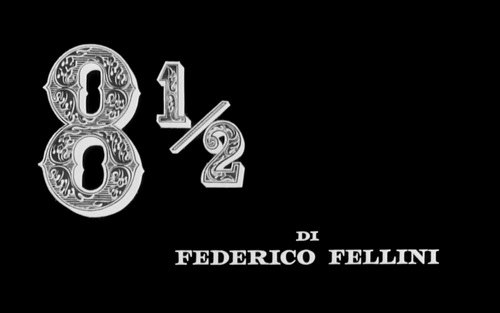
8 poster

Director Federico Fellini has long been one of Italy’s most important gifts to the world of cinema. A daring and proficient filmmaker, Fellini had a career that featured various stages of evolution. Most notably was his turn from popular Italian neorealism to an almost surreal fantasy mode of cinematic storytelling. There are some who have viewed Fellini’s shift in style and approach as a turn in the wrong direction and a small handful of his later films may support that view. But I can’t go along with that, especially when said style shift gave us treasures like “La Dolce Vita” and “8 1/2”.

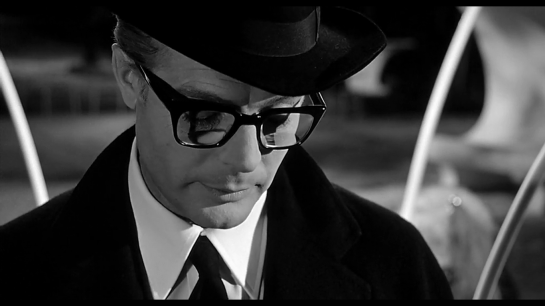
“8 1/2” is a semi-autobiographical film that gets its name from the eight and a half feature films and shorts Fellini had made up to that point. For the first time in his life Fellini was experiencing a creative stall. His struggles with director’s block inspired him to start over and make a film about a prominent Italian director laboring through the same creative pains. Trusted actor and friend Marcello Mastroianni would play the lead role of Guido Anselmi who is an undeniable reflection of Fellini with a few added dramatic twists.
8-3

At first glance it may be easy to dismiss “8 1/2” as a malaise of off-beat dream sequences and surreal imagery. But as with every great cinematic work, there are layers of creativity and ambition that one can’t appreciate with a single viewing. There is no doubting that at that point in his career Fellini was a visual storyteller and his images play a pivotal part in “8 1/2”. But they aren’t images just for the sake of images. Fellini has specific things in mind and it takes some digging to find their meaning.

Take his dream sequences as an example. Each of the film’s dream sequences serve as an escape for Guido – a refuge from the anxiety and stresses of his real life. But each dream also feeds us information about who Guido really is. Some are simply memories taken from his past. Some are past memories heightened with hyperbolic flare. Others are full blown dreams emphasizing Guido’s perspectives, his fantasies, or his different states of mind. In other words the dream sequences in “8 1/2” aren’t simply indulgences or vain attempts at masking Fellini’s uncertainties.
8-2

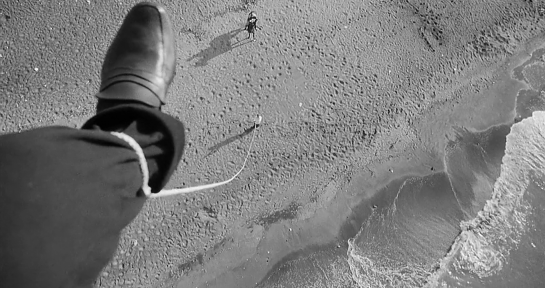
While the movie isn’t thick with plot, it paints a mesmerizing portrait. Its story resides within the Guido character and the absorbing performance from Mastroianni. We get an idea of who Guido is through the film’s unforgettable opening scene. While caught up in a massive traffic jam smoke filters from the vents of his car filling the cab. Desperate for help he pounds the windows, but everyone around him simply stares. He manages to escape and makes an angelic-like ascension. But while in the air and getting a small taste of freedom, he feels the tug from a rope that is tied around his leg. On the other end of the rope is a member of his production team who represents the maddening life he can’t seem to escape.

Guido is surrounded by chaos. He is a respected director working on a big budget science fiction picture, but his deadline to begin filming has come and gone. A huge hunk of “8 1/2” takes place at a fancy Italian resort where his cast and crew have gathered to begin working on the film. The problem is Guido has hit a creative wall and his apathy is frustrating everyone involved. He is bombarded with pressure from his short-tempered producer, his misanthropic lead writer, a high-maintenance French actress, and several others from his production crew. Guido has no defined plan for his movie and we slowly witness the emotional toll it is taking on him.
by r

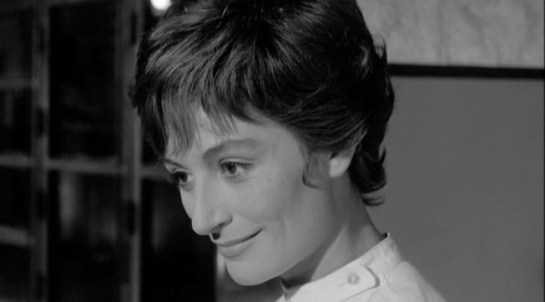
There is another contributor to Guido’s melancholy. It’s his messy, complicated web of relationships which includes his wife and mistress. The alluring Anouk Aimée plays Guido’s wife Luisa, a smart and elegant woman frustrated by her husband’s indifference. Carla (Sandra Milo), his mistress, is a chintzy, nagging starlet who irritates as much as excites. It appears as if Guido juggles these relationships without an ounce of thought. At one point in the film he has both women at the resort at the same time. But is this simply a mismanagement of his mangled love life or is it an intentional move by a man desperate for some form of resolution? As with most of “8 1/2” there is more to it than what we see on the surface.

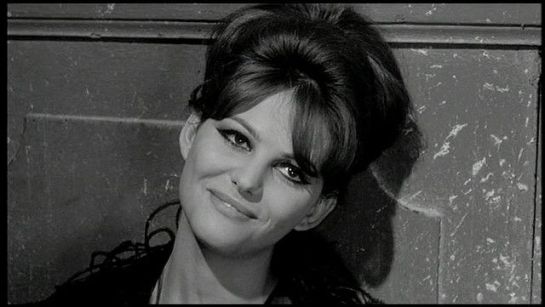
Guido’s perception of women, love, and romance is skewed. We see this in the film’s famous harem dream sequence which features all of the women in Guido’s life embodying various fulfillments of his imagination. While it does reveal his warped perspectives, the dream also visualizes the internal conflict that’s fueling Guido’s deteriorating state of mind. In essence Guido can’t escape the turmoil in his dreams or his reality. To combat this mental and emotional back-and-forth Guido loses himself in reoccurring visions of the “perfect” woman. The stunning Claudia Cardinale represents his ultimate fantasy. She is his symbol of purity, spontaneity, and innocence. She is always dressed in white and she appears with a ghostly elegance and grace. She is his dream girl.
8-4

But as with everything else in Guido’s life, reality offers a much different perspective than his fantasies. That gets to the greater point of “8 1/2” – dealing with reality instead of fleeing from it and finding genuine inner happiness. At the same time and more directly Fellini examines the pains and pressures that accompany creativity – the inspirations and expectations filmmakers struggle with during the creative process. Roger Ebert called this the best film ever made about filmmaking. It’s hard to argue with him.

“8 1/2” is a movie that marches to its own beat and it doesn’t follow any established formula or convention. It is free of any and all caution and hesitation. It is a film that will undoubtedly still have detractors who won’t completely respond to its unbridled vision. But it could be said that the true beauty of “8 1/2” is found in its confusion. It’s found in the physical and psychological mayhem. It’s found in Fellini’s unique film language and audacious visual approach. And the most amazing thing about “8 1/2”? It found its genesis and inspiration in the mind of a struggling, burdened auteur. It just goes to show that true cinematic art, much like the life we choose to live, originates within us and not in some polished and meticulously detailed script.
VERDICT – 4.5 STARS

REVIEW: “Exodus: Gods and Kings”

EXODUS POSTER

I can’t help but wonder if it’s actually possible for a ‘by the good book’ movie to be embraced and appreciated within the arena of contemporary film criticism. Don’t misunderstand me, I’m not saying critics have been given a lot of quality Bible-based movies to consider. I’m just curious if a receptive environment exists in criticism these days for movies like Cecil B. DeMille’s “The Ten Commandments”? Is this why a flawed movie like “Noah”, which drastically alters the biblical account, is widely accepted among critics? Is this why Ridley Scott chose to omit some key portions of the Moses story in his new film “Exodus: Gods and Kings”?

Now make no mistake, thankfully “Exodus” is no “Noah”. Darren Aronofsky used his Noah story as a platform to promote everything from environmentalism and animal rights to redefining the God of the Bible in several unsavory ways. Ridley Scott doesn’t do that in “Exodus”. “Noah” was also utterly ridiculous and downright dumb at times. “Exodus” doesn’t have that problem either. Scott takes several dramatic liberties, but he does maintain a level of respect for the source material. Instead it’s the numerous omissions that hold the film back a bit.

EXODUS1

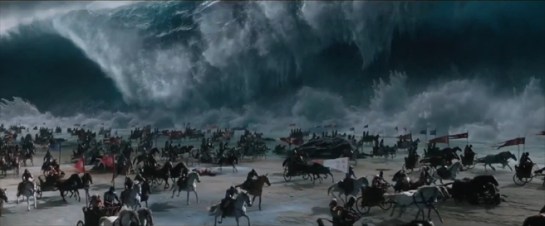
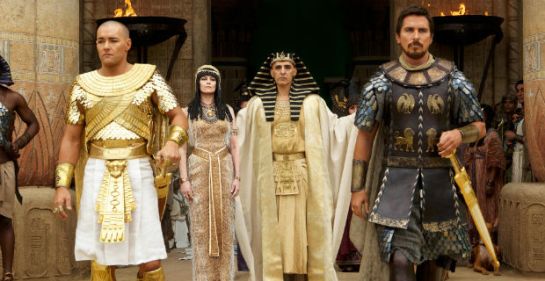
It may be an overused term, but “Exodus” is by definition an epic. Ridley Scott is definitely playing in a familiar period piece sandbox and the sheer scope of the production is jaw-dropping. Over 1,500 special effects shots and some incredible costume and set designs were used to create this vast and vivid landscape. This may be the most visually arresting movie I’ve experienced this year, and it could be said that it should be seen on the big screen to fully appreciate its accomplishments.

The sweeping story begins in 1300 B.C. with Moses (Christian Bale) serving as a general in the Egyptian army. He holds a place of prominence after being adopted into the royal family as an infant and raised with friend and Pharaoh-to-be Prince Ramesses (Joel Edgerton). The Moses of this film is a very complex character. We see him as stubborn, defiant, and conflicted. These traits really come out after God appears to him and tasks him with leading His chosen people out of Egyptian slavery. The film paints Moses as a reluctant prophet at first – one who often disapproves of God’s actions. Only over time does he finally understand that God is with them.

EXODUS2

Now “Exodus” could be theologically picked apart, but I felt its central focus was on target. But there were interpretive decisions that puzzled me. For example, when God speaks to Moses He does so through a messenger – a young boy. I’m sure there is some deeper meaning behind that imagery, but it’s completely lost on me. I also think Moses’ reluctance to follow God and general lack of faith carries on for too much of the film. I think it robs the story of some of its deeper meaning.

On the other hand there are some interpretations that really intrigued me. For instance, I love the way Scott presents the ten plagues. Aside from the odd way the film launches them, there is a natural connection between several of plagues that is very well realized. Some people have voiced displeasure with the use of nature, but I think it works because the plagues are still clearly supernatural. The same with the parting of the Red Sea. It’s definitely a different approach and some of the changes are unnecessary. But the entire sequence is tense and thrilling. It’s an incredible visual spectacle.

EXODUS3

There has also been criticism about the casting of predominately white actors playing Hebrew and Egyptian characters. Some have gone as far as to ask for a boycott. I don’t like these objections because they automatically assume a degree of racism is behind the casting even though no evidence exists to support it. I also think in this case they ignore some really good performances. Bale gives a solid performance that skillfully moves his character from prominent Egyptian royalty to tired and destitute Hebrew leader. And Joel Edgerton is very good as Ramesses. It’s an incredibly committed performance that could have gone terribly wrong in lesser hands. Both actors put all into their characters and I have nothing bad to say about their casting.

“Exodus” is an interesting Bible-inspired epic. There are a number of Bible omissions and deviations that actually hurts the plot. There are also some unfortunate narrative jolts – moments where the story leaps ahead without giving us the information we need to fill in the gap. But the movie doesn’t disrespect the Biblical account and there no hidden or secret agendas as with Aronofsky’s “Noah”. And then there is the overall presentation from director Ridley Scott. No one can visualize huge and ambitious period pieces like he does. I can’t tell you how many times I said “Wow” while sitting in the theater. It’s that visionary style that ultimately brought this amazing and beloved story to life for me. I doubt it will resonate with most critics, but I’m hoping it finds an audience.

VERDICT – 4 STARS

REVIEW: “Ender’s Game”

Enders game Poster

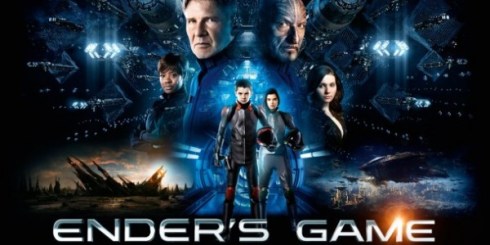
It would be easy to lump “Ender’s Game” in with the current trend of science-fiction films centered around young people. These movies seem to be popular now and modern Hollywood has shown it will milk popular trends dry. But while “Ender’s Game” has several elements that puts it in this category, it also does somethings that sets it apart. It is a movie with a thinly-veiled message, but it’s also a fun bit of science fiction that doesn’t always feel original but still works as a whole.

Asa Butterfield, who I loved as the wide-eyed title character in Martin Scorsese’s “Hugo”, plays a young prodigy named Andrew “Ender” Wiggin. After months of observation, he is sent to an advanced battle school by Colonel Graff (Harrison Ford). The school is the first step in preparing the kids for war with an alien species known as the Formics. 50 years earlier the Formics attacked Earth but were finally repelled by the heroic and sacrificial acts of a now iconic soldier named Mazer Rackham. The military believes another alien attack is inevitable so they plan to strike before the aliens do.

ENDERS2

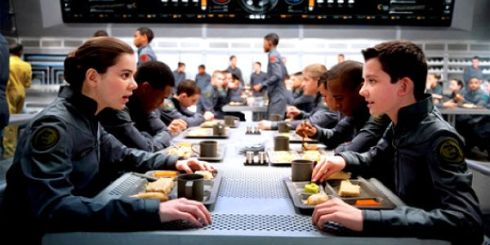
The film follows Ender and a number of other kids through various stages of Battle School. You see apparently these video game savvy youth have acquired a better skill set for the video game-like combat of the future. As Ender advances he encounters an assortment of new kids, some of which are characters we’ve seen in movies a hundred times before. For example, there is an adolescent “Top Gun” rivalry that was just too corny to buy into. All of this is going on under the watchful eye of the cold, businesslike Colonel Graff and his counterpoint Major Anderson (Viola Davis) who is more interested in the children’s emotional well-being.

The story builds and builds towards the seemingly inevitable war to come. Ender develops a few close relationships with fellow cadets including an outgoing girl named Petra. She’s played by Hailee Steinfeld, one of my favorite young actresses in Hollywood. Ben Kingsley also pops up in the second half of the film with an interesting role and a face full of tattoos. The performances from all who I’ve mentioned are solid. I’m really impressed with Butterfield and Steinfeld, both of whom know how to handle themselves in front of the camera. Some of the other young actors, not so much.

ENDERS1

While I liked the story of “Ender’s Game” as a whole it does run into a wall about two-thirds of the way through. It begins to feel as if it is repeating itself (with slight advancements of the plot) at certain junctures. I eventually found myself ready to move past Ender’s training and get to the big finale. It certainly does come with some big special effects and a few rather disorienting twists that took a minute or two to soak in. Some interesting ramifications and personal conflicts follow which I thought was a neat way to end the story.

Maybe I shouldn’t say “end the story” because “Ender’s Game” is clearly set up with a franchise in mind. The final scene leaves no doubt about that. I would check out another chapter of this story although I’m not sure how compelling the new direction might be. As for this first installment, it is a fairly satisfying bit of science fiction that walks the tricky line of trying to appeal to youth and adults alike. For the most part it succeeds. It’s not a movie I would rush to see again, but it is a film I can appreciate.

VERDICT – 3.5 STARS

REVIEW: “Enough Said”

ENOUGH poster

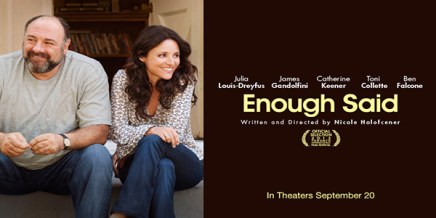
“Enough Said” is an interesting romantic comedy/drama from writer and director Nicole Holofcener. It’s one of those films that has magically latched onto critics who were giving it rave reviews. It has one of the highest aggregate scores on Rotten Tomatoes and it has found its way on numerous Top 10 lists from well respected critics. But what is it about this movie that has earned such high praise? Here are a few things that come to mind: charm, wit, an intelligent script, and two very strong lead performances.

The true magic of “Enough Said” starts with two fine leads. Julia Louis-Dreyfus plays Eva, a divorced single mother and self-employed masseuse. Her life is in a repetitive rut at least until she meets Albert played by James Galdolfini in the first of his final two roles before his death. He two is divorced with a young daughter. The two decide to go on a date which launches a very unlikely relationship. In some ways the two couldn’t be more different. She is a fit and attractive middle-aged woman while he is an overweight middle-aged regular Joe. The film points out these physical differences on numerous occasions and I feel it’s for a specific reason. At first Eva may be desperate to fill a void in her life but soon she sees beyond physical appearances to what really anchors a relationship.

ENOUGH1

“Enough Said” develops one of the purest depictions of an adult relationship you’ll see on screen. For years Hollywood has been fixated on divorcees when it comes to depicting relationships. That has fascinated and at times frustrated me. But here it is very pertinent to the story and more importantly to the characters themselves. Dreyfus and Gandolfini are fantastic and have a remarkable chemistry. You do root for them to make it and overcome their faults and past mistakes. Dreyfus has always had this infectious wit that I’ve been attracted to, and Gandolfini shows a brilliant range that many of us didn’t realize he had.

Holofcener’s script is smart and authentic but I have a few quibbles with it. There are a handful of subplots that are vaguely introduced but never really explored. A couple of them do reflect on our two main characters but others feel tacked on and unnecessary. There is also a twist with a character named Marianne (played by Catherine Keener). She and Eva become friends and they have some good moments together, but I couldn’t really buy into the overall idea behind the twist. I can see where it would work in a film a little more focused on straight comedy. But here it felt like a stretch.

Still, “Enough Said” is an intelligent and refreshing alternative to the bulk of what passes for romantic comedies these days. It’s mature in the sense of its middle-aged focus and it’s grounded in its portrayal of fallible and believable characters. But the biggest treat is watching Julia Louis-Dreyfus and James Gandolfini effortlessly embody these two characters. Both are fantastic and they are the real heart of the film. And for me, it’s their performances that are the biggest draw.

VERDICT – 4 STARS

REVIEW: “Escape Plan”

ESCAPE PLAN MOVIE

Ever since the release of “The Expendables” in 2010 there has been a resurgence of 80s styled action pictures. Arnold Schwarzenegger and Sylvester Stallone, the two biggest names from that once immensely popular genre, have returned to the big screen with a number of bullet-riddled movies. The two stars join together, bicep to bicep, to bring us the silly and implausible “Escape Plan”. But who would go to a Sly and Arnie movie looking for something with deeper meaning?

In many regards “Escape Plan” is big, dumb throwback fun. The entire premise is a bit goofy and writers Miles Chapman and Jason Keller trip over themselves in the telling of the story. But still, there is a nostalgic satisfaction that this movie provides. It hearkens back to ‘the good old days’ for these two stars. They have more gray hair, they’re slower, they need more camera trickery to make them appear like the big screen tough guys they once were. But both still have charisma and an air of confidence that makes this film fun even amid its occasional eye-rolling bad dialogue, gaping plot holes, and overall silly concept.

ESCAPE 1

The story goes like this: Stallone plays a fellow named Ray Breslin and he wrote the book on prison escapes and I mean that literally. He is the head of a security firm that evaluates the strengths of maximum security prisons. How does he do this? He develops a false identity, has himself placed in the prison, and then breaks out. Helping him in this odd but apparently lucrative business is his skittish business partner Lester (Vincent D’Onofrio), his trusted associate (and possible romantic interest) Abigail (Amy Ryan), and a computer hacker named Hush (Curtis “50 Cent” Jackson).

One day Breslin and company are approached by a CIA operative (Caitriona Balfe) who wants him to test a top secret prison built for the worst criminals. It’s the mother of all prison breaks that comes with a healthy $10 million payday attached. Breslin decides the money is too good to pass up so he throws aside his standard safety protocols and allows himself to be captured, drugged, and transported to “The Tomb” (play ominous location music here). Once there he quickly learns he’s been set up and it will take the help of a surly fellow inmate named Rottmayer (Schwarzenegger) if he hopes to get out.

Escape 2

Swedish director Mikael Håfström does a fairly good job of keeping things moving once it gets started and there are some interesting twists along the way. The Tomb itself is pretty neat with its honeycomb glass cells and intriguing secret. The guards wear black uniforms and cool futuristic masquerade ball masks (although I’m not sure why). Then there is Jim Caviezel who is a ton of fun as the soft speaking sadistic warden. His deliveries and mannerisms offer an entertaining variation of a fairly familiar character type. And while Stallone is in serious mode most of the time, Arnie gives the film some humor. Amid his sometimes corny dialogue and patented wooden line reading, he tosses out some pretty decent laughs.

All of that sounds good but unfortunately the problems I mentioned earlier do stand out. You’ll have to accept its absurdity and understand that there are several questions you’ll never get sufficient answers for. The storytelling is a little sloppy in places, the dialogue a bit cheesy, and it doesn’t have many of those big moments that we’re used to getting from these fellows. But I still give the film some credit. Stallone and Schwarzenegger aren’t spring chickens any more but the fact that they still have those big infectious action-packed personalities says something. And that’s a big reason they’re able to make this film work.

VERDICT – 2.5 STARS

REVIEW: “Edge of Tomorrow”

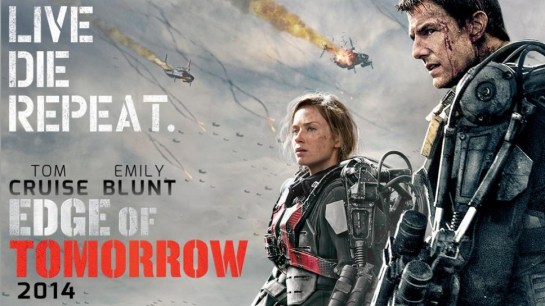
EDGE PSOTER

Some folks immediately dismissed “Edge of Darkness” once they heard the name Tom Cruise and science-fiction joined together again. Not me. This was one of my most anticipated films of 2014. Unlike many I enjoyed Cruise’s last sci-fi project “Oblivion” although it was a movie with noticeable flaws. Now he’s back playing in a science fiction sandbox filled with a strong script, cool special effects, and a time loop angle that makes this film feel undeniably unique despite it dabbling in familiar territory.

“Edge of Darkness” is based on a Japanese graphic novel entitled “All You Need Is Kill”. At first glance it may come across as a typical, run-of-the-mill alien invasion picture. Times are bad on planet earth and the human race is close to extinction. Our last hope lies in a big beach invasion on the European coast akin to D-Day. But while many aspects of that will sound very familiar, the movie throws us a clever curveball which is not only fresh but very entertaining.

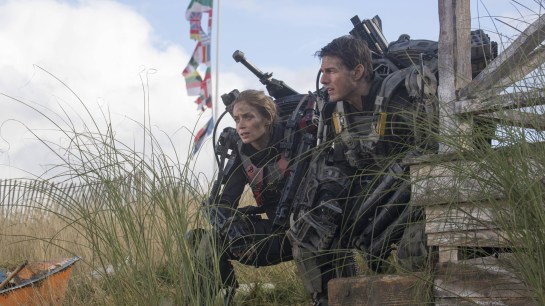
EDGE2

Cruise takes on a very different role than we are used to seeing him in. He plays Major William Cage. That may sound like a macho military tough guy name but actually he’s a public relations specialist who works to encourage people into service while avoiding it himself. There’s no heroic and attractive golden boy aura. He’s actually an unlikable and cowardly man who soon finds himself tossed onto the frontlines of the big invasion. The battle doesn’t go well and the untrained and combat-ineffective Cage is killed in action. But instantly after death he wakes up at a past point before the invasion took place. Over and over this takes place and Cage must adapt while repeatedly reliving the doomed invasion.

We are also introduced to a character named Rita Vrataski (Emily Blunt). She’s a Special Forces Sergeant who has an almost legendary status following her inspirational fighting in an earlier battle against the aliens. She crosses paths with Cage on the battlefield but their connection may go beyond that. Vrataski is a really cool component and not only does she add a lot to the story, but she gives us a strong and capable female lead. I was immediately drawn to her toughness and resolve.

If you’ve read other reviews you’ve probably heard this film compared to the Harold Ramis comedy “Groundhog Day”. That’s an undeniable comparison. Someone else said it best – “Edge of Tomorrow” is an entertaining mix of “Groundhog Day” and “Starship Troopers”. The trippy time loop element works really well within the sci-fi environment and its definitely more than just a gimmick. Director Doug Liman uses it as a focal point and it could have easily went bad. Instead it’s a ton fun and not only does it make for a great plot device, but it also opens the door for some of the movies genuinely funny moments.

EDGE1

Tom Cruise does a nice job going against type and reminding us that he is still a quality actor when given good material. I quite liked him here and he showed that he is still an actor with noticeable range. Emily Blunt once again shows that she is an actress who can play almost any role that she takes on. She never flinches in response to the physical demands of her character and you never doubt her authenticity. We also get Bill Paxton having fun playing with Master Sergeant stereotypes and we get Brendan Gleeson who is always good regardless of what he is in.

So far 2014 has been the year of the really good blockbuster. That is rarely the case but we’ve had several this year that have really won me over. Add “Edge of Tomorrow” to that list. Now it would be very easy to nitpick this movie to death and to point to a few plot points that don’t exactly make sense. But I think the movie works extremely well as a complete package. There’s some good science fiction, strategic funny moments, exhilarating action, and a smart and sharp story that never grows dull. I was thoroughly entertained by “Edge of Tomorrow” and that was exactly what I was hoping for.

VERDICT – 4.5 STARS