REVIEW: “First Cow” (2020)

COWposter

Kelly Reichardt’s “First Cow” opened in a handful of cities earlier this year around the start of the Coronavirus outbreak. Within days it’s run was over, cut short by the wave of theater closings across the country. Surprisingly distributor A24 decided against making the movie available on VOD saying they were going to relaunch the film “once the marketplace has rebounded“.

A few months have passed and the market has yet to rebound, but “First Cow” is finally making its way to home television screens. This is a Kelly Reichardt film through and through which is sure to thrill critics who frequently praise her unique brand of filmmaking. At the same time her minimalist style, slow-moving stories, and ambiguous endings have often stymied general moviegoers.

COW1

Photo Courtesy of A24

I understand both sentiments. I like Reichardt’s working-class focus, contemplative rhythms, and deep affection for her characters. But I’ve long wrestled with ambiguous endings and the fine line between challenging the audience and shortchanging a story. The idea of getting us to write the finish is fine when the movie leaves behind enough for us to do so. But when it doesn’t the results can be frustrating. Take a movie like Reichardt’s “Meek’s Cutoff”. It clearly worked for many, yet by the end I was far more conscious of the intentional ambiguity than challenged to ponder the fate of the pioneers.

“First Cow” is indeed slow-moving, it has a simple focus, and it leaves you with questions. But the difference here is in the film’s ability to both encourage thought and tell a fulfilling story. As you would expect, the movie informs us without holding our hands. Instead much is gleaned through its rich character development and the immersive frontier setting. Both sufficiently give us all we need to connect with the story and add our own interpretations. This may be Reichardt’s best film.

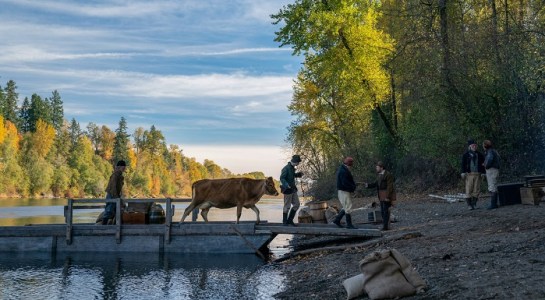
From the very first scene Reichardt let’s us know she is working towards something. A series of shots show a young woman discovering two human skeletons near a riverbank. Too shallow for a grave, these bones have laid there undiscovered for years and there’s no doubting that they have a story to tell. Normally a discovery of two skeletons in the opening minutes would loom over the film like an ominous dark cloud. But as we’re transported back to 1820’s Oregon, Reichardt does such a good job pulling us into the period that we almost forget the cryptic opening.
COW2

Photo Courtesy of A24

We’re first introduced to the gentle, kind, and soft-spoken Cookie (John Magaro) as he picks mushrooms in a lush patch of forest. Turns out he’s a cook traveling with a group of surly, burly fur trappers. In a subtly comical first meeting, Cookie discovers a naked Chinese man named King Lu (Orion Lee) hiding in the bushes. He’s cold, hungry, and on the run from some really bad Russians. Cookie gives him some water, a blanket, and a place to sleep for the night.

They go their separate ways but meet again later in a small settlement. King Lu remembers Cookie’s act of kindness and invites him out to a shack he has turned into a home. The two develop a friendship that form the backbone for the entire film. Through their seemingly natural rapport we learn all we need to know about the pair, their character, their ambitions. Cookie is every bit the big-hearted tender soul while the chatty King Lu is a dreamer with an entrepreneurial spirit. It’s also glaringly obvious that they’re misfits in a harsh and unforgiving land.

Then a conversation about biscuits sparks an idea. The two begin sneaking onto the property of a wealthy Englishman (Toby Jones) in the dead of night to extract milk from the territory’s first and only cow. It’s used to make Cookie’s delicious “oily cakes” which they take into town and sell to the homesick frontiersmen for a tidy sum. In the burgeoning spirit of capitalism Cookie and King Lu keep building their business which means swiping more milk in order to make more cakes (‘Supply and Demand’ and all that jazz). They keep going despite clear indicators that they should take their profits and skedaddle.

COW3

Photo Courtesy of A24

History isn’t here yet, but it’s coming,” Lu prophesies. “Maybe this time we’ll be ready for it.” Of course they aren’t and that’s the sad part of this otherwise warm and slyly funny frontier drama. Reichardt and her co-writer Jonathan Raymond deeply root their script in the human experience. Cinematographer Christopher Blauvelt’s Academy box ratio draws our eyes inward and concentrates our focus on the characters. Plus the film is bathed in an array of colorful faces including a special little nugget, a terrific cameo marking the final appearance of the late René Auberjonois. In other words, “First Cow” isn’t worried about beautiful vistas or untapped lands. It’s the people within each frame that we’re urged to explore.

Before a single image hits our screen Reichardt greets us with a fitting William Blake quote: “The bird a nest, the spider a web, man friendship.” It simply means friendships (like the one Cookie and King Lu share) are natural, complex, and essential parts of our being. But the film reminds us that even the tightest and most earnest bond can be seduced by the sinister allure of “just a little more”. “First Cow” is now available in select theaters and on VOD.

VERDICT- 4.5 STARS

4-5-stars

REVIEW: “Downhill” (2020)

DOWNHILL poster

I wasn’t too sure about an English language remake of the superb 2014 Swedish domestic drama “Force Majeure”. I was even less convinced after seeing the trailer for “Downhill”, an Americanized version starring Will Ferrell and Julia Louis-Dreyfus. I loved the original (from director/co-writer Ruben Östlund) for its subtle dark wit and dramatic gut punch. It’s careful balance of those two key elements made it the movie that it was.

Helmsmen Nat Faxon and Jim Rash co-direct and co-write (with Jesse Armstrong) “Downhill”, a follow-up to their terrific 2013 gem “The Way, Way Back”. Prior to that, the pair penned the Oscar-winning script for Alexander Payne’s “The Descendants”. Here their mix of comedy and drama is far more jagged. It’s in the dramatic moments that we see shades of what made “Force Majeure” effective. It’s the scenes of not-so-subtle comedy that knock the story off-track.

DOWN1

Photo Courtesy of Searchlight Pictures

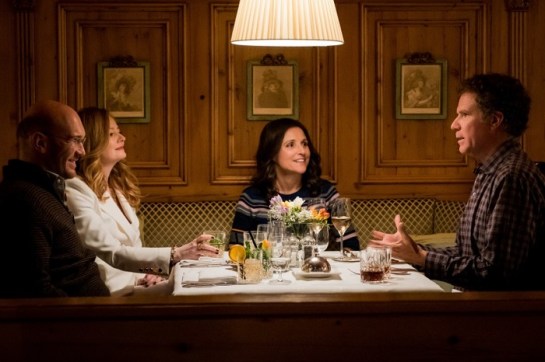
The movie follows Billie (Louis-Dreyfus) and her husband Pete (Ferrell) vacationing with their two sons at a ski resort high in the Austrian Alps. On their second day, as they sit on a deck for lunch, a controlled avalanche sends a cloud of powder barreling down the mountain and towards the restaurant. As it approaches many patrons scramble including Pete who grabs his phone and runs inside, leaving his wife and kids behind to get showered by snow.

As the cloud settles Pete returns to find his family unharmed but terribly shaken by the experience. He promptly orders lunch as if nothing happened, but his actions open a wound that slowly festers for the duration of the movie. Eventually pent-up frustrations boil to the surface and true selves are exposed, but not before potentially irreparable damage has been done to their relationships.

Östlund’s movie was essentially a existential tragedy about a seemingly sturdy marriage built on an emotional fault line. “Downhill” latches onto that idea but seems completely unsure of how far to go with it. Does it embrace the understated psychological bite of the original film or go with the more palatable studio approach? Faxon and Rash try to have it both ways and the results are frustratingly uneven. There are scenes where the tension between characters (either spoken or unspoken) is palpable and the emotions are raw and authentic. But then we’ll get a weird attempt at humor that lands with a tonal thud. This is epitomized in Miranda Otto’s bizarrely out of place free-loving concierge. The character seems plucked right out of a National Lampoon movie.

Much of it has to do with the casting. Louis-Dreyfus carries the movie and frankly we don’t get enough of her on the big screen. Her performance is always at the right temperature and she drives each the film’s most potent scenes. Most importantly she shrewdly manages the aforementioned balance between drama and humor. The script lets her down occasionally, but she’s easily the film’s biggest asset.

DOWN2

Photo Courtesy of Searchlight Pictures

A badly miscast Will Ferrell doesn’t fare as well and his years of playing halfwits actually hurts his character. Ferrell is hardly subtle when it comes to comedy, a truth that was etched in my subconscious from the start. So even when he’s playing it serious I found myself waiting for a visual or verbal punchline. He’s just not that convincing. Even worse, he makes it hard to buy into Billie and Pete as an actually couple.

I can see people going into “Downhill” expecting a straight comedy strictly because of the two leads. These viewers are sure to leave disappointed. The movie’s most striking scenes are its most serious and they are driven by a fantastic Julia Louis-Dreyfus (please do more movies). She literally keeps the picture afloat. But even she can’t make the jarring attempts at comedy work or help the movie nail down any true sense of identity.

VERDICT – 2.5 STARS

2-5-stars

REVIEW: “Fantasy Island” (2020)

FANTposterThe original “Fantasy Island” spawned from two TV movies before becoming a full-fledged television series that ran on ABC from 1978 to 1984. It featured Ricardo Montalbán as an enigmatic fulfiller of fantasies for paying guests on a remote Pacific island. I never watched it much, but I distinctly remember how each show began. With Montalbán’s peppy sidekick Tattoo in a bell tower heralding the arrival of “The Plane, The Plane“. My parents then promptly sent me to bed.


The new big screen version (further proof that they will remake just about anything these days) is a much different affair. As the Blumhouse tag denotes, “Fantasy Island” 2020 guarantees some embrace of the horror genre. But much like it’s inspiration, the film version bounces all over the genre map. One minute we’re in a restaurant during a romantic dinner. The next we’re with a special forces unit carrying out a covert military operation near the Venezuelan border. One second it resembles a hedonistic party movie. Later I was waiting to hear “Previously on LOST“.

None of this is an especially bad idea on the surface and Blumhouse has a history of turning out successful horror movies from minuscule budgets (I’ve read this one was around $7 million). But “Fantasy Island” is a weird concoction. It is unquestionably ambitious and its director/co-writer Jeff Wadlow has some intriguing ideas. But the overall silliness and messy execution (especially in the final act) derails any chance at something remotely memorable.

Ricardo Montalbán is replaced by the less interesting, less charismatic Michael Peña (no fault of his, just an odd bit of casting). He plays Mr. Roarke, the overseer of the beautiful yet mysterious Fantasy Island. He is informed by his assistant (Parisa Fitz-Henley) that a plane of new guests has arrived. As special contest winners, each guest is flown to the island paradise with the promise that their most intimate fantasy will be granted. Do yourself a favor, don’t try to dig any deeper than that. Just a little thought and the whole thing comes unglued from the start.

Fant1

Photo: Sony Pictures

So out of the plane comes the stock of lucky/unlucky participants. Melanie (Lucy Hale) fantasizes about paying back a bully. JD (Ryan Hanson) and Brax (Jimmy O. Yang) are douchey stepbros in search of the ultimate party. Gwen (Maggie Q) wants a second chance at marital bliss. Patrick (Austin Stowell) wants to be soldier like his late father.

It doesn’t help that all four fantasies are so tonally at odds. It’s even worse that they all play out like episodes from a cheap television serial, spotty performances and patches of woefully bad dialogue included. Again, you can see the gears turning in what could have been a potentially fun assemblage of intersecting fantasies, character revelations and other well-worn nonsense. But none of it (including its ten false endings) come together in a cohesive or satisfying way.

I can see this weird genre mashup gaining a minor following and actually making money (It’s projected to clear nearly double its production budget over its opening weekend). And perhaps it can work as a guilty pleasure or throwaway entertainment. But that’s about as far as you can stretch it. “Fantasy Island” does nothing to justify its existence. It’s just a blob of fairly interesting ideas pasted together and thrown out for consumption. And you can bet Blumhouse is already eyeing a sequel.

VERDICT – 2 STARS

2-stars

REVIEW: “ Ford v Ferrari”

FORDBIG

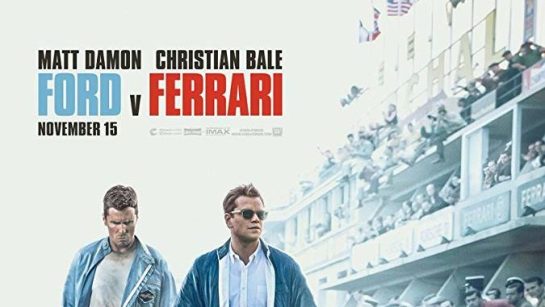
I wouldn’t call myself a fan of auto racing and I can’t really name a movie about racing that I have a lot of affection for. But it’s hard to skip over one with as much star power and early awards season buzz of “Ford v Ferrari”. Christian Bale, Matt Damon, eye-popping visuals, and Oscar predictions aplenty are some of the reasons I had to give it a go.

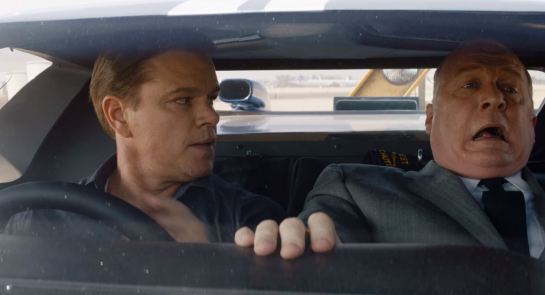
James Mangold directs this character-driven sports drama spawned from the rivalry between Ford Motor Company and Ferrari that ran through much of the 1960s. Their fierce competition reached its apex at the 1966 24-Hour Le Mans, an endurance race which Ferrari had won for six years straight. The Italian company’s dominance didn’t sit well with Ford who hires Texas race car designer Carroll Shelby (played by a spot-on Matt Damon) to build a blazing fast ride to dethrone their counterpart.

Ford1

That’s the gist of the story which comes from the writing team of Jez Butterworth, his brother John-Henry Butterworth and Jason Keller. Actually you could call it the framework the trio uses to explore the big personalities behind this remarkable feat. There is plenty of auto jabber and really cool race sequences. But ultimately it’s the human element that makes this movie work.

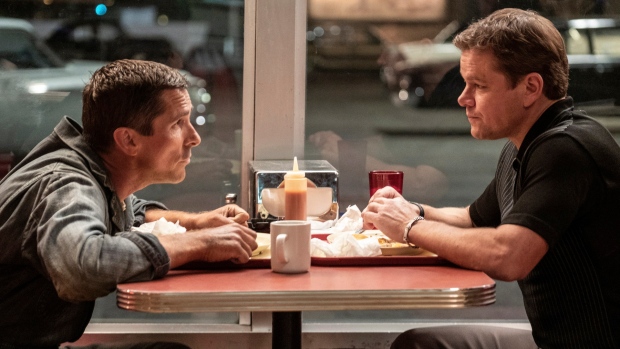
The bulk of that humanity comes through Ken Miles (Christian Bale). A professional race car driver, earnest family man, and a bit of a wild card, Ken struggles to put food on his family’s table and keep his garage out of the hands of the IRS. Predictably Bale gives a fabulous performance whether he’s under the hood, behind the wheel, or sharing quieter moments with his wife (a really good Caitriona Balfe) and adoring young son (Noah Jupe). The awards hype is justified.

Yet another good performance comes from Tracy Letts playing the surly Henry Ford II He’s the CEO of Ford who is anxious to get out of his father’s shadow and make a name for himself. That, along with some insulting jabs from the Ferrari owner Enzo Ferrari (Remo Girone), leads him to follow the suggestion of his VP Lee Iacocca (Jon Bernthal) and enter the international racing scene.

Ford hires Shelby who instantly wants Miles to be his driver. They set out to build their car but quickly discover their biggest obstacle isn’t faulty brakes or design flaws. It’s the Ford executives who are better versed in keeping up the company image than RPMs. This sets up the film’s biggest tension as two racing mavericks go up against the controlling corporate suits best embodied in the movie’s portrayal of Leo Beebe (Josh Lucas).

FORD2

In terms of characters and characterization, this is the film’s one glaring misfire. It was interesting to read that the real Leo Beebe wasn’t the smarmy, opportunistic weasel we get here. I get dramatic license and all that. You never come to movies like this for pure, unwavering authenticity. But the the story’s portrayal doesn’t especially help the film. He feels like a stock movie character pulled right off the shelf. Nothing wrong with Lucas’ performance, but it’s a case where the nuances of the real Leo Beebe might have played better.

My only other quibble is with the film’s 150 minute running time. This may sound contradictory, but the movie never drags. Yet there were a couple of times when I became completely aware of its length. Despite that “Ford v Ferrari” is still a rousing racing drama that doesn’t shirk on the human element. Bale and Damon have a snappy chemistry, and the supporting cast is fantastic (I haven’t even mentioned the superb and always underappreciated Ray McKinnon). And of course, there are the exhilarating racing sequences. Best of all, no racing knowledge required. Just a love for stories rich with humanity and spirit.

VERDICT – 4 STARS

4-stars

REVIEW: “The Fanatic” (2019)

FANATICsmall

Remember Tony Scott’s 1996 psychological thriller “The Fan”? Robert De Niro played a rabid San Francisco Giants fan obsessed with their star outfielder played by Wesley Snipes. You could hardly call it a great movie yet it’s one that at least knows its bat crazy. For that reason it’s a movie I tend to enjoy despite its glaring absurdity. I can’t say the same for “The Fanatic”.

Former Limp Bizkit frontman Fred Durst (yes that Fred Durst) conceived the story, co-wrote the screenplay, and directs this uncomfortably ugly and seemingly pointless look at celebrity obsession. Along the way it dabbles in some toothless black humor (I think), fails to generate an ounce of tension, and features a cringe-worthy portrayal of autism/mental health, linking it to this twisted stalker mentality without any real distinction. I think Durst is trying to say society collectively is to blame but it’s really hard to glean much from this mess.

FAN1

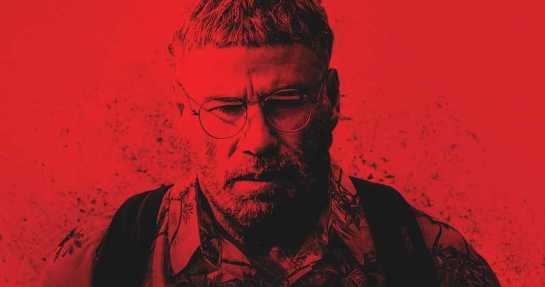
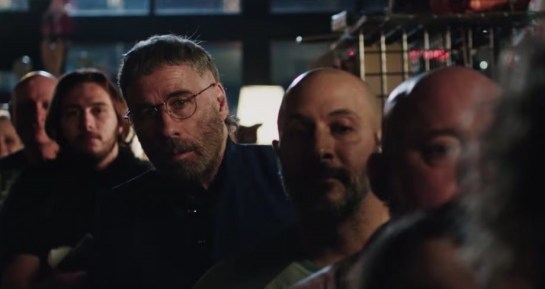
John Travolta plays an autistic street performer in Los Angeles named Moose. He is a huge fan of horror movies and he particularly loves the films of Hunter Dunbar (Devon Sawa). In fact you could say he is a little (say it with me) obsessed. Moose collects celebrity autographs and getting one from Hunter Dunbar would be the top prize of his collection. But every attempt has blown up in his face.

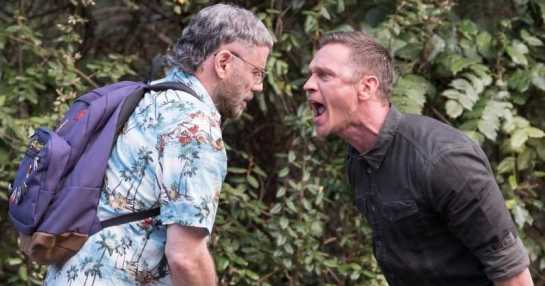
The film goes to great lengths to show the bad hand life has dealt Moose. His street acting gig is going nowhere. He’s constantly bullied by a punk street illusionist. And he’s trashed by his idol once he finally gets to meet him. His one-and-only friend is a well-meaning paparazzi photographer (Ana Golja) who naively does more to fuel his obsessive behavior than quell it.

By now I’m sure you can see where this is going. Moose snaps and takes his fan-love for Dunbar to creepy, compulsive, pathological places. It’s here that the already laboring script completely falls apart. The haphazard final act is utterly ridiculous and full of head-scratching turns and unsightly violence that seems yanked out of thin air. Good luck making sense of any of it.

FAN2

To be fair Travolta attacks the role with every bit of authenticity he can muster. The hideous haircut and loud patterned shirts do him no favors, but it’s not a mean-spirited portrayal. It’s simply a misguided one that really has nothing of value to say. But that’s not as much Travolta’s fault as it is the script. His commitment to the performance is unquestioned, but the entire movie feels off-target starting with Moose’s very first line of eye-rolling dialogue “I can’t talk too long. I gotta poo.”

“The Fanatic” takes a little from “The Fan”, a little from “Misery”, and even a dash of “Reservoir Dogs” but none of it makes for a particularly good movie experience. On one hand it’s kind of entrancing watching Travolta wrestle with such a rudderless story. On the other hand you would be much better served by taking my word for it rather than losing the 88 minutes that you’ll never get back.

VERDICT – 1.5 STARS

1-5-stars

REVIEW: “The Farewell” (2019)

FAREWELLposter

Lulu Wang’s “The Farewell” debuted at the 2019 Sundance Film Festival to a ton of buzz. It has taken some time, but the movie is slowly making its way into more theaters across the country and the critical praise has steadily grown. Wang’s intensely personal family dramedy pulls from her own life experiences with her ailing grandmother, a story she first shared on the Chicago-based radio program “The American Life”.

“The Farewell” could be considered one part biographical sketch and one part meditative think piece. Wang (who serves as writer and director) gives us a central character not only dealing with the illness of a loved one, but straddling the pull of two profoundly different cultural points-of-view. Wang does no finger pointing and her film makes no harsh judgments. Instead she sketches, explores and informs through an observant and sincerely human lens.

FAREWELL2

Awkwafina gives what may be the most eye-opening performance of the year. The edgy comedian/rapper gained a lot of attention for her supporting turn in “Crazy Rich Asians”, a role that essentially restricted her to comic relief. “The Farewell” offers her meatier and considerably more challenging material which the evocative actress absolutely crushes.

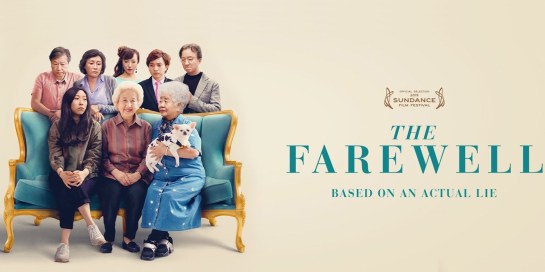
Awkwafina plays Billi, a twenty-something New Yorker who has never quite got her footing in the Big Apple. She has lived there since she was 6-years-old after she and her parents (played by Tzi Ma and Diana Lin) moved to the United States from China. An independent spirit and aspiring writer, she’s a bit down-on-her-luck after being denied a grant from the Guggenheim Foundation.

But she receives even worse news, her beloved grandmother (Zhao Shuzhen) is diagnosed with terminal lung cancer and is given only three months to live. Per a common Chinese custom the diagnosis is hidden from her grandmother (affectionately called Nai Nai). Billi doesn’t like the deception but she doesn’t want to stir up trouble with her family. This leaves her in a state of incertitude, struggling to both understand and cope with her grandmother’s condition.

FAREWELL1

The family concocts a fake wedding for Nai Nai’s grandson and his Japanese girlfriend, but it’s actually just an excuse to bring everyone back to China one last time to say their final goodbyes. Over the next several days Billi joins everyone else in not only hiding the truth from her grandmother but concealing her own heartache.

Wang’s subject matter is heavy but never overbearing. That’s because her movie isn’t strictly about death and grief. Underneath its main story conceit you’ll find several universal themes that hit home regardless of country or culture. But it’s the unexpected playfulness and humor that makes the film feel truly authentic. Wang embraces the peculiarities of family while never pushing it too far. The humor is always at just the right temperature.

Just as essential is Anna Franquesa Solano’s delicate, elegantly framed cinematography and Alex Weston’s supple, melancholy score. They both are impressive on their own, but when working together with Wang’s bittersweet script and a pitch-perfect ensemble cast, we end up with gentle, thoughtful, and profoundly earnest storytelling that often speaks volumes without a word of dialogue.

FAREWELL3

I mentioned how much I enjoyed the soulful and restrained Awkwafina performance. But I can’t say enough about Zhao Shuzhen. I have read this is her first feature film but you would never know it. She effortlessly fits into her character’s skin, giving an energetic and strikingly authentic portrayal, the kind you would see from a wily screen veteran with 50 movies under her belt. She’s a joy to watch and a true scene-stealer. Hopefully the Academy pays attention come Oscar time.

An opening title card tells us this is a film “Based on an actual lie.” Funny thing is “The Farewell” is one of the truest movies about illness and grief I’ve seen in a while. At the same time it asks a variety of questions about individuality, cultural tradition, and the messiness of family among other things. Lulu Wang shows herself to be a filmmaker to watch, exhibiting a keen management of tone and the sincerest treatment of her characters. These are signatures of a really good filmmaker, and they come with only two movies to her credit. Talk about exciting.

VERDICT – 4.5 STARS

4-5-stars