REVIEW: “Gun City” (2018)

GUN2

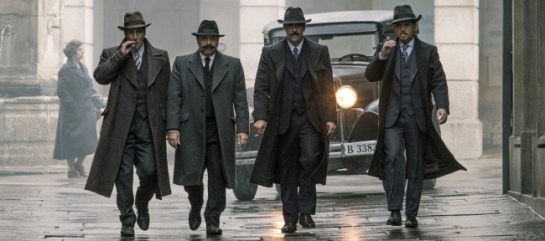
The social and political dynamics of 1921 Barcelona were volatile to say the least. As labor strikes and protests gave way to civil unrest, a number of groups pounced at the opportunity to exploit the boiling tensions between anarchists and authorities. Corrupt police, gangs, the bourgeoisie, and even Primo de Rivera’s military found ways to use the turmoil for their benefits.

“Gun City” (previously titled “The Shadow of the Law”) recreates the powder keg that was Barcelona while telling a story that pulls from a variety of movie genres. Director Dani de la Torre pays a lot of attention to the social issues (some of which feel quite relevant for today) yet also makes a movie that is highly cinematic in both structure and presentation.
GUN1

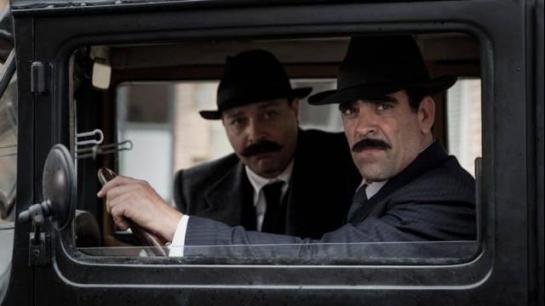
The film opens with a violent train robbery. We learn the mysterious robbers swiped a stockpile of war-bound rifles which if put in the wrong hands could turn Barcelona into a war zone. Officer Aníbal Uriarte (Luis Tosar) arrives into town to help with the police’s investigation. He is assigned to the Information Brigade – a four-man squad ran by the crooked Inspector Rediú (Vicente Romero) who has his hand in several nefarious side dealings.

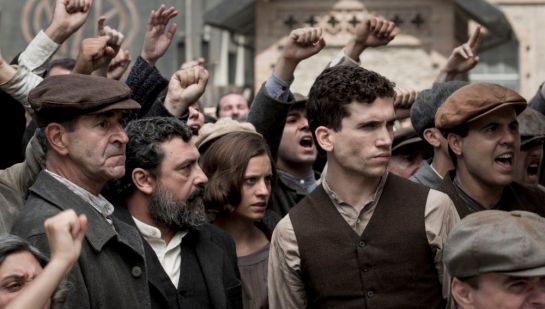
Screenwriter Patxi Amezcua’s main story thread follows Uriarte through the investigation but from a unique perspective. He’s much of an observer who (like us) is soaking in Rediú’s process (both legal and shady). This opens the door for a handful of side-stories all of which eventually intersect. One follows a sleazy gangster/ nightclub owner (Manolo Solo) and his captive dancer and main attraction (Adriana Torrebejano). Another centers on the growing tensions within the revolutionaries ranks. Their labor leader Ortiz (Paco Taos) pushes for peaceful protests while young firebrand Leon (Jaime Lorente) believes it is time to take up arms. Caught in the middle is Ortiz’s dedicated but principled daughter Sara (Michelle Jenner).

Not only does “Gun City” juggle a handful of story angles but it also dips into several different movie genres – crime, action, romance, and even sociopolitical thriller. It’s quite the undertaking and de la Torre mostly gets it right in driving his characters and their narratives. The story remarkably stays on point, never feeling unfocused while always remaining entertaining.
GUN3

Cinematographer Josu Inchaustegui gives “Gun City” a fantastic look loaded with style and snappy visual flourishes. He often uses panning cameras as well as some interesting points of view. I particularly loved one specific close-quarter fight sequence inside the cab of a car. It’s shot in one continuous take with the camera slowly moving around the vehicle. It’s one of the many crafty uses of the camera peppered all through this movie.

Amid its plethora of thick mustaches and stony gazes lies an absorbing piece of Spanish cinema that comes across as a genre stew with a social conscience. But don’t let that description fool you. “Gun City” hits its target. It delves into several strong themes, is never boring, and features fine performances throughout. Will the genre bouncing appeal to all audiences? That’s hard to tell, but it definitely worked for me.

VERDICT – 4.5 STARS

4-5-stars

REVIEW: “The Guardians” (2018)

GuardiansPoster

As Frenchmen fought on the blood-soaked battlefields of World War I women were often left to maintain their family’s farm and ultimately their livelihood. To do so required backbreaking work tending to cattle, plowing fields and harvesting crops. “The Guardians” is a female-driven French drama offering a fresh wartime story of one such family.

Writer/director Xavier Beauvois highlights the strength and fortitude of a group of women toiling over their family’s farmland from 1915 to 1920. Renowned French actress Nathalie Baye plays Hortense. She’s the matriarch, fearing for her two sons and son-in-law on the battlefront but suppressing her concerns through arduous farm work. By her side is her daughter Solange played by Baye’s real-life daughter Laura Smet.

Guardian1

With the harvest season approaching Hortense and Solange search their local village for a farmhand. The only person they manage to find is 20-year-old Francine (earnestly played by newcomer Iris Bry). She’s quiet and unassuming but a capable and hard-working young woman looking for a semblance of ‘home’. Francine settles in and quickly earns the trust of her employers.

Beauvois puts an emphasis on the labor and the quiet determination with which these women work. This is one of several places where the period detail shines. Every chore, every tool, every technique looks and feels of its time. The same could be said with the way Beauvois visualizes the rural French countryside. Resembling Impressionistic brushstrokes he captures one stunning image after another. Yet despite the portrait-like beauty, there is still no doubt that it is a rugged land.

Guardians2

At first their strenuous day-to-day routine is only interrupted when one of the boys return on furlough. While the brief reunions are joyous, the scars of war are evident and each man has been changed by it. The effects begin to linger even after the men head back to the front making things tougher for Hortense, Solange, and even Francine, with everyone embracing the idea that “everything will be better after the war” but slowing losing their faith in those words.

The slow observant rhythms of “The Guardians” may catch some viewers off guard but hats off to Beauvois for not cutting corners throughout his 140 minutes. Based on Ernest Pérochon’s 1924 novel, the film is a canvas rich with painterly beauty thanks to cinematographer Caroline Champetier. It’s also a stirring World War I era story bathed in humanity and told through great performances, emotive faces and quiet communication. And then there is the subtly tragic story of Francine – the beating heart of the film and proof of an emotional narrative punch that may not be noticeable at first glance.

VERDICT – 4.5 STARS

4-5-stars

REVIEW: “Game Night”

Gameposter

“Game Night” is a weird thing and watching it uncurl to reveal some semblance of an identity is one part fascinating and equal part frustrating. On one hand it’s a comedy with several hits and a handful of misses. But as its story unfolds a weirdly off-balanced action element surfaces that adds more blood and bullets but doesn’t always help the humor.

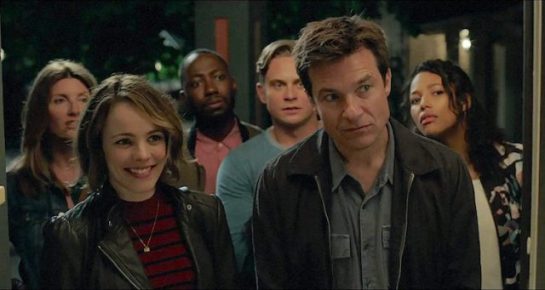
The creative duo of John Francis Daily and Jonathan Goldstein direct “Game Night” which is from a script by Mark Perez. The premise goes something like this: Max (Jason Bateman) and Annie (Rachel McAdams) are a perfect couple. They first met over a game of Trivial Pursuit and have held their own weekly game night since. Their usual guests include fellow married couple Kevin (Lamorne Morris) and Michelle Kylie (Bunbury), along with air-head Ryan (Billy Magnussen) and his fresh date-of-the-week.

Game1

Max’s good-looking and wildly successful older brother Brooks (Kyle Chandler) bulls into town and takes over game night for a week. Always looking to one-up his brother, Brooks stages an elaborate mystery game complete with role-playing, paid actors, and clues scattered across town. The first couple to solve the mystery gets the keys to his Corvette Sting Ray (which happens to be Max’s dream car).

Things get crazy when Brooks’ shady private life crosses paths with the game. Real thugs cross paths with fake ones and our not-so-bright players are caught in the middle. This obviously opens the door for the aforementioned action component which does tee the ball up for a couple of the film’s best scenes. A hysterical bullet removal sequence between McAdams and Bateman is a prime example. But the action, sometimes quite bloody, also clashes with the tone of other scenes.

Game2

Several other positives stood out. Jesse Plemons is the one consistently funny piece. He plays a stone-faced police officer and neighbor to Max and Annie. He’s found himself uninvited to the game nights due to his overtly weird and creepy personality. Plemons steals every scene he is in. I also can’t say enough about the comic timing of both Bateman and McAdams. Both work at just the right pitch and hold everything together even as things begin to unravel in the third act.

So “Game Night” has its moments. It’s only in the instances where Daily and Goldstein resort to their “Vacation” and “Horrible Bosses 2” days that the humor sours. But enough jokes land and its solid cast is committed enough to make this a fairly easy sell. Especially when compared to much of what passes as modern day comedy.

VERDICT – 3 STARS

3-stars

REVIEW: “Geostorm”

GEOPOSTER

Let’s be honest, movie trailers aren’t always reliable. We’ve all seen trailers that excited us for movies which would eventually let us down. We’ve also watched trailers that didn’t impress only to find the movie to be a pleasant surprise. Neither is true for “Geostorm”. The trailer advertised something dreadful and the movie delivered it. At least they didn’t mislead us.

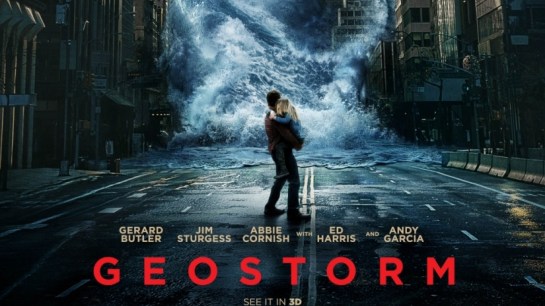
It’s the distant future of 2019 and the United States has developed an elaborate satellite system as a response to a series of devastating weather disasters. The climate-controlling space contraption is affectionately known as Dutch Boy. The mastermind behind it is none other than Gerard Butler. I guess it makes sense. I mean who else would you call to face hurricanes and typhoons head-on?

GEO1.jpg

Butler plays Jake Lawson, the mastermind behind Dutch Boy until being dismissed due to his problems with authority (reminiscent of every Gerry Butler action movie character). Since then three years have passed and his estranged brother Max (Jim Sturgess) now oversees Dutch Boy. Under his watch a series of deadly weather anomalies occur including a frozen village in Afghanistan and tornadoes of flames in a sweltering Hong Kong. Fearing worst disasters, Max convinces Gerry, errr Jake, to come back and sort out why Dutch Boy didn’t catch the anomalies.

The government launches Jake into orbit where he boards the International Climate Space Station (yep, that’s what it’s called). There he meets his pointedly diverse team of techs to figure out what’s wrong with his baby. Both Jake and Max uncover clues which point to tampering, political corruption, environmental terrorism, blah, blah, blah. And if our brave brothers can’t root out the culprit and fix Dutch Boy in time, a global weather disaster known as a (you guessed it) Geostorm will decimate the planet. Good thing Gerry is on our side.

All of that silliness sets up Gerry’s race against-the-clock space station adventure. Director and co-writer Dean Devlin leans heavily into Butler’s stale action-movie persona not even daring to offer anything new. He’s a tough guy, an anti-authority type, with a good physique and plenty of teeth-grinding one-liners.

GEO2

It’s not much better on earth. Max follows a trail of information that could implicate someone in the president’s cabinet whether it be the Secretary of State (a seemingly bored Ed Harris) or even the Commander-in-Chief himself (an equally disinterested Andy Garcia). Thankfully Max has the help of his Secret Service girlfriend (Abbie Cornish) and her ridiculously deep security access.

While “Geostorm” doesn’t offer an ounce of intrigue (not even accidently), it does give us plenty of big city CGI destruction, corny dialogue, bland stock characters and unintentionally hilarious plot turns. It plods along failing to muster even the slightest bit of energy. That’s usually the death knell for this type of movie. Turns out it’s one of many crippling flaws that contribute to this being a $120 million disaster. At least Gerry’s consistent.

VERDICT – 1.5 STARS

1-5-stars

BlindSpot Review: “Grave of the Fireflies”

GRAVEPOSTER

In the final months of World War II American planes began a bombing campaign across the mainland of Japan. Incendiary bombs were dropped on over 60 cities and estimates are as high as 500,000 civilian deaths. This provides the setting for the powerful 1988 animated war drama “Grave of the Fireflies”, a movie I shamefully hadn’t seen until recently.

The film comes from the acclaimed Japanese animation team Studio Ghibli. It was written and directed by one of the studio’s founders Isao Takahata and based on a Akiyuki Nosaka autobiographical short story. Numerous offers were made to Nosaka to adapt his story to a live-action movie, but he felt none could do justice to the deeply personal story. Takahata approached Nosaka with storyboards and a fresh idea – make an animated adaptation. Nosaka was surprised and convinced by the concepts and Studio Ghibli was given the rights.

GRAVE1

The opening scene immediately sets the tone for the film and identifies it as something significantly different than more traditional animated features. It’s a moving bit of foreshadowing which shapes our mental and emotional approach to what’s to come. I’ll leave it there because it truly is something you should take in for yourself (for those who haven’t seen it).

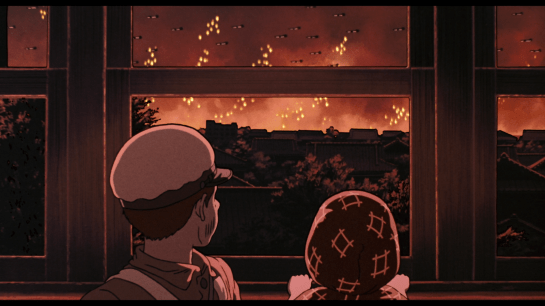
From there the story is told in flashback form. It focuses on a fourteenish boy named Seita and his 4 year-old sister Setsuko. It’s 1945 and the two live in Kobe, Japan with their mother while their father is away fighting the war with the Imperial Navy. One morning the sounds of air raid sirens pierce the sky. Seita sends his ailing mother to the bomb shelter and straps Setsuko to his back. After grabbing some belongings Seita runs outside to see incendiary bombs falling from the sky, almost beautiful in their decent. But on impact they ignite the entire neighborhood – houses, schools, stores, and many residents are incinerated.

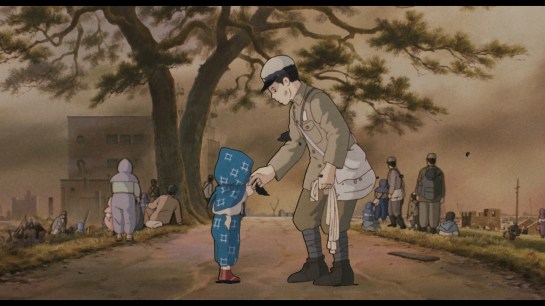
Seita and Setsuko manage to survive but their mother is fatally burned. In one of the film’s many crushing scenes Seita finds his mother in a makeshift hospital and makes the decision not to tell Setsuko. It’s such a well constructed scene that doesn’t exploit the emotions of the moment. It lets them play out as naturally as anything you would see in a live-action rendition. The entire film handles the material with this type of reverence and sincerity.

With nowhere to go Seita and Setsuko’s story ultimately becomes one of survival. Without a home or parents they stay for time with their cruel and exploitative aunt. But soon they are driven away and once again find themselves on their own. Seita takes on the responsibility of caring for Setsuko himself. They essentially create their own little world and sustain it the best they can. Despite the harsh reality they face we also get scenes of them having fun as children do. Seita’s heartwarming compassion and sacrifice for his sister shows in the actions he takes. Setsuko’s love for her big brother comes through in every word or expression she shares with him. And as their circumstances grow more grim, they never lose their shared bond.

GRAVE2

Takahata doesn’t shy away from the horrors of the bombings or the aftermath, but he doesn’t dwell on them either. Sobering glimpses jar us back to the reality these children face and we are never allowed to forget it. But every image is meaningful and effective. There is also practically no context given to the war, the two sides or their ideologies. Takahata isn’t interested in that even though the framework of the story may lead you to believe he is. His vision for the story is far more intimate and personal.

“Grave of the Fireflies” packs quite the emotional wallop. Writing on the conscientious yet more conventional animated films, Roger Ebert observed “they inspire tears, but not grief”. There is a lot of truth to that and it gets at what makes “Grave of the Fireflies” so special. It does more than ‘tug at your heartstrings’. It evokes deeper and more complex emotions. It does indeed give grief a powerful cinematic form. And even if (like me) you struggle with the animation style, the pure potency of the story and the care with which it is presented on screen trumps any hesitation you may have. The movie will not only move you, it will affect you, and that is one of the best compliments it can receive.

VERDICT – 4.5 STARS

4-5-stars

REVIEW: “Get Out”

Comedian Jordan Peele’s directorial debut “Get Out” has certainly reeled in a ton of high praise. The former Comedy Central sketch series star also wrote the screenplay for this wild mish-mash of genres, influences, and ideas. Peele clearly aims to make a movie that can be several different things at once (one of his film’s strengths). But I’m not sure any of the film’s multiple identities are all that strong.

Many have called “Get Out” a horror-comedy and that seems fitting enough. Problem is you may have to strain to find it either funny or scary. The humor ranges from conventional to glaringly satirical. It leans especially hard into its biting social/racial satire, some of which is genuinely funny. But it can be either too silly or too on-the-nose. Then you have the horror element which teases but never fully delivers. I feel Peele is making a subconscious play intended to make us fear what the film is implying more than what it is showing. I like that idea, but even it is subverted by the shaky attempts at humor and the overall absurdity, especially in the final act.

The film starts with promise – a startling opening sequence showing a young Black man walking through a (presumably) white upper-class neighborhood. It’s late at night and the young man is searching for an address. A car creeps up behind him causing him to nervously change course. The inevitable interaction that follows makes a powerfully strong statement as well as launches the story in a compelling direction.

Get1
Image Courtesy of Universal Pictures

There is a very “Guess Who’s Coming to Dinner” meets “The Stepford Wives” vibe from there. It starts by introducing us to a young photographer named Chris (Daniel Kaluuya) who agrees to meet the rich parents of his white girlfriend Rose (Allison Williams). As they pack for their weekend visit Chris asks, “They know I’m Black, right?” Rose reassures him, even tossing out that her parents would have voted for Obama in for a third term. If that’s the case, clearly nothing could go wrong, right?

The two travel to the secluded countryside estate of Rose’s parents (shrewdly played by Bradley Whitfield and Catherine Keener). Their visit coincides with an annual house party her parents throw for their posh, powerful (and white) acquaintances. As the collection of stiff, suit-and-gown bluebloods meet Chris they seem impervious to their racial insensitivities (we get several goofy lines about liking Tiger Woods and Black being “in fashion“).

On one hand Peele is doing something crafty underneath these peculiar interactions. They actually have purpose. On the other hand it’s hard to believe someone wouldn’t see through all the weirdness and (as the title says) get out of there. This is stressed even more by the groundskeeper Walter (Marcus Henderson) and the housekeeper Georgina (a wonderful Betty Gabriel). Both are Black and seem to exist in a freaky trance-like state. Again, how anyone would stick around is beyond me. But to be fair, horror movies often ask you to simply go with things like this.

Get2
Image Courtesy of Universal Studios

Aside from a handful of intriguing bits, things finally begin to simmer in the final act right up until its wonky blood-soaked ending. The finale features a crazy tonal shift which is sure to satisfy crowds but feels jarring and out of sync with the rest of the film. Peele flirts with going in a more gonzo direction which would have been a lot of fun. Instead he chooses a more traditional horror route that could be taken a number of ways from ridiculous all the way to borderline offensive.

There are several other issues that hold the film back. One is Daniel Kaluuya’s performance. Yes, I know he has been universally praised, but for me he gives two very different performances. The first half of the film features a flat, low-key Kaluuya who relies on the same puzzled expression over and over again. The second half sees him open up and his performance moves from bland to really good. Other problems tie into Peele’s script. There are numerous gaping holes in the logic and some laughable conveniences. There is also a key moment where Peele completely tips his hand too early and ends up seriously undercutting the tension in what should have been his film’s signature reveal..

It would be dishonest not to admit to being surprised at the profound adulation for “Get Out”. I do understand why people like it. It explores some meaty themes and there are some truly interesting narrative angles. I think that’s why I found myself so frustrated at its uneven execution. You can see the ingredients for a better film sprinkled throughout. Ultimately it’s a perplexing first feature for Peele – one that shows him to be a promising young filmmaker with big ideas, but one who may need to work on how he his handles them.

VERDICT – 2.5 STARS

2-5-stars