REVIEW: “Love in the Afternoon”

2017blindspot

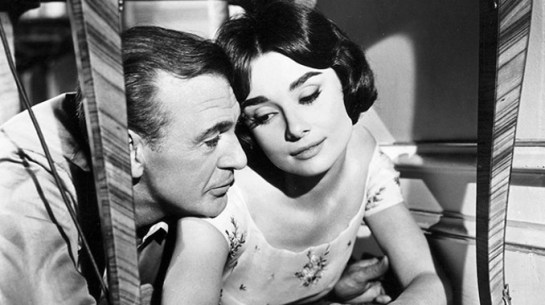
Gary Cooper and Audrey Hepburn. Folks, that’s all I needed to hear to be interested in 1957’s “Love in the Afternoon”. And as if I needed any more prodding, this romantic comedy was directed, produced, and co-written by the great Billy Wilder. And then to add even more personal intrigue, “Love in the Afternoon” is set in the magical city of Paris. So you have an unlikely love story filled with good humor, some really strong central performances and the City of Lights. Sounds good.

One of the first things you’ll notice when watching the film is the dramatic age difference between Cooper and Hepburn. Cooper was 55 years old at the time and there were some people who had a problem with his casting. Hepburn plays a beautiful (and much younger) girl named Ariane. She lives in Paris with her father Claude (brilliantly played by Maurice Chevalier) who works out of their home as a private investigator. Watching Hepburn and Chevalier is pure joy. They have an adorable father/daughter chemistry which shows itself in her playful curiosity about his work and his father-like encouragement of her cello playing.
LOVE1

One day Ariane eavesdrops as her father reveals to a client that his wife is having a fling with a wealthy American named Frank Flannagan (Cooper). She hears the trysts are taking place in Flannagan’s hotel room and that the husband plans to kill him. The curious and adventurous Ariane decides to go warn Flannagan of his upcoming demise. In doing so she finds herself smitten by the millionaire playboy’s charm. Her innocence and inexperience with love creates new feelings within her. On the other hand Ariane is initially just another victim of Flannagan’s globetrotting womanizing. But she leaves him in the dark about many things including her name and her far-fetched tales of her many boyfriends intrigues him. But is that enough to cure him of his playboy ways?

Wilder does a great job of getting us to love Hepburn and her character. She instantly comes off as pure and sweet and her childlike curiosity is adorable. That’s one reason we dislike Gary Cooper and his Flannagan character. We see that she is enamored with him but he sees her as just another toy. We genuinely worry for her as this unusual story plays out. But Wilder also shows that she’s not just a child with a bout of puppy love. She’s clever and, as Flannagan finds out, she can be abstruse. All of this is key to developing what is a well conceived love story.

This was the first of many screenplay collaborations between Wilder and I.A.L. Diamond. As you would expect from anything that Wilder has a hand in writing, the dialogue is slick and smart and his two lead actors handle it nicely. Hepburn was Wilder’s one and only choice to play Ariane but he wanted Cary Grant to play Flannagan. Grant turned down the role (as he did with several other Wilder offerings) which opened the door for Cooper. I admit, Cooper was an unusual choice and at first I wondered if he was going to fit. But as things move along, I think he captures what the role calls for.
LOVE2

The film also features some good bits of humor. The dialogue itself can be quite funny and there are several running gags that become pretty outrageous. There’s a hilarious reoccurring bit with gypsy musicians who Flannagan pays to play for him whenever he has a woman over. But we later see them popping up in some of the most absurd locations. It’s very funny. I also have to again mention the fun moments between Hepburn and Chevalier. She is her usual peppy and sprightly self. But Chevalier is a real scene stealer and for me some of the best moments featured him on screen.

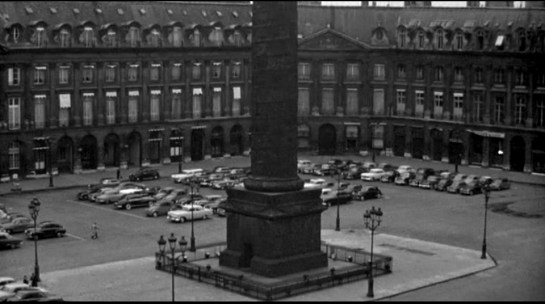
“Love in the Afternoon” is a movie I’m glad I finally caught up with. This is another energetic and intelligent Wilder film that hits the romance and humor it shoots for. “Love in the Afternoon” may not be up there with the great romantic comedies of its time, but it’s still a solid film featuring a wonderful cast, beautiful Paris locations, and a smart director who has no problem putting all of his pieces together.

VERDICT – 4 STARS

4-stars

REVIEW: “Lady Bird”

LADY poster

Over the years Greta Gerwig has shown herself to be much more than simply Noah Baumbach’s muse. That unfair moniker does a disservice to her talents and accomplishments as an actress and co-writer. With her new film “Lady Bird” she can now add director to that list.

Speaking of unfair, for some “Lady Bird” is burdened by expectations it can’t possible meet. Adoring fans have been passionately shouting its praises since it debuted in September at the Telluride Film Festival. “Lady Bird” made news headlines everywhere after Rotten Tomatoes declared it to be the “Best Reviewed Movie of All Time”. No pressure.

LADY1

I’ve got good news for those who can go see “Lady Bird” openly and unaffected by the hype. It’s a good movie. It has some issues which I’ll get into, but ultimately it reveals yet another side of Gerwig, this time completely behind the camera. “Lady Bird” shows her to be much more attuned to the art of filmmaking than many first-time directors. She’s nimble and assured of what she wants from each scene and the film benefits from her understanding and confidence.

Gerwig began writing the script years ago (the full writing credit is hers) under the name “Mothers and Daughters”. The story’s framework is inspired by her own life growing up in Sacramento, attending a Catholic High School, and desperately longing to leave for the east coast. That is also the film’s main character, Christine “Lady Bird” McPherson. She’s played by Saoirse Ronan, an Oscar nominee for “Brooklyn” and the perfect canvas for this movie both physically and expressively.

Gerwig’s coming-of-age story is unique in that its interests are internal and personal. Its narrative centerpiece isn’t the tired ‘girl likes boy, girl gets boy’ plot line. Similar to Richard Linklater’s “Boyhood”, “Lady Bird” deals more with the experience of life and the various elements outside of this young girl’s control that shape her experience. Lady Bird navigates these sometimes turbulent waters while seeking out her own identity and trying to define “her best self”.

LADY2

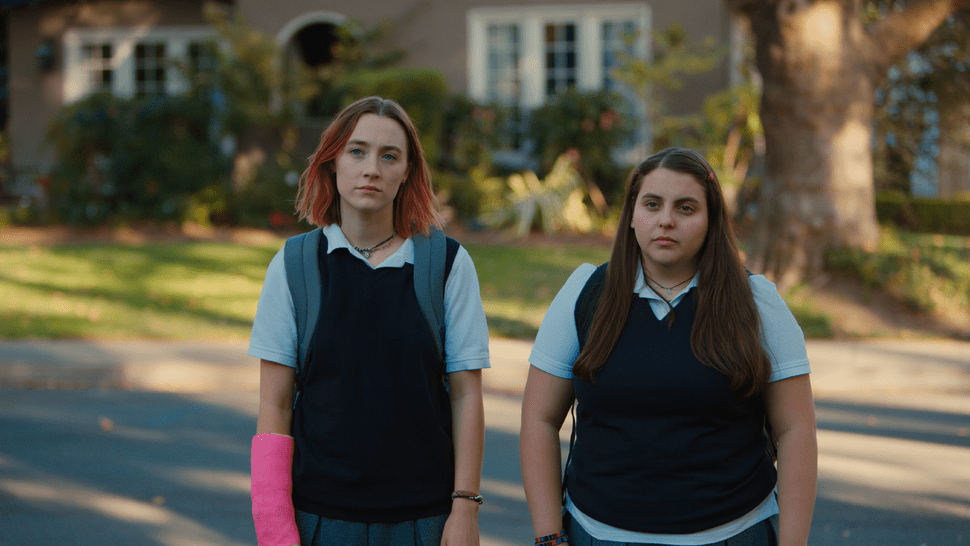
Ronan personifies Gerwig’s vision in what could be called a case study of adolescence (and not the Hollywood version). She effortlessly moves from fireball to introvert and few can sell insecurity quite like Ronan. It’s realized through her many interactions including with her best friend (played in just the right tone by Beanie Feldstein). Mostly it’s in the scenes with her family particularly her deeply caring but passive-aggressive mother. She’s played by Laurie Metcalf who delivers one of the year’s best supporting performances.

Ronan and Metcalf have a staggering chemistry and Gerwig utilizes it in every scene they share. You could say this is a mother who loves her daughter to a fault. She’s a remarkably true yet complex person who one character describes as “warm but also kinda scary”. Lady Bird rebels in her own quirky way but you also see the longing she has for her mother’s acceptance. Look no further than the movie’s superb opening scene. Gerwig’s dialogue for the two is so precise and their relationship forms the emotional backbone of the entire film.

LADY3

As good as the writing often is there are a couple of characters who feel surprisingly conventional. One is the Danny character, well played by Lucas Hedges, but hampered by the tidy and predictable thread that runs throughout his story. Also there is Lady Bird’s father played by Tracy Letts. His daddy archetype has been seen from “Sixteen Candles” to “Brave”. Don’t get me wrong, Letts is fantastic and contributes to some of the film’s best scenes. But his father character feels too familiar and easy to read which is surprising in a movie rich with wonderfully-conceived characters.

In a fabulous interview with Rolling Stone, Gerwig said “I just don’t feel like I’ve seen very many movies about 17-year-old girls where the question is not, ‘Will she find the right guy’ or ‘Will he find her?’ The question should be: ‘Is she going to occupy her personhood?’ Because I think we’re very unused to seeing female characters, particularly young female characters, as people.” This approach from Gerwig is what makes “Lady Bird” such a good movie. Its 2002 post-911 setting feels relevant, its portrait of adolescence feels genuine and personal, and its pitch-perfect and bittersweet final shot lands just right. I can understand the adoration especially from women who see reflections of their own mother/daughter relationships. The film has that kind of powerful resonance, but also expect to enjoy some good laughs along the way.

VERDICT – 4 STARS
4-stars

REVIEW: “The Lost City of Z”

zposter

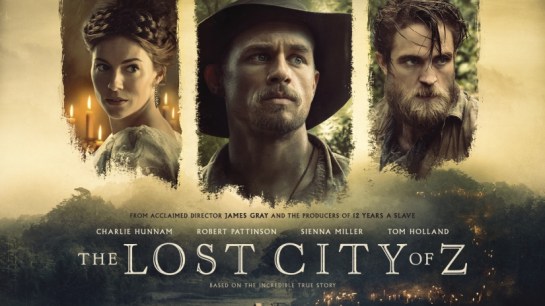
“He’s been rather unfortunate in his choice of ancestors.” We get this key line of dialogue early on in James Gray’s masterful biographical adventure “The Lost City of Z”. This snide, condescending jab is aimed at the film’s lead character Percy Fawcett and surprisingly it gives a ton of insight into what makes this complex fellow tick.

Percy Fawcett was a British officer, geographer, and eventual South American explorer. His intriguing life was made all the more fascinating by his mysterious disappearance in the Amazon during a 1925 expedition to find a long-lost ancient city. Many theories blossomed concerning his vanishing but there has never been any concrete evidence to help determine his fate.

z2

James Gray writes and directs this sweeping epic that’s based on David Grann’s 2009 book. As with his previous film 2014’s “The Immigrant”, Gray exhibits  a strickingly classical form of filmmaking and an impeccable eye for period detail. There is an undeniable familiarity with many of his visual and narrative choices, yet he stays away from common cliches and he’s not afraid to hold a magnifying glass to subjects glossed over in similar movies.

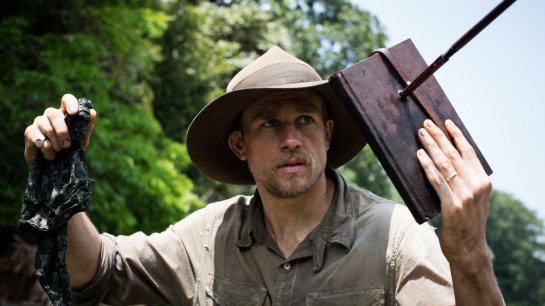
Fawcett is played with sturdy authenticity by Charlie Hunnam whose performance travels the spectrum from dashing and gentlemanly to rugged and determined. We first meet him in 1905 where he is stationed in Ireland but called to London to meet with the stuffy heads of the Royal Geographical Society. He’s offered an assignment that would allow him to redeem his family name and finally earn officer decoration that has unfairly been denied him due to his father’s (wisely unexplored) past transgressions. The mission – represent the British government as a neutral party in surveying and mapping the border between the warring Brazil and Bolivia.

z3

Fawcett agrees but it will require him to be away from his young son and wife Nina. She’s played by Sienna Miller who is very good here. Nina is a strong progressive type but is also supportive of her husband. She vanishes for a good chunk of the film but plays a more significant part in the second half. We also get Robert Pattinson in another absorbing yet slightly underutilized role. He plays Corporal Henry Costin, a man familiar with the Amazon who faithfully accompanies Fawcett on his mission.

Upon getting wind of an alleged lost city somewhere deep in the Amazon, Fawcett is driven to push further into uncharted territory to prove its existence. Gray does several interesting things here. The dangers of the land grow more and more evident yet Gray and cinematographer Darius Khondji offer a unique perspective. Often the dangers are camouflaged by a liberating sense of calm and beauty captured through the camera. I don’t mean to say it’s romanticized. In fact at times it feels downright tranquil – the result of a crafty visual touch that puts us in tune with Fawcett’s point of view.

z1

It’s also interesting to watch Gray tilt the Fawcett character towards madness without ever letting him topple over. Both script and performance move him dangerously close to the mental edge, but he never ceases to be sensible and empathetic. Hunnam is a perfect canvass for this, equally balancing Gray’s call for rationality and obsession. And despite the film’s massive scale, it always maintains an intimacy with its lead character.

“The Lost City of Z” is as beautiful and mysterious as the isolated world it explores. You can’t help but see shades of Herzog’s “Aguirre, the Wrath of God” and “Fitzcarraldo”. Even touches of John Huston come to mind. Yet remarkably James Gray has created a movie that feels completely of itself. It’s his best film. It’s Hunnam’s best performance to date. It’s one of my favorite movies of the year.

VERDICT – 4.5 STARS

4-5-stars

REVIEW: “The Lego Batman Movie”

LEGO poster

I think it’s safe to say that 2014’s “The Lego Movie” was a ground-breaking achievement for the plastic toy building block film genre. It was a hysterical and all-around unique animated feature that captured audiences with its gorgeous animation, sharp humor, and surprisingly big heart. It also incorporated a host of fun characters none more heralded than the Dark Knight himself.

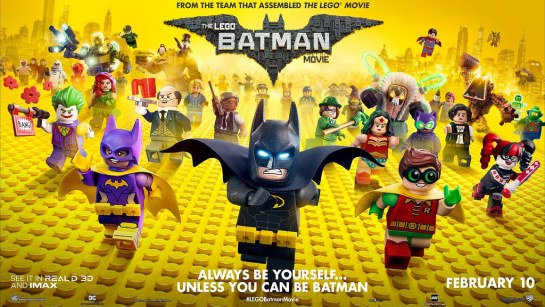
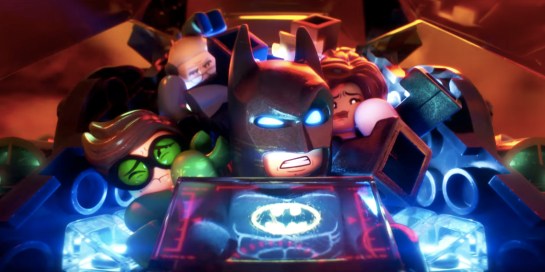
Captivating cinema history aside “The Lego Batman Movie” is a spinoff that cashes in on the wildly positive reaction to the previous film’s Batman character. It features the same sense of humor but with (obviously) a more Batman-centric flavor. It steadily riffs on the dark, brooding tone of the many Batman films. It has a ton of fun playing with Batman’s extensive rogue gallery, even goofy obscure villains that comic fans are sure to find hilarious. It also spoofs the superhero genre in general. And with so many comical targets it’s amazing how many of them they hit dead-center.

lego1

After a stellar supporting spot in “The Lego Movie” Will Arnett returns as the titular title character. His story is pretty familiar. Burdened by the pain of his parents’ murder, Batman finds sanctuary in crime-fighting, cool gadgetry, and alone-time in his dark, moody estate. Along the way we meet his colorful array of ‘acquaintances’ – Commisioner Gordon (Hector Elizondo), his daughter Barbara (Rosario Dawson), and of course Batman’s faithful butler Alfred (voiced by the soothingly empathetic Ralph Fiennes).

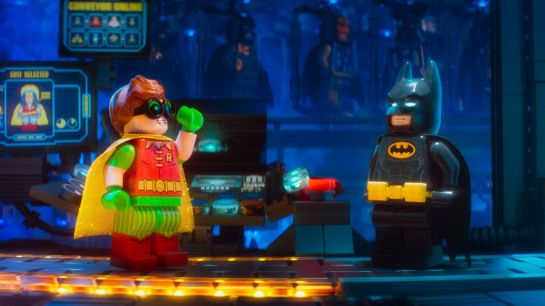
When Batman unknowingly hurts the feelings of the fragile Joker (Zach Galifianakis) by denying him the title of arch-villain, the Clown Prince of Crime (I’ve always loved that nickname) sets out for the ultimate revenge. Bats has to decide whether he can stop him alone or go against his style and actually seek the help of others. Along the way he gets another lesson in togetherness in the form of an energetic young orphan named Robin (Michael Cera).

LEGO2

Five writers combined to put together this story that is often too hyperactive for its own good. It’s not that they offer a barrage of jokes. It’s that the writing team, along with director Chris McKay, give them no breathing room whatsoever. The onslaught of gags can be relentless sometimes to the point of making them impossible to follow. It’s a shame because the movie has some big laughs (and I do mean BIG). I can’t help but wonder how many I missed simply because the filmmakers kept things constantly moving at 100 mph.

The same can be said for the action. Once again the animation is gorgeous and the Lego aesthetic still feels fresh and unique. But for every great action sequence (and there are a ton) you get one that is far too wild and frantic. Ultimately the film’s rambunctious pacing wore me down, not enough to ruin the movie but definitely enough to temper my enjoyment. I found myself checking out in the final act. But I still think the film has enough going for it to recommend and if you’re able to stay focused you will undoubtedly have fun with it. Just prepare yourselves with a few cups of coffee before heading in. That should help.

VERDICT – 3 STARS

3-stars

REVIEW: “Les Cowboys”

cowboys-poster

In “Les Cowboys” (or simply “The Cowboys” if you prefer) director Thomas Bidegain attempts to bring a modern French flavor to the John Ford western “The Searchers”. It’s certainly not the easiest undertaking considering the lofty status of the 1956 John Wayne classic, but Bidegain isn’t simply rehashing old material. He has his own story to tell. He just happens to nestle it within this well made homage.

Oddly enough the film begins at an American cowboy festival in France. Yep, a French hoedown complete with Stetsons, Wrangler jeans, line dancing, and the Tennessee Waltz. The entire cowboy fair is a celebration of the American country/western culture and you can’t help but giggle at the entire thing. At the same time it kinda fits with the story that will follow.

cowboys7

This is where we meet Alain (Francois Damiens), his wife Nicole (Agathe Dronne), his teenaged daughter Kelly (Iliana Zabeth), and son Georges (Finnegan Oldfield). They seem like a normal, tight-knit family, well liked by everyone else in attendance. But as the family prepares to leave after a full day of festivities they notice Kelly is missing.

It’s hard to gauge how much more I should say about the story. It takes several dramatic turns and becomes a much different film as it moves forward. Alain’s obsession to find his daughter is both understandable and sympathetic. But it consumes Alain to the point where he loses everything. Bidegain doesn’t give a black-or-white depiction of Alain’s state of mind. Constant dead-ends drive his obsession to darker more complex places.

cowboys1

A significant hunk of the story focuses on Alain’s son Georges. He joins the hunt for his sister, but pulls back after witnessing what it does to his father. Much like his father, his life is dramatically changed due to the disappearance of Kelly. It allows for an interesting conversation on grief, family communication, religion, and more. Bidegain has the writing chops having penned the scripts for “The Prophet” and “Rust and Bone”. Here we get some of the same intriguing character exploration.

I’ve tried dancing around the details of “Les Cowboys” simply because specific details  drastically alter the course of the story. Knowing them in advance would cost the film its edge. As it takes these turns the film ventures into several unexpected areas both narratively and geographically. It can be a bit clunky especially with its use of time lapses and setting changes. But if you’re able to navigate those storytelling hurdles “Les Cowboys” gives you plenty of emotional meat to chew on.

VERDICT – 3.5 STARS

3.5 stars

REVIEW: “The Lobster”

lobster-poster

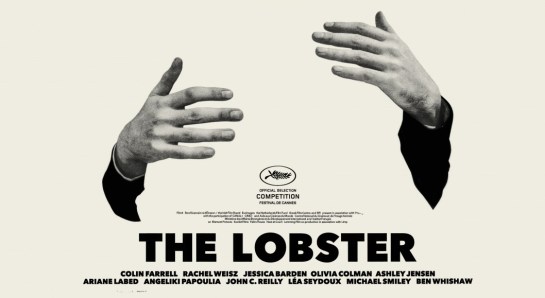
Occasionally you stumble across a movie that is nearly impossible to describe. In many of these cases it’s tough enough wrapping your own mind around what your seeing much less putting it into words. That is certainly the case with “The Lobster”, the latest film from Greek filmmaker Yorgos Lanthimos.

Much like his Oscar-nominated “Dogtooth” before it, “The Lobster” is a wacky surrealist concoction originating in the idiosyncratic mind of Lanthimos. I guess you could call the film a romantic dystopian sci-fi black comedy, but even that doesn’t cover all the bases. “The Lobster” once again finds Lanthimos toying with cultural standards and wickedly satirizing society’s view on love and relationships. For my money it’s funnier, stealthily more romantic, and a bit more digestible than “Dogtooth”. Yet it still requires a willingness to embrace the bizarre nature of its story.

lobster1

That last sentence is a biggie. “The Lobster” demands that we just go with it. It’s imperative. Spend too much time thinking on the absurdity and you’ve already gotten off on the wrong foot. Lanthimos starts off by setting the rules. In this ‘not too distant future’ being single is against the law. Those not married are taken to a hotel where they are given 45 days to find a new mate. If they do they are given the opportunity to earn their release back into the city. If they don’t they are transformed into the animal of their choosing and released into the wild.

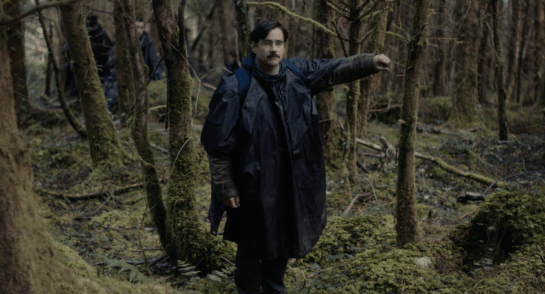
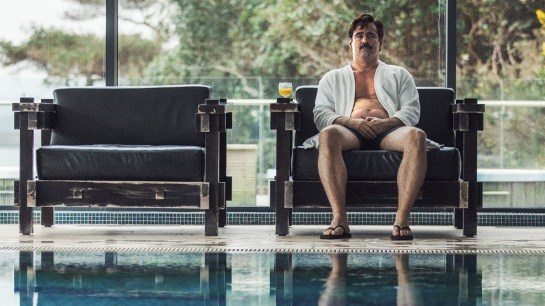
See what I mean, bizarre beyond description yet within the boundaries set by the filmmaker it works. The main character is David (Colin Farrell). After his wife leaves him for another man, David is taken to the hotel where he begins his 45 days. Once registered David is placed within the hotel’s strict program featuring all sorts of weird companionship training and preparation. He makes friends with fellow residents John C. Reilly and Ben Whishaw, but finding a future wife before his time runs out proves to be a challenge.

It’s best to be vague and let you sort through the nuttiness on your own, but I will say “The Lobster” has a sense of humor all its own. It’s rarely laugh-out-loud hysterical (although it can be). Instead the bulk of the humor is found in a variety of unexpected places. It’s all conveyed through an incessant deadpan style from straight-faced characters who live in a constant state of melancholy. There is also a smattering of brief bursts of violence to make things feel even more off-kilter.

There is a fairly dramatic shift at the midway mark and the second half sets off in a much different direction. The tone remains the same and the humor is still wacky and offbeat. But Lanthimos pulls back the reins and changes his focus as Rachel Weisz and Léa Seydoux are introduced into the story. Both actresses are really good, especially Weisz who gives us a reminder of why she’s an Oscar-winner. But the slower pace of the second half becomes an issue and it starts to wander as it makes its way to the finish line.

lobster2

And that brings me to the ending (without getting into spoilers). So many critics love ambiguous endings and “The Lobster” feeds those hearty affections. I too enjoy them as long as they leave me with something to chew on. This film’s abrupt, open-ended finish is more of an eye-roller than a thought-provoker. It doesn’t offer near enough in its ambiguity to contemplate other than the base narrative questions.

Despite its slow third act and frustrating end, “The Lobster” is uncompromising, provocative, and highly original at every turn. You literally never know where it’s going next. In this his first English-language film, Yorgos Lanthimos showcases his darkly funny form of absurdism through his own moody, muted lens. With “The Lobster” he works with a sharp satirical edge destroying our notions of companionship while also declaring our genuine need for it. The movie may lose some steam near the end, but it consistently engages us with this compelling idea.

VERDICT – 3.5 STARS

3-5-stars