
Over the years Greta Gerwig has shown herself to be much more than simply Noah Baumbach’s muse. That unfair moniker does a disservice to her talents and accomplishments as an actress and co-writer. With her new film “Lady Bird” she can now add director to that list.
Speaking of unfair, for some “Lady Bird” is burdened by expectations it can’t possible meet. Adoring fans have been passionately shouting its praises since it debuted in September at the Telluride Film Festival. “Lady Bird” made news headlines everywhere after Rotten Tomatoes declared it to be the “Best Reviewed Movie of All Time”. No pressure.
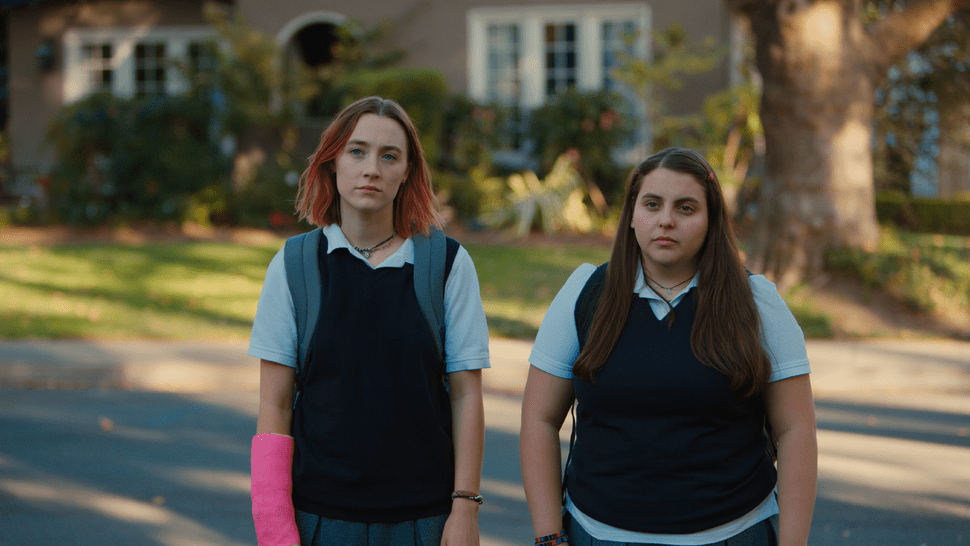
I’ve got good news for those who can go see “Lady Bird” openly and unaffected by the hype. It’s a good movie. It has some issues which I’ll get into, but ultimately it reveals yet another side of Gerwig, this time completely behind the camera. “Lady Bird” shows her to be much more attuned to the art of filmmaking than many first-time directors. She’s nimble and assured of what she wants from each scene and the film benefits from her understanding and confidence.
Gerwig began writing the script years ago (the full writing credit is hers) under the name “Mothers and Daughters”. The story’s framework is inspired by her own life growing up in Sacramento, attending a Catholic High School, and desperately longing to leave for the east coast. That is also the film’s main character, Christine “Lady Bird” McPherson. She’s played by Saoirse Ronan, an Oscar nominee for “Brooklyn” and the perfect canvas for this movie both physically and expressively.
Gerwig’s coming-of-age story is unique in that its interests are internal and personal. Its narrative centerpiece isn’t the tired ‘girl likes boy, girl gets boy’ plot line. Similar to Richard Linklater’s “Boyhood”, “Lady Bird” deals more with the experience of life and the various elements outside of this young girl’s control that shape her experience. Lady Bird navigates these sometimes turbulent waters while seeking out her own identity and trying to define “her best self”.

Ronan personifies Gerwig’s vision in what could be called a case study of adolescence (and not the Hollywood version). She effortlessly moves from fireball to introvert and few can sell insecurity quite like Ronan. It’s realized through her many interactions including with her best friend (played in just the right tone by Beanie Feldstein). Mostly it’s in the scenes with her family particularly her deeply caring but passive-aggressive mother. She’s played by Laurie Metcalf who delivers one of the year’s best supporting performances.
Ronan and Metcalf have a staggering chemistry and Gerwig utilizes it in every scene they share. You could say this is a mother who loves her daughter to a fault. She’s a remarkably true yet complex person who one character describes as “warm but also kinda scary”. Lady Bird rebels in her own quirky way but you also see the longing she has for her mother’s acceptance. Look no further than the movie’s superb opening scene. Gerwig’s dialogue for the two is so precise and their relationship forms the emotional backbone of the entire film.

As good as the writing often is there are a couple of characters who feel surprisingly conventional. One is the Danny character, well played by Lucas Hedges, but hampered by the tidy and predictable thread that runs throughout his story. Also there is Lady Bird’s father played by Tracy Letts. His daddy archetype has been seen from “Sixteen Candles” to “Brave”. Don’t get me wrong, Letts is fantastic and contributes to some of the film’s best scenes. But his father character feels too familiar and easy to read which is surprising in a movie rich with wonderfully-conceived characters.
In a fabulous interview with Rolling Stone, Gerwig said “I just don’t feel like I’ve seen very many movies about 17-year-old girls where the question is not, ‘Will she find the right guy’ or ‘Will he find her?’ The question should be: ‘Is she going to occupy her personhood?’ Because I think we’re very unused to seeing female characters, particularly young female characters, as people.” This approach from Gerwig is what makes “Lady Bird” such a good movie. Its 2002 post-911 setting feels relevant, its portrait of adolescence feels genuine and personal, and its pitch-perfect and bittersweet final shot lands just right. I can understand the adoration especially from women who see reflections of their own mother/daughter relationships. The film has that kind of powerful resonance, but also expect to enjoy some good laughs along the way.
VERDICT – 4 STARS