REVIEW: “Moulin Rouge!”

MOILIN ROUGE POSTEROn the surface there’s nothing about the 2001 romantic musical “Moulin Rouge!” that would draw me to it. I’m overly picky and less enthusiastic about musicals than any other movie genre. Baz Luhrmann’s schizophrenic style of filmmaking isn’t something I naturally gravitate towards. Also Nicole Kidman is an actress that I appreciate but who has never really blown me away. So I sat out during the movie’s release and eventual Oscar run. “Moulin Rouge!” would go on to earn 8 Oscar nominations including a Best Actress nod for Kidman. It would win two for Costume Design and Art Direction.
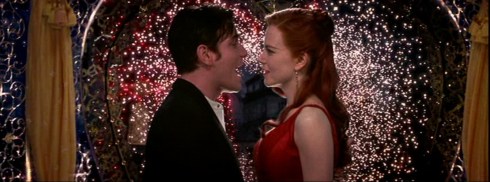

It’s been over 10 years since the release of “Moulin Rouge!” and I’ve finally caught up with it. It’s funny, it wasn’t the music or the popularity or the Oscar recognition that finally got me to sit down and give this film a shot. It was my very real and deep-seated affection for the city of Paris. This proves to be fairly misplaced motivation. The beauty and essence of Paris is never explored or injected into the story and my overall “Moulin Rouge!” experience danced between stimulation and tedium.

I won’t deny that “Moulin Rouge!” has its moments. There’s a visual flare that Luhrmann has that’s undeniable. Here he presents a kaleidoscope of hyperactive visual pageantry. The colors and the pizazz leap off the screen as he moves from one shot to the next at break-neck speed. The problem is he milks it for all its worth, especially in the first half of the film. There’s an almost sensory overload as he bombards us with wild, raucous dance sequences, painted faces, and swirling dresses in a relentless parade of musical debauchery that had me ready to leave Montmartre and head to the more pensive and subdued Latin Quarter.

Moilin 1

Yet, just as I was ready to check out, there would be some little nugget that kept me there. Whenever Luhrmann would dial things back the movie would take a better turn and I could latch on. These are the moments where we get into the actual story. It’s set in 1899 Paris. A young writer named Christian (Ewen McGregor) moves to Montmartre with hopes of experiencing the true Bohemian life of the area. Christian is a wide-eyed idealist who has a special boyish obsession with love, something he has never truly experienced before.

Luhrmann instantly begins to lay out his unusual world. His depiction of Bohemian life opens up on a frantic sugar rush. He quickly baptizes Christian into this weird world through a wacky assortment of characters. He runs into an eccentric group of artists and performers who acquire his help in finishing their musical production. Their ultimate goal is to sell their show to Mr. Zidler (Jim Broadbent), the proprietor of the wild and rowdy Moulin Rouge. The biggest attraction of the Moulin Rouge is the beautiful Satine (Nicole Kidman) and Christian is instantly smitten with her. But Zidler has other plans for his most prized property especially after she catches the eye of a wealthy Duke and potential financier (Richard Roxburgh). If Christian is going to win her love he’s going to have to fight for it.

Listening to that setup of the plot you would think there was a pretty strong story in place but it’s actually a bit anemic. There is an interesting romance in there but it ends up being swallowed up by the injections of peculiar song numbers that feel terribly out of place at times. We get big show versions of everything from Madonna’s “Like a Virgin” to Nirvana’s “Smells Like Teen Spirit”. Clearly these wild song choices worked for many people but for me they got in the way of something much more interesting – the complicated romance between Christian and Satine. Luhrmann does allow the romance more breathing room in the final act but by that time I felt worn down by the relentless pomp and spectacle. Luhrmann hasn’t an ounce of subtlety and here he flexes his hyper-stylized muscle whenever he can.

moulin 2

Even though the more interesting story is smothered for much of the movie, it still manages to stay interesting thanks to the fantastic performances of the two leads. Ewen McGregor is great and watching his character move from innocent naivity to someone who has the harsh realities of the world revealed to him is great fun. But for me it was Kidman’s performance that not only stole the show but kept the movie going. She was a key reason I wanted to sit through the patented teeth-grinding Luhrmann scenes. Kidman is the one performer who has a lot to do and I found her work to be fascinating. Broadbent was okay but his character was so wacky and it was hard for me to get passed that. John Leguizamo has a fairly nice sized role as Henri Toulouse-Lautrec. Toulouse-Lautrec was a noted French artist but in this film his scenes mirror what I would imagine an acid trip to be like. He’s all over the place and comes off as a clown. Now considering the difficult life Toulouse-Lautrec had, from his childhood struggles to his crippling health problems which resulted in his death at age 36, this portrayal of him could be construed as an insult. Either way it didn’t work for me.

Unfortunately that also sums up my overall reaction to “Moulin Rouge!”. It just didn’t work for me. It’s a shame really because under the heavy coating of Baz Luhrmann’s mind-numbing stylistic excess lies a romantic tale that actually has heart. It’s a romance that’s made all the more interesting by two deeply commited lead performances. But sadly that doesn’t erase the countless times I was rolling my eyes or checking the time. I know “Moulin Rouge!” has a following and if you can connect to this type of schizophrenic storytelling you’ll probably find a lot to like here. But for me it was a case of too much visual insanity, too many poor choices for songs, and not enough of the central romance. That’s enough to keep “Moulin Rouge!” off my rewatch list for quite some time.

VERDICT – 2 STARS

REVIEW: “Mud”

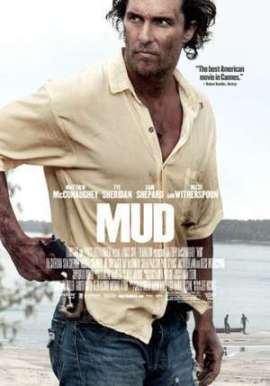
MUD posterAfter just two feature films Jeff Nichols has become a director whose name instantly attracts my attention. His first film “Shotgun Stories” was a real and gritty look at rural southern life. His next movie “Take Shelter” was a powerful and potent look at mental illness and its effects on a working class family. It was pure brilliance and one of the best films of the last decade. Now he’s back with another slice of southern gothic storytelling. This time he teams up with some marquee stars and a slightly larger budget to give us “Mud”. But does a little more cash and bigger names equal success or does it take away from the down-to-earth filmmaking that Nichols is known for?



Let me get this out of the way, “Mud” is a scintillating piece of cinema. It’s a coming-of-age story. It’s a thriller. It’s a skewed romance. It’s a film that dabbles in several areas yet it all comes together in a gripping story full of life and grit. Nichols takes us to a world that I was mesmerized by and lost in – a world that many people don’t know exists today. He also gives us characters that interest us and that we care about. He raises the stakes and wraps them up in a mystery that we can sink our teeth into. In other words he gives us the experience that is at the heart of why we go to the movies.

Jeff Nichols started writing the story for “Mud” around 2000 and it’s clearly a personal project for him. Many critics have called this film a modern-day “The Adventures of Huckleberry Finn” and for good reason. Nichols was particularly influenced by the Mark Twain classics. But what makes this movie stand out is the familiarity that Nichols has for the locations and the people he is depicting. The reason we buy into the story is because of the sharp reality that we see through his constantly moving camera. Like me, Nichols is an Arkansas native and the stunning detail and unashamed portrayal of a vanishing river subculture and small town life was as honest of a depiction as I’ve ever seen on screen.

It’s here in the south Arkansas delta, that 14-year-old Ellis (Tye Sheridan) calls home. His family is part of a low income river community that works the waterways as a source of income. He and his best friend Neckbone (Jacob Lofland) are adventurous sorts. One day they take their boat out to an island and discover a bigger boat left in the trees after a recent flood. They claim it as their own but there’s one problem. Someone has beaten them to it, namely a mysterious stranger who goes by the name of Mud (Matthew McConaughey). Ellis and the more cautious Neckbone develop a friendship with Mud but soon find out he’s a man of many secrets.

MUD 1

Sheridan, Lofland, & McConaughey

The movie builds itself around the mystery of Mud. Who is he, where did he come from, and why is he hiding on the island? Is he harmless? Is he dangerous? McConaughey and Nichols combine to create a fascinating character and I was thoroughly intrigued by him as they peeled back layer after layer. McConaughey seems to have reinvented himself over the past two years and his career has taken a better turn. But despite his recent good work, nothing he has done matches the phenomenal performance he gives here. For my money this is his very best work and I found myself always anxious for his next scene.

Just as impressive is young Tye Sheridan as the sensitive, tough, and vulnerable Ellis. I loved watching Sheridan navigate his scenes of discovery, revelation, and heartbreak like a seasoned professional. There was never a moment in the film that seemed too big for him and he felt right at home in his character’s shoes. This is really his story and the movie wouldn’t have worked without his amazing performance.

Nichols also puts together an incredible supporting cast loaded with personal favorites of mine. Reese Witherspoon plays a beautiful stranger who arrives in town and who may have deeper connections to Mud. She’s very good here and her name adds some pop to the cast but it’s a fairly small role. Sam Shepard is great as a surly old river hermit who prefers to be left alone. A Jeff Nichols favorite, Michael Shannon also appears in a small but well acted role as Neckbone’s uncle and guardian. But I want to single out a terrific supporting performance by the underrated character actor Ray McKinnon. He plays Ellis’s father and it’s a much more layered role that you might at first think. This is a character that’s right in McKinnon’s comfort zone and he shines particularly in what I thought were two of the movie’s more stirring and emotional scenes.

MUD 2

Matthew McConaughey as Mud

While “Mud” is a deep south thriller filled with mystery and intrigue I was surprised to find a deeper reoccurring theme that penetrates the entire story. It’s really a movie about love. Throughout the film we see the ravaged emotions, fractured relationships, and heartbroken cynicism left in the wake of failed love. A big part of the film focuses on Ellis’s confusion over what he believes love to be and the harsher reality that he witnesses all around him. It’s sad to watch him innocently cling to his idyllic perception of love. In fact, every character in the film has some dealings with the painful side of love. The way Nichols weaves this throughout his narrative is simply genius.

There are only a couple of things which keep me from calling this the perfect movie. One centers around the Neckbone character. Young Jacob Lofland delivers a nice performance especially considering he had no acting experience. My problem with his character isn’t in his work but surprisingly in Nichols’s writing. Neckbone is a potty mouth and Nichols uses that as a source of humor. But he constantly goes back to it over and over through the entire movie. First of all I don’t particularly find a cursing kid that funny, but beating the same drum over and over was a drag. There’s also a big sequence at the end that is actually satisfying although it’s a bit jarring. It delivers in the end but it did feel a little out of place with the rest of the movie.

That said, it’s clear to me that “Mud” once again verifies that Jeff Nichols is a master craftsman who uses his southern roots and appreciation for classic filmmaking to tell stories rich with vigor and authenticity. “Mud” is an atmospheric and evocative film that takes a southern fried look at adolescence. It’s nestled in the reality of trot lines, cottonmouths, Piggly Wigglys, and Big Banjos while never coming across as clichéd or condescending. It’s a part of the world not far from where I live which makes the movie’s treatment all the more satisfying. “Mud” was my most anticipated movie of 2013 and my expectations were through the roof. Thanks to Jeff Nichols for exceeding those expectations with what will surely be one of the year’s best films.

VERDICT – 4.5 STARS

REVIEW: “Mr. Hulot’s Holiday”

Classic Movie SpotlightHULOTMy recent time spent looking at the movies of French filmmaker Jacques Tati has been a true delight. As I’ve made my way through his small but brilliant catalog of films I’ve grown more and more impressed with the ingenious craft at the heart of them. “Mr. Hulot’s Holiday” was the first film featuring Tati’s lovable Monsieur Hulot character and it’s arguably the greatest display of his physical comedic abilities. Tati both starred in and directed this picture and his meticulous approach to filmmaking is seen in every frame from his carefully conceived sight gags to his beautiful work with the camera.

There’s no strict and focused narrative in “Mr. Hulot’s Holiday”. It simply follows Hulot’s vacation at a small French beachside resort. Much like other Tati films, there is a great focus on community here. We’re introduced to a number of fellow vacationers each with their own unique personalities and quirks. There’s no real effort towards character development. Instead they simply become familiar faces who we grow to know through their reappearances. This is one of the characteristics of Tati’s films that I enjoy the most. I love how he develops a community of characters all built around their individual interactions with Mr. Hulot.

Hulot is the picture of gentleness and happiness. With his pipe in mouth and striped socks showing he certainly stands out in the crowd. But it’s his fidgety demeanor and overall clumsiness that makes him so physically awkward, something only rivaled by his social awkwardness which he seems totally unaware of. He simply goes on enjoying life completely impervious to the inconveniences he may be accidentally causing. He annoys several of his fellow vacationers which provides some great laughs for the audience.

HULOT2

For me the true treat was just watching him interact with this wonderful assortment of people. For example there’s the grumpy and mopey waiter who doesn’t crack a smile for the entire movie. There’s the pretty blonde who gets the attention of nearly every young man at the resort yet she lives in her own uninterested little world. There’s the older couple who just stroll around observing everyone and taking everything in. We get the mischievous children and a handful of animals, both of which Tati loves to incorporate into his films. There are several other great characters and we never really get to know any of them yet they become very familiar to us. They all share the resort, the dining area, and the beach with Mr. Hulot which results in some hysterical moments.

First and foremost Jacques Tati is a physical comedian, a skill that dates back to his early years as a mime. His films often reflect back on the days of Chaplin, Lloyd, and Keeton when the stories were told through the amazing vehicles of expressions, gestures, postures, and athleticism. That’s certainly the case here. The dialogue is scarce and the speaking we do hear from people is mostly unintelligible. Instead the story is made for our eyes and mainly told through the lens of Tati’s camera. His skill is incredible and you can’t take your eyes off what he’s doing on screen. It’s unlike anything we see today.

In many ways “Mr. Hulot’s Holiday” resembles a classic silent film yet there is a steady emphasis on sound. There’s the aforementioned chatter from the characters. Most of the time we have no idea what they’re saying yet they are a delightful ingredient. The spitting and sputtering of Mr. Hulot’s funky automobile almost makes it a character itself. Then there are the little things such as the swinging door to the dining room. Every time someone walks through, it makes this peculiar “fwoom” sound. Tati removes the music and places a heavy emphasis on that unusual sound. It may not sound like much but in the flow of the film it fits perfectly.

HULOT1

Tati is also a director of timing. So many of his hilarious gags are dependent on precise timing and I can imagine even some of the smallest scenes taking a lot of time and expertise to get right. Take one scene where Hulot is fixing his broken down jalopy on the side of the road. He is underneath his car but with his legs laying out in the road. Another car comes flying through and at just the right time Hulot pulls in his legs as the car barely misses them. He never moves his legs to miss the oncoming car but to just shift positions yet the timing is perfect. Now there could very well be some camera trickery involved but it’s just one example of the many great gags revolving around perfectly timed people or objects.

“Mr. Hulot’s Holiday” was a huge success upon its release and it remains a cherished movie for many today. It’s a perfect display of Jacques Tati’s artistry as both a filmmaker and a comedic actor. It’s a celebration of silent comedy as well as its own unique brand of filmmaking. It also gives us our first introduction to one of the most lovable characters in cinema chock full of his deadpan humor. Just a couple of days ago as I sat in a theater watching a series of comedy trailers that looked neither interesting or funny I thought of this film. I thought of how lazy and formulaic the one-trick-pony comedies of today are. Then I thought of Tati’s creativity, his style, his skill with the camera, his poetic grace. All of these things and more are beautifully wrapped up in “Mr. Hulot’s Holiday”. I sat in that dark theater thinking the same thing I’m thinking now – “Man I wish they still made comedies like this today”!

VERDICT – 5 STARS

5 STARSs

5STAR K&M

REVIEW: “Mon Oncle”

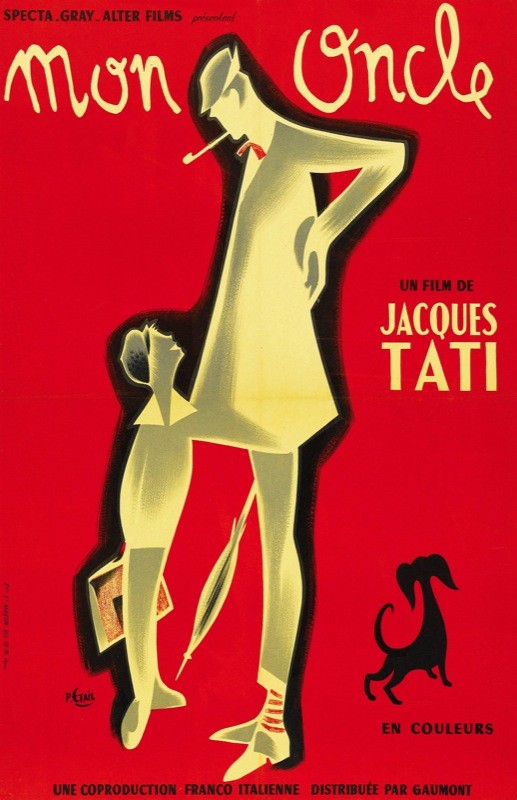
mon_oncle poster“Mon Oncle” Is French filmmaker Jacques Tati’s 1958 comedy and his second of four films featuring his Monsieur Hulot character. The acclaimed director only had six feature-length films to his credit and this was his first in color. It’s also a widely appreciated picture that earned Tati an Academy Award for Best Foreign Language Film. There are several themes that Tati plays with in what’s an otherwise playful comedy. He satirizes materialism and the lust for things. And he shows the sterile and artificial relationships of those absorbed with social status. These and other things are certainly interwoven within the story, but for me the movie is more effective as a fun and often times charming comedy.

Tati not only directed, produced, and co-wrote “Mon Oncle”, he starred in it as well. His Monsieur Hulot character is as lovable as he is inept. He’s an awkward and almost child-like character who views life with a smile, a bow, and a tip of his hat. Hulot lives in an energetic working class neighborhood in Paris filled with older buildings and busy streets. For me the very best part of this film is the time we spend in this close-knit community. Tati does a wonderful job of familiarizing us with the places and the people who make up Hulot’s lively neighborhood. There’s the lovely young girl from his building who always greets him with a smile and sometimes sweets. There’s the short cranky produce man whose tools fall out of his truck whenever he opens his door. There’s the friendly street sweeper who spends more time talking than sweeping. There’s the group of men who spend most of their time at the Chez Margot cafe. These are just a few of the people who give this community its beautiful life and character.

In stark contrast you have the wealthy upscale suburb which is where Hulet’s sister and brother-in-law Monsieur and Madame Arpel live. Their modern, high-tech home is as cold and sterile as an operating room, a description that also fits their relationship. Their true joy is in showing off their house to their more important visitors. There is a reoccurring joke that has Madame Arpel running to turn on a hideous metallic fish fountain in their front garden whenever a truly important guest shows up. It’s all about appearance and self-importance with the Arpel’s.

MON ONCLE

But their young son Gerard feels trapped inside the monotonous walls of the Arpel estate. That’s why he loves it when his Uncle Hulot comes to visit. Gerard loves going back to Hulot’s neighborhood to enjoy the vibrant atmosphere and especially to play with his mischievous friends. Some of the film’s funniest moments involve these little pranksters pulling all sorts of practical jokes on passersby. Hulot, in many ways a child himself, really doesn’t try to control them. He just reacts to them as he does everything else – no harm, no foul. Gerard’s affection for his uncle doesn’t make Monsieur Arpel very happy. He is jealous of the relationship even though he doesn’t invest any time in Gerard. He also looks down on Hulot as his inferior. Madame Arpel believes she can change all of that by introducing Hulot to their social circle, an idea that’s doomed (and hilarious) right from the start.

For the most part “Mon Oncle” is a visual comedy with very little understandable dialogue. Often times we hear the unintelligible voices of the people but it’s plenty to let us know what’s happening. The dialogue that is there is strategically placed and works perfectly within the confines of the story. The bulk of the story is told through nods, gestures, and mannerisms and the humor depends more on slick and subtle sight gags than normal straightforward jokes. All of this contributes to the sheer genius of this movie. Tati incorporates some methods taken from the great silent films both is his direction but especially in his acting.

I adore the Monsieur Hulot character. I love watching him tip his fedora and tap his pipe on the bottom of his shoe. I love his happiness and contentment that is ever-present even though he lacks the material possessions that others crave. I love his innocent naivety about the modern world and I love his playful relationship with his nephew. He’s such an endearing character and he’s the perfect model for Tati’s ‘man versus modern technological’ concern.

It’s not just the good humor and great characters that make this movie so good. There’s also Tati’s amazing visual technique. He uses the camera like a pair of eyes just watching and taking in what his characters are doing. This is what gives “Mon Oncle” it’s undeniable life and vibrancy. Tati never shortchanges any detail and as a result I felt I was right there walking through the neighborhood square and watching the same five little dogs pop up throughout the movie. This is made all the sweeter after getting a taste of the Arpel’s cold and impersonal home. The contrast is huge but it’s that kind of connection that makes the characters so dear and the humor so effective. And that’s what makes “Mon Oncle” such a classic.

VERDICT – 4.5 STARS

REVIEW: “Mama”

MAMA POSTER

If there’s one thing that modern horror movies love to use it’s creepy little girls and we get a big dose of them in “Mama”, the new horror picture from executive producer Guillermo del Toro and first time director Andres Muschietti. “Mama” steers clear of the cheap and often used blood and gore and instead goes the eerie ghost story route. But while it may stay away from one set of conventional, hackneyed horror movie gimmicks it fully embraces others. But that’s okay. There’s enough here to make “Mama” feel fresh. More importantly, it has it’s fair share of creepy moments.

Jessica Chastain gets her first movie of 2013 under her belt by playing a role that shows her incredible and impressive range. Here she dons a short black wig and fake tattoos to play Annabel, the bass player in a punk rock garage band. No, I’m serious! Her boyfriend Lucas (Nicolaj Coster-Waldau) has exhausted his resources in a 5-year search for his twin brother and two young nieces. His brother snapped, killed several co-workers and his estranged wife, then disappeared with the girls. We learn all of this in the opening sequence and it’s pretty effective table setting.

MAMA 2

Lucas’ final search team stumbles across the wrecked car of his brother which leads to an old abandoned cabin. Inside they find Victoria and her younger sister Lilly. The two are nothing more than wild animals. They immediately go under the care of Dr. Dreyfuss (Daniel Kash) who is able to make progress with Victoria through the small bit of English she remembers. He ends up sending them home with Annabel and Lucas with hopes that the familiarity and love will help their progress. I shouldn’t need to tell you that something else comes home with them, something the girls simply refer to as “Mama”.

Now it won’t take you long to notice almost every familiar ghost story gimmick. There are flickering lights, mysterious slamming doors, eerie voices, terrifying dreams, loud bursts of music, and even a spooky closet and a “what’s under my bed?” scene. And of course horror movies can’t feature smart characters. Everybody does some pretty dumb yet standard stuff. I mean at what point do these people finally realize that walking towards the creepy screams, moans, and gurgling sounds IS NOT A GOOD IDEA!

MAMA 1

But let’s be honest, these things are a given when it comes to modern horror pictures so you have to accept it. And despite these predictable devices, “Mama” still manages to deliver a ghostly good time. Like any good PG-13 horror flick, the scares in “Mama” generate in your head with director Muschietti often using what the audience doesn’t see. He works heavily in mood and tone and his skillful use of sound is one of his key instruments. But he also has a keen eye for visuals and I noticed several classic techniques taken from Hitchcock and other accomplished directors. All of this makes the movie a little unnerving when it needs to be and creepy throughout. It’s never ‘jump out of your seat’ scary but it doesn’t need to be.

Then there’s the way the story plays with the deep love of a mother for their child. Two opposite approaches to this collide head-on. I won’t go into spoiler territory but I found it to be pretty clever. In fact “Mama” as a whole is pretty clever. Yes, horror movie cliches abound and the ending may leave you scratching your head, but this is still a satisfying endeavor filled with strong performances and made by a director who knows what he’s doing. This may not break new ground or take the genre in new directions, but it’s a lot of fun and ultimately satisfying. That’s how movies should be.

VERDICT – 3.5 STARS

REVIEW: “Miracle on 34th Street”

MIRACLE POSTER

While there have been two serviceable remakes, neither come close to the magic of the original “Miracle on 34th Street”. This 1947 Christmas picture has become a stalwart for Christmas movie watchers each and every year. But while most modern Christmas movies are cheap and gimmicky, “Miracle on 34th Street” rightfully holds its place as a true Christmas classic as well as an incredibly well-made film. It’s also one of the few seasonal pictures to get recognition from the Academy Awards. It won four Oscars, was nominated for Best Picture, and is a movie that deserves the accolades and treasured status it has received.

George Seaton directed and wrote the script which begins on Thanksgiving day. The beautiful Maureen O’Hara plays Doris, a cynical single mother who works for Macy’s and is in charge of their Thanksgiving Day Parade. As she frantically works to get the parade under way, she discovers that her Santa Claus is drunk off his feet. Desperate to find a replacement for the big finale of the parade, she convinces a passerby named Kris (Edmund Gwenn), who strikingly looks the part, to fill in. His convincing work eventually earns him a spot as Macy’s department store Santa. His only quirk? He claims to be the real Santa. But Doris’ bosses overlook that after seeing their customers positive reaction to him.

MIRACLE

But the core of the story and the most satisfying component of it revolves around the relationship between Kris, Doris, and her young daughter Susan (Natalie Wood). Susan is just like her mother, cynical and skeptical about all sorts of things, most notably the existence of Santa Claus. Kris sets out to not only convince Susan that he is Santa Claus but to convince Doris that there are many things in life worth believing it. Helping him along the way is Fred Gailey (John Payne), a struggling attorney who is also attracted to Doris. Fred uses the crafty old technique of getting close to the daughter in order to get close to the mother. He and Doris eventually hit it off even though his willingness to believe in things sometimes clashes with her stubbornness.

I really like the chemistry between O’Hara and Payne. Their developing relationship is easy to buy into especially thanks to O’Hara’s cautious confidence and Payne’s witty self-deprecating humor. Both give spot-on performances. Also, young Natalie Wood is fantastic. She wonderfully portrays Susan and her childlike innocence combined with her inherited skepticism. And then there is Edmund Gwenn who is still the most convincing Santa Claus I’ve seen on film. His undeniable sincerity and infectious charm flows from every scene he’s in and his Oscar was well deserved. The movie also gives us great supporting roles such as Porter Hall as Macy’s psych evaluator and the movie’s chief antagonist, James Seay as a nursing home doctor and friend to Kris, and Jerome Cowan as a district attorney given an certain impossible task. The cast is fantastic from start to finish.

“Miracle on 34th Street” is a nice mix of holiday sentimentality (in a good way) and genuine feel-goodness. But it’s also a wonderfully written story that’s flawlessly realized through sharp direction and the perfect cast. It’s easy for some to dismiss Christmas movies as shallow seasonal escapism. But there are those special gems that are simply great movies. They show us that sense of style and craft that remind us of how good movies can be. This is one of those films.

VERDICT – 4.5 STARS