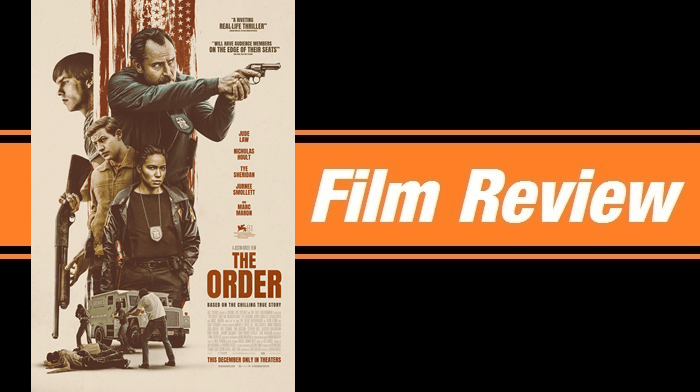
REVIEW: “The Order” (2024)

Out of the many features premiering this Fall movie season, few have peaked my curiosity quite like Justin Kurzel’s “The Order”. Based on the 1989 non-fiction book “The Silent Brotherhood” by Kevin Flynn and Gary Gerhardt, Kurzel’s period crime thriller sets out to tackle some potent subject matter. And with Jude Law, Nicholas Hoult, Tye Sheridan, and Jurnee Smollett starring, he has the cast to pull off what is one of the best thrillers of the year.

Kurzel has had a fascinating career. He emerged in 2015 with his powerful “Macbeth”. The very next year he hit a speed bump with “Assassin’s Creed”, a video game adaptation that has more strengths than it gets credit for. But he picked back up in 2019 with his gritty “True History of the Kelly Gang” and earned critical acclaim with 2021’s “Nitram”. Every film he has made is well worth watching and that remains true with “The Order”.

Set to a striking 1980s backdrop, Jude Law delivers one of the year’s best performances playing Terry Husk, an accomplished FBI agent who reopens the Bureau’s one-man office in the small rural town of Coeur D’Alene, Idaho. He’s come to investigate murmurings of rural neo-Nazi activity which the local Sheriff Loftlin (Philip Granger) is quick to downplay. But he finds an ally in Deputy Jamie Bowen (Sheridan), a clean-cut family man with his finger on the pulse of the area.

Image Courtesy of Amazon MGM Studios

Terry is a compelling central character as seen through Law’s richly lived-in performance. He’s someone who has been around the block, building cases against the New York mafia and the Ku Klux Klan. But while he is driven by his work, it has also taken a heavy toll as evident by his lingering health problems and the allusions to his estranged wife and daughters. Sporting a thick mustache and a world-weary veneer, Terry is an honest and savvy agent who knows how criminals think.

Elsewhere we’re introduced to Bob Mathews played by a captivating Nicholas Hoult. He’s an attractive young man with an all-American smile and disarming sincerity that hides his more disturbing convictions. Bob is the leader of a neo-Nazi splinter group whose hate-fueled agenda is inspired by white supremacist William Luther Pierce’s 1978 novel “The Turner Diaries”.

In the film’s most unsettling scene, Bob has a secret roadside meeting with Rev. Richard Butler (a slyly chilling Victor Slezak), a religious zealot and the leader of Aryan Nations. Both share the same racist worldview but differ on how to bring it about. Butler is shrewd and meticulous, working under the firm belief that the political system is their best way forward. Bob is tired of talking and is ready to put words into action. He’s busy recruiting a militia; robbing banks and armored trucks to fund his revolution. But he’s drawing unwanted attention in the process.
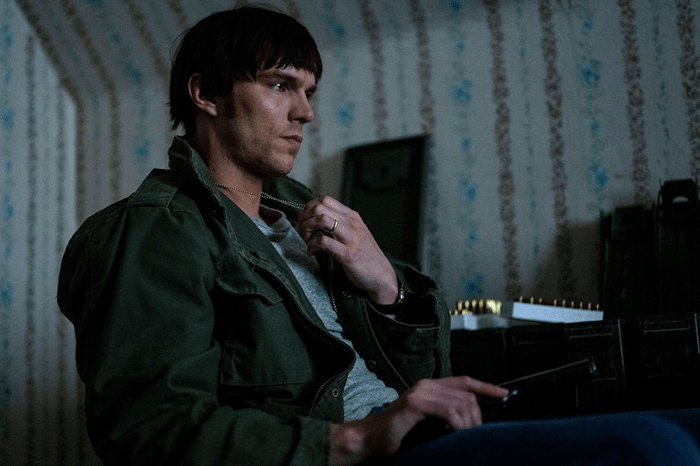
Image Courtesy of Amazon MGM Studios

Screenwriter Zach Baylin shapes their internal tension with a resonating urgency while defining their characters through their single-minded ambitions. As Butler sinks into the backdrop (a terrifying thought once you think about it), Bob’s fervor earns him a small but loyal group of followers who help him carry out a series of heists and soft-target bombings. But when his group (who calls themselves The Order, taken from Peirce’s book) murder Jewish talk-radio host Alan Berg (Marc Maron) in cold blood, it gives Terry and the FBI all they need to make Bob their #1 target.

As the “based on true events” story unfolds with a realistic tenor, the characters careen towards an inevitably violent conclusion. Along the way a handful of side characters provide the film with some welcomed context and depth. Smollett sheds some needed light on Ted playing his old friend and fellow agent, Joanne. In the same way, Bob is opened up more through his frustrated wife Debbie (Alison Oliver) and his pregnant side dish Zillah (Odessa Young). All three could use more screen time, but they have important roles and serve Kurzel’s laser-focused purpose well.

“In every revolution someone has to fire the first shot.” By the time those chilling words pass through Bob’s lips we fully understand the lengths he will go for his cause. And on the other side, Terry is just as committed to bringing Bob to justice. Both raise the stakes in what becomes a simmering cat-and-mouse thriller set within the stunning vistas of the Pacific Northwest. Law deserves an Oscar nomination for his performance while Hoult continues his tremendous 2024 run. As for Kurzel, he adds yet another compelling entry into his already strong filmography.

VERDICT – 4.5 STARS

REVIEW: “On the Wandering Paths” (2024)

Director Denis Imbert teams with Academy Award winner Jean Dujardin in “On the Wandering Paths”, a soulful adaptation of Sylvain Tesson’s 2016 autobiographical travel journal of the same name. Tesson’s book was based on his own deeply personal experience which led to a life-changing and contemplative journey of self-discovery.

Imbert eloquently captures the human pulse of Tesson’s story via a thoughtful script (which he co-wrote with Diastème) and a beautifully introspective performance from Dujardin who is the centerpiece of every scene. In addition to the stunning photography of the French countryside by DP Magali Silvestre de Sacy, “On the Wandering Paths” is built upon the self-reflections and philosophical meditations from one wayward man’s soul-searching odyssey.

Dujardin plays Pierre Girard, an accomplished writer with an adventurous lifestyle whose backstory plays out through a collection of memories and reflections. Pierre has enjoyed a successful life, but it is forever changed in one ill-fated moment of recklessness. While drunk, Pierre falls three stories from a balcony to the unforgiving pavement bellow. The accident leaves him with a broken leg and a serious back injury. He also loses his hearing in one ear and even his sense of smell is affected.

As he endures multiple surgeries and a lengthy recovery, Pierre falls into despair which costs him his relationship with his girlfriend Anna (Joséphine Japy). While bed-ridden, Pierre makes himself a promise – if he is ever able to walk again he will set out to cross France on foot. He eventually regains his ability to walk and immediately begins to fulfill that pledge. He plots himself a 1,300 kilometer route starting at the Italian border and across to the Cotentin Penisula.

His friends and family think he’s crazy. But for Pierre, his journey has a significantly deeper meaning. It’s not only about finding himself, but also proving himself to himself. And while there may be physical and emotional dangers with such off-the-grid solitude, Pierre sees it as a means of self-redemption and as an opportunity to close troubling chapters in his whirlwind life.

Imbert’s ability to immerse his audience in Pierre’s personal pilgrimage proves to be one of the film’s great strengths. He makes us feel like quiet observers, following closely as Pierre climbs each mountain, navigates each forest, and passes through each eroding village. We sense every bolt of pain that courses through his barely mended body, each threatening to end his mission. Yet he’s propelled by an unbending determination that often gives way to obstinacy, testing fate with each step and content with its final judgement.

Pierre’s trek isn’t one of complete isolation. He talks with several locals he encounters along the way. He pays a visit to his Aunt (Anny Duperey). He’s helped by a Good Samaritan (Dylan Robert) who accompanies him for a leg of his journey. And for a brief stretch he’s joined by his friend, Arnaud (Jonathan Zaccaï), and a little later by his concerned sister, Céline (Izïa Higelin). Though most of his time is spent alone, Pierre gleans something new from every person he spends time with.

“On the Wandering Paths” may be light on story but it’s full of spirit. It’s a visually delightful movie full of eye-catching landscapes and beautifully rugged vistas. But there is a lot more beyond the pretty scenery. In addition to chronicling Pierre’s stirring self-exploration, Imbert and Diastème offer a handful of economic and societal observations, mostly surrounding the depopulation of rural France. And it all funnels through Dujardin whose textured performance thoughtfully conveys the movie’s soul.

VERDICT – 4.5 STARS

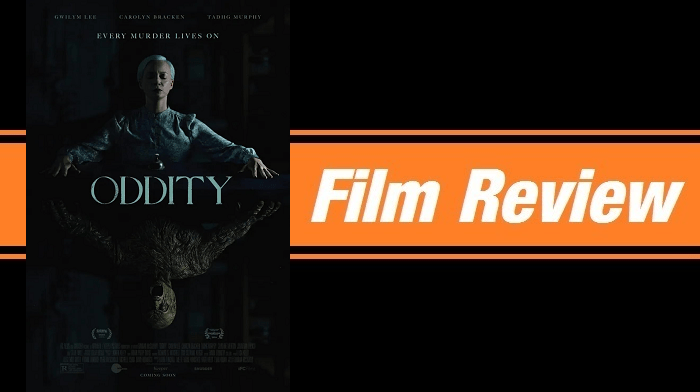
REVIEW: “Oddity” (2024)

2024 has been a surprisingly rich and diverse year for horror movies. We’re only in July yet there have already been strong entries into nearly every possible horror movie sub-genre. Writer-director Damian Mc Carthy adds another gem to this year’s catalog with “Oddity”, a spooky and atmospheric Irish chiller that builds some genuine suspense while keeping us guessing right up to its final frame.

“Oddity” is a cunningly crafted indie feature that adds a supernatural spin to a surprising straightforward murder mystery. As compelling as it is disquieting, Mc Carthy’s story is one of human wickedness and paranormal retribution. His direction is shrewd and methodical, often embracing elements of the horror genre but never held captive by them. That’s a big reason why “Oddity” stands out as unique despite its familiar dressings.

Image Courtesy of IFC Films

The movie is anchored by a brilliant dual performance from Carolyn Bracken. She plays Dani Timmis, the wife of psychiatrist Ted Timmis (Gwilym Lee). The couple recently invested in an old country house which they are in the process of remodeling. While Ted works the night shift at an area asylum, Dani decides to spend the weekend working on and enjoying their new home.

Dani is startled late one night by her husband’s former patient, Olin Boole (Tadhg Murphy). He appears at her door frantically claiming someone has slipped into her house while she wasn’t looking. A frightened Dani is confronted with a critical choice. Does she believe the man outside her door or does she stay locked in her house until Ted can get home? Her decision proves to have heavy consequences as she is violently murdered.

A year later we’re introduced to Dani’s blind and eccentric sister, Darcy (also played by Bracken). She owns and operates a small shop that sells oddities of all kinds, many of which she claims are cursed. She also claims to be psychic which keeps Ted at arms length. Meanwhile Ted has a new girlfriend, a co-worker named Yana (Caroline Menton) who just recently moved in with him. They’re caught by surprise when Darcy shows up unannounced, determined to stay the night. And that’s when things get really uneasy.

Image Courtesy of IFC Films

While Ted is off working his night shift, Yana is forced to stay at the house with the suddenly more hostile Darcy. To make things even eerier, Darcy brought Ted and Yana a present – a ghoulishly life-sized wooden mannequin from her shop, marked by its uncomfortable frozen scream and five finger-sized holes drilled in the top of its head. What’s the mystery of the wooden man? Is its agonized face telling a haunting story of pain? Is the carved creation housing something malevolent? Or does it represent something else entirely?

With his pieces in place, Mc Carthy begins playing with our minds by patiently revealing truths that were hidden right in front of our eyes. At the same time he does a good job ratcheting up the dread, often by something as a simple as a static shot of a door or through his clever use of lighting, shadows, and deafening silence. As you watch “Oddity” you’ll notice there’s a simplicity to Mc Carthy’s approach yet he is remarkably sure-handed. That, along with some pitch-perfect performances, helps make this another stand-out chiller from 2024. “Oddity” is now playing in select theaters.

VERDICT – 4 STARS

REVIEW: “One Life” (2024)

Following its world premiere at the 2023 Toronto International Film Festival, the biographical drama “One Life” was greeted with quite a bit of praise from critics. Deservedly so. Now audiences in the States get their chance to experience this outstanding and heart-wrenching drama that once again highlights Anthony Hopkins as one of our greatest living actors.

Directed by James Hawes, “One Life” is based on the book “If It’s Not Impossible…: The Life of Sir Nicholas Winton” by Barbara Winton. It tells the fascinating true story of humanitarian Nicholas Winton, a London stockbroker who was instrumental in the rescue of 669 children, mostly Jewish, from Prague in the shadow of Hitler’s invasion of Czechoslovakia.

Image Courtesy of Bleecker Street

A little historical background…in 1938, following the Nazi occupation of Austria, Hitler wanted possession of the Sudetenland region of Czechoslovakia. In their misjudged hopes of avoiding war, Britain, France, and Italy gave in to Hitler’s demands. The very next day Nazi forces were marching into Czechoslovakia sending tens of thousands of predominantly Jewish refugees, many of them children, fleeing towards unoccupied Prague. Once there the homeless and starving refugees gathered with the worst of winter still to come and under the looming threat of a Nazi invasion.

Co-written by Lucinda Coxon and Nick Drake, “One Life” blends two inseparable timelines. One is set in 1987 where an elderly Nicholas Winton (Hopkins) lives in Maidenhead, England with his wife Grete (an outstanding Lena Olin). The other is set in 1938 where a 29-year-old Nicholas (played by Johnny Flynn) is determined to travel to Prague after hearing of the humanitarian crisis. As the scenes with the elder Nicholas show a man haunted by the children he wasn’t able to help save, the scenes with the younger Nicholas highlight the courageous work he did to save as many children as he could.

Hopkins delivers yet another powerful performance – an awards-worthy turn that’s subtle yet rich and emotionally layered. He carries Winton’s immense regret with sincerity and humility, showing him to be burdened by the weight of a reality he can’t come to terms with. Several moments help depict this part of Winton’s life including some superb scenes with his wife Grete and one particularly good scene with an old friend, Martin Blake (played by the great Jonathan Pryce in a “The Two Popes” reunion). And it all culminates in a finish that’s equal parts uplifting and crushing.

As for the scenes with the younger Nicholas, Hawes covers ample ground in giving us a comprehensive account of his selfless and harrowing efforts in Prague and in London. Flynn is excellent as an idealistic and driven Nicholas who is moved to action after seeing firsthand the number of endangered children. And Hawes shows Nicholas’s work wasn’t possible without the help of others including his straightforward and persuasive mother Babi (Helena Bonham Carter), Doreen Warriner (Romola Garai), the head of the British Committee for Refugees from Czechoslovakia, and Trevor Chadwick (Alex Sharp), a crucial player in getting the children out of German-occupied Czechoslovakia.

Image Courtesy of Bleecker Street

As the two-pronged story unfolds, Hawes puts a lot of effort into recreating his dual settings. The costume and production designs are key, as is the director’s ability to convey the tensions and emotions unique to each period. In some ways its framework resembles that of other biopics that came before it. But Winton’s story is inherently moving and the movie sticks close to it, touching us with his compassion, inspiring us by his diligence and courage, and shattering us with a cathartic release that feels honest and earned.

Through the years there has been no shortage of films dealing with the Holocaust. That’s a good thing, because as movies like “One Life” remind us, there are still affecting and consequential stories worth telling. Yes, there’s a slight by-the-numbers quality to this one and some may grumble that it keeps its hands a little too clean. But Hawes trusts his audience to fill in the gaps. And we get everything we need from Hopkins and Flynn and the undeniable kinship between their two portrayals. Hopkins gives us something particularly special – another sublime performance to be cherished from a beloved actor who never seems to disappoint. “One Life” hits theaters March 15th.

VERDICT – 4 STARS

REVIEW: “Out of Darkness” (2024)

If the idea of a Stone Age survival horror thriller sounds up your alley you won’t want to miss “Out of Darkness”. This moody and tension-soaked feature from director Andrew Cumming had its world premiere two years ago at the BFI London Film Festival. This past year the film received five nominations at the British Independent Film Awards and this week it’s set for its North American release via Bleecker Street.

Written by Cumming and Ruth Greenberg, “Out of Darkness” tells a dark and gritty tale that fully immerses us in its prehistoric setting. Set 45,000 years ago, the story follows a group of six early people searching of the proverbial promised land but finding themselves fighting for their lives instead. On its surface there is a simplicity to the story, yet it remains gripping throughout thanks to the provocative themes at its core and Cumming’s brilliant visual storytelling. More on that in a moment.

Image Courtesy of Bleecker Street

The film opens with the six arriving in a new world. The group consists of their determined leader Adem (Chuka Modu), his sickly pregnant wife Ave (Iola Evans) and their young son Heron (Luna Mwezi). There’s Adem’s loyal little brother Geirr (Kit Young), the clan’s ever skeptical elder Odal (Arno Lüning), and a “stray” named Beyah (Safia Oakley-Green). Unable to survive on their homeland, Adem has led the group across the sea to a place he claims is marked by tall mountains, fertile valleys, warm caves for shelter, and an abundance of wildlife for food.

But what they find is considerably different. On top of the incessant chilling winds, they discover the earth to be barren. Even worse there are no animals to hunt. Cold, starving, and exposed, Adem leads the desperate group across the harsh, arid land towards the distant foothills in hopes of finding shelter. But on the journey they quickly learn they’re not alone. Something lurks in the night – its bloodcurdling screeches echoing through the pitch-black darkness. And then everything turns after Heron is snatched in the night, sending the unhinged Adem on a hunt that puts everyone in danger.

As the story takes its seemingly inevitable darker turn, Cumming digs deeper into the uglier sides of human nature. His message becomes pretty obvious, but it remains compelling right through to its fitting and impactful finish. Along the way he says a lot through his characters who mirror people-types in a number of subtle but thought-provoking ways. Their actions are often motivated by a number of factors which shrewdly speak to issues that (for better or for worse) remain a part of the human DNA.

Image Courtesy of Bleecker Street

And then there is the incredible detail from the fabulous costume design to the camerawork. The way Cumming and DP Ben Fordsman use various forms of light and eerie darkness; the way they shoot the stunning yet forbidding environments (the movie was filmed in the Scottish Highlands) – it’s all crucial to the storytelling. Cumming even used the guidance of a linguist and an archaeologist to develop an entirely new spoken language specifically for the film.

Though clocking in at under 90 minutes, “Out of Darkness” packs impressive vision and craft into its lean running time. Cumming makes a number of smart choices, none better than keeping the terrifying threat a secret until the final act. Amplified by haunting visuals, tension-soaked atmosphere, some gnarly makeup/effects, and a brooding score by Adam Janota Bzowski, “Out of Darkness” is an absorbing and well-executed horror thriller set within a grim, unwelcoming, yet fascinating hellscape. And it marks the scintillating feature length debut for an exciting new filmmaker. Opening in theaters February 9th.

VERDICT – 4 STARS

REVIEW: “Outlaw Johnny Black” (2023)

Mixing blaxploitation, kung fu cinema, spaghetti westerns, and at least five other genres and sub-genres, the upcoming “Outlaw Johnny Black” is a genre lover’s dream. This crazy yet undeniably delightful concoction sees director, co-producer, co-writer, and star Michael Jai White giving an open-armed embrace to films and filmmaking from a bygone era. It’s chock-full of cool callbacks and it tips its cowboy hat to everything from “A Fistful of Dollars” to “My Name is Nobody” to “Blazing Saddles”. And that only scratches the surface of White’s many inspirations.

Sporting the tagline From the Brothers Who Brought You “Black Dynamite”, White’s latest has been called a “spiritual sequel” to that 2009 cult hit. “Outlaw Johnny Black” definitely exists in the same vein and is a movie that is almost certain to throw some people for a loop – specifically those unfamiliar with the genres and tropes it is spoofing or paying homage to. But what can I say? White has made a movie that is right up my alley.

Image Courtesy of Samuel Goldwyn Films

The story kicks off in earnest after one of the best opening credits scenes of the year – a retro collage of music and imagery that could have been plucked straight out of a Sergio Leone spaghetti western. Johnny Black (White) is a sharpshooting gunslinger out to avenge the death of his father 25 years earlier at the hands of a cold-blooded ruffian named Brett Clayton (a deliciously vile Chris Browning).

Johnny is a notorious outlaw who is constantly dodging relentless marshals and bounty hunters all across the territory (there’s a hilarious running gag involving a wanted poster that had me laughing every time). One particularly close call sends Johnny fleeing across the dry arid plains. On the verge of dying, he’s saved by Reverend Percy Fairman, Jr. (played by co-writer Byron Keith Minns) who’s on his way to Hope Springs, Oklahoma to pastor a small church and propose to a lovely young parishioner named Bessie Lee (Erica Ash).

From there let’s just say things go a little sideways. Percy is believed to be killed and Johnny finds himself in Hope Springs awkwardly posing as their new preacher. Once there, we’re introduced to an eclectic collection of entertaining characters who Johnny must schmooze in order to keep up his ruse. He also learns the town has its share of troubles, namely an oppressive land baron named Tom Shealy (Barry Bostwick) who’s after the church’s property.

You can probably guess where the movie ends up, but it’s getting to that point that is so much fun. White has a blast picking at and playing around with age-old and well-defined genre tropes. And aside from one misguided sequence that doesn’t land at all, he delivers some really funny bits in the process. Yet White doesn’t just poke fun at everything. He has a genuine affection for genre filmmaking that finds its way on screen from the opening shot to the final scene.

Image Courtesy of Samuel Goldwyn Films

And again, the crazy batch of characters play a big part. They’re played by a terrific ensemble who are all in on what White is going for. Among them is the plucky and straight-shooting Jessie Lee (Anika Noni Rose), her crackpot brother Elmer (Eme Ikwuakor), the spineles Mayor Williams (Gary Anthony Williams) and the equally spineless Sheriff Yarbrough (Tony Baker), the vivacious Sister Betty (Kym Whitley), the skittish Clancy (Tommy Davidson), the dogged Bill Bassett (Randy Couture), and the ever suspicious Marshall Cove (Kevin Chapman).

Again, not every joke lands as intended and there are a couple of instances of White simply trying too hard. You could also make the case that the movie didn’t need to be over two hours long. But what can I say? I soaked up every minute – admiring the throwback craftsmanship, trying to spot the many callbacks, chuckling at the subtle and not-so-subtle humor, and enjoying the handful of cameos, especially two at the very end that had me smiling like a kid on Christmas morning. Like I said at the beginning, this movie is right up my alley. “Outlaw Johnny Black” releases in theaters on September 15th.

VERDICT – 4 STARS