REVIEW: “Robot & Frank”

robot-and-frank-Poster

“Robot & Frank” may offer the most unique look at growing old that you’ll find. It touches on several of the age-related elements we’ve seen addressed in other movies, but the key difference here is that it’s looked at through a semi-futuristic lens. This comedy/drama from director Jake Schreier is a smart and well made picture that may not instantly call you back for a second viewing, but it will touch your heart and make you laugh. And on those two merits alone, it’s easy to call “Robot & Frank” a success.

But there is more to the movie than just that. In fact what originally drew me to the picture was that it offered a starring vehicle for Frank Langella. I’ve always been a big fan of his and consider him one of the more underrated actors. At age 75 he’s no longer Hollywood’s prime target age for lead roles (unfortunately) so it was a nice surprise to see him here. He’s joined by Susan Sarandon, James Marsden, Liv Tyler, and Peter Sarsgaard who supplies some really fun voice work.

In the not too distant future, Langella plays an elderly man reasonably named Frank who lives by himself in upstate New York. Frank is starting to see his health deteriorate particularly through early signs of dementia. His son Hunter (Marsden) lives five hours away and he’s grown tired of the weekly trips to see his father. Frank’s daughter Madison (Tyler) is an ‘out there’ activist who occasionally checks on her father via video phone. Their entire family dynamic is fractured due to some past baggage and Frank’s health issues force them all to deal with it. But it takes a little prodding before anyone is willing to do that.

Robot and frank

Hunter’s solution for caring for his father is to provide him with a robot caregiver who will cook, clean, and watch over him. Frank hates the idea and does everything he can to discourage the robot. But he begins to grow fond of it after this man and machine make an interesting connection. Frank begins sharing memories of his past jobs to his robot. Now Frank’s job was no ordinary job. He wasn’t a carpenter, a truck driver, or a lawyer. Frank was a thief and actually spent time in prison for it. Before long he begins to see some new possibilities with his robot friend, possibilities that may not be the wisest.

You may think you know where this movie is going but the path it takes is an unconventional one. That’s what sets it apart from so many other movies that deal with these subjects. Langella is fantastic and he gives us an endearing and genuinely sympathetic character. He grumbles and growls in some scenes while in others he masterfully portrays a man in mental decline. It’s a beautiful performance and he’s the force that really drives this picture. Sarandon appears as a local librarian. She’s very good and I have to say some of my favorite scenes are when she and Langella are sharing the screen together.

“Robot & Frank” is a small movie built around a tight script and Frank Langella’s strong work. It’s humor is often subtle but always effective and the emotionally meaty undercurrent really worked for me. Now, as I mentioned, I wouldn’t say this is a film that I want to rush out and see again. It’s just not that kind of movie for me. But I won’t deny the film of the praise it deserves. It accomplishes a lot by taking a few weighty subjects and taking them on in new creative ways. That’s something I really appreciate and responded to.

VERDICT – 4 STARS
REVIEW: “La Rafle” (“The Round Up”)

la_rafle_banner

Over the years there have been many movies that have examined the Jewish Holocaust. Some have dealt with the horrors surrounding the Nazi’s brutal and barbaric campaign while others have focused on the individual stories of heroism and survival. Due to the number of these films you would be hard-pressed to find an angle of the Holocaust that hasn’t been covered. But that does nothing to lessen my love for these movies that remind us of what were some of our world’s darkest days.

For me, when a movie about the Holocaust is done well it can be one of the more heartrending film experiences. Even with a familiar subject, if a director can tell a good story and lend their own unique voice to the film, I’m emotionally invested. Such was the case with “La Rafle” which is translated “The Round Up”. Much like “Sarah’s Key” (review coming very soon), a movie that came out the same year, “La Rafle” is set in Paris during the Vel’ d’Hiv Roundup. This was the mass arrest of over 13,000 Jews, mostly women and children, by the French police and secret service. Most were taken to the Vel’ d’Hiv stadium and kept in inhumane conditions before being taken to internment camps. Nearly all were eventually sent to and murdered in Auschwitz by the Nazis.

rAFLE1

“La Rafle” starts with a bit of fractured storytelling. It hops back and forth between the different people who we will follow as the story moves forward. The central focus is at first on the Weismanns, a Jewish family living in Paris’ Montmartre district. Schmuel (Gad Elmaleh) is an artist and devoted father. Sura (Raphaëlle Agogué) is a tender and loving mother. They have two daughters – one loves ballet while the other is spunky and outspoken. Then there is 11-year old Jo (Hugo Leverdez), their warm-hearted son growing up in occupied Paris. He’s playful and a bit rambunctious especially when he’s with his pals Simon and Noé. We see a lot of the story through Jo’s young and innocent eyes.

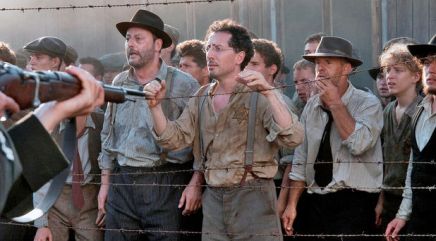
There are also breakaways to a young Protestant nurse named Annette Monod (Mélanie Laurent), a character who becomes a central focus in the second half of the film. But there are also scenes featuring a smug Adolph Hitler carrying on the facade of a family man while secret meetings are taking place at his command – meetings that put the Vel’ d’Hiv Roundup in motion. That leads to the morning of July 16th, 1942 when the French police under Vichy orders do the unthinkable. The film takes us through the horrible arrests and “processing” of that morning and then puts us in Vel’ d’Hiv stadium with the Weismanns and the others we’ve come to know.

la-rafle-still-1-smallAnnette comes to the stadium and volunteers medical help. While she’s there she develops close relationships with Jo and some of the other children. She’s also inspired by a dedicated Jewish doctor named Sheinbaum (Jean Reno). It’s here that the atrocities become real to her and she sets out to do everything she can to help. All of these characters have their paths connected by this one truly horrific event – something that will scar them, the country, and the entire world.
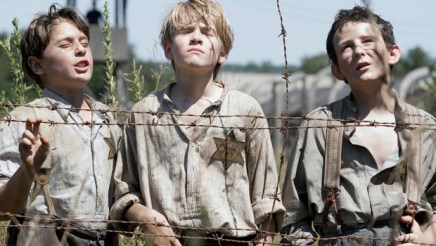

“La Rafle” works because writer and director Roselyne Bosch keeps her focus on the characters. She leaves the graphic depictions of the violence and barbarism to other movies yet its looming reality is always with this film. The tension of the real life events soak every scene even if they aren’t visually depicted. I found that to be very effective. Bosch wants us to connect and invest in the characters and once we do that, the emotion and the intensity flows. Now the movie does feel polished and some have criticized it for its lack of edge. Their are scenes where that criticism is fair but overall I think it misses what Bosch is going for.

Perhaps the most powerful component of the film is that each of its characters were real life people who faced the roundup and what followed. Bosch used their real names and their true stories. For me that just added to the stinging realism. The wonderful costume and set design also worked to draw me in. The shots of Montmartre seems plucked right out of that decade and every person fit perfectly in the period they were representing.

The performances are another strong point. I’ve grown to be a Mélanie Laurent fan. After seeing her in a handful of French and American films, I find her to be an impressive actress. I also really appreciated Raphaëlle Agogué’s work. There’s a subtlety and humble beauty to her performance that really worked for me. I also liked Gad Elmayeh who brings a very believable and well written father to life. I also have to mention the performances from the children. They play a big role in this film and without their solid work the movie would have suffered.

La rafle3

I wish I could say this was a flawless 5 star movie but there were a couple of issues I had with it. The movie seems to assume that the audience is familiar with the subject. Now being a French production I’m sure many of the film’s bigger audiences were very familiar with the history. Having read a decent amount about the events, I was pretty knowledgable as well. But I still found myself unable to follow some of the scenes featuring the planning and the politics between the Vichy and the Nazis. They aren’t all that well constructed which was a little frustrating. I also felt the film slowed down a little too much in the middle. It certainly didn’t kill the film’s effect but it was noticeable. Aside from these gripes, “La Rafle” strikes every chord and tells a truly incredible story.

While in Paris last year my wife and I took time to visit the Shoah Memorial. It was one of the most sobering experiences of my life. This movie reminded me of that visit and of the terrible events faced by the Jewish people in Paris. “The Round Up” is a pretty polished film but its also reverent, sober, and responsible. It’s received some unfair criticism and it’s a film that has went unseen by many here in America. That’s a shame. For me it was wonderfully done and it’s an easy film to recommend.

VERDICT – 4.5 STARS

The Public Movie Defender – “Robin Hood”

MOVIE DEFENDER ROBIN HOOD

The idea behind The Public Movie Defender is to take up the cause of a particular movie that I believe is better than the majority of reviews it has received. These are movies which I feel are worth either a second look or at least a more open examination considering the predominantly negative opinions of them. The films chosen are ones that I like so therefore I’m taking their case and defending them before the court of negative opinion. Let the trial begin…

DEFENDANT # 1 – “ROBIN HOOD”

ROBIN HOOD

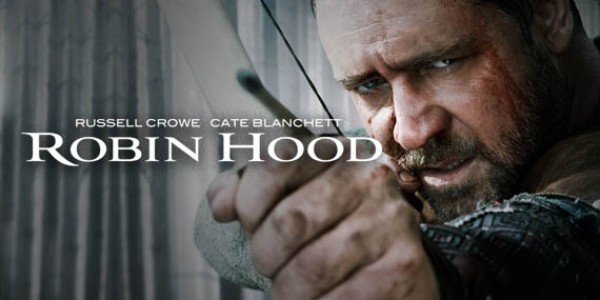
Occasionally I like to take the time to focus on a particular movie that I really like but many others didn’t. Call it my unnecessary yet obligatory sense of personal duty or some warped affection for getting blasted by my fellow movie fans. Whatever it is, I find it fun defending movies that I appreciate but many others may not. One such film is Ridley Scott’s 2010 period adventure “Robin Hood”. Lingering at an undeserved 43% on Rotten Tomatoes, “Robin Hood” has faced a variety of gripes from its slow, plot-heavy narrative to its historical inaccuracies. These things didn’t bother me at all and the movie went on to be one of my favorite films of that year.

I still remember when I was driving to the theater to first see Ridley Scott’s “Robin Hood”. I couldn’t help but wonder if I had set my expectations so high that it would be impossible for the movie to reach them. After all, this is Ridley Scott and Russell Crowe, the same team who brought us “Gladiator”, a true favorite of mine. Could one of my favorite working actors and one of my favorite working directors come close to matching the success of their previous Oscar winning period film? The answer is yes, for my money they did come close. While overall “Robin Hood” isn’t as grand or as seamless as “Gladiator”, it does well in many of the same areas that made “Gladiator” such a strong film.

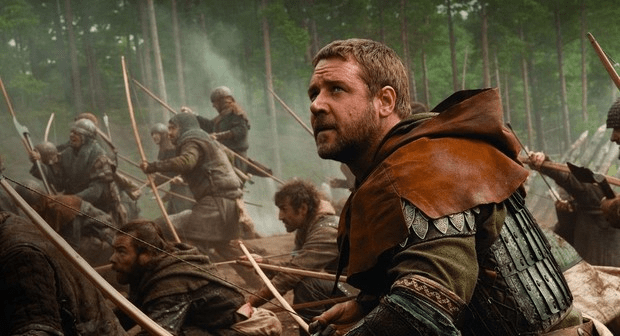
This isn’t your standard Robin Hood that we’re all familiar with. This is considered a prequel to the ‘steal from the rich, give to the poor’ story that’s been told numerous times before. It follows Robin Longstride (Crowe) as he goes from being an archer in King Richard’s army to the most wanted man in all of England. Along the way he witnesses the death of King Richard in battle and the rise of King John (Oscar Isaacs), Richard’s younger brother. King John isn’t a likable leader. His arrogant, self-serving approach to governing and his burdensome heavy taxes have turned the people against him and it couldn’t be a worse time for that. An invading French army is knocking on England’s door but the people need unifying.

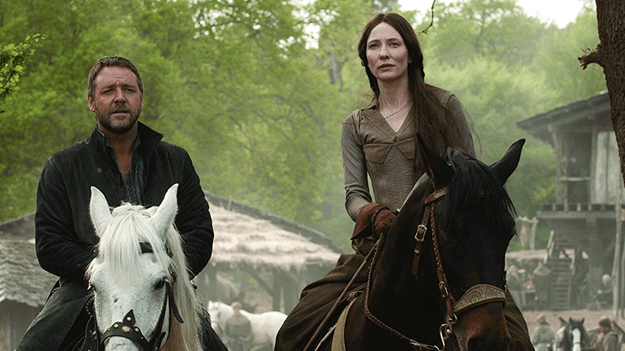
Meanwhile Robin and his three new but merry men find themselves in Nottingham where secrets to his past may lie. Its here than he runs into the proud and spirited Marion (Cate Blanchett). I won’t give anything away but anyone even remotely familiar with the Robin Hood story knows that they eventually hit it off. But violence and war comes to Nottingham which catapults Robin right into the center of the tumult. The story takes its time getting to this point. It deliberately moves through several plot points and it lays out a lot of story along the way.

This is what turned off a lot people. They found it all flat and plodding. Personally I loved the slow and calculated buildup. I loved the clear focus on the characters, the politics, and the strategies behind the events taking place. I loved that it wasn’t just another period film focused almost exclusively on the action. For me the intentional time spent with character development worked fine and it fed the action sequences giving them more meaning and weight. With the exception of a couple of needless inclusions, I was wrapped up in this story and while it might have been too slow for some, I found its proficient script in the hands of this truly great cast made for some wonderful entertainment.

Now when it comes to making an epic-scale period piece few can do it better than Ridley Scott. Here his amazing attention to detail, extravagant set pieces, and gorgeous cinematography create a believable and stunning 13th century England. From the film’s opening sequences to it’s furious finish, the realistic feel and old English atmosphere is one of the reasons the film worked so well for me. As alluded to above, Scott also brings just the right amount of action scenes. The frantic, gritty camera work and carefully executed CGI allows for the small battles and huge epic scale war sequences to maintain an undeniable energy. But again the film doesn’t totally rely on them. There’s a very deliberate tale that unfolds in an effort to set up the legend of Robin Hood. Scott takes his time and adds a fresh depth to these very familiar characters.

Then there’s the strong lead performance of Russell Crowe. He has always been able to take a character and combine strength with a genuine humanity. Crowe’s Robin Hood is possibly the most human of any previous portrayals showing a sad but strong man in the dark about his past and uncertain about his future. It isn’t loud or showy work but it fits nicely with the tone that Scott is looking for. I also have to mention the performance of another favorite actor of mine. Mark Strong takes on another “bad guy” role and he’s able to create yet another delightfully despicable villain. He’s such great fun to watch. Cate Blanchett puts together a very different and intriguing Marion. She’s strong and independent and Blanchett certainly holds her own amid the slew of male performances. There’s tons of great supporting work from Max von Sydow, Oscar Isaac, William Hurt and more.

“Robin Hood” is an entirely different look at the classic character that does lend to a more serious telling of his legend. That, mixed with the slower plot-thickened narrative, clearly didn’t work for those with much different expectations for the film. It not only worked for me but it impressed me and I found it easy to be absorbed into the story. I’ll admit there are some moments that could have been cut and there are bits of silliness in the big finale. But they never came close to ruining my experience and after several viewings I still believe this is one of the best films of the Scott/Crowe collaborations. That’s my defense and I’m proudly sticking to it.

VERDICT – 4.5 STARS

REVIEW: “Room 237” (2012)

room 327 POSTERI’m not the biggest fan of Stanley Kubrick. He has a couple of movies I really like and a couple that I hate. I recognize his talent and filmmaking skills but I’m not always blown away by this storytelling. “The Shining” is one of his films that I like although not near as much as the obsessives we find in the documentary “Room 237”. While I enjoy “The Shining”, I’m not as smitten with it as many are. But the five people we meet in “Room 237” are beyond smitten. They are consumed with the film.

I had read very little on this unsanctioned documentary prior to watching it. I just knew that it was a look at the deeper meanings of what is perhaps Kubrick’s most recognized film. In its own way that’s what “Room 237” is about. But the documentary doesn’t look at popular theories surrounding some of the film’s bigger questions. It more closely resembles far-fetched conspiracy theories thought up through obsessive analysis. I can’t say I left the picture with any new sense of revelation. To be honest I was a little disappointed. It wasn’t at all what I expected. On the flip side there were some unexpected elements in the movie that I found fascinating.

“Room 237” shows the incredible ability of cinema to open itself to a variety of interpretations. It also shows the amazing love that some people have for movies. That’s certainly the case with the enthusiasts we are introduced to here. Not only do each love “The Shining” but their interpretations wildly differ. It really drove home something I’ve always said – movies often speak to different people in different ways. I love the ability to discuss a film and present my interpretation to someone who sees it differently. Movies that give us that have done us a great service.

room 237

But there is a such thing as letting your obsession run wild and that’s what we get here. One person goes through detailed analysis of how the film is about the “white man’s” genocide of the American Indians. Another firmly believes that the entire film is about the Jewish Holocaust. Yet another believes that Kubrick uses the movie to expose his participation in the faking of the Apollo 11 moon landing video footage. Perhaps the funniest theory is that the film is loaded with subliminal messages that support a subtext involving haunted phantoms and demons who are sexually attracted to humans. Yes, someone actually believes that.

Their impassioned defenses of their theories can be interesting especially when they break the film down frame by frame to offer evidence. But honestly it’s hard to take a lot of their ideas seriously. Their entire argument may hinge on a typewriter, the number 42, or a carpet pattern. They often times point to interesting oversights found in the movie. But their relevance to the theories they’re purporting can be pretty flimsy. That’s where the movie falls a bit short. I can appreciate the passion and near fanaticism that the movie features. But the fact that none of these theories carry much weight makes the documentary feel lightweight. Yes I was entertained, but I was left wanting more.

Close to the end of “Room 237”, a gentleman speaks of his life becoming “The Shining”. He talks about his plans to move his family to a secluded part of the country where he can continue to study the film. What an example of a man’s creepy monomania. These infatuations and enthusiasms are what this documentary is really about. Some are intriguing, most are preposterous. Yet there is still something to be said about this kind of love for a movie. For some of us a movie can deeply stir us and a special love for that film can arise. I think “Room 237” shows that you can take that a tad too far. I just wish this documentary gave me a little more to chew on.

VERDICT – 3 STARS

“Ruby Sparks” – 4 STARS

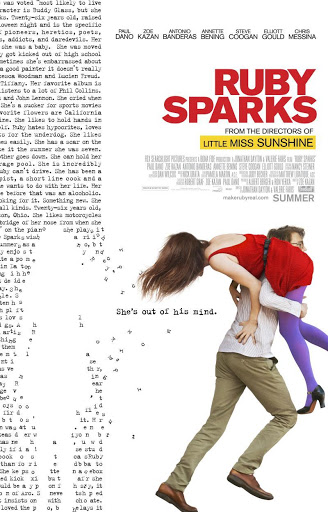
ruby sparks posterThere are some movies that you know you have no interest in seeing from the first moment you hear of them. Whether you’re repelled by the story, the director, or someone in the cast, certain films can instantly turn you off. That was my initial reaction to “Ruby Sparks”. Since I’m an official Paul Dano hater, “Ruby Sparks” was immediately thrown into my ‘do not watch’ bin. But you know there are also movies that completely catch you off guard. Despite your lack of interest or minuscule expectations, some movies come out of the blue and totally surprise you. That was my reaction after finally seeing “Ruby Sparks”.
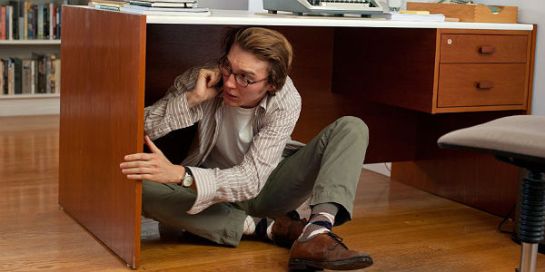
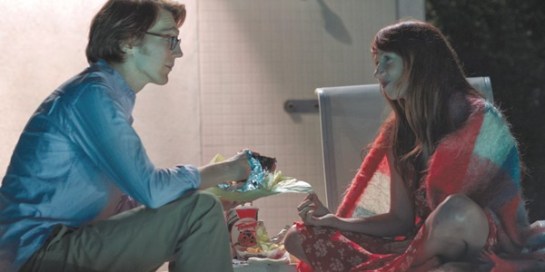
I really hadn’t given this film much consideration at all. But after reading a few recent positive reviews and desperately needing a movie for my Netflix queue, I decided to give “Ruby Sparks” a look. I’m glad I did. This is a smart and fresh romantic comedy that looks at control issues, insecurities, and the failures of people to look inward when it comes to solving a relationship problem. The film takes its unique idea and makes it work thanks to a superb script, nice direction, and yes, even a good performance from Paul Dano.

Zoe Kazan wrote and stars in this film about a struggling writer named Calvin (played by Kazan’s real life boyfriend Dano). Calvin captured lightning in a bottle at age 19 with a best selling novel that took the country by storm. But since that time he’s been unable to latch onto a good idea for a follow up. Calvin also has a poor track record when it comes to relationships. He spends the majority of his time alone with his dog Scotty dwelling on a long past breakup with a girl named Lila. Calvin’s jerky but caring brother Harry (Chris Messina) tries to help him with his depression and his therapist Dr. Rosenthal (Elliott Gould) gives him various writing assignments to try and provide him with the emotional and career push he needs.

Ruby Sparks2

Then something miraculous happens. Calvin has a dream where he has a lovely encounter with a girl in a park. He wakes up and immediately feels inspired to write about her. Day and night he enthusiastically writes about Ruby Sparks and falls for her more with each word he types. Then one morning Calvin is astonished to find Ruby (Kazan) in his house – a living, breathing embodiment of all he’s written. This provides several obvious complications for Calvin but it also offers some interesting possibilities for him. Could this be the one chance for him to have the girl of his dreams (yes, I actually went there)?

I don’t want to go much further into the story at risk of giving too much away. Lets just say the movie makes Calvin face a number of relationship questions and moral quandaries. With a few punches on his typewriter he’s able to change or adjust Ruby in any way he sees fit. But is that love? Is that what relationships are all about? Are our fantasies good measuring sticks for companionship? You’ll find these types of questions cleverly nestled between some good subtle humor and a touch of romance. I really responded to it and that’s mainly due to Kazan’s slick, intelligent script. This was her screenwriting debut and she shows an amazing knack for telling a good story while bucking conventional methods. The directing team of Jonathan Dayton and Valerie Faris keep Kazan’s story moving with energy and fluidity. At least most of the time. The film does hit a lull at the midway point but the directors quickly change directions which gets things back on track, right up to the satisfying ending.

Ruby Sparks1

It would be unfair for me to finish the review without talking about Paul Dano. He gives a really good performance here. Now I still stand by my assertion that he’s only good in certain and very specific roles. In fact, Kazan wrote this part with him in mind. But this is perfect for him and he nails it. Kazan is also very good in a small but tricky role. There is also good work from Messina and Gould as well as Annette Benning as Calvin’s free-spirited mother and Antonio Banderas as her peculiar boyfriend.

Let me sum this all up by saying “Ruby Sparks” was a pleasant surprise. I never expected to enjoy this movie nearly as much as I did. It may sputter in a spot or two and some of the characters may not feel as genuine as they should. But the acting is strong and the writing is fantastic. That was more than enough to bring this unique story alive for me. While Paul Dano still isn’t an instant box office draw for me, I believe that with the right material he can be good. And “Ruby Sparks” has me really excited to see what Kazan writes next. For me, she’s the one who shines the brightest from this film.

“Rust and Bone” – 3.5 STARS

RUST PosterThere are several things that attracted me to “Rust and Bone” but nothing more than seeing Marion Cotillard take on another challenging role. To me, Cotillard is one of the best female actresses working today and she has never shied away from a difficult or demanding performance. That’s certainly the case in “Rust and Bone”, a French language picture from director Jacques Audiard. Audiard’s last directed film was 2009’s “A Prophet” so I expected this to be a bit gritty. But in the end it was his grittiness and edginess that kept me from absolutely loving this movie.

Now don’t misunderstand me, I do like “Rust and Bone”. There’s such a harsh reality to Audiard and co-writer Thomas Bidegain’s script and the incredibly committed performances are essential to bringing us into the fragile and stained worlds of Alain (Matthias Schoenaerts) and Stéphanie (Cotillard). But as in real life, there are some things I don’t need to see over and over again and I felt Audiard’s desire to be edgy sometimes took away from the much better story at the heart of “Rust and Bone”.

The story revolves around two struggling people whose lives cross paths. We first see Alain as a single father with no money or home. He and his son Sam (Armand Verdure) end up crashing at his sisters house in a poor part of Antibes, France. He moves from one low-paying job to another while still holding out hope of reviving his kickboxing career. While working as a bouncer at a nightclub he has a brief encounter with Stéphanie. She works with killer whales at a Sea World type tourist park. Later during a performance there is a terrible accident which leaves Stéphanie as a double amputee. With her lower legs gone, she sinks into a world of deep depression. She reconnects with Alain and the two begin a peculiar relationship centered around two different sets of needs.

RUST2

“Rust and Bone” rarely offers the audience an opportunity to smile. It deals with tough issues and never adds an ounce of sugarcoating or melodrama. When it uses this approach to advance the plot the film is very effective. And that’s not to say the movie lacks heart. There are a few scenes that do lift your spirits and they drive you to root for these characters and their individual transformations. You find your self invested in Alain and Stéphanie even if you don’t particularly like them all the time. This is in large part due to the performances from Cotillard and Schoenaerts. There isn’t one bit of insincerity in these performances and you’ll never doubt them for a second. Cotillard continues to amaze me with her subtlety and ability to express genuine emotion through her expressions. Here she gives an intense yet grounded performance. The only distraction from the actor’s work comes from the movie’s persistent focus on the edgier part of their relationship. For me, Audiard goes to the proverbial well one too many times.

I also have to mention the insanely good CGI work and visual trickery used to make Cotillard look as if she has no legs. If you weren’t familiar with the actress you would never know otherwise. It’s that convincing. Of course I don’t have to explain how essential that is to making the story work. Much of the film deals with her struggling and dealing with her handicap and I was amazed at how visually impressive it looked.

“Rust and Bone” could be called an unconventional love story but that’s cutting it short. There’s so much more going on in this film and most of it works great. There’s some fantastic technique at work behind the camera and the performances are brilliant. But my overall experience with the film was brought down a bit by some pointless content that wasn’t just distracting but that caused things to drag a bit. A tighter script and a broader focus could have made this good film even better. Nevertheless there is some solid storytelling here and the raw emotion that it leaves you with says a lot about the movie.