REVIEW: “Spotlight”

SPOTLIGHT POSTER

I’ve always been a sucker for movies with journalism at their center. I like all kinds of them – the character-driven dramas and especially the more focused procedurals. For years Hollywood has enjoyed using journalism as a means of telling numerous kinds of stories. Many have been fantastic films while others…not so much.

The latest journalism picture sets us down in the world of investigative reporting. It is Thomas McCarthy’s “Spotlight” – an absorbing newsroom drama about a Boston Globe investigative team’s discovery of child sexual abuse by Catholic priests. The story goes even further by following the team’s uncovering of an elaborate and disgusting cover-up by the Boston Archdiocese.
Spotlight1

The film is inspired by the true story of the Globe’s ‘Spotlight’ unit who in 2001 exposed the abuse and cover-up eventually winning a Pulitzer Prize for their work. McCarthy also co-wrote the script which notably doesn’t feature a true lead performance. This serves the story well. “Spotlight” is a full-on ensemble picture built around several key characters and represented by some of the best performances of the year.

The ever-entertaining Michael Keaton plays Walter “Robby” Robinson who heads the Globe’s four person Spotlight team. His team consists of the fervent, high-strung Michael Rezendes (Mark Ruffalo), the tireless Ohio transplant Sacha Pfeiffer (Rachel McAdams), and the seasoned Matt Carroll (Brian d’Arcy James). It’s a tight-knit and semi-autonomous group who determine their own investigations and are given all the time and resources needed.

spotlight2

That appears to change when, amid potential company cuts, the Globe brings in a Boston outsider Marty Baron (Liev Schreiber). Feeling there is an important story to be told, the new boss immediately pulls Spotlight off their current project and has them investigate alleged child abuse among local priests. Their trail winds back several years implicating more priests and revealing more victims.

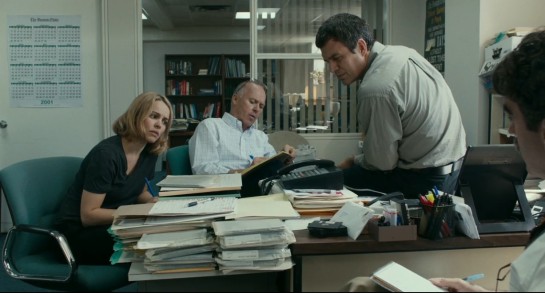
“Spotlight” is a painstaking procedural more focused on credible detail than big, showy moments. There is no pomp or pageantry. McCarthy is far more interested in examining the journalistic process than standard issue newsroom clichés. Everything he presents is done so with the utmost realism. You truly get a sense that you are watching an investigative process in motion. It may be the energy of the newsroom (much of which was shot in the Boston Globe offices) or something as simple as digging through old news clippings, making phone calls,  or examining old records.

spotlight3

But there is an incredible balance within the film. It is a journalism procedural but there is also the serious and unsettling story we witness being uncovered. “Spotlight” handles this prickly subject deftly and earnestly. It pulls no punches while at the same time respectfully representing the victims. Even in these moments the movie avoids the temptation to go big. It maintains a consistent level of restraint both from the actors and the director.

And not enough can be said about the performances. Keaton and Ruffalo are flawlessly in tune with their characters. Liev Schreiber may be the biggest surprise delivering a clever minimalist performance. John Slattery even dials it back as the paper’s deputy editor. And Stanley Tucci is fabulous as an attorney on the wrong side of the church due to his unsuccessful crusade against clerical molesters. Tucci is an actor known to go big, but even he is more concerned about serving the story than his character. It’s something the entire cast shares.

spotlight4

Ironically the film is titled “Spotlight” yet a spotlight is something no one involved seeks. Whether you’re talking about the director or a cast member, everyone seems more interested in the story being told. That chemistry allows for the film to center its focus on smart, meticulous storytelling. McCarthy’s film is subtly thrilling and it flows at such an invigorating pace. Better yet it doesn’t hold our hand or insinuate we need every narrative beat explained for us. And in the end there is no chest pounding or lofty hero statuses. Just a stinging indictment that reaches beyond the church. As one character says “There is enough blame to go around”.

The Spotlight team ran a series of revealing articles that had a profound impact throughout Boston and beyond. It was true journalism at its purest during what could be called the last great age of the newspapers. “Spotlight” the movie is a worthy tribute to the important work done by that team. It also happens to be one of the best films of 2015 and easily one of the best films about journalism itself.

VERDICT – 5 STARS

5 STARSs

5STAR K&M

REVIEW: “Suffragette”

SUFF POSTER

suf·fra·gette (/səfrəˈjet/) noun • historical

a woman seeking the right to vote through organized protest.

That definition is true yet in no way does it adequately define the women and the movement they sparked in the late 19th and early 20th century. In Great Britain the suffragette movement became a force sometimes blurring the lines between lawful and militant protesting. Militant groups such as the WSPU led by Emmeline Pankhurst went from picketing, protesting, and hunger strikes to arson and bombings. While their tactics may have sometimes crossed the line, the rights they fought for were important and deserved. It was a complex time.

“Suffragette”, the new film from director Sarah Gavron, sets itself in this period and seeks to tell the story of passionate women standing up for their right to vote. But movies like this can be tricky. When you have a wealth of rich historical source material you automatically have a story to tell. It also offers a chance to deliver a powerful message. Movies have often stumbled when trying to balance these two creative opportunities.

The story is told through predominantly fictional characters but with a few historical figures included. Instead of telling a specific historical account, writer Abi Morgan creates several characters and reveals that period through their eyes and their experiences. The always absorbing Carey Mulligan serves as our main lens. She plays Maud Watts a wife and mother who also works long, strenuous hours as a laundress.

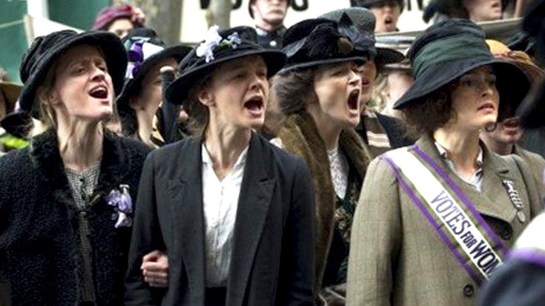
suff1

It’s London in 1912. The suffragettes have only begun to make waves. Maud first witnesses the movement through street speakers and storefront vandalism. But her interest is mainly influenced by the inequalities she experiences at her workplace. She is also encouraged by the infectious enthusiasm of her friend Violet (Anne-Marie Duff). Maud becomes more involved as she meets inspirational women like Helena Bonham Carter’s Emily and Meryl Streep’s Emmeline Pankhurst.

Wisely, Gavron and Morgan don’t make Maud’s decisions easy. We get a compelling internal struggle and there is a constant wrestling with the potential consequences of going too far. The decisions are made even more difficult by her unsupportive husband Sonny (Ben Whishaw) and the thoughts of being separated from her young son. Add to that the dogged pursuit of the government assigned Inspector Steed (Brendan Gleeson). As the movie progresses that struggle evolves in a way that is very organic and satisfying.

The character and the struggle mainly works thanks to Mulligan. This is such an understated and subdued performance that plays in perfect sync with the character. She skillfully articulates every feeling and raw emotion. It’s no glamorous role. Mulligan sports a tired and worn face and she often expresses a convincing sense of physical and emotional exhaustion. It’s impressive watching her transition from a woman sadly content with the hand she has been dealt in life to a woman driven to action by that very same hand. It’s a fine performance.

SUFF2

Then there is Meryl Streep. In a bit of promotional manipulation you would think Streep has a significant role. Actually she does not. It’s basically a glorified cameo. It’s almost as if they were positioning her for the obligatory Oscar nomination she gets every year (apparently no one feels “Ricki and the Flash” is going to do it for her). She’s not bad here, but there is nothing to her small appearance that stands out either.

Where “Suffragette” stumbles is in the omission department. The film looks at Maud’s life and tells her story well. But at the same time it wants to represent an important historical struggle and does so in broad strokes. Much of the struggle is thinly represented namely the motivations behind voter suppression and the political manipulation and posturing. So much in this area could have been explored. Instead we just get highlights. There is also the ending which is fine in concept but came sudden and abrupt.

“Suffragette” dances in numerous shades of gray both in the actions of the women shown in the film and in the film’s opinion about them. But it certainly doesn’t waver in its message about the plight of women during a time that wasn’t that long ago. Regardless of any hiccups, the film deals in powerful and important themes and does so in a way that can’t be ignored. There is such a great sense of time and place and falling into the life of Maud is effortless for us. It also helps to have a great performance by Carey Mulligan – one that could easily earn her a nomination come Oscar time.

VERDICT – 4 STARS

4 Stars

REVIEW: “Spectre”

SPECTRE POSTER

In a way I owe Daniel Craig a debt of gratitude. His tenure as James Bond is what lured me into the hugely popular franchise. Purists will likely scoff, but Craig’s iteration of the British super spy has featured less cheese and more humanity and vulnerability. An argument could be made that the high-energy cheese is what made those earlier films great. I believe that to a degree. But ultimately it has been Craig’s Bond run than has drawn me and given me an greater appreciation for the franchise as a whole.

This is Craig’s fourth turn as the dapper 007 and his second Bond film with director Sam Mendes. Their previous installment “Skyfall” was a global juggernaut at the box office becoming the 14th film to earn over $1 billion dollars. It was also well received by critics many of whom called it Craig’s best Bond picture. So now comes the next film and the unenviable task of matching the success of its predecessor. To do that the film was given a budget that has made it one of the most expensive movies ever created. But throwing money at a project doesn’t automatically equal good results.

SPECTRE1

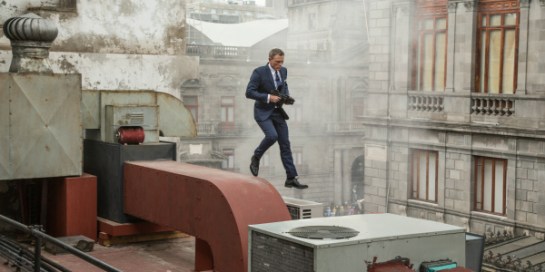
“Spectre” starts off firing with Bond in Mexico City during the Day of the Dead. He’s on a deeply personal mission which leads him to a terrorist named Marco Sciarra (Alessandro Cremona). Sciarra is connected to a sinister secret criminal organization called Spectre which is led by the shadowy Ernst Stavro Blofeld (Christoph Waltz). At the same time M (Ralph Fiennes) is battling to protect MI6 from the aggressive head of the Joint Intelligence Service who wants to do away with the 00 program.

Bond tracks Spectre to Rome, the first leg of his globetrotting search for answers. He discovers that he may have a deeper connection to Ernst and his organization. As 007 hunts to unearth the truth, Spectre is out to stop him at all costs. They go head-to-head in a number of exotic locales including Rome, Morocco, Austria, and London. One of the film’s strong points is how well it captures all of the fun and varied locations.

Spectre2

In fact all of “Spectre” looks good. Hoyte van Hoytema’s cinematography lives up to the franchise expectations and at times it absolutely shines. The Mexico City opening is exciting and energetic featuring several visual highlights. The same goes for a fun car chase through the streets of Rome and a thrilling plane vs. Land Rover chase down a snowy Austrian mountain. The film definitely has its moments.

Unfortunately “Spectre” also has its flaws and no amount of visual splendor can cover them up. While I liked “Spectre” as a whole, I was expecting more action, more energy, more drama, more character development, and more signature Bond moments. Compared to Craig’s three previous Bond movies “Spectre” feels hollow, inert, and terribly inconsistent. After the phenomenal Mexico City start, the movie is constantly fluctuating between excitement and slow stretches of vapidity.

Spectre3

You simply don’t expect this considering how well these movies have worked in the past. But as I sat in the theater I kept waiting for the film to gain its footing. I kept waiting for it to kick into gear. But there is a frustrating sluggishness to the screenplay – the collaborative work of four different writers. It wastes so much time that could’ve been better spent developing some of the characters namely the story’s villain.

Christoph Waltz is a superb actor but the amount of screen time he is given never allows him to flesh out a compelling villain. His villainy is mainly referred to more than shown and we never see that big Bond vs. Villain moment. The closest we get is an absurd torture scene that features one head scratching moment after another. I was so excited to see him as a Bond villain but this was a tremendous waste. As was Dave Bautista as Spectre’s hitman. He’s a stereotypical henchman who shows as much emotion as a house plant.

Spectre4

Craig gives another good performance but he isn’t offered any material to stretch his character. All of the supporting Bond cast members are here including Q (Ben Whishaw) who gets more screen time than before. He’s a lot of fun. Moneypenny (Naomie Harris) has a few good lines and Fiennes is good when wrangling back and forth for the 00 program’s survival. Unfortunately both feel underused. Lea Seydoux is the main ‘Bond girl’ this time around and her performance is solid. But her character is a bit flimsy and uneven.

That could be the best way to describe “Spectre” – uneven. It’s a film undoubtedly approached with mile-high expectations from many. Perhaps too high. But truthfully expectations aren’t the problem. This is a film that features some fine action sequences. It has a good story at its core and there are moments where it comes together in really interesting ways. But there are also moments where it makes practically no sense and other moments where it sputters and spins its wheels. Still I liked the movie, and I’m anxious to give it another look. But with this cast and this pedigree I can’t help but be disappointed with what we get.

VERDICT – 3 STARS

3 Stars

RETRO REVIEW: “St. Elmo’s Fire”

fire

Rewatching “St. Elmo’s Fire” is like stepping into a time machine. As with so many films from its period, it contains numerous components that are unequivocally and distinctly 80s. “St. Elmo’s Fire” was released right in the heart of the decade, July of 1985, and that seems amusingly fitting. Its cast, its look, its mechanics all function like a movie made within those definable 10 years. In some ways that is a compliment because the 80s were so indelibly marked with a unique cinematic style and playfulness. In other ways it is not a flattering statement because many of these films drown in that style and never feel as imaginative or important as they try to be. They simply don’t stand up well outside the boundaries of their decade. All are true when it comes to “St. Elmo’s Fire”.

The film was directed and co-written by the ever so divisive Joel Schumacher and featured most of the major members of the unfairly branded “Brat Pack”. Along with “The Breakfast Club”, “St. Elmo’s Fire” is considered the centerpiece and measuring stick of the Brat Pack genre. Again, this actually contributes to the cool and nostalgic feel, yet watching this cast, all young and promising at the time, wasn’t without a certain amount of baggage (whether fair or not).

ELMO1

At first it would be easy to dismiss “St. Elmo’s Fire” as a film that does nothing and says nothing. Most of the film plays out like scenes of encounters and conversations pasted together and bound only by a thin semblance of plot. That’s actually pretty accurate. But to say the film says nothing would be inaccurate. Often times its storytelling and messaging is muddled and messy, but there is a deeper meaning that I still find effective.

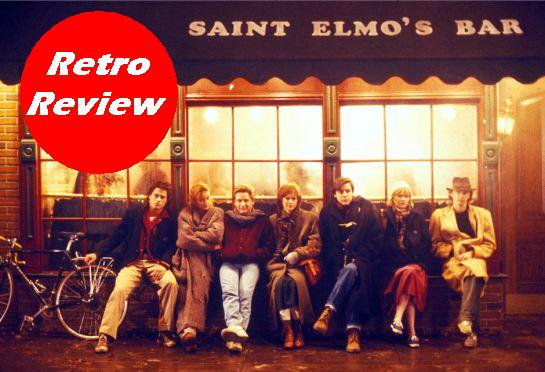
The story follows seven close college friends who have recently graduated from Georgetown University. The film’s intent is to show us their transition from the comforts and structure of college life to the responsibilities and unpredictabilities of adulthood. Emilio Estevez, Judd Nelson, Ally Sheedy, Demi Moore, Andrew McCarthy, Rob Lowe, and Mare Winningham each play ‘types’ (as they were known to do in many of their films). We get the yuppie, the bad boy, the party girl, a buttoned up nerd, the brooder, etc. It is a bit surprising and frustrating as none of them stray too far from their types.

ELMO2

Still some of the characters carry some weight and their intersecting stories are interesting. Ally Sheedy is the most compelling of the bunch and she has the most interesting and thoughtful story. On the opposite end you have Estevez and his throwaway character. His weird and sudden obsession with a past college crush (played by Andie MacDowell) is silly and disjointed. Most of the other characters fall anywhere in between, but ultimately it is their group dynamic that the film banks on and for the most part it works. The performances are pretty solid and even when the material flounders a bit they are often able to salvage the scene.

“St. Elmo’s Fire” was trampled by many critics who saw it as a huge waste of time. The film doesn’t do itself many favors. It meanders a bit and you can’t help but recognize its feelings of self-importance. It simply isn’t as cool or as smart as it wants to be. But I still think its a good movie and I still think it contains a satisfying message. Perhaps some of my appreciation is rooted in unashamed nostalgia. I’m willing to admit that. Ultimately I think there is too much here to write off, even if it is a little rough around the edges.

VERDICT – 3 STARS

3 Stars

REVIEW: “Sicario”

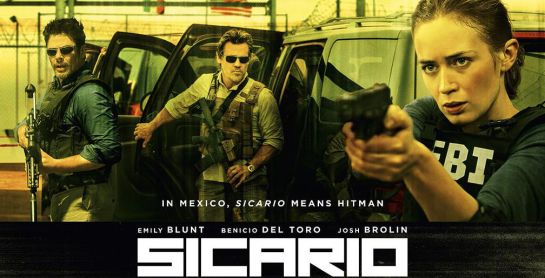
SICARIO poster

I think we have reached a point where we can watch a movie and confidently say “That is a Denis Villeneuve film”. The French-Canadian filmmaker can be defined as someone not afraid to claw deep under the surface of difficult subject matter. He also spares his audience no amount of discomfort or unease when telling his stories. His films are incredibly cinematic and are recognized by both their narrative and visual intensity. Several films have helped reveal his uniquenesses, but his new film “Sicario” is his best yet.

Every one of Villeneuve’s characteristics mentioned above are  present in “Sicario”, a border thriller that stings with relevancy. Emily Blunt is superb playing Kate Macer, an FBI field agent specializing in hostage rescue. The film opens with a gripping sequence featuring Kate leading a raid on an Arizona housing division. Her actions catch the attention of her superiors who then ask her to join a task force led by Department of Defense ‘advisor’ Matt Graver (played with amusing cockiness by Josh Brolin). The mission is to strike back at the drug cartels responsible for a number of brutal killings. Anxious to finally make a significant difference, Kate agrees to join Graver’s team.

SICARIO1

Also on the team is the mysterious and shadowy Alejandro played with unflinching precision by Benicio del Toro. Back in 2000 he won the Supporting Actor Oscar for “Traffic”, but this stellar performance rises above his past work. His Alejandro is impenetrable – a walking contrast of information and emotion. The vast majority of the film is shown through Kate’s perspective. Like her, we struggle to figure out Alejandro, Graver, and the entire mission for that matter. Screenwriter Taylor Sheridan meticulously feeds us small bits of information never allowing us the feeling of being fully informed.

“Sicario” is also strengthened by the sting of its moral ambiguity. There is no easy way to navigate the morality of what we see on screen. Kate struggles with it and Villeneuve forces his audience to struggle with it too. It casts a bright light on the drug war, border violence, and government policy painting each as murkier and far more complex than we normally hear through political talking points. It operates under the idea that we have lost the drug war. Now it’s about control and making sure it doesn’t consume us. But does that mean compromising our moral conscience and turning what we known to be ‘right and wrong’ into a much more gray area? These questions hit Kate like a crashing wave.

And there is no way to talk about this movie without mentioning its phenomenal presentation. Villeneuve has perfectly matched the intensity of his story and subject matter with a visual rendering that is truly absorbing and stimulating. It will come as no surprise that Roger Deakins’ cinematography is magnificent. When will this man finally win the Oscar he deserves? His camerawork is key in making many of these scenes work. There are no vanity or prestige shots. They all have meaning. Deakins visually infuses so many scenes with tension and potency.

Sicario2

There is one particular sequence that may be my favorite of the year. Kate joins Graver’s team in a extradition mission to Juarez. They are to move across the border, pick up a high value target, and make it back. Deakins’ magic takes over the moment they leave the military base. Through his lens, Deakins reveals to us the boiling tension of the location and situation – the same tension that Kate is experiencing for the first time. It is also helped by Jóhann Jóhannsson’s simmering score – one of the year’s best. The entire sequence is cinema at its finest.

“Sicario” is a searing and provocative thriller – visceral and unflinching in its depiction of a situation with no easy answer. Denis Villeneuve and company expertly craft a cinematic experience grounded in relevancy and unwilling to sugar coat its subject matter. Villeneuve, Blunt, del Toro, Deakins, and Jóhannsson all deserve Oscar nominations and the film itself is among the year’s very best.

VERDICT – 4.5 STARS

4.5 STARS

REVIEW: “The Salvation”

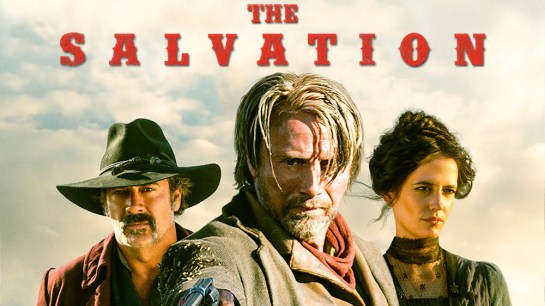
Salvation poster

Several years ago Westerns saw a bit of a resurgence. It didn’t come close to matching the genre’s popularity of the 1950s and 1960s, but it was great to see the visions for Westerns from modern perspectives. We still get the occasional Western from time to time which brings me to “The Salvation”, a Danish revenge tale from co-writer and director Kristian Levring. The film tips its hat to several classic Western movie tropes, but at the same time it maintains an evocative and unique edge to it.

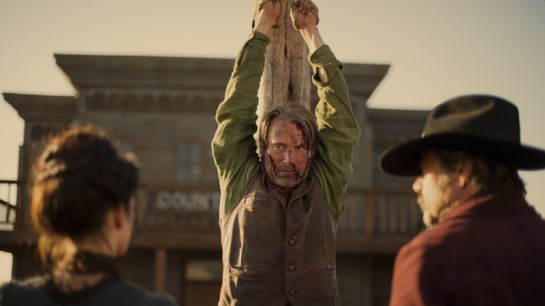
One of the film’s strengths is found in its charismatic lead Mads Mikkelsen. He plays Jon, a Danish settler and ex-soldier in 1870’s America. With the help of his brother Peter (Mikael Persbrandt), Jon establishes himself and then sends word for his wife and son to cross the Atlantic and join him at their new home in the American West. But shortly after reuniting with his family, an encounter with two thugs ends with his wife and son being murdered. Jon tracks down and kills the thugs responsible.

Salvation1

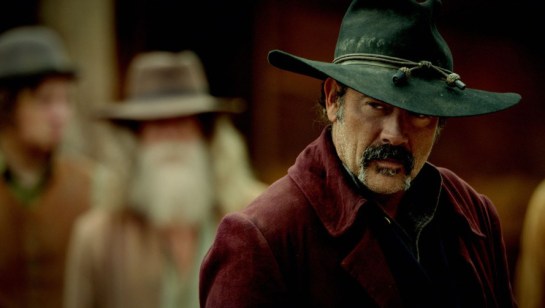
But Jon doesn’t realize that one the dead killers is the brother of a ruthless gang leader named Delarue (played with grizzled gusto by Jeffrey Dean Morgan) and the husband of the physically and emotionally scarred Madalaine (Eva Green). Delarue makes it his aim to find and pay back his brother’s killer. This sparks a conflict with the revenge-fueled Jon that (literally) bleeds into a small town held hostage by fear of Delarue. The town’s weak-kneed sheriff (Douglas Henshall) and opportunistic Mayor (Jonathan Pryce) are little help and they leave Jon to fend for himself.

Mikkelsen is the perfect man for his role. Jon is stern and rugged but also reserved and soft-spoken. Mikkelsen has always been able to convey through expression and Levring often relies on that. The story takes its lead character to some pretty grim places, and a quick gander at Mikkelsen’s filmography will show he’s familiar with taking characters to grim places. On the opposite end of the spectrum is the burly, gravelly voiced Morgan who seems to be channeling a nuanced Jack Elam vibe. Morgan’s character chomps up scenes with a playful abhorrence and he’s a nice counterbalance to Mikkelsen’s Jon.

Salvation2

Another strong point is the revolving aesthetic that defines the film’s dry and dusty world. In shooting the movie Levring and cinematographer Jens Schlosser move between classic Western imagery and a type of visual hyperbole. At times the film looks as if it were plucked out of a Sergio Leone picture. Other times things look stylized and experimental. We see it in backgrounds, camera techniques, and color pallets.

One could say “The Salvation” is too generic and cliché, but I don’t think Levring’s approach is that simplistic. The film certainly borrows from or pays homage (depending on how you choose to look at it) to certain Westerns that came before it. Yet the film has a unique feel and an intense visual flair that goes along with its violent self-awareness. Mikkelsen shines, Morgan is a hoot, Eva Green is a boiling mystery. When put together as a whole it is a stylishly focused and concise movie which happily embraces its influences.

VERDICT – 4 STARS

4 Stars