REVIEW: “Stalingrad”


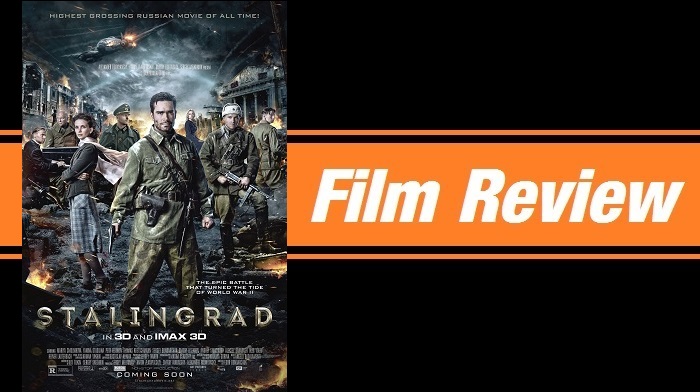
Sifting through the various layers of  “Stalingrad” can be difficult. The Russian war drama from director Fedor Bondarchuk is one of the most visually stunning war pictures you will ever see and there are several interesting and compelling narrative choices. At the same time it struggles with a bit of an identity crisis. It can be hard to determine what kind of movie “Stalingrad” wants to be. This and other story concerns have made it tough for some critics to fully embrace the film.

Me, I didn’t struggle with the story Ike some did. Shortcomings become obvious as the film moves along, but I was never pulled out of the story by them. Still I would be interested to see this film as it was originally meant to be. Ilya Tilkin wrote the original script and heavily based his vision on museum archives, personal diaries of those who were there, and other historical documents. Just days before filming was to begin Bondarchuk and screenwriter Sergey Snezhkin made major changes to the story. This could be why the movie feels a bit scattered and unfocused.
stalin1

The film opens in the wake of the 2011 earthquake and tsunami which devastated Japan. A Russian rescue worker attempts to calm trapped survivors by telling them the story of his mother and his five fathers. The story shifts to 1942 and The Battle of Stalingrad which has been referred to as the bloodiest battle in history. It was a turning point in World War II, but at the end of the conflict nearly 2 million Allied soldiers, Axis soldiers, and civilians were dead.

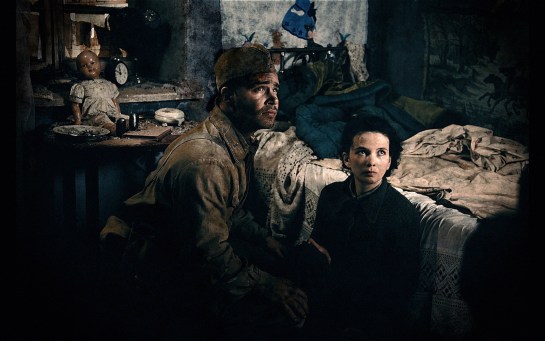
The story sets us down in the early stages of the five month battle where a handful of Russian soldiers seek refuge in a large five story apartment building. The soldiers were part of a bigger Russian force attempting to cross the Volga River but were scattered by a firey German ambush. Based loosely of the famous Pavlov’s House, the film focuses on five soldiers who lead the small force holed up in the building. With limited supplies and weapons they fortify the building to the best of their ability in hopes of holding out until reinforcements arrive.

STALIN2

Adding to the drama is the presence of a 19-year old girl named Katya (Maria Smolnikova) they find holed up in the building. It’s her home and she refused to leave after her family was killed. One of the film’s central storylines involves the five soldiers (or the five fathers from the rescue worker’s story) and the relationship they form with Katya. The leader of the soldiers Captain Gromov (Pyotr Fyodorov) is frustrated with Katya’s stubbornness fearing that his men are no longer fighting for country but for her. It’s a really interesting angle but it’s also one part of the story that contribute to the film’s somewhat murky identity.

We also follow a decorated German officer named Kahn (Thomas Kretschmann) who is tasked with clearing the Russian soldiers out of the building. Kahn has grown frustrated with the war and with his badgering superior Colonel Henze (Heiner Lauterbach). Kahn becomes infatuated with a local Russian woman, much to the chagrin of Henze. Their complicated and uncomfortable relationship plays into the main story but it’s another story angle that contributes to the film’s identity issues.

Stalin3

While the various story threads may not harmoniously fit, it isn’t because any of them are bad. In fact they all offer some compelling drama. And that includes the incredible action sequences. “Stalingrad” has some of the most vividly arresting war sequences you will ever see on film. The visuals are a key component to the film. It’s the first Russian movie shot in IMAX and millions of dollars went into recreating the locations. The mind-blowing detail shows itself in every background, in every setting, and in every shot. And the war violence has an almost operatic quality to it. It’s intense and often brutal but never gratuitous.

“Stalingrad” has received various criticisms. In Russia some critics criticized for its lack of patriotic focus. In other areas critics felt it was too biased in its perspective. I don’t care to get into political criticisms. I look on it as a story that I really latched on to. It is a bit sentimental. It does lean heavily on its special effects. There are moments that feel a bit contrived. Still I found it to be a grand and ambitious production filled with great performances, intensely satisfying visuals, stylish action sequences, and sporadic yet compelling stories. Maybe “Stalingrad” is a flawed movie, but I appreciate any movie that sweeps me away like it did.

VERDICT – 4 STARS

4 Stars

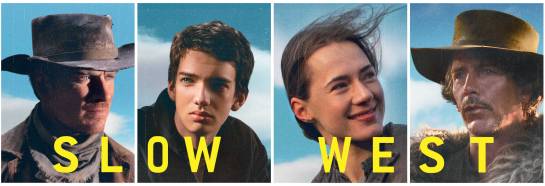
REVIEW: “Slow West” (2015)

SLOWposter

“Once upon a time, 1870 to be exact, a 16-year old kid travelled from the cold shoulder of Scotland to the baking heart of America to find his love. His name was Jay. Her name was Rose”. This quick bit of narration opens and sets up the fairly simple story of “Slow West”. But while the story sounds pretty basic and familiar, it does several surprising things within its barely 80 minute running time.

“Slow West” is a Western with a European twist from first time writer and director John Maclean. Maclean plays with several of the genre’s well known staples, but he also brings several fresh ingredients to his film. Perhaps these contrasts are best realized in the two main characters. Jay (convincingly played by Kodi Smit-McPhee) is driven by emotion, his love for Rose guiding his compass. He’s a bit of a dreamer, seeing the American West through a naive but unique and spirited lens. He is also out of element and ill equipped for the dangers in the new world. At one point he is referred to as “a jackrabbit in a den of wolves”.

Slow1

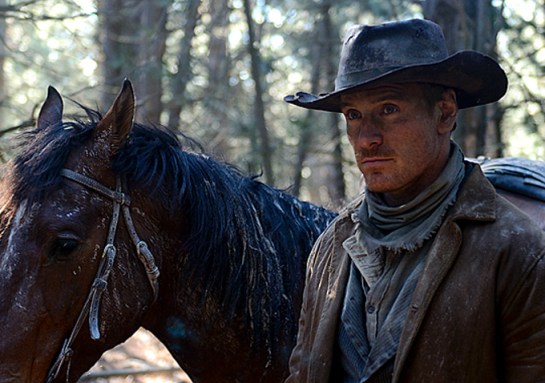
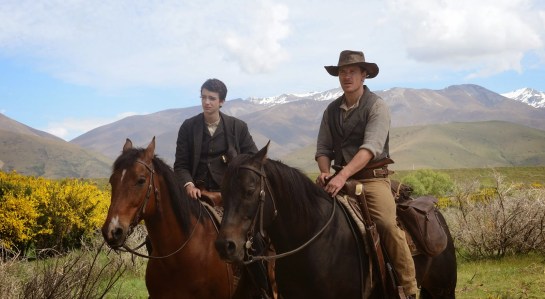
Silas (Michael Fassbender) represents our familiar view of the Wild West. He’s a rough and tough bounty hunter who knows how to survive. But he has seen his sensibilities numbed and over time he has grown a bit calloused to the violence and dangers of his world. On a couple of occasions Jay simply refers to Silas as “a brute”. These two come together in a fitting way – with Silas saving Jay from a killer posing as a soldier. Jay then hires Silas for protection until he can find Rose.

The heart of the film is centered around this rather odd relationship. For Jay, Silas brings a reality check and an understanding that the West isn’t a pretty place. But at the same time Jay never loses his hope, optimism and spirit. For Silas, Jay reminds him of what it’s like to feel, to care, and to have emotion. Jay ‘s childlike exuberance clashes with Silas’ tough-as-leather exterior and begins to soften his hardened perspectives. Having this intriguing focus on the relationship gives a unique meaning to the different things they encounter along the way.

West2

Another thing that sets this film apart is its covertly quirky tone. There is something slightly off (and I mean that in a really good way). And even more surprising, there are moments when the film is really funny showing off a daffy, Wes Anderson-esque sense of humor. It can be found in the subtle, dry wit or in some of the absurd situations which oddly feel at home in the film. Maclean weaves these lighter threads in with serious and sometimes violent ones much like we have seen in films from the Coen brothers.

“Slow West” was an absolute treat. A compelling story set within familiar Western boundaries but strikingly original in the paths it takes. The choice to film in New Zealand provides a gorgeous landscape while Fassbender and Smit-McPhee ground the story with solid performances. Even the always fun Ben Mendelsohn pops up later on. Innocence versus reality. Which wins in the end? A true spirit versus a cold callousness. Which is most important to have? “Slow West” plays with these questions and answers them in its own fun, compelling, and thoroughly entertaining way.

VERDICT – 4.5 STARS

TEST star

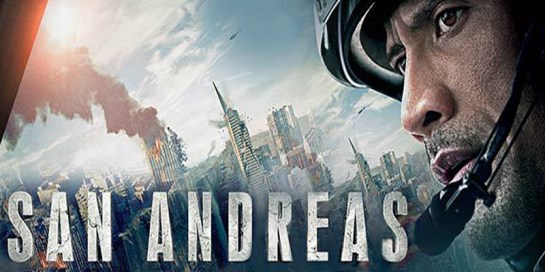
REVIEW: “San Andreas”

ANDREAS POSTER

It looks like this is the big one – earthquake that is. You know, the massive ‘mother of all earthquakes’ that leaves epic-scaled devastation which is prime fodder for a summer popcorn audiences. And trust me, “San Andreas” has the summer popcorn movie cred. It is loud, often silly, filled to the rim with corny lines and CGI destruction, and it stars The Rock. Yet at the same time it also manages to entertain – an accomplishment that many summer blockbusters can’t claim.

Disaster movies have always managed to find an audience and if you look at the catalog of film history you’ll see that almost every disaster imaginable is represented. Earthquakes are no different. Quake disaster picks have been around for a while as evident by the great Clark Gable film “San Francisco” from 1936 and Charlton Heston’s “Earthquake” from 1974. “San Andreas” certainly doesn’t fall into the same category of those films in terms of quality, but I would be lying if I didn’t say I had fun with it.


ANDREAS1

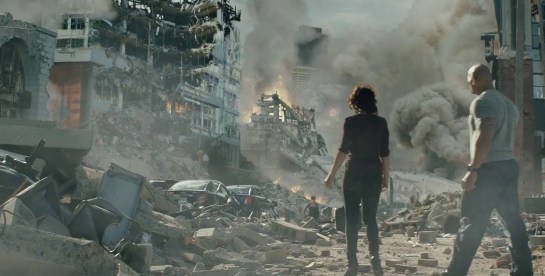
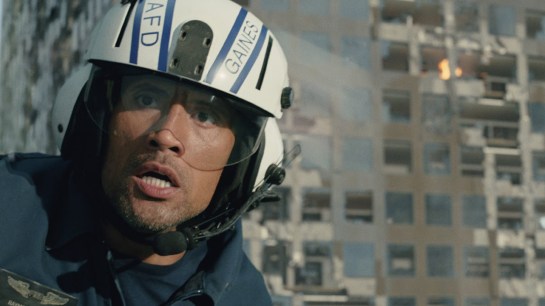
The movie starts in typical fashion – with an introduction to the players. Dwayne Johnson plays Ray, A helicopter rescue pilot for the Los Angeles Fire Department. He is in the middle of a divorce with Emma (Carla Gugino) who has moved in with her wealthy real estate broker boyfriend (Ioan Gruffud). Their daughter Blake (Alexandria Daddario) is seemingly caught in middle and maintains a strong relationship with her father. Meanwhile seismologist Lawrence Hayes (Paul Giamatti) and his team are studying small tremors in hopes of perfecting their earthquake prediction theories. And we are also introduced to a young engineer named Ben (Hugo Johnston-Burt) who has eyes for Blake and his younger brother Ollie (Art Parkinson).

I don’t need to tell you but an earthquake hits and the epicenter is near the Hoover Dam. But little does everyone know that it is simply a precursor to a bigger quake – one unlike any we’ve seen before (how’s that for dramatic effect). It just so happens that when ‘the big one’ hits the central family is separated and Ray sets out to save his estranged wife and daughter. The story bounces back and forth between each group of characters as they navigate an assortment of perils and close calls.

The city of San Francisco is the computer generated ground zero of “San Andreas” and the special effects crew leaves no street undamaged and no landmark unscathed. This reveals some of the film’s strengths and its weaknesses. Visually the film shines. Watching this there is no question that modern special effects are capable of capturing almost anything. Even the film’s more ridiculous and absurd sequences were impressive due to the spectacular visuals. On the other hand the barrage of CGI destruction is relentless to the point of becoming almost numbing. And there are times when you question whether the filmmakers are even considering the catastrophic death toll resulting from their visual artistry.

ANDEAS2

But my biggest mixed reaction centers around the characters. Unquestionably the movie features several throwaway characters and some prototypical cookie-cutter characters that you’ve seen in a hundred other movies. I won’t spoil who is who, but the sheer lack of imagination in some of the character development is ridiculous. On the more surprising side, I actually found myself liking the family dynamic as cliché as it was. Even amid the sometimes lame dialogue and laughably cheesy lines I liked the three main characters. And the performances were generally good. They are nothing that you will  remember but they’re able to weather the occasional hackneyed writing that can sometimes leave you shaking your head. It’s a pretty solid cast some of whom feel a bit wasted.

When watching movies like “San Andreas” I feel you sometimes need to have a discernment switch you can flip off in order to enjoy the movie. It’s that critical switch that when flipped on keeps us from seeing past a film’s negatives so that we enjoy the positives. Many summer blockbusters stink regardless of whether the switch is flipped on or off. But I found “San Andreas” to be entertaining in its own cheesy, summer blockbustery way. The predictability is undeniable. The corny lines are too many to count. The CGI devastation and last second rescues are aplenty. But at the same time “San Andreas” kept me engaged thanks to its visuals, its cast, and even the occasional unintended humor which I count as part of its charm. I can see where some may pile on or dismiss “San Andreas”, but for me it was good throw-away summer fun.

VERDICT – 3.5 STARS

3.5 stars

REVIEW: “Selma”

SELMA POSTER

The process to bring “Selma” to the big screen began in 2008. Since then “Selma” has had director changes, producer changes, cast changes, and script rewrites. But now it has finally hit theaters with director Ava DuVernay at the helm. As expected the film has generated a lot of buzz, critical acclaim, and its share of controversy. Going into the film I was excited to see how well the story would be told. I was also cautious and concerned about how the historical liberties I’ve been reading about would effect the film’s impact.

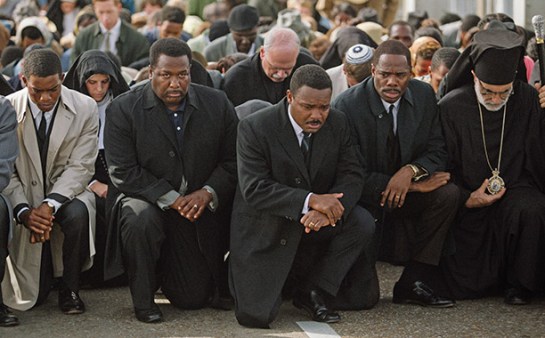
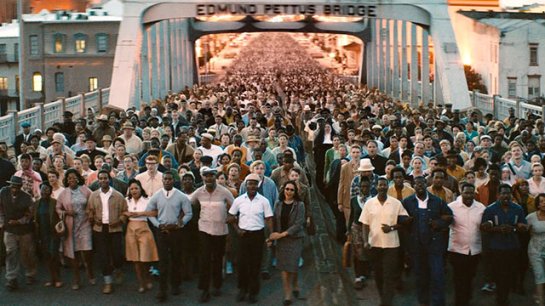
“Selma” doesn’t set out to be a comprehensive biography of Dr. Martin Luther King Jr. Instead it focuses on the events surrounding the 1965 voting rights march from Selma to Montgomery, Alabama. I appreciated the film’s disregard for the standard biopic blueprint. MLK’s entire life isn’t crammed into one story. This movie has a very specific story to tell, yet it allows us to glean much about this influential figure. We learn of his motivations, his faults, his fears, and his uncertainties all through observation. We also learn of his bravery, his sacrifice, and his determination.

SELMA1

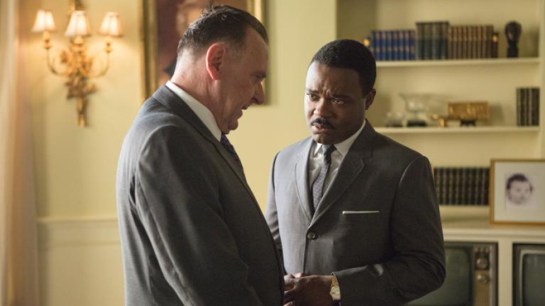
This chronicle of the Selma march starts with Martin Luther King Jr’s (David Oyelowo) desire to secure true and unhindered voting rights for black Americans. We see him going to President Lyndon B. Johnson (Tom Wilkinson) and urging him to give immediate attention to the matter. We see the festering racial tensions in the south particularly in and around the town of Selma, Alabama. We see King visiting Selma with his fellow SCLC members. He speaks in churches and spreads the message of change through peace and offers encouragement to the black community. We also see the violent backlash against the peaceful protests – something that weighs heavily on Dr. King’s heart.

“Selma” has the big showcase scenes that you would expect, but DuVernay also gives us the smaller more intimate moments. These personal strokes paint a much more detailed portrait of King. There’s a fun scene where he and his SCLC buddies arrive at a female friend’s house for breakfast. It’s a great scene filled with playful banter and jests. There is also a piercing scene between King and his wife Coretta (exquisitely played by Carmen Ejogo). It’s a low-key but intense family moment that DuVernay films with subtle but brutal honesty. We get a number of these touches which are much more than just emotional gimmickry.

SELMA2

And you can’t have a discussion about “Selma” without talking about the performance of David Oyelowo. The British actor loses himself in the role of Dr. King. He is a great match in terms of physical appearance, but he gives us so much more. I was blown away by the steadiness of his voice and his near perfect accent. He also conveys the passion and charisma that I imagine from Dr. King. We see this most in his speeches/sermons at a church in Selma. Oyelowo’s performance is graceful, committed, and nuanced.

“Selma” has so many important things to say and it hits head-on the disgraceful racism that was prevalent at the time. It’s a film that could be taken as an important historical reflection. Unfortunately it loses a portion of its credibility due its historical liberties. I generally stay away from controversies surrounding historical inaccuracies, but for me “Selma” genuinely suffers due to decisions made by DuVernay and writer Paul Webb. It has nothing to do with the racism and violence shown in Selma. All of that was shown with such power and potency. Instead it’s the decision to cast Lyndon B. Johnson as an antagonist, something that simply wasn’t true.

History has shown that Johnson had King had disagreements. But they also had a deep respect and worked together to accomplish the shared goal of equality. Even some close to King have come out to defend Johnson from the film’s characterization. The movie shows Johnson as an obstructionist who grows more and more annoyed with King’s efforts towards equal voting rights. But it doesn’t stop there. The film stops just short of calling Johnson a racist. It also shows Johnson callously using the FBI to hurt King and his family. Many have said this never happened and it depicts Johnson as cold and pernicious. And when he does finally put voting rights legislation forward, the film shows him to be motivated more by his legacy than doing what’s right.

Selma3

But why did this hurt the film for me? Historical inaccuracies happen all the time in biography movies. For me it hurts the film because it strips it of a potentially strong and relevant message. I mean which would have more impact and resonance, the movie’s characterization of an obstructive and self-serving sitting white President or the true depiction of a white and black man standing side-by-side working towards true and meaningful change? The power and relevance of that message in the current climate is undeniable. Why did DuVernay choose the direction she did? Some of her comments about the making of the film may shed light on her motivations. Regardless it is a frustrating decision that seems unnecessary.

Sadly the “controversy” surrounding “Selma” isn’t without some merit. A lot of people, particularly younger viewers, may look at the film and take it entirely as historical fact. While that may not be completely true, the majority of the movie serves as a forceful and unflinching reminder of the faith and courage shown by Martin Luther King, Jr. and the persecuted black community of that day. The film forces us to experience the undeserved attitudes of hatred commonly thrown at black Americans at the time. It also raises our spirits by showing the determination of a brave community unwilling to sit by and have their rights trampled. The true story of Selma, Alabama has an inspirational power. “Selma” the movie also has that power except when it wanders off into its own revisionist world.

VERDICT – 3.5 STARS

REVIEW: “The Spectacular Now”

Spectacular poster

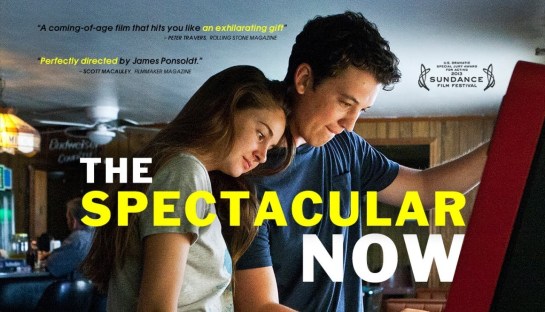
It’s rare to find a teen movie that actually treats teens like real people with real problems and real emotions. So often these films peddle juvenile humor and exaggerated stereotypes in place of stronger and meatier stories. That’s why it’s refreshing to find a movie like “The Spectacular Now”. This intelligent and nuanced coming-of-age story steers clear of cliches and gimmickry by respecting its characters and portraying their circumstances in a thoughtful and naturalistic way.

Miles Teller plays Sutter Keely, a popular and hard-partying high school senior. He has a hot girlfriend, a great personality, and no real ambition for the future. Sutter tells several people he lives in the now, not worrying about anything other than the moment. But that attitude proves to be destructive – something he can’t see through his fog of hedonism. His girlfriend Cassidy (Brie Larson) finally has enough and breaks up with him. He is warned by a concerned teacher that he may not have the grades to graduate. And his constant drinking becomes a growing concern. Sutter’s life “in the now” isn’t the happy, sunshiny place he projects. It’s just a facade to hide the truth of a troubled and conflicted life.

SPECTACULAR1

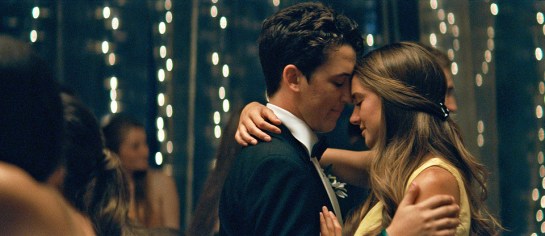
Sutter’s life takes an unexpected turn when he meets Aimee (Shailene Woodley). She’s a shy and studious ‘good girl’ whose reserved lifestyle is in stark contrast to Sutter’s. The two opposites hit it off but it takes some time for their relationship to blossom. But several of Sutter’s issues get in the way – his ego, his ‘cool guy’ reputation, his fixation on old flame Cassidy, and his self-destructive behavior. We never really know how Sutter and Aimee’s relationship will turn out. The film doesn’t lay out a standard formulaic plot line and a big part of its success is the experience we have watching this authentic relationship play out.

The story is also helped by some nice performances by the two leads. Teller and Woodley have noticeably different acting styles yet they seem to gel nicely with these two characters. For Teller this film is wedged in between two run-of-the-mill raunchy comedies so I was pleasantly surprised at his work here. Woodley’s nice performance is no surprise. Her film debut in Alexander Payne’s “The Descendants” received rave reviews and here she delivers another eye-catching performance. The supporting work is also uniformly good. Larson, Jennifer Jason Leigh, Mary Elizabeth Winstead, and especially Kyle Chandler each have some strong screen time.

One of the interesting things about “The Spectacular Now” is how it employs several familiar plot points, but it treats each of them with a fresh and prudent sincerity. There are moments where you can guess how certain things will play out, but the film also steadily surprised me by not going the conventional route. More importantly it is all grounded in a realistic portrayal of these two teenaged characters which separates this film from the bulk of teen pictures we get. That alone is something I welcomed with opened arms.

VERDICT – 4 STARS

REVIEW: “Snowpiercer”

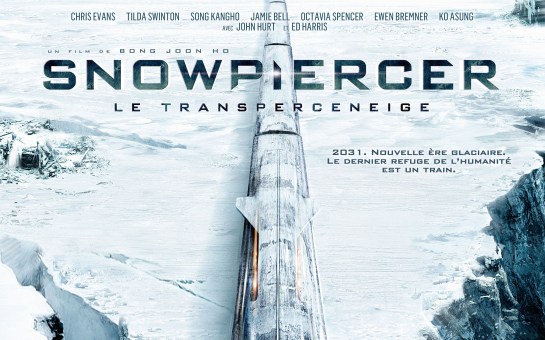
SNOW POSTER

Every revolution has a cost and the cost is high in Bong Joon-ho’s sci-fi action flick “Snowpiercer”. This is the Korean filmmaker’s first feature since “Mother” from 2009. “Mother” was my first exposure to Bong Joon-ho and my christening of sorts into the art of Korean cinema. “Snowpiercer” is a much different film yet it doesn’t stray too far away from the style and approach which lies at the heart of this auteur.

Despite the efforts of blowhard extraordinaire Harvey Weinstein, “Snowpiercer” has finally made its way to the United States. Weinstein acquired the North American rights for the film with a wide release planned. But the pompous film mogul demanded that 20 minutes of footage be cut and when Joon-ho rightly refused, Weinstein sabotaged the movie by delaying it for almost a year and severely restricting its release. But word of mouth and positive reviews eventually earned it a broader release although nothing like what was originally planned.

The story is taken from a 1982 French graphic novel and as with any good science fiction, the premise is everything. To stonewall the effects of global warming mankind injects the atmosphere with an experimental agent that instead brings on a second ice age. Humanity’s last inhabitants live within the Snowpiercer, an enormous train in constant motion powered by the “eternal engine”. Onboard the train a social order has been created. The affluent upperclass live in the lavish head section while the poor and needy inhabit the tail. Now at first the movie appeared to be a climate change and class warfare lecture, but once we begin to meet the blend of interesting and eccentric characters, we realize there is more under the hood.

SNOW1

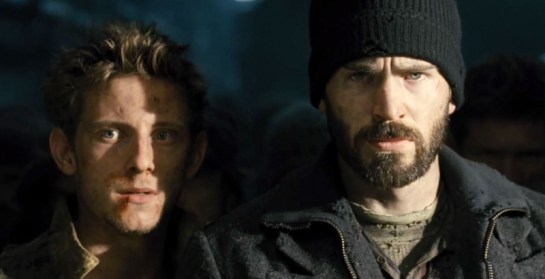
After several failed attempts the tail section puts together another revolt against the privileged and the armed soldiers who defend them. Curtis (Chris Evans) is quickly established as the strongest link and the man many look to for leadership. His mentor Gilliam (John Hurt) is grooming him to be the leader once they are able to take over the train. Curtis is a complex character. He often shows heart particularly in his dealings with his fellow tail-sectioners. Evans continues to grow as an actor. He’s mostly been known for playing goofballs or superheroes but I love seeing him open himself up as an actor. He once again flexes his action star muscle, but it’s nice to see him digging deeper into a character and doing it well.

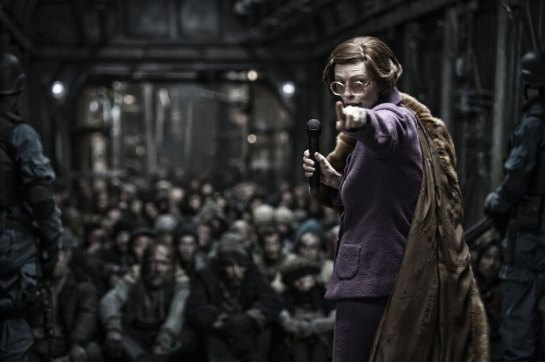
Evans is helped out by an incredible supporting cast. Jamie Bell is good as a character who starts out as a standard sidekick but evolves into something more. Oscar-winner Octavia Spencer plays a mother determined to get her son back after he is taken by the upperclass authority. A Joon-ho favorite Song Kang-ho plays the drug addicted designer of the train’s many doors separating the cars. The fabulously quirky Alison Pill is great as a character simply titled Teacher, and the always exceptional Ed Harris pops up in a significant role. But the true scene stealer has to be Tilda Swinton. She plays Minister Mason, an overseer of sorts who is really a glorified lacky. Swinton has a ball playing such a wacky and neurotic character. Everything from her appearance to her ways of expressing herself works to inject a bit of humor while never derailing the movie’s more prominent tone.

SNOW2

All of these characters work to energize Joon-ho’s engaging story. To be honest it’s hard to deny the absurdity of it all, and a surface reading would make this sound like a pretty standard action romp. But when the story is this well told and it moves at such a fluid and dynamic pace, it’s so easy to get completely caught up in it. I had a blast with its central conceit and the stylized storytelling. The careful mix of action and character development is well done and the setting is superb. It ranges from beautiful and colorful to dark and dirty while always maintaining a sense of claustrophobia. And as with almost every other sci-fi film, we get plenty of commentary here. Joon-ho paints a parallel portrait of the modern societal standard which is sometimes effective and other times ham-fisted. His climate change theme was the most compelling showing an awareness while also showing the dangers of overreacting. His class warfare approach is a little more uneven. But other themes such as drug abuse, political power, and revolutions are laced throughout the story in intriguing ways.

“Snowpiercer” also looks amazing from its wide assortment of environments within the train to its ice-ravaged world outside. The variety of action we get is also a treat. It may be intense close quarters shootouts or hand-to-hand combat in precarious situations. Some of it dances close to the edge of brutality, but so often Joon-ho pulls back his camera just as the violence is happening sparing the audience from the gore while keeping the sheer intensity of the scene. It’s a mark of the creative Korean style and it gives the movie a particular look that I absolutely loved. It’s a visual delight.

Thanks to Weinstein “Snowpiercer” hasn’t gotten the release it deserves but word of mouth is spreading. Let me happily add to its positive press. This is a fantastic science fiction picture that sounds similar to many other films yet feels completely unique and fresh. It’s a film with many strengths and as a lover of good sci-fi, I had an absolute blast with it!

VERDICT – 4.5 STARS