REVIEW: “Prince Avalanche”

PRINCE

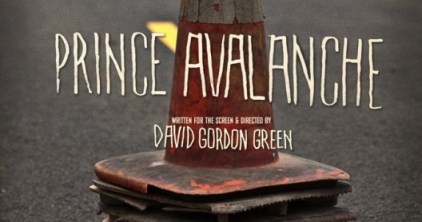
Good luck trying to classify David Gordon Green’s “Prince Avalanche”. Green directed and wrote the screenplay for this odd little independent film that is part drama, part comedy, and part offbeat character study. It was inspired by an Icelandic picture titled “Either Way” only here it takes place in an isolated woodland area in Texas. It’s a 2013 film that didn’t get much press and brought in less than $200,000 during its very limited release. But now word of the film is starting to ease out and that’s a good thing.

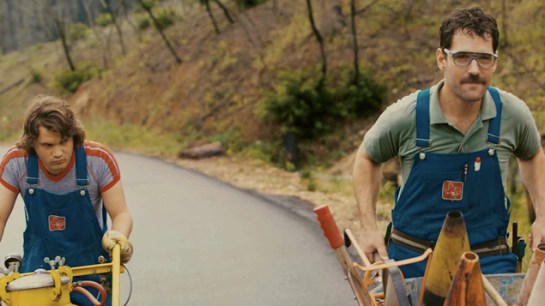
Paul Rudd plays the starched, tightly wound Alvin. He’s a highway worker who hires his girlfriend’s airheaded but well-intentioned brother Lance (Emile Hirsch) to help him paint yellow traffic lines on a long stretch of isolated roads. The roads wind through a forest area that has recently been ravaged by wildfires. This is the dreary, near apocalyptic landscape where the entire film takes place. We just follow along watching Alvin and Lance go through their workday. We sit with them at their camp enjoying a plate of grilled fish and coffee. The story is truly that simple but Green is quite clever in how he opens up these characters to his audience. It’s amazing what all we pick up just by listening to their many conversations.
AVALANCHE

There are a number of pleasant but telling scenes early in the film. It becomes clear that Alvin and Lance are distant. In many ways they’re very different people and they obviously don’t have a longstanding relationship. Watching the slow-moving male bonding is good fun and it tosses in several well-conceived laughs. But it also connects us to these characters so that we are invested once things get rough. And they do get rough. The two personalities clash and some humorous scenes follow. But these problems end up revealing a lot to each one about themselves. That’s when the true meaning of this film surfaces.

This is a slow and meditative story that spends a lot of time on simple observation. Just watching and listening. Both Rudd and Hirsch are fantastic They both unwrap these two characters exposing their charms and faults with great clarity. Alvin is a man who desperately needs to break out of this lonely world he has created for himself. In it he sees what he wants and ignores important elements to life. Lance needs to realize he is no longer a child. He has to grow up and take responsibility. These two very different men with very different problems are actually in a very similar boat.

“Prince Avalanche” is an independent film through and through. David Gordan Green adapts and directs this light but crafty picture that made me laugh often. But it also develops two really good lead characters who despite their eccentricities are very human in more regards than you may think. This is a tightly made film that has heart and humor. I really appreciate that.

VERDICT – 4 STARS

REVIEW: “The Defiant Ones”

Classic Movie Spotlight

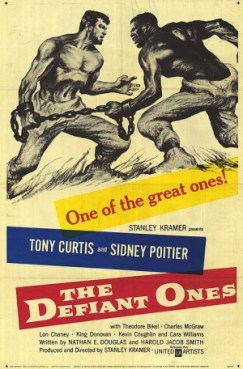
DEFIANTStanley Kramer’s “The Defiant Ones” opens with a prison transport truck on a dark and rainy night. The guards in the cab are distracted by two fighting prisoners which causes them to lose control and roll into the ditch. With a heavy rain falling two men stumble out of the prison truck. They take off running, shackled together arm to arm, a white man and a black man. Each have their own prejudices and each have a hatred towards the other. The question becomes will they escape the law or will they kill themselves first?
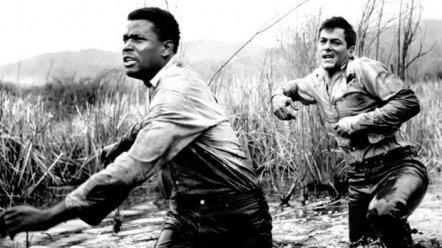
Kramer was known for making what some call “message movies”. Throughout his acclaimed career he addressed a number of social and political issues. “The Defiant Ones” takes a candid look at racism through two fascinating characters and a story that allows for a pointed but entertaining approach to the subject. Tony Curtis and Sidney Poitier handle the two lead roles and it doesn’t take long to see that these two men hate each other. Constant insults and unflattering nicknames such as “Colored” and “Joker” make up the bulk their early conversations.

DEFIANT1

The shackles that bind them together serves as an interesting metaphor. I won’t spoil it by going into detail but it was clearly the intent of Kramer and writers Harold Jacob Smith and Nedrick Young (Young had been blacklisted at the time. In fact both writers won Oscars for the film and Young’s award went to his pseudonym Nathan E. Douglas). On one hand the movie is a thriller about two escaped convicts and the manhunt to find them. But the social aspect can’t be ignored and unlike some of the more heavy-handed approaches that we see, “The Defiant Ones” looks at this subject through a smart and effective lens.

Tony Curtis wasn’t the first choice to star in the picture. Kramer insisted that Poitier be his man but conflicts involving Robert Mitchum and Marlon Brando, both in the running to star in the film, made that a problem. Mitchum eventually turned down the role and Kramer maneuvered his filming so that Brando had to drop out due to prior obligations. This opened the door for the casting of Curtis. I’ve always been mixed when it comes to Tony Curtis but he delivers a fantastic performance. His character’s arrogance and unbridled racism is the catalyst for the animosity between the two. Curtis slides into the role and sells it nicely.

DEFIANT2

But Kramer’s main choice Sidney Poitier was the real standout for me. Poitier is often looked at as a pioneer for African-Americans in the film industry. He certainly is that. But he was also a brilliant actor and we see it in this film. Poitier portrays a tough and rugged guy who has clearly been hardened by his experiences. There isn’t an ounce of insincerity from Poitier and I found his character compelling from the start. Both he and Curtis received Best Actor Oscar nominations (both would lose to David Niven for “Separate Tables), but for me Poitier is the highlight of the picture.

“The Defiant Ones” is also a visually stunning film thanks to Sam Leavitt’s Oscar-winning cinematography and Kramer’s sharp direction. A strong supporting cast featuring Theodore Bstraight ikel and Cara Williams (both of whom also received Oscar nominations) add even more quality. This is a smart and crafty movie that manages to be reflective and insightful. But it’s also highly entertaining as a thriller and it rarely takes its foot off the pedal. It hooked me from the opening scene.

VERDICT – 4.5 STARS

REVIEW: “The Darjeeling Limited”

DARJEELING POSTER

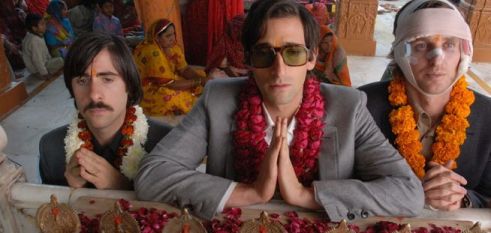
I’m a huge Wes Anderson fan so whenever he makes a film I take notice. But oddly enough his 2007 comedy/drama “The Darjeeling Limited” is one I still needed to see. In true Anderson style “The Darjeeling Limited” has a quirky sense of humor and it dabbles in several of the filmmaker’s familiar themes. It also features some of Anderson’s acting staples including his old college buddy Owen Wilson, Jason Schwartzman, Adrien Brody, and Bill Murray. And while some people consider this some of Anderson’s lesser work, I think it’s a movie that captures what I like about his films while carving out its own unique path.

In this offbeat concoction the opening scene is important. In India a businessman (Murray) tries unsuccessfully to catch his train as it departs the station. While he fails another man, encumbered by heavy luggage, just manages to board the train as it heads down the tracks. This short sequence is a microcosm of the entire film. It’s strange, funny, well shot, and filled with meaning.

DAJEELING1

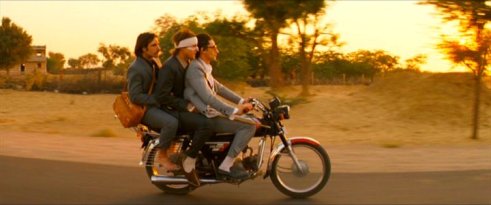
The man who made the train is Peter (Brody). He is onboard the Darjeeling Limited passenger train to meet his two brothers, the controlling and downright anal Francis (Wilson) and the brokenhearted and obsessive Jack (Schwartzman). The three haven’t seen each other since their father’s funeral and Francis sets up the reunion in hopes of bringing them closer together. The train trip across India is framed as being a spiritual awakening of sorts but Francis may have something else as his motivation.

The movie pulls many laughs from these odd personalities, but that shouldn’t come as any surprise. Wes Anderson’s wacky cinematic worlds routinely feature idiosyncratic people with an assortment of troubles and in various states of despair and melancholy. His humor can be a bit prickly. By that I mean it isn’t easy for some viewers to cozy up to. Personally I love his unique brand and we get plenty of it in this film. But there is also a strong dramatic thread that runs throughout the film and really shows itself in the last act. This mix of well executed comedy and heartfelt, meaningful drama is what drives the picture.

Considering the amounts of dry kooky humor, it may surprise some people to find this much heart. But Anderson has always had a knack for that. He’s always dealing with family troubles as well as feelings of isolation and despondency. We certainly get that in this film. There is symbolism scattered throughout the film that deals on more emotional levels once they are realized. For example, take the aforementioned luggage. Anderson takes something simple like luggage, weaves it throughout the narrative, and uses it to make one of the movie’s more effective points. These treats are clever and satisfying.

Darjeeling2

I also must give credit to Wilson, Brody, and Shwartzman. These guys work so well within Anderson’s narrative style which probably explains why he keeps going back to them. The three offer great subtlety in their humor and watching them play off each other is a lot of fun. But they also dial it back when the story calls for it which is vital. Theres some good supporting work from Amara Karan as a train stewardess, Wallace Wolodarsky as Francis’ “assistant, and Waris Ahluwalia as the Darjeeling’s chief steward. Bill Murray has a brief but fun role and Anjelica Huston has a small yet important appearance. There are also some nice cameos from Natalie Portman (remember Hotel Chevalier?) and Irrfan Khan.

“The Darjeeling Limited” is soaked with Wes Anderson’s style. Whether it’s the humor and storytelling or his visual methods which include panning cameras, use of colors, or his particular use of music. There are a few lulls that the film experiences particularly in the second half. They never last long but they are noticeable and maybe they do keep this from being some of Anderson’s best work. Regardless I’m still a big fan of this film. I laughed a lot and I really responded to the emotional tugs we get later on. In the end it’s yet another example of why I love Wes Anderson movies.

VERDICT – 4 STARS

REVIEW: “White House Down”

WHD poster

Who would have thought that 2013 would be the year of the ‘terrorists take over the White House’ action movie? Well, that is if two movies about a White House terrorist takeover warrants such a title. The first of these films was “Olympus has Fallen”, a straightforward old school action picture that I liked due to its clear idea of what it wanted to be. Now we get “White House Down” – a mess of a film that lacks the focus and material to be memorable or even slightly worth watching.

“White House Down” is a bad movie. It’s filled with one contrivance after another and it hasn’t an original bone in its entire 130 life-draining minutes. I actually had to look up the running time because it felt like a 3 hour movie. It’s slow, laborious, and director Roland Emmerich never seems to know when to pull the plug. It would be fine if the story was engaging or the action was exhilarating. Unfortunately it isn’t either of those things, and an action movie that lacks excitement already has one strike against it.

WHD1

The story is pretty basic. Channing Tatum plays John Cale, A US Capitol police officer with aspirations of joining the President’s Secret Service team. He’s a divorced father on the outs with his daughter Emily (Joey King). So he tries to win her over by taking her to the White House where he is interviewing for a position. Unfortunately he picks a day when a group of politically correct terrorists take control of the White House, kill a bunch of people, unveil their master plan, yada yada yada. I think you get the drift. Jaime Foxx plays President James Sawyer and forms the film’s ‘buddy cop’ team with Tatum. Maggie Gyllenhaal plays a Secret Service head. Jason Clarke, James Woods, Richard Jenkins, and Lance Reddick are also present.

For the most part the performances are terrible. Tatum is as unconvincing as ever and his attempts at being a cool macho-type don’t work. Jaimee Foxx probably gives the worst performance. At times he shows slight bits of believability but then he destroys it with some goofy line or ridiculous delivery. Jason Clarke runs around like a madman and seems wildly miscast. Reddick is laugh-out-loud bad as a stiff and grunting General. Gyllenhaal may give the best performance of the group but even she is eventually smothered by the weak material.

WHD2

As bad as the performances are it’s the script that is the biggest problem. It’s hard to believe that James Vanderbilt, the man who wrote “Zodiac” from 2007, penned this garbage. The jokes are hokey, the reveals are predictable, and the dialogue is sometimes painful to endure. And then there is Roland Emmerich who has a history with inflated underachieving action pictures. He misses nearly every target he aims for. He drags scenes out too long. He wallows in corny melodrama. And the action (his bread and butter) falls flat. With the exception of one sequence, which entertains despite its silliness, Emmerich’s action is repetitive, hackneyed, and not the least bit exciting.

I do get the argument that “White House Down” isn’t aspiring to new things and it’s just trying to be an old-school action romp. Heck I used that same defense with “Olympus Has Fallen”. But this movie stretches my tolerance level for dopey dialogue, dull action, and poor filmmaking in general. None of the characters have appeal and the movie is littered with poor performances. This was a $150 million mess and I have to believe Columbia Pictures could have gotten a better movie with that kind of money.

VERDICT – 1.5 STARS

REVIEW: “Philomena”

PHILOMENA POSTER

When making a movie based on an emotionally-charged true story there are certain obstacles and temptations that filmmakers must avoid. Time after time we’ve seen movies succumb to dizzying melodrama and cheap emotional tugs. Actors and actresses sometimes go big which can drown out the true heart of their characters. But some films get it right. They balance grounded emotion with smart and crisp storytelling. For the most part “Philomena” is one of the films that gets it right.

“Philomena” tells the touching true story of Philomena Lee and her search to find her son after 50 years of separation. The unquenchable Judi Dench plays this mother who is haunted by thoughts and visions of her long-lost son which drives her to find him. Her daughter introduces her to a journalist named Martin Sixsmith (Steve Coogan) in hopes that he will investigate and tell her remarkable but heartbreaking story. But he’s not without baggage. He was recently unfairly fired from a government position and his journalism career is floundering. He thinks a human interest story is beneath him but he takes it and hoping of getting back on track.

PHILO-01

We learn Philomena’s story along with Martin. Through flashbacks we see that a young Philomena was left at a convent in Ireland by her father after she becomes pregnant. Later on the sisters force her to work seven days a week in a hot laundry room as some sort of twisted act of penance. They allow her and other mothers to see their children once a day but then, without the mother’s consent, they give the children up for adoption. This is what happened to her son. Philomena and Martin’s search begins at the convent and eventually takes them to the United States.

While this is a story of a mother searching for son, it’s also about two very different individuals who form an unlikely friendship. Along the way they have many fascinating conversations that pull the curtain back and reveal more about them. For example Martin is sour and cynical while Philomena is gentle and optimistic. There are also reoccurring discussions on faith. Martin sees faith and the belief in God as pointless. Philomena finds strength in her faith and it permeates every part of her being. Their discussions never fall into sermonizing. They feel natural and believable.

Steve Coogan is mostly known for his comedic work but this is unquestionably a serious role. There is some good humor in the film which works really well, but most of it comes at Philomena’s expense. Coogan mostly plays everything straight and he is fantastic. I’ve often overlooked and underappreciated Steve Coogan as an actor. This performance makes me a true believer. And as expected Dench is amazing. She is such a wonderful actress and she works with an effortless brilliance. In this film she tells more in a close-up expression than some can say with two pages of dialogue. Needless to say her Oscar nomination is well deserved.

PHILO 2

Unfortunately Philomena isn’t criticism proof. Despite all of its strengths, there are moments where the script stumbles or Stephen Frears’ direction undermines the great performances. Most of the film’s emotion is earned, but there are tearjerker moments that feel a bit staged. The script also tosses in some glaring ham-fisted political jabs. They come out of the blue without an ounce of smarts or subtlety behind them. These quibbles may not seem major but they are a distraction.

Still “Philomena” is quite the story. While several dramatic liberties were taken with the actual true account, most of them help make this a better film. There are a few missteps and personally there are several films I would rather see get a Best Picture Oscar nomination. But “Philomena” features two sparkling performances and enough humor and heart to win me over.

VERDICT – 3.5 STARS

REVIEW: “Mr. Smith Goes to Washington”

Classic Movie SpotlightSMITH POSTERSome say that 1939 was the greatest year for movies. It’s hard to argue with them. I mean listen to this list of films that came out that year: “Gone with the Wind”, “The Wizard of Oz”, “Ninotchka”, “Stagecoach”, “Wuthering Heights”, “Dark Victory”. Oh, and there was also a little movie called “Mr. Smith Goes to Washington”. This Frank Capra classic was a bit controversial when first released due to its strong look at the American political system. Yet over time it has earned its status as a classic and continues to be remembered as a glorious showcase for the great Jimmy Stewart.

“Mr. Smith Goes to Washington” initially ruffled a few feathers among U.S. Senators and a select few among the Washington press. Numerous complaints were hurled its way including accusations that this film was pro-Communist and anti-American. It was said the film would damage our standing in Europe and in other countries. Others stated it was a shameful distortion of the United States Senate. But others felt the movie was a revelation. They viewed it as one of the first movies to expose a side of the political system never seen before.

The story itself centers around a simple and naive boy scout leader (called Boy Rangers in the film because the Scouts refused to lend their name) who is appointed by the governor to fill in a recently vacated Senate seat. The governor has a crooked political boss named Jim Taylor (Edward Arnold) pressuring him to appoint a controllable stooge while others seek someone who will bring meaningful change to Washington. The governor plays it down the middle and chooses Jefferson Smith (Stewart), an honest and good-hearted bumpkin with strong patriotic beliefs in American exceptionalism.

SMITH3

But the core of the movie deals with Smith’s principled ideals coming face-to-face with the political corruption of a powerful Washington machine. It’s pure ideals versus the thirst for prominence and power. Smith first seeks council from a respected Senator and family friend Joseph Paine (Claude Rains). He also looks for help from his secretary Clarissa Saunders (Jean Arthur). She served Smith’s predecessor and she’s well versed on how things work on Capitol Hill. But Smith quickly learns that trusting people in Washington, whether they are politicians or the press, is a hard thing to do.

Despite its detractors, “Mr. Smith” was nominated for 11 Academy Awards. But due to the crowded field of amazing movies it only took home one statue. Lewis Foster won for Best Original Story, an Oscar that is no longer awarded. Still the recognition of the film and its achievements was warranted. Foster’s story was great but so was Sydney Buchman’s brilliant screenplay. Buchman perfectly creates a political fish-out-of-water story that balances slight doses of humor with compelling and thought-provoking drama. He also gives us the right amount of political jargon and atmosphere that immerses us instead of drowning us. He takes a scalpel and opens up the system and asks us to see a side of the political landscape that at the time had never been seen. This made some squirm but others found it to be wonderful and powerful cinema.

And then there are the performances led by Jimmy Stewart. I swear he’s one of the best actors to ever grace a big screen. This role seems tailor-made for him. Smith is a humble, sincere, and down to earth – all qualities that Stewart has always been able to bring out of his characters with ease. This is called the role that made him a star and his performance earned him his first Academy Award nomination. The film also featured an impeccable supporting cast including Claude Rains and Harry Carey who played the head of the Senate. Both received supporting actor Oscar nominations. We also get Thomas Mitchell, Dick Elliott, Beulah Bondi, and H.B. Warner – all who Capra would later bring back to join Stewart in “It’s a Wonderful Life”.

SMITH2

But I also have to take time to praise Jean Arthur. I think she is fantastic and her performance is one of my favorite things about this film. Arthur began her career as a silent movie star but was able to make the transition to the talkies. Capra had used her prior to “Mr. Smith” so he knew her sharp and unshakable talents. Arthur defines her role by bringing charm, wit, sarcasm, and energy to the character. She has such a natural enthusiasm that bleeds over into the performance which in turn is a real strength of the film.

I could go on and on about the Oscar nominated art direction from Lionel Banks or Joseph Walker’s inspiring cinematography. There is just so much to love about this film. One of the only gripes I’ve had with the movie was with the ending. Capra abruptly pulls the plug and closes up shop leaving several loose ends untied. It’s not a frustrating or unsatisfying ending at all. I just really would have liked to see a bit more considering what has taken place. Aside from that “Mr. Smith Goes to Washington” is a true classic and a testament to the smart and capable filmmaking that we so often lack today. If you haven’t taken time to see this gem, you owe it to yourself. It’s that good.

VERDICT – 4.5 STARS