Revisiting “Avatar” (2009)

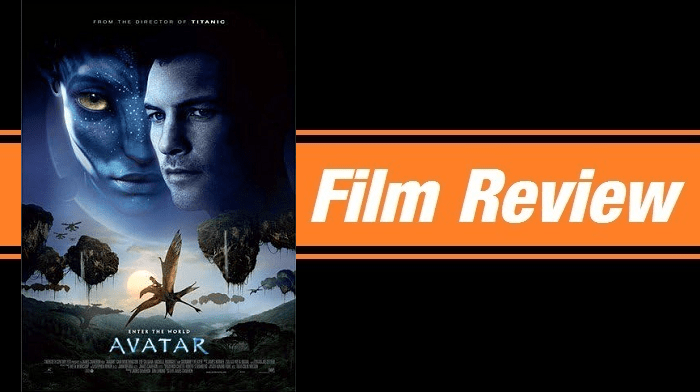
I’ve had an interesting relationship with James Cameron’s “Avatar”. Without question the 2009 science-fiction epic was a landmark box office achievement. It took theaters by storm, earning its first billion dollars in only 19 days on its way to becoming the highest grossing movie of all time. “Avatar” shattered numerous records, many of which it still holds today. It was a global phenomenon, accompanied by a vast marketing campaign, several companion books, and even its own Disney World attractions.

As for the movie itself, there’s no denying it was cutting edge moviemaking. Cameron made the most of his massive budget in creating one of the most visually breathtaking worlds ever put on screen. But it was the story that I had trouble getting past. I ended up having three main complaints – the copy-and-paste plot, the heavy-handed messaging, the over-the-top characterizations. They drew too much attention away from the extraordinary technical wonder that was “Avatar”.

Over the years and several watches later I’ve softened up on my criticisms of “Avatar”. The most recent call to reevaluation came after seeing the long-awaited 2022 sequel “Avatar: The Way of Water”. It’s a terrific follow-up that (for me at least) shined a new light on the first film. I’ve actually rewatched “Avatar” three times since “The Way of Water” released and have seen my perspective and opinion evolve. Yes, I still think it borrows liberally from other films (“Dances With Wolves” always comes to mind). It’s still a bit clumsy in its messaging. And there are absolutely some exaggerated characterizations.

Image Courtesy of 20th Century Studios

But after a lengthy reconsideration, I’ve come to some unexpected conclusions. For starters, I think using “copy-and-paste” to describe Cameron’s story is reductive and frankly unfair. He’s clearly pulling inspiration from a number of places. The idea of a foreign invaders persecuting an indigenous people is nothing new. In this case it’s humanity who have depleted Earth’s natural resources. Now they’ve arrived on Pandora to mine a valuable mineral to send back home. The operation is ran by the Resources Development Administration (RDA), an oppressive corporation who force their will on the Na’vi, the blue-skinned humanoid inhabitants of Pandora who live in harmony with nature.

Again, the general outline for the story is familiar, but there’s so much originality in Cameron’s vision, from the world he imagines to the Na’vi culture he creates. Both are key in taking a well-used framework and shaping it into something that pulsates with new creative life. You can’t help but be enamored with Pandora and it’s variety of wildlife, fascinating array of flora, towering waterfalls, and floating mountains. It’s not only an incredible work of imagination, but also visualization. There’s never a moment where Cameron and his VFX wizards aren’t giving us something to take in that’s both stunning and transporting.

As for the messaging, it’s still pretty on-the-nose with Cameron spelling out his numerous stances with varying degrees of effectiveness. His views on the environment, big corporations, and even the military are most impactful when he allows the natural flow of the story to do the talking for him. But there are still lines of dialogue so awkwardly blunt that you can’t help but roll your eyes and laugh. Interestingly, they’re not as noticeable to me as in earlier viewing. But they’re still there.

Image Courtesy of 20th Century Studios

And then there are the characterizations. In my earliest viewings, Stephen Lang’s Colonel Miles Quaritch, the RDA’s head of security, was the epitome of a ridiculously over-the-top character. He’s a military meathead made even more absurd by Lang’s exaggerated performance. Yet over time I’ve warmed up to the character and the performance. Yes he’s silly to the point of caricature. But Lang has a blast as the chief antagonist and delivers some really good laughs. I can’t say the same for Giovanni Ribisi’s Parker Selfridge, the corporate head of the RDA mining operation. He too is cartoonishly over-the-top, but without a hint of humanity or humor. He’s impossible to take seriously.

Still Cameron gives us a number of great characters including the film’s lead. Sam Worthington plays Corporal Jake Sully, a former Marine and a paraplegic sent to Pandora to take part in the Avatar program. It’s where scientists genetically match a human operator to a Na’vi body. Whether as his human self or in motion-capture, Worthington is terrific in conveying Jake’s frustrations, conflict, and courage. Matching him scene for scene is Zoe Saldaña as Neytiri, the daughter of a local Na’vi clan leader. In many ways she’s the film’s heart and soul.

In addition to building an imaginative world and compelling mythology, Cameron packs a surprising amount of emotion into his story. And of course there is the inevitable final showdown – an edge-of-your-seat thrilling and visually stunning spectacle built around some well developed stakes. Yes, it still has some nagging issues. But over the years I’ve found them to be less pronounced and far less distracting. And even with them, “Avatar” remains a transporting experience – an entertaining blend of old-fashioned adventure and technological wonder.

VERDICT – 4 STARS

REVIEW: “The Settlers” (2023)

In the revisionist Western “The Settlers”, director Felipe Gálvez sits us down in 1901 Tierra del Fuego, Chile during the Selk’nam genocide. That’s when land-hungry sheep ranchers backed by large livestock companies and protected by the Chilean and Argentine governments carried out the systematic extermination of native tribes that populated the area. It was yet another dark and vile stain on human history.

Gálvez begins by introducing us to a young Chilean mestizo named Segundo who is our eyes and ears for much of the harsh and uneasy 90 minutes that follow. Segundo (played with such quiet yet pained intensity by Camilo Arancibia) works in the fields under the cold-hearted Alexander MacLennan (Mark Stanley), a former British lieutenant who is now a foreman for a wealthy rancher named José Menéndez (Alfredo Castro).

Image Courtesy of MUBI

The haughty Menéndez claims that the local indigenous tribe, the Onas, are killing and stealing his sheep. So he sends MacLennan on a lengthy expedition across his land. It’s under the guise of scouting a path for him to safely move his sheep to the Atlantic Ocean. In reality there is something far more sinister behind it – a secret agenda at the heart of the mission.

MacLennan orders Segundo to come along without letting him in on the details of their expedition. They’re joined by Bill (Benjamin Westfall), a ruthless, racist, and borderline cartoonish American mercenary who is Menéndez’s right-hand man. The three head out on horseback across the vast open territory eventually arriving at the base of the snowcappeed Andes Mountains.

Along the journey, Gálvez and his co-screenwriter Antonia Girardi give us a clear sense of who these three men are. This is especially true when the trio happen upon a small camp of Ona. The sheer barbarism at the hands of MacLennan and Bill along with their cold and calloused indifference is hard to stomach. Meanwhile the mostly silent Segundo is horrified by what he witnesses but is too frightened to try and stop it. His feelings of complicity torture him through the rest of the film.

The story is broken down into chapters tagged with ever so slightly pretentious headings like “The King of the White Gold”, “The Half-Blood”, and “The Ends of the Earth”. Yet it gives us a harrowing and unflinching dive into Chile’s colonial past, offering a piercing and fittingly uncomfortable critique. And all to the backdrop of DP Simone D’Arcangelo’s stunning John Ford-esque canvas.

Image Courtesy of MUBI

Gálvez makes a bold choice for the final 30 minutes – a turn that’s both mesmerizing and frustrating. It sees the story suddenly bolt forward seven years. In these scenes an envoy of the Chilean president named Vicuña (Marcelo Alonso) confronts Menéndez about the massacres across his land in an effort to make amends with what remains of the indigenous people. It’s utterly engrossing and ends the movie with a morally repugnant gut-punch. But that jump in time leaves a big gap full of questions that never get satisfying answers.

Even with that conflicting miscalculation, Gálvez has his points to make and he does so by handling his material in a manner that you wouldn’t expect from a first-time filmmaker. He shows a willingness to take risks and makes choices that may not completely work as intended, but that show confidence and vision. And for a movie like this one, that’s the kind of approach that proves to be invaluable.

VERDICT – 4 STARS

Sundance Review: “Brief History of a Family” (2024)

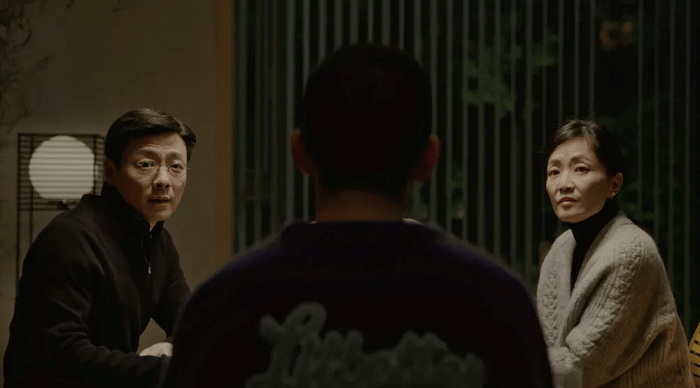
From the earliest moments of “Brief History of a Family” first-time feature filmmaker Jianjie Lin has his audience in the palm of his hand. And he keeps us in his hand, along with our instincts and expectations, until late into the film where he loosens his grip and suddenly has us second guessing nearly everything we thought we knew. That’s just one part of the genius of this smart and crafty movie.

“Brief History of a Family” is a strikingly assured debut for Lin who writes and directs this absorbing thriller set in China following the 2016 rescission of the government’s one-child policy. The setting adds a sociopolitical layer to the story that mostly exists in the background yet looms over much of the story. But Lin’s interests go well beyond that. This becomes evident once he begins digging into the complex dynamics of an upper middle-class family following the arrival of an enigmatic young guest into their lives.

From the first moment we first see 15-year-old Yan Shuo (Xilun Sun) he’s a mystery. He’s quiet and reserved; a bit of an outcast. At school he gets beaned in the head with a ball by the more athletic Wei (Muran Lin). Feeling guilty, Wei invites Yan Shuo to his house to play video games. A little later, Wei’s parents ask Yan Shuo to stay for dinner. This sets in motion a story with all the markings of a family infiltration thriller. But are things really what they seem to be?

It takes no time for Lin to raise our suspicions and have us questioning Yan Shuo. Who is he? What are his intentions? Is he being truthful with this family? Xilun Sun’s performance adds to the mystery. He’s unreadable and impenetrable which prompts us to suspect him more. Wei and his parents attempt to learn more about him by asking about his family. But all they get are cryptic responses about his deceased mother and hard-drinking father. It’s enough to earn their sympathies and Yan Shuo becomes a regular at their home.

The subtle thriller elements become more pronounced the deeper Yan Shuo penetrates the family’s encapsulated lives. He wins the affections of Wei’s mother, Mrs. Tu (Ke-Yu Guo) by simply showing interest in her, listening to her stories, and helping in the kitchen. He wins over the stern Mr. Tu (Feng Zu) with his admiration of Bach and his academic drive. And he wins over Wei by keeping his parents off his back. As it all plays out, deep secrets and buried tensions surface. Feelings of disillusionment and disappointment as well as sorrow and regret shed more light on the family and where the story is going.

As the story percolates Lin’s visual creativity and technique is essential in creating tension and unease. Everything from his precise framing to his use of light and shadows to the sleek modernist architecture – it all helps Lin guide his audience to certain conclusions. There is a thematic correlation with some of the imagery. Other instances reveal a cunning filmmaker using imagery like a carrot on a stick. It’s a testament to Lin’s vision and DP Jiahao Zhang’s ability to realize it through his camera.

With “Brief History of a Family” Jianjie Lin subtly yet effectively speaks to a variety of political, cultural, and domestic issues. At the same time, he plays around with genre in some unexpected and crafty ways. Better yet, his handling of the material, character work, tone management, and visual imagination show a filmmaking acuity usually found in the more seasoned and accomplished. It’s a big reason why Lin should be on everyone’s ‘to-watch’ list.

VERDICT – 4 STORY

REVIEW: “Argylle” (2024)

In the mood for some goofy and altogether mindless fun? Let me tell you about “Argylle”, the new action spy comedy from director Matthew Vaughn. Full disclosure: I’ve been pretty lukewarm when it comes to Vaughn’s past work. That said, there has always been a certain flair to his filmmaking that I appreciate (he was in line to direct “Man of Steel 2” which sadly never came about).

His latest film takes that signature flair and mixes it with a silliness, self-awareness, and genre tropes galore. And that’s not necessarily a bad thing. Mainly because “Argylle” makes no mistake about what kind of movie it wants to be. It’s unmistakably ludicrous from the get-go which is really the only way a movie like this could ever work. Vaughn and screenwriter Jason Fuchs embrace their gonzo premise, adding an equally all-in cast of big names to bring it all together.

Armed with a $200 million budget, “Argylle” sets itself up as the first film in a trilogy, complete with a surprise ending and even a mid-credits scene. It begins by introducing us to spy novelist Elly Conway (Bryce Dallas Howard) who is trying to put the finishing touches on the fifth book in her popular Argylle series. In need of help with her ending, the introverted Elly loads up her cat Alfie and hops a train for her parents house after her mother (Catherine O’Hara) agrees to help her write the final chapter.

Image Courtesy of Universal Pictures

That kickstarts one side of the “Argylle” story. The other side takes part in Elly’s imagination and features the characters she has created for her book series. As Elly types away Vaughn transports us to the fictional world inside her head where super spy Aubrey Argylle (Henry Cavill) and field agents Wyatt (John Cena) and Keira (Ariana DeBose) attempt to stop a voluptuous terrorist known as LaGrange (Dua Lipa). These scenes are intentionally over-the-top and hilariously follow the spy movie formula to the action-packed letter.

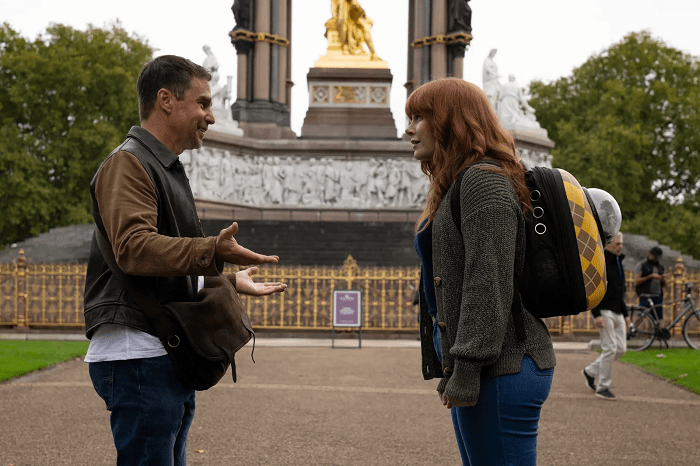
Back in the real world, Elly is approached on the train by an animated fellow named Aiden Wilde (Sam Rockwell). He claims that a nefarious spy organization known as the Division are targeting her for the most unexpected reason and he’s there to save her. After beating down a parade of assassins, Aiden grabs Elly and Alfie and makes an improbable escape.

Once to safety, Aiden informs Elly that her novels have intersected with reality. It turns out that her stories have supposedly paralleled with real events in the actual spy world. He tells her about the existence of a flash drive containing detailed files that could expose the Division and bring them to their knees. The head of the Division, Director Ritter (Bryan Cranston) believes that Elly knows the location of the drive and is about to reveal it in upcoming book. So while Ritter wants to neutralize her, Aiden wants to save her in hopes of finding the drive and bringing down the Division.

Image Courtesy of Universal Pictures

Before we know it Elly’s two worlds begin to blur as she’s thrust into a life of espionage, globetrotting, and double agents. We’re hit with big reveals and bigger twists by the dozen, and they come from all possible directions. Sometimes they’re genuinely surprising and other times they’re utterly preposterous. But that’s exactly what Vaughn and company are going for and the movie is better for it. In fact, any time I began to worry that things were getting too serious, something absolutely bonkers would happen to put me at ease.

This is summed up best in the film’s action-fueled finish which I won’t dare spoil. But let’s just say it’s one of the most gleefully outrageous things you’ll see on a screen this year. If I were guessing, I’d say for some people the ending will perfectly encapsulate why they dislike this movie. But for others (myself happily included), the final 15 minutes or so is a fittingly nutty culmination of everything the movie has been working towards.

“Argylle” sees Matthew Vaughn having a blast with the campy spy movie formula, taking its many tropes and stretching them to absurd limits. It results in something proudly ridiculous and consistently entertaining. The script is a little messy in spots and making sense out of some of its twists is nearly impossible. It’s also hampered by an unnecessarily long running time. But the steady humor and the big stylish action land well. And what a treat seeing Bryce Dallas Howard getting such a fun and meaty lead role. Pair her with the effortlessly charming Sam Rockwell and you have a duo I’ll follow on any mission. “Argylle” opens today in theaters.

VERDICT – 3.5 STARS

Sundance Review: “In the Summers” (2024)

Hot off of winning the Sundance Film Festival’s top prize in the U.S. dramatic competition, the slice-of-life family drama “In the Summers” marks the filmmaking debut for director and screenwriter Alessandra Lacorazza. The story is loosely based on Lacorazza’s own childhood summer visits to her father in Columbia. That’s an admirable basis for a movie, even if the movie itself doesn’t pack nearly the same emotional punch for us as it does for her.

“In the Summers” is the kind of quiet humanist work that I often find myself drawn to. But there’s several things missing here. Lacorazza’s approach is distinctly unhurried and relies heavily on the audience to pluck details out of the mostly plotless story. But beyond those details there is little to glean. And while there’s no denying the movie has a beating heart, it takes a long time to go a short distance while saying very little along the way.

The film has in intriguing structure. It follows two sisters, Eva and Violeta who live with their mother in California. Their story is broken up into four chapters set during four summer visits to see their father in Las Cruces, New Mexico. Each chapter is set at different stages in their lives and begins with the girls waiting for their father Vicente (played throughout by René Pérez Joglar aka Residente) to pick them up at the small town airport.

The first visit sees the sisters as children – Eva played by Luciana Quinonez and Violeta by Dreya Renae Castillo. Vicente picks them up and drives them to his nice adobe style home that he inherited from his late mother. There’s clearly some hesitation at first, especially from Violeta, but things go well. The trio go swimming, he teaches them to play pool, they visit an amusement park, they even do some stargazing. With Vicente we do see signs of recklessness and a short temper. He also drinks too much. But altogether the three have a good time.

The next visit is during their teen years and much has changed with them and their father. Eva (now played by Allison Salinas) is hungry for her father’s affection but is routinely rebuffed due to his favoritism towards Violeta (Kimaya Thais Limón). “She looks like her mother,” Vicente says of Eva, perhaps giving us a little insight into his otherwise out-of-the-blue lack of interest in her. And despite his doting, we see the tension building between Vicente and Violeta that finally boils over.

I won’t say much more other than the film loses its identity in the haphazard final chapter. Now barely into their twenties, Eva (Sasha Calle) and Violeta (Lio Mehiel) still pay their father a visit. But Lacorazza veers away from the more intimate father-daughters dynamic and more towards Eva and Violeta’s individual angles. Eva’s story is the most compelling although it’s hindered by a terrible lack of detail. Violeta’s feels like it belongs in another movie altogether.

Without question “In the Summers” has its touching moments and the unique structure opens the door for an equally unique exploration. Even better, the film features an eye-opening performance from Puerto Rican rapper Residente. But the final chapter really brings the movie down, needlessly splintering the story and exposing holes that otherwise would have gone unnoticed. It’s a frustrating and unfortunate finish to a film that starts on such a strong note.

VERDICT – 2 STARS

Sundance Review: “Rob Peace” (2024)

Chiwetel Ejiofor impressed with his terrific yet underseen 2019 directorial debut “The Boy Who Harnessed the Wind”. He hits his mark again with his sophomore effort “Rob Peace”, a biographical drama in the same vein of his first film. This time he tells an empathetic and earnest true story of an inner-city kid with big dreams but a hard to shake past. Following in the footsteps of his debut, “Rob Peace” had its premiere at this year’s Sundance Film Festival hoping to earn a sizable distribution.

Ejiofor also wrote the screenplay which is based on the 2014 biography “The Short and Tragic Life of Robert Peace” by Peace’s good friend Jeff Hobbs. While the film at times plays like a conventional biopic, Ejiofor takes it in a number of compelling directions as Rob’s life intersects with issues of race, urban housing, criminal justice, the education system, and more. The story explores the blessings and curses that come with family and community particularly through the Black experience. It results in a film that can be a little uneven but is mostly involving.

Ejiofor makes stops at key points in Rob Peace’s life beginning in 1987. That’s where 7-year-old Rob (played by Jelani Dacres) lives with his supportive and hard-working single mother Jackie (a sublime Mary J. Blige) in East Orange, New Jersey. He looks up to his father, Robert “Skeet” Douglas (played by Ejiofor), an irresponsible man who loves his son and preaches unwavering loyalty to his people and neighborhood. The instillment of that mindset from father to son reverberates through the entire story.

From the earliest scenes we’re shown Rob’s brilliance. He enjoys school and has a special interest in science. But his promising life hits a speed bump after his father is arrested and convicted of a double murder. Skeet is sentenced to life in prison despite vehemently proclaiming his innocence. Jackie doesn’t want the same for her son so she takes on three jobs in order to save money for Rob’s education. She wants him to leave East Orange behind for a better life – the exact opposite of his father’s desire.

From there we jump ahead to 1994 where teenage Rob (now played by Chance K. Smith) is attending St. Benedict’s Prep School in Newark. He excels thanks to the steady encouragement of his teacher, Reverend Edwin Leahy (Michael Kelly). Between schoolwork and taking small jobs to help out his mom, Rob begins studying his father’s case, determined to prove his innocence and get him out of jail.

Most of our time is spent a few years later as Rob (portrayed via newcomer Jay Will’s star-making performance) is accepted into Yale. Things start out great as he earns several opportunities to pursue his passion for science. He makes new friends and catches the eye of girl named Naya (an underused Camila Cabello). But his unhealthy loyalty to his father puts everything he has accomplished in jeopardy. Cracking under the pressure of prison, Skeet pushes Rob to help him raise money for a lawyer. It ultimately sends the young man down a path that could cost him everything.

While there is a degree of predictability to the film and it doesn’t stretch too far beyond the conventional, Ejiofor’s grounded and focused approach to telling Rob Peace’s story keeps it from being overly sentimental despite some big emotional beats. He does throw in unneeded voiceover rather than leaning on his capable cast and some of his dialogue is a bit clunky. Also the final act stretches out beyond what’s necessary.

But those things are overcome by Ejiofor’s commitment to Rob’s story and all of its complexities. He thoughtfully guides us through a life marked by ambitious dreams and inspiring successes. It’s also a life that sees firsthand the different set of rules for someone poor and Black – rules that lead to bad choices with tragic results. It’s all relayed through some incredible performances, most notably Blige’s quiet strength and a magnetic Jay Will. It’s a breakout turn from the young Julliard-trained actor and a big step towards what should be an exciting career.

VERDICT – 3.5 STARS