
REVIEW: “Isle of Dogs”

ISLE POSTER

There isn’t much middle ground when it comes to Wes Anderson movies. As is often the case, his films either work for you or they don’t. They definitely work for me. My wife, not as much. But it’s not because she doesn’t try. I’m pretty sure I’ve shown her every Anderson flick and we usually have some pretty good discussions after each viewing. Deep down I like to think she actually has an untapped appreciation.

But we’ll leave that for another time. Wes Anderson movies are special because without fail they always feel refreshingly different from anything else in theaters. His latest film is no different. From the very first frame of “Isle of Dogs” we know we are watching an Anderson picture. The stop-motion animation (ala 2009’s “Fantastic Mr. Fox”), the slightly offbeat music, and the almost instant deadpan humor are unquestionably Andersonian. It instantly fits right into his spectacular comic movie catalog. So why am I hesitant to fully embrace this film in the same way I have his others?

ISLE1

Now don’t get me wrong, “Isle of Dogs” is another fascinating Anderson experience that (like most of his films) begs for multiple viewings to fully appreciate the richness of the visual and thematic language. Once again we find the filmmaker creating and inhabiting another wacky quasi-real place within his own wacky quasi-universe. Japanese culture lends its influence to Anderson’s fictional city of Megasaki City but that’s as far as the similarities go. Anderson doesn’t work within the real world. He only borrows from it and speaks to elements of it.

In “Isle of Dogs” the conniving cat-loving Mayor Kobayashi (Kunichi Nomura) runs a dystopian not-to-distant-future Japan with an iron fist. Exploiting a dog flu virus outbreak, the authoritarian mayor banishes the entire dog population to Trash Island. Among the dogs is Spots (Live Schreiber), the best buddy to the mayor’s nephew and ward Atari (Koyu Rankin). But Atari will have none of it. He sneaks away and flies a rickety mini-plane to Trash Island to find his canine companion.

After crash landing Atari is taken in by an eccentric pack of pups led by the reluctant Chief (Bryan Cranston). The rest of the group is voiced by a fun assortment of actors including Edward Norton, Bill Murray, Bob Balaban, and Jeff Goldblum as the scene-stealing gossip of the group. They venture across Trash Island to find Spots while back home a youth protest against the Mayor’s doggie decrees is led by a foreign exchange student named Tracy (Greta Gerwig), one of many outcasts found throughout the story.

ISLE2

As the movie moves forward you can’t help but be smitten by the superb animation and art direction. The vivid detail in both the backgrounds and the characters (both human and hairy) are quite stunning. And so often it’s the gorgeous yet quirky visuals that spur some of the film’s bigger laughs. But normally it’s Anderson’s dry, offbeat, deadpan humor, cleverly balanced throughout his movies, that carry them. Here it isn’t nearly as pronounced. In fact, in the final act it’s fairly sparse. And as the pieces all-too-neatly fall into place, I found myself not knowing how to feel about the ending.

In some ways how Anderson tells his story is more fascinating that the story itself. “Isle of Dogs” is a technical delight both visually and in its use of sound. The huge and talented cast offer up superb voice work and they all meld seamlessly into Anderson’s handsomely idiosyncratic world. It’s another reminder that Wes Anderson is a meticulous master of his craft. Yet from a story standpoint I can’t help but feel ever so slightly conflicted. And whether looking at it as a message piece soaked in political metaphors or simply as a story about a boy and his dog, I still left with the same uncertainties. Maybe I just need to give it another view. Or maybe I’m just too much of a cat person.

VERDICT – 3.5 STARS

3-5-stars

REVIEW: “A Quiet Place”

QUIET POSTER

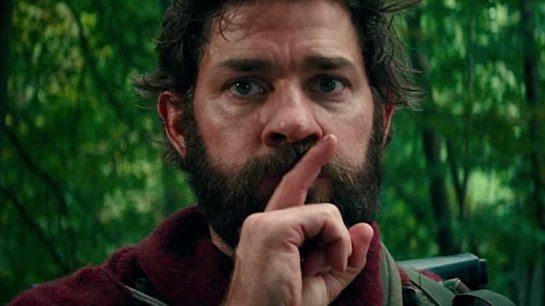
From the very outset “A Quiet Place” develops a central conceit which it fully embraces throughout its tight, lean 95-minute runtime. But while it’s undoubtedly a genre flick, this John Krasinski directed horror thriller has more of an emotional punch than you would expect.

In addition to directing, Krasinski also co-writes and stars alongside his real-life wife Emily Blunt. They play Lee and Evelyn Abbott who live on a remote farm in a not-to-distant future. The human race has been ravaged by creatures with no sight who hunt via their heightened and lethal sense of hearing. The Abbott’s along with their daughter Regan (Millicent Simmonds) and son Marcus (Noah Jupe) are still coping with grief after a family tragedy while trying to survive in a world where the slightest sound could mean immediate death.

QUIET1

The great trick of this film is causing us (the audience) to lock in to every sound we hear. We become much more attentive and attune to what we hear rather than what we see. Krasinski does a great job of leading us in that direction both with the sound design and some clever visual cues. It’s also seen in numerous details – trails of sand to silence their steps, crocheted Monopoly pieces, etc. The most everyday things take on a new perspective in this world.

It goes without saying this adds a natural tension to “A Quiet Place”. Even in quieter scenes (no pun intended) the dread of an accidental bump or the smallest sound constantly looms in the background. Krasinski leans heavily into it without going overboard. When sound is employed it can be pretty profound and Marco Beltrami’s score ratchets up the intensity by both adding to the stillness and accentuating the terror. Yet at it’s core you can see the film constantly tipping its hat to the silent film era.

The movie also works because of the small but superb cast who flesh out their characters despite having little dialogue. Kasinski conveys so much through his tired and concerned eyes. Blunt knocks it out of the park as an emotional anchor for her family. But there is also Millicent Simmonds, great in last year’s “Wonderstruck” and just as good here. The young actress (who is deaf in real life) is a fundamental piece of the story and Simmonds is asked to juggle a range of emotions. She does so magnificently.

A QUIET PLACE

And this gets to where “A Quiet Place” scores the most points – the characters themselves and its story of family. Many have looked for more political meaning, but I find it most piercing when observing the family dynamic. I couldn’t help but sympathize with Krasinski’s Lee, a man who would do anything to protect his family, especially his children, yet on some levels struggles to connect with them. Blunt speaks to this particularly in one line where she says “Who are we if we can’t protect them? We have to protect them.” These characters and their relationships matter. The film does a keen job of making us care about what happens to each of them.

You could call “A Quiet Place” an old-fashioned horror picture. It’s smart, light on gore, but heavy on tension. It knows its premise and fully embraces it. Never does it feel the need to give us tedious and uninteresting exposition nor does it overstay its welcome. There are a few instances where you could question the movie’s logic, but for the most part Krasinski cleverly covers all of his bases. In the end he delivers an exhilarating and surprisingly heartfelt experience that is a huge win for the horror genre as a whole.

VERDICT – 4.5 STARS

4-5-stars

Blind Spot Review: “My Night at Maud’s”

2017blindspot

“My Night at Maud’s” is technically the third installment in Éric Rohmer’s Six Moral Tales series even though it was the fourth film made. Due to a required Christmas time shoot and prior commitments, lead actor Jean-Louis Trintignant wasn’t available until the following year. That little nugget aside, the film became Rohmer’s first big critical and commercial success both in France and in the United States.

Rohmer was the oldest of the French New Wave pioneers, nearly ten years the senior of his contemporaries. He was also known for being stylistically reserved compared to Godard, Truffaut and the like. But that doesn’t mean his films weren’t bucking trends. Quite the opposite. Just watch a Rohmer film and you can’t help but see the La Nouvelle Vague sensibility.

MAUDS

His Six Moral Tales basically follow the same narrative framework. They feature individuals who find their own moral code challenged in one way or another. More specifically, they are men who are in love with a woman but find themselves tempted by another. A big part of the focus is on how each of their personal moral codes lead them through their crisis.

In “My Night at Maud’s” we have a devout Catholic named Jean-Louis (Trintignant). He is firm in his beliefs and in the practice of his faith. He’s fallen for a young blonde parishioner (Marie-Christine Barrault) from a church he attends even though he has never spoken with her. But it’s not for lack of trying. He follows her out of church or down the tight city streets only to lose her around a corner.

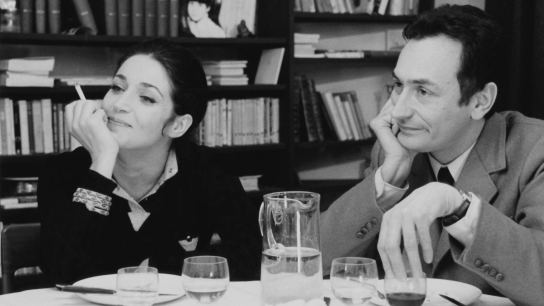
One evening Jean-Louis bumps into an old childhood friend Vidal (Antoine Vitez), a brash opinionated fellow who rather enjoys the chance to needle and poke. Vidal convinces Jean-Louis to accompany him on a late night visit to a recently divorced friend named Maud (played by the captivating Françoise Fabian). The three share an evening of conversations about love, marriage, Christianity, and the writings of Blaise Pascal. After Vidal leaves Maud encourages Jean-Louis to stay. What follows is a seductive game of cat-and-mouse versus a deeply-held set of moral convictions.

maud2

Rohmer’s audacious middle act is filled with long talky takes mostly between Jean-Louis and Maud and that’s not a knock on it. Just the opposite. The natural flow of the dialogue and the subtle movements of Néstor Almendros’ camera completely sells it and keeps us locked onto these two characters. We also get a good sense of Jean-Louis and Maud’s fascinations with each other and their differing perspectives on practically everything. Plus seeds are planted throughout the conversations that surface in the last act.

Over the years the chatty middle act is what “My Night at Maud’s” has become known for. The title itself contributes to that perception. But there is more to Rohmer’s film than that both before and after the signature scene. As with all French New Wave films, this one still feels fresh and unique. Nearly fifty years after its release you still see it bucking trends and plowing new ground. That alone is a remarkable accomplishment.

VERDICT – 4.5 STARS

4-5-stars

REVIEW: “Logan Lucky”

LOGANPOSTER

You could argue that Steven Soderbergh is the architect of the modern heist film. Look no further than his hit movie “Ocean’s Eleven”. In that 2001 remake Soderbergh pretty much wrote his own set of rules for a heist flick and would follow them through two sequels. Now years later he returns with “Logan Lucky”, a working class version of the “Ocean’s” formula, less focused on being cool and more on straight southern-fried humor.

Channing Tatum (an actor I have steadily warmed up to) plays Jimmy Logan, a down-on-his-luck blue collar construction worker who loses his job at Charlotte Motor Speedway. Soon after, Jimmy learns that his ex-wife Bobbie Jo (Katie Holmes) and her slug of a husband Moody (played with just the right amount of macho slime by David Denman) plan to move to Lynchburg making it harder for Jimmy to see his daughter Sadie (Farrah Mackenzie).

LOGAN1

Tatum’s performance is funny in a number of ways. One is in how he reacts to all of his bad luck (referenced several times in the film as the ‘Logan Hex’). He takes everything in stride, never getting worked up. But he doesn’t sit around and take it. You could say he’s a man of action. So needing money in order to stay closer to Sadie, Jimmy concocts an elaborate plan to rob the speedway. But he’s going to need a crew.

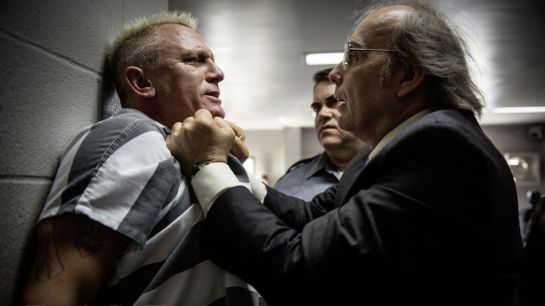
First he recruits his brother Clyde (Adam Driver), an Iraq war veteran and bartender with a prosthetic hand, and his hairdresser sister Mellie (Riley Keough). Needing someone experienced with vaults they contact the currently in-car-cer-ated Joe Bang. He’s played by Daniel Craig channeling something far different than his dapper James Bond persona. Joe’s two numbskull brothers (Brian Gleeson and Jack Quaid) join in to fill out the wacky team.

Several other names round off the cast – Sebastian Stan, Dwight Yoakam, Katherine Waterston. And then there are a couple who don’t quite fit. Seth MacFarlane plays a scumbag NASCAR team owner with a bad British accent and an even worse wig. Not sure what he’s going for but it doesn’t work. And then there is Hillary Swank as a not so hot on the trail FBI agent. Swank’s performance is hard to interpret and feels out of tune with the rest of the film. Thankfully both are smaller roles and are easy to look past, but they do stand out.

LOGAN2

This zany bunch of country folk is a far cry from Danny Ocean’s good-looking and snazzy dressed band of burglars. That’s part of the fun. In many ways Soderbergh is spoofing his own “Ocean’s” trilogy and has a lot of fun doing it. You can’t help but notice similarities in the two story structures, but “Logan Lucky” adds its own unique twist and is by far the broader comedy.

Out of the blue newcomer Rebecca Blunt is credited with the screenplay but there is a catch. Many say Rebecca Blunt doesn’t exist. No one can seem to find her. Some believe it’s a pseudonym for Soderbergh himself. Others have speculated that Soderbergh’s wife, former E! personality Jules Asner, is the real screenwriter. This weird little mystery surrounding Rebecca Blunt seems only fitting for such weird little movie. Whoever wrote it deserves some attention for dishing out a fun madcap caper with big personalities and even bigger laughs. Toss in that Soderbergh flavor and an all-in cast and you have one of last year’s funniest movies.

VERDICT – 4 STARS

4-stars

REVIEW: “Tomb Raider”

TOMB poster

As a younger video game enthusiast I remember being excited at the news of “Lara Croft: Tomb Raider”, a 2001 movie based on the “Tomb Raider” video game franchise. It seemed ripe for the big screen with potential to be an Indiana Jones styled action-adventure. While it certainly couldn’t hold a candle to the three true Indy pictures, it was a fun and successful adaptation. A sequel followed – not quite as good and not quite as successful.

The video game series started in 1996 and over the years has seen several sequels, remakes, and spin-offs. The most recent reboot was in 2013. The game from developer Crystal Dynamics was critically acclaimed and wildly successful. It would become the highest grossing game in the franchise. Players responded to the grittier tone and human element that was sometimes overlooked in past games.

tomb1

Now the movie series returns, freshly rebooted and based on the most recent incarnation of the “Tomb Raider” games. And like its inspiration, it seeks to be grittier and more focused on giving us a more human Lara Croft. For the most part the movie succeeds.

The first smart decision was casting Oscar-winner Alicia Vikander. She gives us a Lara who is considerably more grounded than Angelina Jolie’s version from the previous films. Vikander’s portrayal is anchored by heartbreak, vulnerability and uncertainty. She isn’t a swashbuckling tomb-rainding buttkicker by nature or desire. The story frames her as a heartbroken young woman at a loss following the disappearance of her father (played by Dominic West) some seven years earlier.

But Lara is also full of determination and bravery. An unexpected clue leads her to her father’s secret study at the family’s now abandoned estate. There she discovers her father last set off for a mysterious remote island outside of Hong Kong. Through a ‘if you’re watching this I must be dead’ recording he commands Lara to destroy all of his research regarding the island. Instead she uses it to find the location and heads there in hopes of discovering what happened to him.

This opens the rather obvious door to Lara’s adventure. She runs into Walton Goggins who plays Mathias Vogel, the film’s chief antagonist. Turns out he heads an expedition on the island to find the same ancient tomb Lara’s father was seeking. Goggins is an unexpectedly fun choice. He brings a subtle (and slightly humorous) wide-eyed madness to his character who is a bit stir-crazy from his years on the island. For Lara it becomes a journey of revelation and self-discovery as she finds herself at odds with Vogel and his band of mercenaries. Oh, and of course there is also the tomb and the potentially devastating power it may hold.

TOMB2

Director Roar Uthaug’s last film was the excellent 2015 Norwegian disaster picture “The Wave”. Here he is given a much different canvas but the sharp camera eye from his previous movie remains. The action scenes are shot with energy and clarity. No annoying rapid-fire quick cuts or shaky hand-held approach. He also wisely stops at certain points and sets his camera on Vikander allowing her to flesh out pieces of her character through her performance. That may sound a bit obvious, but far too often directors don’t give good performers that room. And again, Vikander is spot-on.

Does “Tomb Raider” break new ground or change the movie landscape? Not hardly. But is that a prerequisite for every film? Absolutely not. Will it be pigeonholed as just another video game movie? I think we’ve already seen some of that. But when you toss aside any preconceived notions or sky-high expectations, what you get is a fun and often times thrilling action-adventure with a strong, believable female protagonist . It’s a nice new foundation for a franchise. Unfortunately due to some iffy box office numbers that may not happen. What a shame.

VERDICT – 4 STARS

4-stars

REVIEW: “Paul, Apostle of Christ” (2018)

PAUL POSTER

Faith-based movies have had a tough time finding a seat at the big screen table. Much of it is due to budget quality filmmaking. It can also be tough to get a look from more secular-minded moviegoers especially when the messaging is pretty heavy. And while hardly the case with every critic, it can be difficult for these movies to get an objective analysis. Take this quote from a review of the new film “Paul, Apostle of Christ” – “A Faith-based snuff flick with little appeal beyond the Bible-thumping demographic”. Ouch.

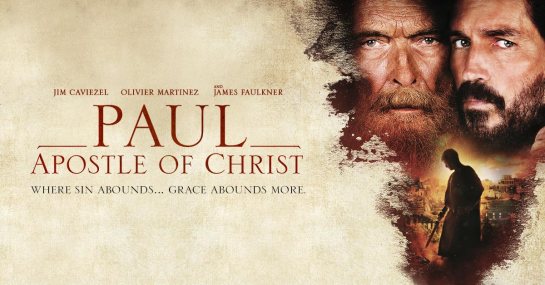
That’s one reason I appreciate Affirm Films, a label of Sony Pictures. While several of their productions are hampered by the above-mentioned problems, the label does offer an avenue for many of these movies to reach the big screen. “Paul, Apostle of Christ” is their latest and it’s definitely on their higher end in terms of quality yet not without a few quibbles.

PAUL1

Set in A.D. 67, the film takes place in Rome during a desperate time for the fledgling Christian church. Followers of Christ find themselves subjected to brutal persecution at the command of Emperor Nero. Some are burned alive on the streets. Others are thrown into the “Circus” where they are torn apart by lions for sport. Only a handful of the older church leaders were still alive. One was the Apostle Paul.

As the story begins Paul (a still, affecting portrayal by James Faulkner) is locked up in Rome’s Mamertine Prison. After several missionary journeys sharing the Words of Jesus and training young churches, the Apostle knows his remaining time on Earth is short. Yet while his body is tired and frail he maintains a heart full of faith, inspiring believers, many of whom hide away within the walls of the violent city. Among those believers is Aquilla (John Lynch) and Priscilla (Joanne Whalley), a couple who secretly shelters a small community of believers in Rome and who anxiously await a word from Paul.

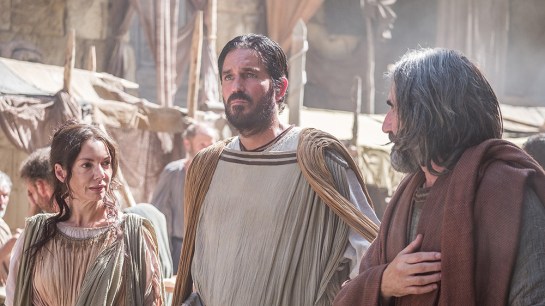
In 2004 Jim Caviezel gave an intense, heart-wrenching performance as Jesus in Mel Gibson’s “The Passion of the Christ”. Now 14 years later Caviezel portrays Luke, follower of Christ and writer of portions of the New Testament. Luke returns to Rome where he secretly meets with Paul and begins writing what will become The Acts of the Apostles.

Writer and director Andrew Hyatt carefully takes portions of scripture to form the framework of his story. Chunks of the film feature quiet, thoughtful jail cell conversations between Paul and Luke where the two reflect on Paul’s journeys and discuss faithfulness amidst persecution. Some of Paul’s signature life moments are touched on through dream-like flashbacks – the stoning of Stephen, his Damascus road conversion, just to name a few. Hyatt does a good job of showing the weight those events still have on Paul.

paul2

At the same time Priscilla and Aquilla struggle with a fracture among their community. Should they stay in Rome or attempt to leave? Should they take up arms and fight back? Another key figure is Mauritius (French actor Olivier Martinez), a Roman prefect put in charge of the Mamertine prison. He is a bit disillusioned with Nero’s leadership yet steadily loyal to Rome. He’s also fascinated by his enigmatic and most prominent prisoner.

The structure of “Paul” could be a stumbling block for some. You could definitely call the film a slow burn and it sometimes struggles to maintain a sense of dramatic tension. This is particularly noticeable through its middle act. Yet at the same time there is something about its quietness that works with the story being told. That’s not to say the film is a bore. Hyatt visualizes the brutality of the persecution, nothing on the level of Gibson’s “Passion”, but quite effectively. And the circumstances surrounding each of the characters lend to some satisfying individual story threads that make the movie work as a whole. That was more than enough for me. Hopefully it will be enough to find an audience because “Paul, Apostle of Christ” deserves one.

VERDICT – 3.5 STARS

3-5-stars