REVIEW: “All the Money in the World”

MONEY POSTER

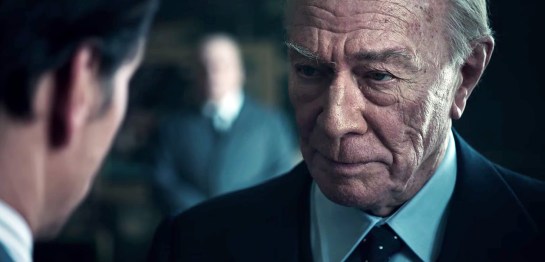
Ridley Scott’s “All the money in the World” was a fascinating news story before it ever hit the screens. Kevin Spacey was cast in the key supporting role of J. Paul Getty. But after several sexual assault allegations the decision was made to replace Spacey even though he had shot all his scenes and appeared in the early ad campaign. Christopher Plummer (Scott’s original first choice) was brought in just a month from the scheduled release to reshoot Spacey’s scenes. The movie’s release date was only knocked back three days.

It was a gutsy but principled gamble by Scott and company and it paid off. Plummer is outstanding and has already earned several nominations around the awards circuit. Plummer’s J. Paul Getty is the film’s the most compelling character.
MONEY

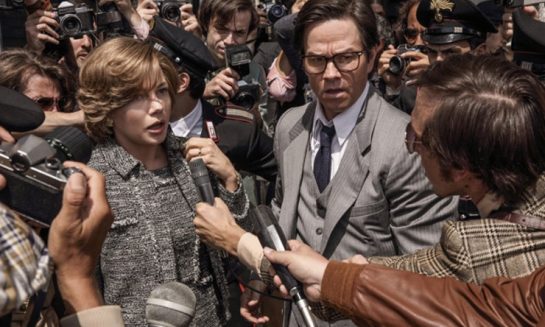
The story opens in Rome, 1973. Paul Getty (played by Charlie Plummer, no relation), the 16 year-old grandson of oil mogul and well-known ‘richest man in the world’ J. Paul Getty, is abducted by a van full Calabrian thugs. The kidnappers contact Paul’s mother Gail (Michelle Williams) and demand $17 million in ransom money. The problem is she doesn’t have it. A series of flashbacks reveals an ugly divorce with Paul’s father where Gail chose full custody of their children over the Getty’s money.

Gail approaches her cold-hearted ex-father-in-law but is stunned when he denies her the ransom money. At one point he says “I have none to spare”. A few scenes later he’s revealing plans to build himself another lavish estate. Screenwriter David Scarpa doesn’t give Plummer a ton of screen time but every scene he’s in has energy and bite. Ultimately this isn’t J. Paul’s movie. Gail quickly becomes the centerpiece and our emotional connection.

J. Paul won’t part with his money but he does send his oil broker, a former CIA operative, Fletcher Chase (Mark Wahlburg) to help Gail negotiate a release. In the meantime young Paul is taken to a remote countryside location in Italy where he gains the sympathy of his head captor Cinquanta (played by fantastic French actor Romain Duris). He and Gail begin negotiations but both sides are hindered by powerful outside forces driven by their own motivations.
MONEY2

This “Inspired by True Events” story is based on John Pearson’s book “Painfully Rich: The Outrageous Fortunes and Misfortunes of the Heirs of J. Paul Getty”. Scott’s treatment starts a little slow and it takes some time to get its footing. But once it does it zips along and becomes a good suspenseful crime thriller with several cool touches. For example, Scott’s portrayal of the paparazzi instantly hearkens back to Fellini’s “La Dolce Vita”. There is also the undeniable 70s vibe that shines through, not just in look but also in the style of the storytelling.

Perhaps the biggest reason “All the Money” works is because Ridley Scott steps out of the way and puts his full trust in his actors and the script. There are fine performances throughout, particularly from Plummer and Duris. And Michelle Williams is more than capable of carrying a bulk of the story. As you would expect from a Scott picture the production is superb, and while the story is slow out of the gate, once it gets going it’s a pretty invigorating ride.

VERDICT – 3.5 STARS

3-5-stars

REVIEW: “The Cloverfield Paradox”

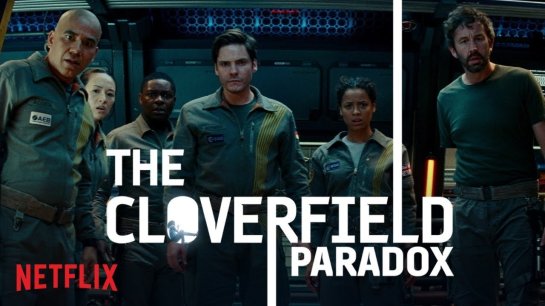
clove poster - Copy

Paradox: (noun) a statement or proposition that seems self-contradictory or absurd but in reality expresses a possible truth.

Cloverfield: (noun-ish) a kooky yet cool concoction from J.J. Abrams featuring a series of movies seemingly revolving around the same cataclysmic event. Kind of. But not really.

What started in 2008 as a simple yet effective found-footage horror movie has blossomed into a surprisingly successful feature film franchise. The original “Cloverfield” was followed by 2016’s “10 Cloverfield Lane”. Now two years later we get a third installment, “The Cloverfield Paradox” and a fourth is due out in October.

One of the fascinating things about these movies are how each (so far) are from different horror movie sub-genres. “Cloverfield” was a monster horror movie while the second film was a psychological thriller. “The Cloverfield Paradox” is a straight science fiction horror movie taking place mostly in space. All three are openly influenced by other films but are unique within their franchise. But defining the franchise as a whole, well that’s a bit tricky.

GDP-08575.raf

“The Cloverfield Paradox” takes place in 2028 which immediately separates it from the previous movies. The earth has been crippled by a global energy crisis and nations have joined together to launch the Cloverfield space station. The station is manned by a multinational crew of technicians and scientists who are preparing for an experiment which could lead to an infinite energy supply for the entire planet. But tin-foil hatters warn that the experiment could rip a hole in the space-time continuum allowing all sorts of bad things to happen.

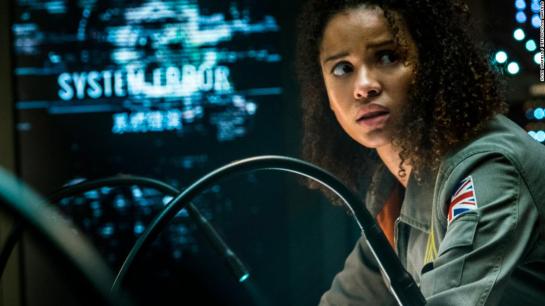
On earth, communications officer Ava Hamilton (Guga Mbatha-Raw) reluctantly leaves behind her husband Michael (Roger Davies) to join the Cloverfield mission. The station’s crew consists of several good faces: Daniel Oyelowo, Daniel Brühl, Zhang Ziyi, Chris O’Dowd, John Ortiz, and Aksel Hennie. Each come from different backgrounds and have their own perspectives about the mission and the chaos down on earth. Sometimes the planetside political tensions bleed over onto the station and the film smartly explores that dynamic. Perhaps not as much as it could have.

Needless to say the experiment doesn’t go exactly as planned and the crew begin noticing a series of creepy anomalies. At the same time officials on earth have lost contact with the Cloverfield and the situation on the ground has worsened. The film tries to juggle time on the space station with Michael’s time on earth, but it’s Michael’s side that feels a little underserved. For the crew it turns into a survival horror story as they try to undue what their experiment has done.

CLOVE2

“Paradox” operates much differently than its predecessors. At the same time its story rhythms and some of the character treatments lean heavily on the movies that inspired it. You can’t help but notice it. There are times when the familiarity and predictability are a bit much. Also you can see potential in some of the story threads they begin but do little with. Still, I tend to have a soft spot for these types of genre pieces so the issues weren’t hard to get past especially considering all the movie does well. It stocks a good cast and the performances hit there marks. The production design and special effects are impressive and Bear McCreary’s score hearkens back to 90’s era adventures – big and persistent but fitting. Most importantly, “Paradox” sprinkles in some clever clues as to how it is connected to the overall “Cloverfield” franchise.

Director Julius Onah and writer Oren Uziel have been attached to the project since 2012 when it used the developmental title of “God Particle”. It was eventually confirmed to be the next Cloverfield film but faced numerous delays. The true stroke of advertising genius (and guts) came February 4, 2018, Super Bowl Sunday. A teaser trailer debuted proclaiming the movie would be available immediately following the big game. No press tour or pre-release trailer campaign. It marked a new attention-getting approach for the industry.

So where does “The Cloverfield Paradox” fit in? Let’s just say you could call it a prequel. That’s my take on it and I enjoyed how this film brought me to that conclusion. But many people have left it with a much different reaction and with their critical guns have been blazing. Sure, it’s a traditional sci-fi horror picture that doesn’t break new ground outside of its slick advertising trick. But is it really trying to break new ground? I would argue it’s trying to make a fun, intriguing “Cloverfield” installment. Speaking for myself, mission accomplished.

VERDICT – 3.5 STARS

REVIEW: “Blade Runner 2049”

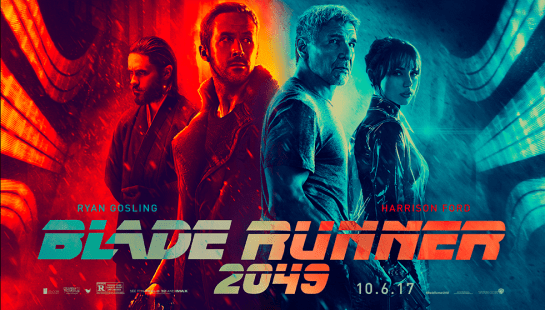
BLADE poster

Green-lighting “Blade Runner 2049” could be considered one of the gutsiest movie moves in recent years. Ridley Scott’s 1982 original landed with mixed reactions both from critics and moviegoers. It’s unique and unconventional approach to practically everything pushed many viewers away and it failed to bring in the money Warner Brothers was banking on. Yet over time perceptions have changed and the film is widely regarded as a science fiction classic.

Now, 39 year later, along comes “Blade Runner 2049” and you could say it has followed the same path as its predecessor. While critics weren’t as divided, audiences didn’t come out for it and the movie fell well short of what it needed at the box office to break even. Yet just like the ’82 film, it wouldn’t be a stretch to expect a re-evaluation over time and a greater appreciation for what “2049” is doing.

BLADE1

Talks of a “Blade Runner” sequel had been ongoing for years with names like Christopher Nolan and a returning Ridley Scott attached. Denis Villeneuve eventually signed on to direct and with him came long-time collaborator and top-tier cinematographer Roger Deakins (fourteen Oscar nominations without a win and counting). What quickly became obvious was Villeneuve’s intention to keep certain things very close to the original. The look, the tone, even the deliberate storytelling all hearken back to Scott’s picture.

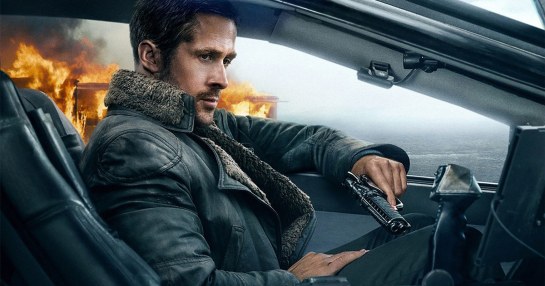
Ryan Gosling plays K, a Blade Runner for the LAPD. In case you need a refresher, Blade Runners are tasked with hunting down and “retiring” bioengineered humans known as replicants. K’s superior Lt. Joshi (Robin Wright) puts him on the trail of a rogue replicant of interest (Dave Bautista) who needs to be put down. In his encounter with his target K discovers evidence of a child born possibly from two replicants. Joshi believes this startling knowledge that replicants can reproduce could start a war so she orders K to hunt down the child and erase any evidence of its existence.

BLADE3

The devilish Tyrell Corporation from the first film is no more and the even more nefarious Wallace Corporation has risen to take its place. It’s ran by a mannered, milky-eyed Jared Leto who has also learned of the miracle child’s possible existence. And as you can probably guess, he wants it for his own reasons. He sends his personal strong-arm Luv (Sylvia Hoeks) to tail Agent K and capture the child for the company.

The writing team of Hampton Francher (co-writer of the original film) and Michael Green (who contributed to four 2017 screenplays) wisely steer clear of altering the “Blade Runner” formula. Much like its predecessor, 2049 is a methodically structured puzzle, solved through slow but persistent drips of revelation. Surrounding that central mystery is a visually jaw-dropping world – a consistent evocation of the original film’s unforgettable aesthetic. Production designer Dennis Gassner deserves a ton of credit for visualizing such a stimulating dystopia, from the exquisitely dank and dreary Los Angeles to the glowing orange hue of the sandy and barren Las Vegas. Then Deakins elegantly shoots the world in a way that amplifies the moody sci-fi/neo-noir vibe and immerses the audience.

BLADE2

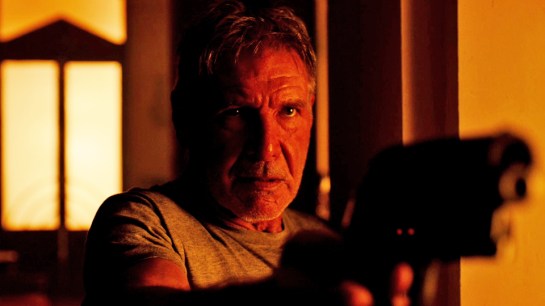
Gosling (known for often acting in a perpetual state of lethargy) is a perfect fit for his role. K is a character hungry to feel and there is a surprising emotional resonance in Gosling’s portrayal. K is a tragic figure, mutually disliked or dismissed by both humans and replicants. He attempts to fill that void with a holographic companion called Joi (Ana de Armas). But ultimately it’s his mission to hunt down the child that puts the pieces together for him. One of those pieces is a returning Harrison Ford who brings an unexpected subtlety and nuance to the now older and wiser Rick Deckard.

“Blade Runner 2049” isn’t the first movie to pose the question ‘What does it mean to be human?’ Ridley Scott has long been fascinated with variations of that question and Villeneuve’s movie is no different. It’s an idea that lies under the surface of “2049” and its entire two hours and forty-five minute runtime. It is a bit long which certainly contributed to the lower box office. And viewers attuned to more action-packed rhythms have undoubtedly had a hard time with the picture. That’s a shame. “2049” has more to say, has more visual ingenuity and takes more risks than the bulk of the genre films we get today.

So for now it appears the gutsy call hasn’t paid off. But I can’t help but believe that over time “2049” will be reassessed by many who dismissed it and I can honestly see it someday being heralded as a new science fiction classic just like its predecessor. Sure, those are bold words but some people were saying the same thing in 1982.

VERDICT – 4.5 STARS

4-5-stars

5 Phenomenal 2018 Super Bowl Teasers

PHENOM 5

The amount of money spent on Super Bowl advertisements is notorious. Products pay millions of dollars for 30 seconds to one minute of commercial time. Movie studious are no different. I have a blast watching for new movie reveals and this year’s stock was pretty strong. Here are my five favorites:

#5 – “Jurassic World: Fallen Kingdom”

Why is this even on the list? Because it is a substantial step up from the first trailer. In fact, it actually has me a little interested in what Universal has in store for us. The previous film was pretty forgettable (and sometimes down-right laughable). This well-made teaser offers a little optimism for the next installment.

#4 – “Solo: A Star War Story”

My skepticism over this idea is still pretty high, but I would be lying if I didn’t admit to a little excitement over the images we get in the Super Bowl teaser. I love the look of the film (what we can see) and it appears there may be a pretty good concept behind it all. But our first look at Ehrenreich’s Solo compared to Harrison Ford’s from “A New Hope”…let’s just say connecting those two may be a challenge.

#3 – “A Quiet Place”

What started off as a cool horror movie concept has grown into a film I’m genuinely excited for. John Krasinski directs, co-writes, and stars alongside real-life wife Emily Blunt. It also features Millicent Simmonds who was wonderful in 2017’s “Wonderstruck”. The Super Bowl teaser is soaking with tension and it will be interesting to see if the movie can deliver on such potential.

#2 – “The Cloverfield Paradox”

Well played Netflix. Well played. “The Cloverfield Paradox” gets a spot this high just for the sheer audacity of it all. The teaser was a surprise and looked cool in and of itself, but when it was revealed that it would premiere on Netflix immediately after the game, well who saw that coming? It was an incredibly gutsy move and something completely new for the motion picture business.

#1 – “Mission Impossible: Fallout”

I’ll admit it. I’m a big fan of Christopher McQuarrie’s take on the “Mission Impossible” series. The Super Bowl teaser highlighted many of the reasons why. It looks like the full cast is back including Rebecca Ferguson who was amazing in “Rogue Nation”. New addition Henry Cavill and his killer mustache gets a proper introduction and it looks like he’ll be a key player. And then we learn it’s all a teaser for the full trailer which is even better. Needless to say I can’t wait for July 27th.

So which movie teasers were your? Please share you favorites and no-so-favorites in the comments section below.

REVIEW: “Hostiles”

Hostiles poster

A new traditional Western is somewhat of a rarity these days. You could say 2016 was the year of the subversive Western while 2017 didn’t offer much of anything for the genre. But then along comes “Hostiles” which sits somewhere between subversive and traditional.

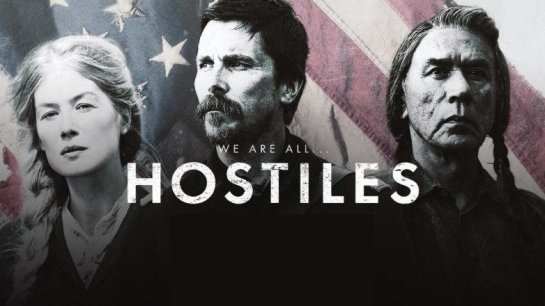
“Hostiles” is written and directed by Scott Cooper, probably best known for his award-winning feature film debut “Crazy Heart”. The movie begins with the ‘traditional’ – a familiar but effective opening sequence showing a frontier family brutal attacked by a Comanche war party. The lone survivor, a wife and mother named Rosalie Quaid (played by an excellent Rosamund Pike), is left in a state of shock.

HOSTILES1

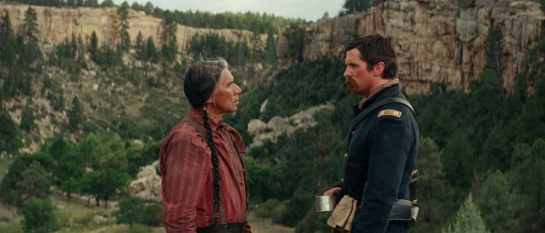
The story then moves to Fort Berringer, New Mexico. Captain Joseph Blocker (Christian Bale) has seen his share of frontier bloodshed. And while he tells himself he was justified by simply “following orders”, the killing has taken a toll. He reluctantly accepts a mission to escort an imprisoned, dying Cheyenne war chief (Wes Studi) and his family back to their Montana tribal homeland on orders from President Harrison.

Bale and his handpicked soldiers set out with their Native American prisoners to make the dangerous journey north. Cooper fills this party with some good faces. Bale is outstanding with a ‘less is more’ approach and I’ve always enjoyed Wes Studi. But we also get Rory Cochrane, Jesse Plemons, Adam Beach and current flavor of the year actor Timothée Chalamet. Pike joins them after her traumatized Rosalie is discovered among the charred remains of her frontier home. A blood-soaked pilgrimage follows with several characters forced to reckon with their past and present sins.

There is an interesting line “Hostiles” walks. On one side it openly recognizes the part bigotry and brutality played in American policy towards the indigenous peoples. On the other side it doesn’t insult Native Americans by portraying them as overly sentimental dramatic pieces. Walking that line is Blocker, disillusioned by the military he has blindly served and bitterly prejudiced because of the men he has lost in battle with the natives. He is the film’s centerpiece and while there are intriguing ideas about what he represents, I was just as much into his personal quest as a broken man in search of repentance.

HOSTILES2

“Hostiles” is a bleak and tough-minded movie. In Cooper’s portrayal of death and suffering neither discriminates and none of his characters are free from the sting whether it be during their trek north or from scars of the past. Cooper uses explosions of violence but he also allows for quiet meditative moments that aren’t without purpose. It makes for a slow burn which may not satisfy those looking for a more traditional western shoot ’em up. But as the group moves across Masanobu Takayanagi’s beautifully shot landscapes I appreciated the action as well as the contemplation.

Some of the responses to “Hostiles” have been curious. Many have criticized Cooper for his “white perspective” even going so far as to say the movie is an attempt to ease a nation’s guilt over their treatment of Native Americans. Those are dramatic stretches which tags the film with an unfair label. It never draws a broad equivalence between the motivations of the U.S. Army and the natives. Again, Blocker makes several references to his “job” which he knows is genocide. And the Army’s atrocities take various forms within the characters particularly Cochrane’s and in Ben Foster who appears later on. It’s even hinted at in the D.H. Lawrence quote which opens the movie — “The essential American soul is hard, isolate, stoic, and a killer. It has never yet melted.”

“Hostiles” is unquestionably solemn and dour yet fittingly so considering the subjects it wants to explore. But at the heart of the movie lies a message of reconciliation and healing which is especially welcome during our current times of such division. The wonderful final shot offers us a glimmer of hope. It’s filled with uncertainty and it’s far from tidy. Yet it’s hopeful in a way that brings the film’s ultimate message to light.

VERDICT – 4.5 STARS

4-5-stars

REVIEW: “The Commuter”

COMMUNTER POSTER

I must admit, I do find some enjoyment in these January/February Liam Neeson action-thrillers. They are rarely great but almost always entertaining (to varying degrees). These things started with 2009’s “Taken” which reinvigorated Neeson’s career and made him an unexpected action star. Multiple films have followed (most with the same familiar flavor) and most do pretty well at the box office.

The latest addition is “The Commuter” which sees Neeson playing a 60 year-old ex-cop turned insurance salesman named Michael MacCauley. Each day he takes the same train into the city with many of the same fellow commuters. His daily routine is shattered when out of the blue he is laid off from his job. Now unemployed with a son heading to college and a mortgage due, Michael boards his train for the ride home to break the news to his wife.

COMMUNTER1

As he takes his seat an unusually inquisitive woman played by Vera Farmiga sits opposite of him. Turns out she and the people she works for know a lot about Michael. The mystery lady tells him of $25,000 hidden in the train’s bathroom. If Michael takes the money they will consider him working for them. All he has to do is identify a passenger who goes by the name of Prynne before the train’s final stop. If he does that an additional $75,000 is his. The woman hops off and the train leaves the station.

The financially desperate Michael finds the money in the bathroom but quickly learns the task isn’t as easy or as innocent as it sounds. The people pulling his strings prove to be bad news and they will do anything to get the job done including hurting Michael’s family. From their the film becomes a cross between Michael identifying Prynne while also finding a way out of the mystery group’s clutches.

Commuter2

As the train speeds along the track it’s the story that flirts with derailment. The further it goes the more intense and absurd it becomes. But that’s part of what I like about these things. Plus I enjoy watching Neeson who by now can do this role in his sleep. I also like the always good Vera Farmiga and Patrick Wilson who pops up playing Michael’s sympathetic friend and ex-partner (sorry, no Ed and Lorraine Warren shared universe stuff). But it’s Neeson who keeps the story rolling which isn’t the easiest of tasks.

“The Commuter” marks Neeson’s fourth collaboration with Spanish director Jaume Collet-Serra. All four of their ‘race against the clock’ thrillers feature the same basic framework with a few narrative differences. In other words you know what to expect – a fast pace, good action, that Neeson growl, and some amusing corniness. If you don’t like their previous movies this one won’t change your mind. But if you’re like me and get a kick out of these things “The Commuter” will give you what it promises. Nothing more, nothing less.

VERDICT – 3 STARS

3-stars