
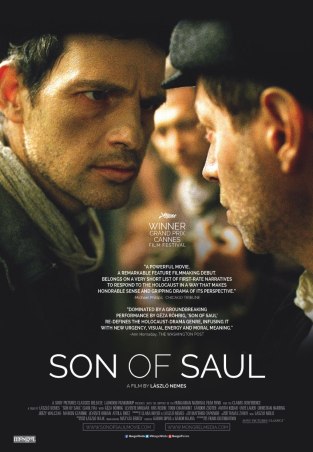
 One of the most highly praised films of 2015 came from 39 year-old Hungarian filmmaker László Nemes. He wrote and directed “Son of Saul”, a Holocaust drama set within the walls of the Auschwitz concentration camp. This certainly isn’t a new topic, but critics praised Nemes for his unique, honest, and unsentimental approach to it. The film has also won a slew of awards including several big prizes at Cannes, a Golden Globe, and it is the front runner for the Best Foreign Language Oscar. The great thing is “Son of Saul” is worthy of its praise.
Doing a film about the Holocaust requires a certain level of responsibility because reactions will undoubtedly vary depending on how you approach the subject matter. I remember criticisms surrounding 1997’s “Life is Beautiful”. Some took offense perceiving the film as too jokey and whimsical. While I completely disagree with that sentiment, it goes to show the range of reactions audiences often have even towards to most earnest of efforts.
Nemes doesn’t dodge these potential obstacles and he doesn’t take shortcuts. He firmly tackles the Holocaust with confidence both in the pull of his story and in the truth in his depiction. Nemes was inspired by a book titled “The Scrolls of Auschwitz”. It was a collection of true stories about Sonderkommandos – Jewish prisoners in concentration camps who were forced to dispose of those murdered in gas chambers and then executed themselves after a few months of work. Nemes and co-writer Clara Royer worked for five years on the script collaborating with historians and struggling to find financiers.
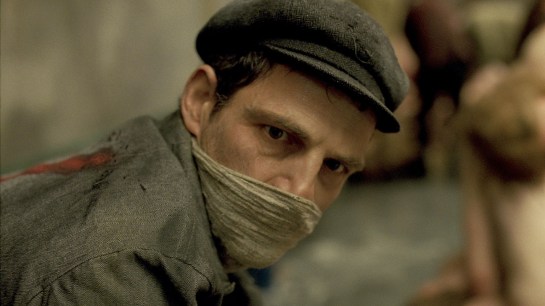
Hungarian poet Géza Röhrig (who had not acted since television 25 years ago) plays the lead character Saul Ausländer. It’s 1944 where Saul works as a Sonderkommando in Auschwitz. While clearing out gassed bodies of fellow Jews he discovers his son among the murdered. Nazi doctors designate the boy’s body for autopsy, but Saul wants a proper Jewish burial for his son. Obvious obstacles make that difficult. There is the brutal authority of his Nazi captors which is constantly in the background. He’s also caught in the middle of a brewing uprising which makes finding help among fellow prisoners difficult.
Röhrig’s performance is quiet but powerful. We know little about his character. No time is give to his history or backstory. But we do see Saul as a shell of a man. He is someone who has seen the very worst and it has left him emotionally cauterized. It is the sight of his son that stirs up something of his former self. It is that devastating discovery that reveals a small spark of life.
Nemes takes us along with Saul in a near moment-to-moment telling of his story. There is rarely a time lapse. His visual technique is clever, but it isn’t the easiest to get comfortable with. We spend the vast majority of the film looking at things through an over-the-shoulder third person perspective. We are literally right behind Saul. The camera will occasionally rotate around to focus in Röhrig’s intensely expressive face. We also get a few shots that zoom in to spotlight something that has grabbed Saul’s attention. But for the most part we are right on his back peering over his shoulder. It can offer some truly harrowing perspectives, but it can also be terribly disorienting especially when scenes intensify. This is clearly by design, but there were instances where I wanted the camera to just be still.
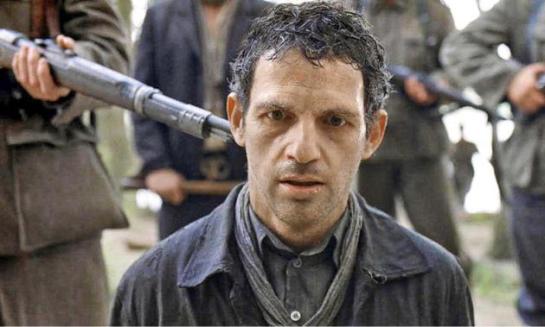
Thankfully the strengths of the visual presentation heavily outweigh the weaknesses. For example our vision is often hindered by our position. And since our line of sight is often strictly joined to Saul’s, we are often spared clear looks at the gruesome horrors taking place around us.
Nemes and cinematographer Matyas Erdely sometimes blur the outside boundaries of the shot which represent our unfocused view from the corners of our eyes. There is also a heavy dependence on sound. Tamás Zányi’s sound design is impeccable and plays a crucial part in deciphering what is going on around us. These techniques require our senses to play a major role in interpretation. We take the glimpses and sounds and paint our own mental depictions which can be challenging but also uniquely rewarding.
The approach the film uses frees it from many labels often cast upon Holocaust movies. It doesn’t sadistically wallow in misery. It doesn’t bludgeon the audience to death with the grisly horrors of the atrocities. At the same time it doesn’t soften its emotional punch in the slightest. “Son of Saul” is a difficult, harrowing, and exhausting film to endure – claustrophobic and psychological. But it’s also an intimate and gripping experience and an extraordinary feature film debut from László Nemes. What he has created is breathtaking and you won’t shake off its effects anytime soon.
VERDICT – 4.5 STARS













 Oh how I love Wes Anderson movies. When you watch one there is no denying he is the man behind what you’re seeing. “Moonrise Kingdom” is a true gem in a filmography filled with gems. So many of Anderson’s favorites fill out the wonderful cast and the humor is the perfect measure of silly and quirky. And as with every Anderson picture there is a beautiful, warm heart at the center.






 Keith & the Movies