The 50 Best Films of the Decade (So Far) #50 – #41

50 Best

The decade is a little over half way gone so I thought it would be fun to look back at the first five years and see what movies have stood out the most. It is also a good chance to see how the films stand up against each other as well as how they have stood up with the passing of time. Today we are starting off with #50 – #41. Let’s get going…

#50 – “Frances Ha” (2013)

FRANCES

The one film that perfectly encapsulates all that makes a Noah Baumbach movie special can be found in “Frances Ha”. Deliciously quirky and slyly intelligent, “Frances Ha” features Baumbach’s muse Greta Gerwig at her absolute best. Stylish black and white cinematography is an added treat.

#49 – “Contagion” (2011)
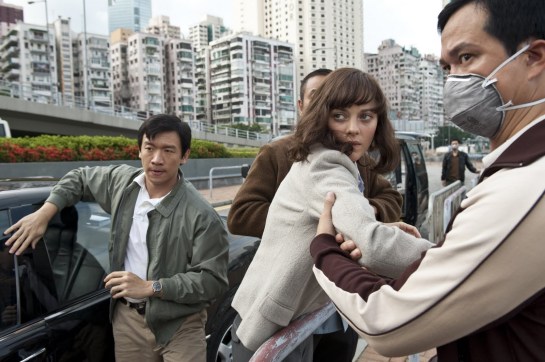
CONTAGION

I’m a bit of a sucker for medical/virus thrillers and “Contagion” is one of my favorites. Dismissed by many as flimsy, I immediately was swept away by director Steven Soderbergh’s nervous, paranoid take on a worldwide viral outbreak. A great ensemble cast and truly intense pacing. “Contagion” is an underappreciated film.

#48 – “Calvary” (2014)
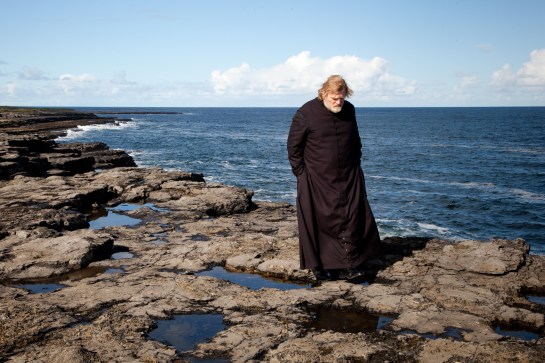
CALVARY

There is such an intensity boiling under the surface of every single scene of “Calvary”. John Michael McDonagh writes and directs this story of a troubled priest (played perfectly by the always magnificent Brendan Gleeson) and the dark situation he finds himself in. A wonderful supporting cast flesh out an assortment of despicable characters at the core of this uncomfortable but hypnotic picture.

#47 – “127 Hours” (2010)

127 hours

The incredible true story of Aron Ralston was ripe for a movie adaptation but only with the right people involved. Danny Boyle and James Franco proved to be the right people. Franco gives a truly eye-opening performance and Boyle’s energetic visual style is a perfect fit. Also features a wonderful soundtrack.

#46 – “Alamar” (2010)
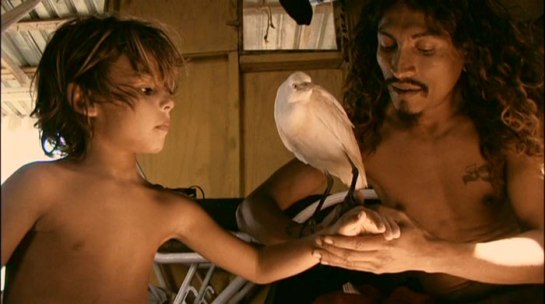
ALAMAR

With its small 73 minute package, “Alamar (To the Sea)” says more about a father/son relationship than most ‘bigger’ films ever accomplish. That relationship mixed with the fascinating depiction of life on the Banco Chinchorro coral reef makes for a truly beautiful experience. “Alamar” didn’t get much attention but it still deserves an audience.

#45 – “The Avengers” (2012)
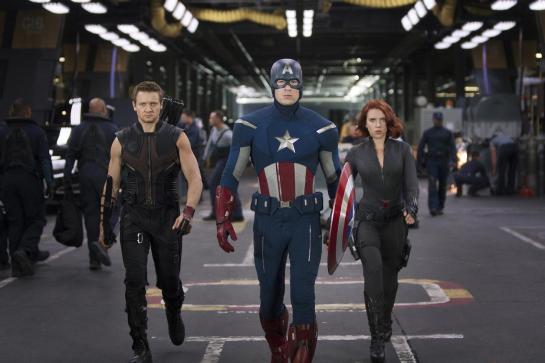
AVENGERS

Speaking of bigger movies, there were so many ways “The Avengers” could have failed. It was the project that the entire Marvel Cinematic Universe was heading towards. With so many links to other films and so many characters to juggle, this could have been a disaster. Instead Joss Whedon created an incredibly fun superhero concoction that was better than most people ever expected.

#44 – “The Kid with a Bike” (2012)
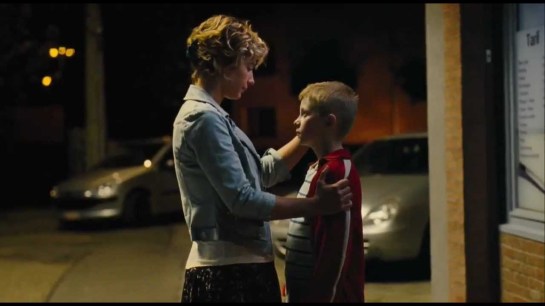
KID BIKE

Jean-Pierre and Luc Dardenne have established themselves as naturalistic filmmakers who examine the human experience from the most honest of perspectives. “The Kid with a Bike” is a brilliant example. It’s a story of a troubled 12-year old boy who is let down by the most important people in his life. But grace comes from an unexpected source. It’s a heartbreaking yet beautiful drama.

#43 – “Phoenix” (2015)
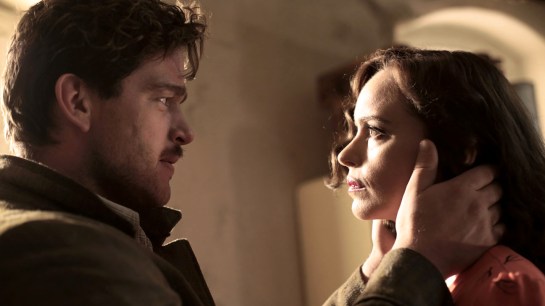
PHOENIX

While watching “Phoenix” you can’t help but notice the absurdity of what you’re seeing. Yet at the same time the story is so keenly written and heart-shattering that you can’t help but invest in it. This stinging German drama features three characters brought to life through three superb performances. And then there is the crushing ending – one of the most powerful I have seen in years.

#42 – “Skyfall” (2012)
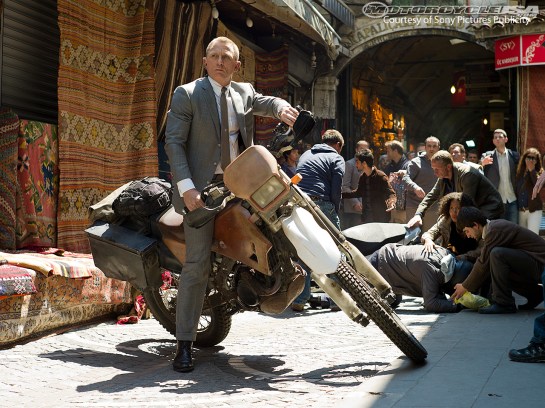
SKYFALL

Daniel Craig brought me into the James Bond franchise. 007’s adventures became important to me starting with “Casino Royale”, but “Skyfall” may be his very best so far. Everything about it hit its mark. Great action, fun villain, and a delightful use of its many entertaining side characters. This was Bond done right.

#41 – “Beasts of No Nation” (2015)

BEASTS

Great movies aren’t always easy to watch especially when dealing with disturbing subject matter. Such is the case with Cary Fukunaga’s intense “Beasts of No Nation”. It is a sometimes brutal exploration of child soldiering that visualizes it through the eyes of a young boy. Idris Elba gives the best performance of his career and young Abraham Attah is something to behold.

That’s it for now. Follow along and look for #40-#31 tomorrow. And be sure to share your thoughts in the comments section below.
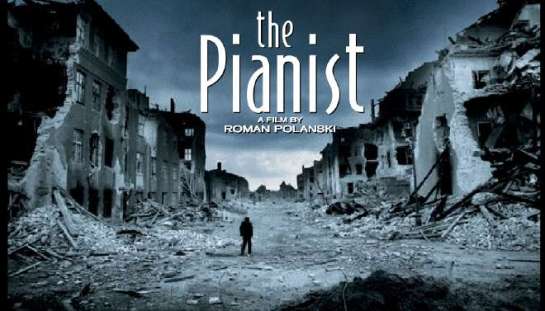
REVIEW: “The Pianist”

PIANIST poster

One of the things that fascinates me about “The Pianist” is how deeply connected it is to the true life experiences of its director. Roman Polanski has had a colorful life – one which has been severely tarnished by some deplorable behavior. But his childhood is an incredible story of horror, loss, and survival. Polanski and his family were crammed into the Kraków Ghetto along with 15,000 other Jews during the Nazi’s ‘purification’ of Poland.

As a young boy he watched as his father was marched away to a Nazi work camp. His mother was shipped to Auschwitz where she was among the 1.1 million Jews murdered there. Young Polanski managed to escape the Ghetto and survived by living in a barn until the war ended. He would be reunited with his father, but the scars left from the Holocaust would never leave and they heavily influenced much of what we see in “The Pianist”.

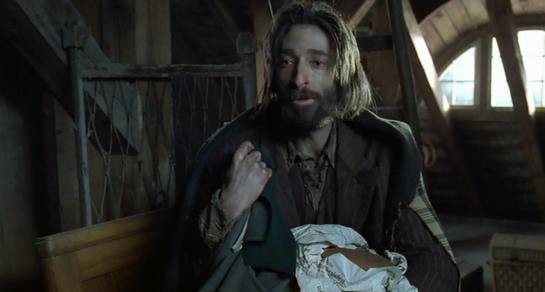
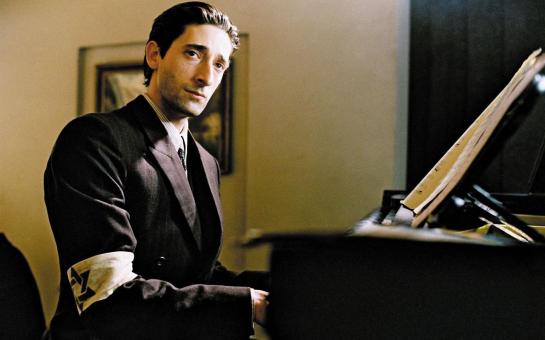
The film is directly based on the autobiography of Polish-Jewish pianist Wladyslaw Szpilman. Like Polanski, Szpilman was seperated from his family during the Nazi occupation and found himself desperately struggling to survive. Adrien Brody plays Szpilman and gives a truly revelatory performance that garnered critical praise and earned him an Academy Award. He is in nearly every frame and the depth and range of emotion he manages to convey is staggering.

Pianist1

We first meet Wladyslaw Szpilman in 1939 where he plays piano for a Warsaw radio station. He is there when the Nazis invade and eventually takeover Warsaw. Like many at the time, Wladyslaw and his family at first underestimate the gravity of what has happened, but as the Nazi grip tightens the reality becomes clear. Jews are stripped of their jobs and forced from their homes into the overcrowded Warsaw Ghetto. Thousands of Jews die of starvation, disease, and from all sorts of Nazi brutality.

The Szpilman’s try to find normalcy among the hardships but things only get worse. They are among the thousands of Jew rounded up to be sent to the Treblinka extermination camp. An unexpected act finds Wladyslaw seperated from his family and on his own. The story becomes about survival against the grossest inhumanity.  But at the same time Polanski and writer Ronald Harwood go to great lengths to show actual humanity in many unexpected forms.

Pianist2

One of the most a compelling characteristics of Wladyslaw is that he is no hero. He is no soldier filled with courage and fight. It shines so brightly through Brody’s performance. The frailty and desperation of his character is seen clearer through each new stage of adversity he faces. But even more we see it through his means of survival. There is nothing within Wladyslaw, aside from his will to live, that keeps him alive. Instead it is the dangerous and sacrificial acts of people he meets that helps him along. Every step of the way Wladyslaw’s survival hinges on the compassion and heroism of others. It is an important story thread and the only true glimmers of light in an otherwise dark story.

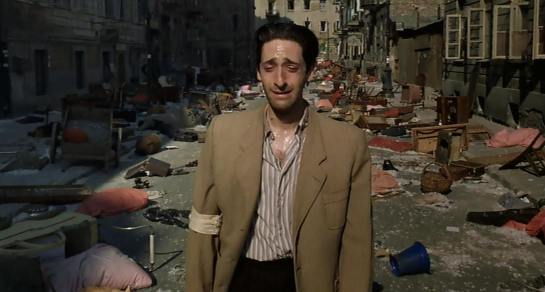
Everything about “The Pianist” sets it apart as a substantial work and not enough can be said about Polanski’s obvious passion for his subject. Consider the stunning work of his cinematographer Pawel Edelman. He never wastes a scene and many are cleverly shot from Wladyslaw’s perspective. Others wonderfully emphasize the film’s brilliant production design. For Polanski accurately recreating the city was a priority as was putting a  special emphasis on detail. Whether it’s in the small space of an apartment or the broader images of a devastated city. The keen detail stands out.

PIANIST3

Polanski’s own experiences allow him to bring a steady seriousness, sincerity, and reverence to “The Pianist”. His vision isn’t hazed by lack of knowledge or understanding. But at the same time he sticks closely to the true story of Wladyslaw Szpilman. Even the ending (which some have called contrived) lines up with Szpilman’s experience. Those two components, along with Brody’s unforgettable performance, play a big part in my reaction to “The Pianist”. I see it as a master work on humanity vs. inhumanity, on the resilience and mercy of art, and on the personal horrors brought on by one of the world’s darkest events.

Some critics have complained that “The Pianist” isn’t “Schindler’s List”. Some seemed to want weightier emotion. Some complained that it does a disservice to the larger number of persecuted Jews due to its narrow focus on one man. I can’t line up with any of those criticisms. For me Polanski’s vision is honest, unflinching, and strips away any sentimentality. While it remains hard to embrace Polanski as a man, “The Pianist” makes it easier to embrace him as an artist.

VERDICT – 5 STARS

5 STARSs

5STAR K&M

2016 Blind Spot Series: “Paths of Glory”

PATHS POSTER

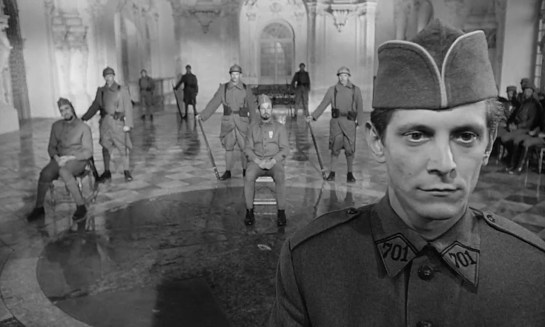
It was 1957’s “Paths of Glory” that first placed Stanley Kubrick among cinema’s prominent directors. It was his first true commercial success and critics praised it for its bold and unflinching anti-war message. But not everyone loved it. In a very crafty way the film would be banned in France until 1975 due to its depiction of the French military and government. In some ways you could say that is a testament to the power of its message.

The film is based on a 1935 novel by Humphrey Cobbs. MGM heads were impressed with Kubrick’s previous film “The Killing”so they hired him to write and direct a film which would later become “Paths of Glory”. But the project was almost derailed by MGM’s reluctance to finance another war picture. That changed when new heads were brought in and Kubrick was able to entice Kurt Douglas to star in the film. He and his production buddy James B. Harris were then given the green light.

PATHS1

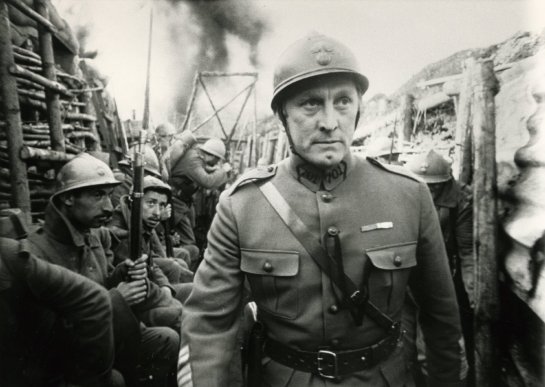
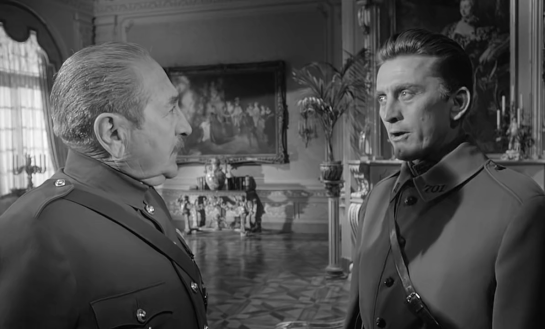
The story is tight and straightforward. It’s about a French military unit led by Colonel Dax (Kirk Douglas) who are given an impossible mission. General Mireau (George Macready) is offered a nice promotion by his superior General Broulard (Adolphe Menjou) in exchange for taking a German fortification known as the Anthill. That would require Mireau’s men led by Colonel Dax to sustain substantial casualties.

There is a great early scene where Mireau weighs the loss of so many soldiers against the glory of a new promotion. In a cold and callous conversation he and Broulard estimate as many as 55 percent of Dax’s men would lose their lives. For Mireau it’s a worthy risk especially when the personal gain is so significant. He agrees to the mission knowing the costs but also aware of the probability of failure.

PATHS2

I won’t give too much away, but suffice it to say the mission goes poorly and a livid General Mireau takes action to protect his reputation and his promotion. Colonel Dax who has fought for his men on the battlefield now finds himself fighting for them in a kangaroo court of French military officers hungry to make examples. In many ways this battle is more appalling and vicious than the one on the battlefields. In one scene a general causally reasons “One way to maintain discipline is to shoot a man now and then.”

There are several different ways this movie could have went but Kubrick deserve credit for not caving in to a more conventional approach. I think I have been wired by many contemporary filmmakers to expect the routine and the predictable. Here Kubrick stays true to the film’s intent by not wimping out and abandoning the story’s sharp and pointed commentary. To have done differently would have dulled the edge and made this a much lesser picture.

PATH3

The film also excels thanks to Kubrick’s visual choices particularly his decision to shoot in black and white. It is perfect considering the harshness of the material and the morally murky waters we navigate through. There are also a number of scenes that stand out due to Kubrick’s cameras. The well known battle sequence was shot with six cameras placed around a huge war-torn battlefield. It offers up one of the most intensely arresting war scenes you’ll see.

The ending is a bit of a strange shift that may at first catch you off guard. It features a young German woman singing a song to Dax’s men in a small club (the woman is Christiane Harlan who later married Kubrick). Within this scene is a subtle shift in mood that works perfectly as a conclusion to this story. It’s a satisfying fit with Kubrick’s fluid and economic storytelling and it ends this powerful film with a poignant prick of the heart.

VERDICT – 4 STARS

4 Stars

5 Phenomenal Movie Songs from the 80s

PHENOM 5

It could be said of the 1980s that it was the best time for pop songs in the movies. Popular, playful, and sometimes just goofy, so many huge music hits in the 80s came from movie soundtracks and found massive popularity via radio and music videos. Today’s Phenomenal 5 is focusing on them. Now these may not be the “best” songs in the literal sense, but they were so much fun and such a key part of their movie during that time. To narrow it down a bit I’m mainly focusing on the very biggest songs. Now with so many to consider I wouldn’t call this the definitive list. Still, I have no problem calling these five movie songs from the 80s absolutely phenomenal.

#5 – (I’ve Had) The Time of My Life (“Dirty Dancing”)

Without question, one of the biggest crazes of the 80s surrounded “Dirty Dancing”. In 1987 it blew up the box office. Its soundtrack was equally popular releasing TWO multi-platinum albums. The music was led by (I’ve Had) The Time of My Life and it wasn’t just young girls who were into it. Women of all ages were singing along with Bill Medley and Jennifer Warnes. The song would go on to win a Grammy, a Golden Globe, and an Academy Award.

#4 – Ghostbusters (“Ghostbusters”)

When Ray Parker, Jr. agreed to do the theme for “Ghostbusters” he wasn’t given much time. Short on ideas, he saw a late night infomercial which inspired the immensely popular Ghostbusters theme. It is an incredibly playful song which would reach #1 on Billboard’s charts and be nominated for an Oscar. It’s probably best known for its full blown 80s-styled video which was directed by Ivan Reitman. It featured loads of cameos, loads of cheese, and loads of good silly fun.

#3 – Danger Zone (“Top Gun”)

I remember sitting at home in 1986 when the video for Danger Zone came on MTV. I had seen it before, but I had something else in mind. I called my dad into the room. He watched the video and that afternoon we were in the theater watching “Top Gun”. Mission accomplished. Danger Zone was such a cool and energetic song from Kenny Loggins. And while it never received any major award nominations, its amazing how often it still pops up on television, in commercials, in trailers, and even in other films.

#2 – Flashdance – What a Feeling (“Flashdance”)

The accolades for Irene Cara’s fantastic “Flashdance” theme song are most impressive. The song topped twelve global charts. It won the Oscar for Best Original Song. It won a Golden Globe. It won Cara the Grammy for Best Female Pop Vocal Performance. “Flashdance” was a box office hit despite a generally negative reception from critics. But over the years the music may be what people remember more than the movie. The soundtrack released several hit songs but none better than this one.

#1 – Footloose (“Footloose”)

It was February 17, 1984 and Kevin Norwood Bacon was about to see his career explode. That was day “Footloose” hit theaters. The film and Bacon garnered a lot of attention. But so did the soundtrack, particularly the theme song from Kenny Loggins. The song became legendary among 80s movie music and the video endeared Kevin Bacon to a generation just as much as the movie did. It hit #1 on the charts, was nominated for an Oscar, and won the Grammy for Song of the Year. I still start tapping my toe every time I hear it.

So there are just a few of the many great movie songs from the 80s. So many others come to mind – Eye of the Tiger, The Power of Love, Don’t You Forget About Me. What else did I miss? Please share your thoughts in the comments section below.
REVIEW: “The Maze Runner”

MAZE poster

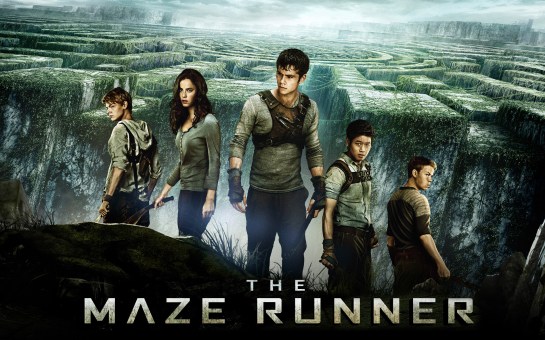
Fear not my friends, teen dystopian science fiction is still alive and well! Don’t believe me? Just check out the laundry list of films that fit the description. As we speak “The Hunger Games” and “Divergence” are two franchises currently going (or recently ended) that are based on popular teen books. Add to that list “The Maze Runner”, the first installment of the film adaptations of James Dashner’s popular 2009 book series.

“The Maze Runner” serves as one big introduction to the characters, the setting, and the circumstances. It functions specifically as the opening of a series and it does little to expand its identity beyond that. First time director Wes Ball follows a pretty bland blueprint in establishing his world. There are several cool elements at work and the entire premise is pretty intriguing. There are also several common shortcomings that plaque many of these types of films.

MAZE1

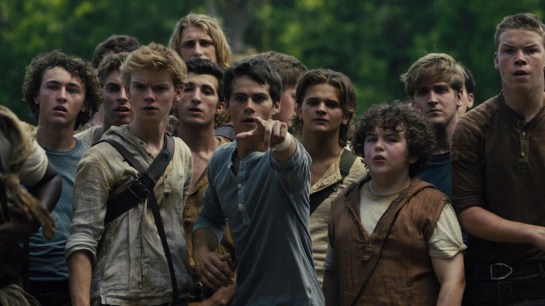
The story begins with a 16-year old boy (Dylan O’Brien) suddenly waking up in a moving service elevator. He is met at the top by a group of boys in a place called the Glade – a big grassy area completely surrounded by huge stone walls. The boy (who we later find out is named Thomas) doesn’t know who he is or how he got into the elevator. And obviously he has no idea what kind of world he has awoken to.

The boys of the Glade have built a social structure filled with several of the usually character types. Thomas and the audience learn about the world through scene after scene of exposition. For a while it seems like each character he meets has to stop a lay out another explanation of what this group of people does or of what that particular threat is. Very little is allowed to happen organically in the first half of the film.

But even amid some pretty generic table setting an intriguing  foundation is laid and the second half of the film builds upon it. The walls around the Glade actually lead to a giant maze filled with a number of dangers. The group has given into the idea that they will never make it out of the Glade. Thomas defies that reasoning and sparks a movement to learn the maze and escape their captivity. But what is actually looming behind the maze? Don’t worry, you’ll have three whole movies to find out.

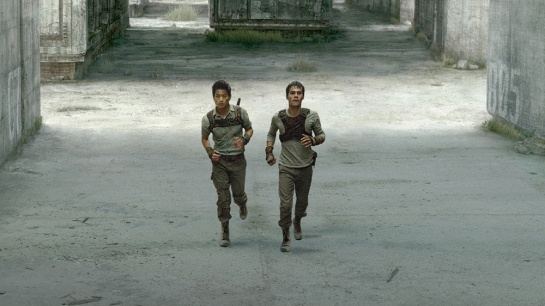
THE MAZE RUNNER Minho (Ki Hong Lee, left) and Thomas (Dylan O'Brien, right) search for a way out of the maze. TM and © 2014 Twentieth Century Fox Film Corporation.  All Rights Reserved.  Not for sale or duplication.

The suspense builds up pretty good in the second half and I was genuinely hungry to get some hints as to what was going on. Unfortunately “The Maze Runner” offers up very little in terms of answers. There also isn’t a big cliffhanger high. Instead it simply ends. It also leaves you with plenty of plot holes to ponder. I’m not talking about obvious storylines that we can expect to be answered in future installments. These are portions of the story that just doesn’t make sense.

You could point to other storytelling deficiencies and you could pick apart the performances of some of the young cast. Yet despite its pretty glaring flaws, “The Maze Runner” managed to do one of the most important things – it left me interested in seeing where the next film was going. I did find enough here to get me involved and I did find myself curious about the secrets being kept. And there are a few unorthodox angles that I did find pleasantly surprising. These are reasons I can slightly recommend “The Maze Runner”. At the same time it isn’t a film I’m anxious to see again and I can certainly understand why others would be even less enthusiastic.

VERDICT – 3 STARS

3 Stars

REVIEW: “Hiroshima Mon Amour” 

Hiroshima2

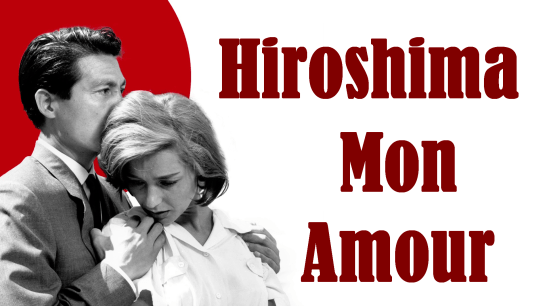
There is an almost disorienting effect to the first fifteen minutes or so of Alain Resnais’ “Hiroshima Mon Amour”. A man and a women, their faces obscured by Resnais’ focus on their deep embrace, share an intimate moment while their skin is covered by dust and ash. The romantic but disturbingly metaphoric shot is intermittently broken up by troubling newsreel footage showing the effects of the nuclear bomb on Hiroshima, particularly to its people. A coded, hypnotic back-and-forth between the man and woman speak poetically of memory and denial.

This opening, like the film itself, has been pondered and studied since the movie opened in 1959. It was Resnais’ debut feature and is considered a pivotal film in the French New Wave. Resnais was lauded by his contemporaries for his unique approach highlighted by his gutsy subject matter and nonlinear storytelling. Marguerite Duras was instrumental. She wrote the screenplay and would earn an Academy Award nomination for her work.

HIRO1

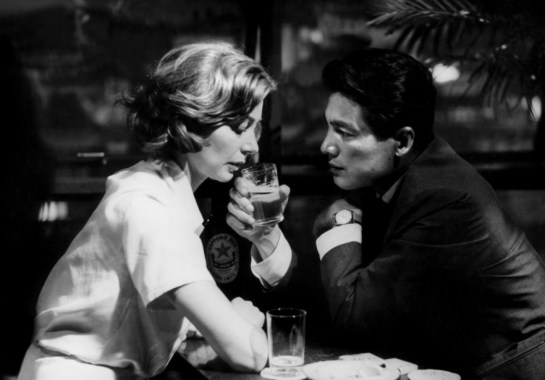
The story basically revolves around a continued conversation broken up over a 36 hour span in Hiroshima and takes place twelve years after the war. A French actress filming a movie about peace has an overnight fling with a Japanese architect. Known only to us as He and She, The two have lives deeply influenced by the bombing of Hiroshima. His is more literal while hers is metaphorical. They embark on an extended conversation that unveils deep scars from the past and desperation and uncertainty of the future.

To divulge any more details about the plot would be doing a disservice to how Resnais and Duras intend for their story to unfold. You could call it an emotional contemplation but it turns from that and becomes a fascinating character examination. Memories are shown through quick fragmented flashbacks – a clever device which represents the resurfacing of suppressed pieces of information. And the nonlinear approach challenges us to piece together the bits of personal history we are fed.

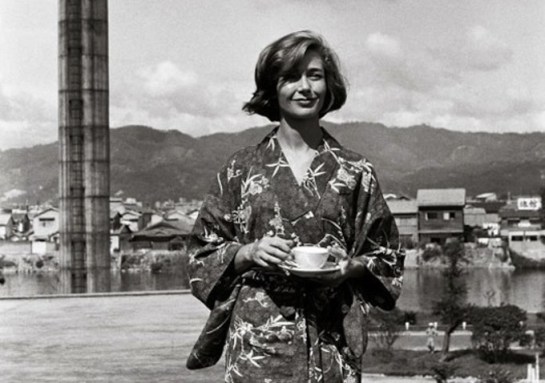
The true centerpiece of the experience is Emmanuelle Riva. You may remember her from her Oscar nominated performance in Michael Haneke’s “Amour”. Riva immediately becomes a mesmerizing figure. Each movement and expression down to the most precise nuance hint at her character’s burdened soul. Even smiles feel like carefully constructed facades. Riva channels a genuine melancholy that intensifies with each new bit of information. She sells it as coming from a place considerably deeper than the “dubious morals” she speaks of at one point in the film.

HIRO2

Resnais’ camera loves Riva and it concentrates on her abilities to tell us so much often without a word of dialogue. Eiji Okada plays ‘He’ who often serves as our eyes. Like us, his eyes are constantly watching this mysterious woman with fascination and curiosity. The relationship between the two struggles to find sure footing and Resnais emphasizes the point of the past intruding on the present. It’s an everpresent them throughout the entire picture.

“Hiroshima Mon Amour” became a highlight of Left Bank filmmaking and a showcase of the French New Wave’s bold creative direction. It’s interesting to note that Alain Resnais initially set out to make a documentary and that original vision influences the early parts of the film. But from there it blossoms into a poignant character drama that presents its story by its own unique set of rules. It can be perplexing out of the gate, but once you are in tune with what Resnais is doing it becomes a mesmerizing cinematic experience.

VERDICT – 4.5 STARS

4.5 STARS