5 Phenomenal Hitchcock Scenes (that aren’t from “Psycho”)

PHENOM 5

Alfred Hitchcock was a cinematic master. We can all agree on that. Look back on his incredible filmography and you’re sure to find a number of classic films and unforgettable scenes. That’s what today’s Phenomenal 5 is examining – great Hitchcock scenes. Now when starting this talk there is one that will automatically come to everyone’s mind – the shower scene from “Psycho”. For that reason I’m leaving it off. There are still so many superb scenes to choose from so I wouldn’t call this the definitive list. But there is no denying these five Hitchcock scenes are certainly phenomenal. Oh, and be warned, since these are scenes within the movies there are POTENTIAL SPOILERS.

#5 – The Gas Station Scene – “The Birds”

You could probably pick out five or six scenes from Hitchcock’s 1963 horror thriller “The Birds” and each would deserve a spot on this list. I’m going to stay away from a couple of obvious choices and go with the spectacular gas station scene. Let me just put it this way, birds attack gas station, gas pours out of nozzle, man lights match near gas, BOOM!

#4 – The Murder? – “Dial M for Murder”

Why would anyone want to murder Grace Kelly – the beautiful, elegant, entrancing Grace Kelly? Ray Milland wanted to in Hitch’s 1954 crime thriller “Dial M for Murder”. There are so many dramatic threads that lead to this incredible murder scene. Hitchcock’s camera and Rudi Fehr’s strategic editing makes it one of the director’s most intense and satisfying sequences.

#3 – Intersection & Cropduster – “North By Northwest”

This particular scene from 1959’s “North By Northwest” could be broken down into two different but equally glorious parts. The first features Cary Grant alone at an isolated crossroads with farmland all around. The mystery behind the scene is enhanced by Hitchcock’s superb camera work. But then it transitions into one of Hitch’s most famous scenes – the cropduster attack. It’s equally brilliant.

#2 – The Carousel – “Strangers on a Train”

Hitchcock’s 1951 psychological thriller “Strangers on a Train” is a testament to the filmmaker’s incredible talent at creating tension and carrying it through his entire film. In this particular case it all comes to a head when our two main characters have a showdown on (of all things) a merry-go-round. The scene offers one of Hitchcock’s most visually thrilling moments.

#1 – Thorwald Returns – “Rear Window”

Here we are again, talking about great tension and Grace Kelly in trouble. Such is the case in this superb scene from 1954’s “Rear Window”, my favorite of Hitchcock’s films. You know it’s not going to go well the very moment Kelly breaks into the mysterious Mr. Thorwald’s apartment. A wheelchair bound Jimmy Stewart can only watch from his apartment window as Thorwald returns to find Kelly snooping where she doesn’t belong. And that glance Raymond Burr gives. Priceless.

So there are my choices for the best Hitchcock scenes that didn’t come from “Psycho”. See any you disagree with? How about ones that would have made your list? Be sure to share your thoughts in the comments section below.

K&M RETRO REVIEW: “Rambo III”

rambo

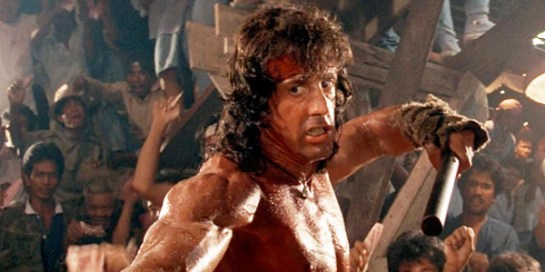
“Rambo III” holds a very distinguished position within my movie history. It has the honor of being the first R-rated movie I watched in the theater. It was 1988 and I was 16 years-old. My uncle was down for the weekend and offered to take me to a movie. This was a big deal because there was no theater in my small town and going to the movies was a real treat. Being a huge fan of 80s action movie icons Schwarzenegger and Stallone, naturally I went with “Rambo III” when asked to choose. To my surprise my uncle agreed and the rest is meaningless movie history.

For me the Rambo franchise ended after “Rambo III”. Sylvester Stallone attempted to bring it back in 2008 with the profoundly mediocre and generically titled “Rambo”, but it lacked the feel and (yes I’m going to say it) the charm of the original three flicks. For me “Rambo III” is a satisfying  way to finish a testosterone-fueled, biceps-flexing, action-packed exercise that fits nicely into the over-the-top 80s action catalog.

RAMBO2

The Rambo series will never find its way onto drama school curriculums, but by this time Stallone was pretty in tune with what his character needed. The screenplay (co-written by Stallone) gives us a more grounded John Rambo (aside from the one-man-army awesomeness of course) and Stallone isn’t asked to stretch beyond the bounds of his acting abilities. For example, gone are the schmaltzy end of the movie theatrics he gives us in the first two films. Well meaning but laughably bad scenes and slightly worse acting.

But that doesn’t mean the film is free of cheese. We get plenty of it especially from Richard Crenna who delivers several lines dripping with Velvetta. My personal favorite: (speaking about Rambo) “God would have mercy. He won’t”. This goes hand-in-hand with the film’s attempt to inject a touch of humor. It tries not to take itself too seriously as evident by Rambo’s numerous jokey one-liners, some that work, some not so much.

The film starts by giving us a disillusioned Rambo who has finally found a degree of peace working at a Buddhist monastery in Thailand. His mentor and one true friend Colonel Traitman (Crenna) finds him and tries to recruit Rambo to join him on a special mission. Rooted in the politics of 1988, the mission is to deliver supplies to rebels fighting the Soviets in Afghanistan. Rambo declines, Trautman goes anyway and ends up captured by a brutal Soviet officer named Zaysen (Marc de Jonge). Rambo gets word and sets out on a solo mission against all odds to rescue his friend.

RAMBO22

This bromance takes Rambo to the toughest terrain he has faced. Filmed mostly in Israel and a bit in Arizona, the locations offer themselves up to a believable setting and some great action sequences. This also may be Stallone’s most physically demanding performance of the series. Sly runs, jumps, climbs, fights, and unleashes an insane amount of carnage. In several ways he tries to outdo the second film – bigger stunts and bigger action. For me it absolutely works.

“Rambo III” was hammered hard by critics but still made good money at the box office. I can see some of the criticisms now better than before. It is loud, violent, and mindless. Also the film doesn’t have an ounce of strategy or subtlety with its political messaging. Perhaps it’s the jaws of nostalgia tightly clamped on my perspective, but I still have a ton of fun with this film. It’s lighter, the action is energetic, and the cheese adds to the experience. I was the target audience back in 1988 and I had a blast with “Rambo III”. Maybe the ability to still look at it through that lens enables me to appreciate it for exactly what it is.

VERDICT – 4 STARS

4 Stars

YOUR VOICES: On Your Favorite Movie Score

your-voices

Your Voices is a simple concept created to encourage conversation and opinions between movie lovers. It works like this: I throw out a certain topic or question and I’ll take time to make my case or share my opinions. Then it’s time for Your Voices. Head to the comments section and let fellow readers and moviegoers know your thoughts on the topic for that day.

Music has played such a memorable part in so many movies. Just think about how many movies you can identify just by hearing their theme music. Or think about the times when music has been so perfectly in tune with the tone of a film. For years great composers have made names for themselves enhancing film experiences with the original music they create. And when you think about it how do you pick a favorite?

MOHICANS POSTER

When thinking about my favorite movie score so many wonderful ones popped into my head, but for me there is a clear number one. Truly great scores provoke a response while also carefully serving its movie or particular scene. For me they also transcend the film setting. I listen to and admire them completely on their own. The score from 1992’s  “The Last of the Mohicans” does all of those things to perfection.

Trevor Jones was the artist behind this masterfully diverse soundtrack. Funny thing is at the last minute director Michael Mann changed the score from electronic to orchestra. So not only did Jones create gorgeous and stimulating music, he did so with several time limitations in place. Randy Edelman was brought in to score a handful of smaller scenes which ridiculously disqualified it from Oscars contention. Nevertheless the two created something that is just as important to the film as is the great script, direction, and performances.

Whether it is the soft emotion of “The Glade Part II”, the delicate elegance of “Cora” (which was actually played at my wedding), or the pulse-pounding energy of “Fort Battle”, the pieces of music from “The Last of the Mohicans” are so strikingly unique. To go further, no movie music has ever stuck with me more. I’m not talking simply in terms of recognition. I mean music that has struck an emotional chord and continues to this day. That’s why this is an easy choice for me. But what about you?

YOUR VOICES: What is your favorite movie score?

So let Your Voices be heard. What is your favorite movie score? Is their one that holds a special place in your heart? Is it too difficult to narrow it down? Please share Your Voices on today’s question. I would love to hear from you in the comments section below.
REVIEW: “Me and Earl and the Dying Girl”

ME EARL POSTER

For several years now the independent movie scene has offered up some of the better and more intelligent teen movies in ages. Mainstream studios continue to milk every current fad as evident by the steady flow of teen dystopian flicks and rocks-for-brains raunchy comedies. But independent cinema continues to provide a platform for unique voices and perspectives.

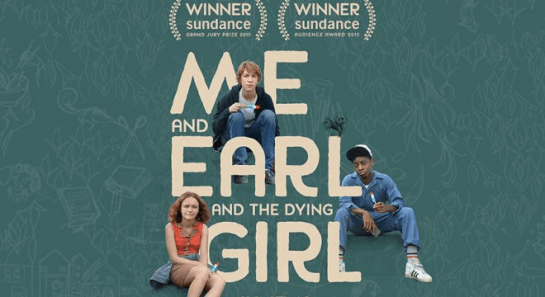
A more recent example comes in the form of the awkwardly titled, conjuction-heavy “Me and Earl and the Dying Girl”. It’s a film that straddles so many fine lines. At different points it flirts with being too whimsical, too weepy, too self-aware, too hip, or too cliché. Miraculously it balances itself well throughout its journey from breezy, stylistic comedy to sensitive, bittersweet drama.

EARL1

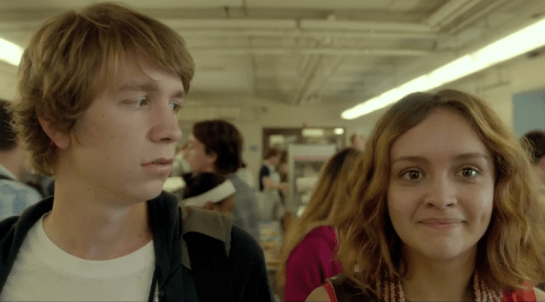
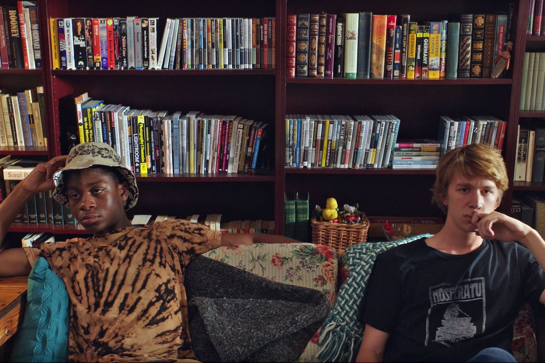
Alfonso Gomez-Rejon directs the film which is based on Jesse Andrews debut novel (Andrews also wrote the screenplay). Thomas Mann plays Greg, the ‘Me’ in the story. He is a demure and self-loathing high school senior who manages his outcast status by subtly mingling with every social group at school but never truly connecting with any of them. His one friend is the brusque and outspoken Earl (RJ Cyler), although Greg doesn’t call him a friend. He’s a “co-worker”. The two spend their time making crappy short films which are parodies of all kinds of classic movies.

The “Dying Girl” is Rachel (quietly yet keenly played by Olivia Cook) who has just been diagnosed with leukemia. Greg’s insistent mother (Connie Britton) forces him to hang out with Rachel which eventually sparks the reluctant friendship at the center of this film. The relationship becomes therapeutic for both of them providing a refuge from each of their very different personal ills. We’re tossed a curveball or two which keeps this from being just another teen cancer picture even after the story takes a slightly more serious tone.

EARL2

But unlike the good but hankie-heavier “The Fault in Our Stars”, this movie relies on its sense of humor and attitude. One of its strengths is how it both highlights and irreverently squashes all of our conversational timidity and awkwardness when it comes to such weighty subjects as cancer. We get conversations rich with witty back-and-forths and uncomfortable honesty.

As hard as it tries to be unique and subversive, certain elements of it will undoubtedly feel familiar. And sometimes you can sense it trying hard to be stylish and to show off its pop culture coolness. But Gomez-Rejon deserves a ton of credit. He avoids so many of the trappings that would make this an easy film to dismiss. Instead he gives us something that is genuinely witty while never compromising its earnestness. It’s a story with a lot to say about the value of true friendship and it’s not ashamed to tackle a difficult subject in its own personal way. I kinda like that boldness.

VERDICT – 4 STARS

4 Stars

2016 Blind Spot Series : “The Killing”

KILLING poster

When talking about Stanley Kubrick films conversations often gravitate towards “2001: A Space Odyssey”, “The Shining”, and “A Clockwork Orange” to name a few. While these films have been called masterpieces by many, I have always resisted portions of them (all of “A Clockwork Orange” if I were to be honest). I’ve tended to be a bit dismissive of claims to Kubrick’s greatness, but that was before discovering what may be the biggest strength of his filmography – his early movies.

In 1955 Kubrick met a young film producer James B. Harris and the two formed their own production company. Their first film together was a tight classical noir titled “The Killing”. Built around a documentary-ish structure and nonlinear narrative, “The Killing” is actually a fairly straightforward heist picture but one brimming with an effervescent style and craft.

killing1

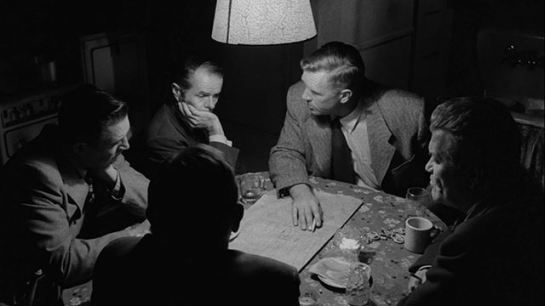
Popular crime noir novelist Jim Thompson was brought in to handle the dialogue and an assortment of actors familiar with film noir were cast. Sterling Hayden plays a career criminal named Johnny who wants to settle down and marry his girl (Coleen Gray). Before tying the knot he sets out to pull the familiar ‘one final heist’ – an elaborate plan to swipe $2 million from a racetrack. To pull it off he brings in an assortment of characters who each have their own unique role to play in the heist.

Kubrick put a heavy emphasis on characterization and he takes just enough time to show each of the motivations for signing on to Johnny’s plan. Elisha Cook plays a weak-minded cashier at the track who needs the money to satisfy his insulting gold digger of a wife (Marie Windsor). Ted de Corsia plays a boozing crooked cop. Joe Sawyer plays the racetrack bartender who needs money to help his sick wife. Jay C. Flippen plays an old friend of Johnny’s who funds the heist. Toss in a gunrunning sharpshooter (Timothy Carey) and a brutish wrestler (Kola Kwariani).

Johnny’s plan works like one big puzzle where every man serves as a piece. If one piece is missing the puzzle is incomplete. None of the players other than Johnny know the entire plan. They know their roles and outside of that they are in the dark. In a sense Kubrick leaves the audience in the same boat. We know the individual parts people play but we don’t know how they all fit together.

1956, THE KILLING

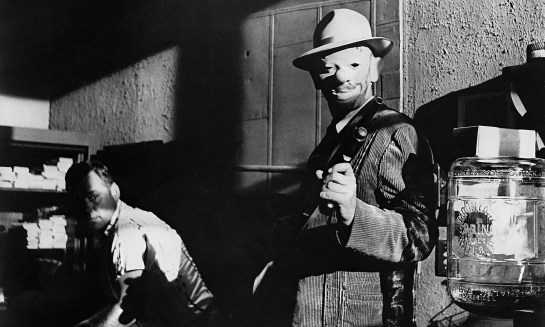
One method Kubrick uses to keep us in the dark is his fractured storytelling. The narrative bounces back and forth feeding us bits of the timeline but not in chronological order. This nonlinear approach makes it tough for us to fully realize the plan until the job is underway. It is a crafty bit of tension building that was incredibly effective despite its unorthodoxy. Kubrick would become famous for his dabbling in unorthodox forms of moviemaking. “The Killing” is his creative approach at its simplest but also its best.

“The Killing” isn’t a highly polished film. It feels raw and a bit crude. That’s one thing I love about it. It also highlights one of the shining (no pun intended) characteristics of Stanley Kubrick. Like him or not, he was a filmmaker determined to make each film different than the other. Think of the vast differences between “2001”, “Dr. Strangelove”, “A Clockwork Orange”, “The Shining”, “Full Metal Jacket”, etc. “The Killing” sticks to that trend by giving us a superb crime noir that holds a unique place in Stanley Kubrick’s filmography.

VERDICT – 4.5 STARS

4.5 STARS

REVIEW: “Far From the Madding Crowd”

MADDING POSTER

It seemed that “Far from the Madding Crowd” was one 2015 film that came and went with practically no fanfare. That’s a shame because any movie with Carey Mulligan as its lead is worth talking about. Mulligan is one of the most emotionally earnest actresses working today which is strikingly clear in the two movies she released last year, “Suffragette” and this one.

The film is directed by Thomas Vinterberg whose last film was 2012’s stinging social indictment “The Hunt”. Here he takes the reins of this fresh, new adaptation of Thomas Hardy’s classic 1874 novel. It’s the third time the story has been turned into a feature film and the first since Julie Christie’s 1967 treatment. Vinterberg narrows his focus to give us a much more compact telling of Hardy’s romantic period drama.

MADDING1

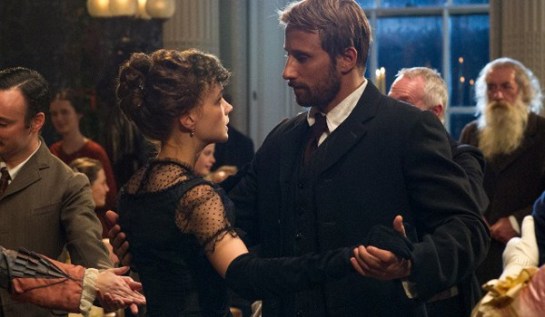
It’s set in 19th century rural England and tells the story of a headstrong woman and the trio of men who pursue her hand in marriage. Mulligan plays Bathsheba Everdeen (the inspiration for “The Hunger Games” protagonist Katniss Everdeen). She’s an independent hard worker on her Aunt’s small farm when she meets Gabriel Oak (played by Matthias Schoenaerts). He has invested his savings in a healthy patch of land for his sheep farm. He is the first to fall in love with Bathsheba.

A reversal of fortune sees Gabriel selling his farm and hunting for work while Bathsheba leaves her Aunt to claim a huge profitable farm left to her by her uncle. The large farm next to her new property is ran by a wealthy bachelor (Michael Sheen) who is quickly smitten with her. Later a third admirer enters the picture in the form of a charismatic but weaselly soldier played by Tom Sturridge.

MADDING2

David Nicholls handled the screenplay duties and chose to put his focus on the key relationship between Bathsheba and one of her three suitors. It’s a decision that allows for Vinterberg to tell a tighter and more economical story that gives the central romance room to breath and develop. It also allows the actors the time to fully flesh out these characters particularly Mulligan.

There is a hypnotic quality to Mulligan’s acting. She has an effortless honesty that is seen in every detail of her performances. Here it’s found in the layers of humanity lying beneath her character’s tough, confident exterior. But she also shows those slight breaks of vulnerability which never compromise the character. It simply makes her human. Mulligan is the perfect actress to convey it all to us. She can say so much through a slight grin or a subtle roll of her eyes.

MADDING3

Matthias Schoenaerts is also an important part of the film’s success. The Belgian heartthrob is a believable mix of farmland physicality and humble, earnest subservience. You never doubt him. Michael Sheen is also very good giving us a character that undergoes a few subtle transformations. Sturridge gives the only performance that is a bit uneven. He’s not bad but his tendencies to go big doesn’t always serve the scene well.

As you watch “Far from the Madding Crowd” you’ll have a pretty good idea how things are going turn out. But that’s okay because the movie is so well made and the performances are top notch. There is just a great flow to Vinterberg’s version of the Hardy classic and its easy to fall into the beautiful period setting and the simple charm of the story. It also offers another example of Mulligan’s magic as an actress.

VERDICT – 4 STARS

4 Stars