REVIEW: “Burnt”

BURNT poster

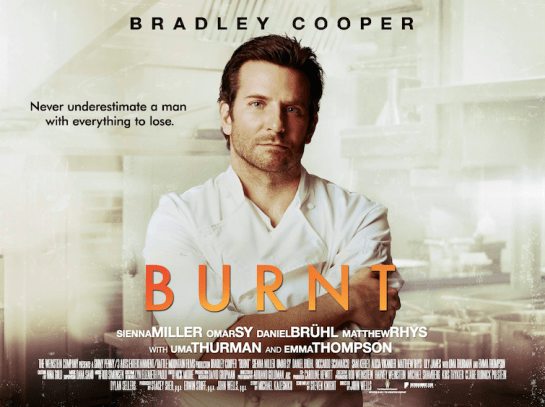
The Food Network, The Cooking Channel, Iron Chef, Chopped and so many other entertainment delicacies have made cooking mainstream and cool. It only follows that a movie dealing with modern culinary sensibilities would have to be hip and sexy. And of course that would require casting Bradley Cooper as not only the best chef on the planet but also the coolest, right? Well wouldn’t you know that is exactly what we get in the fashionable food feature “Burnt”.

To be fair Bradley Cooper isn’t what is wrong with “Burnt”. There are moments where he will undoubtedly have you questioning his casting, but as a whole he manages fine. The trouble is “Burnt” struggles to have a single unique idea of its own. On the broadest level there is an intriguing story here, but the guts of the plot feature a predictable storyline and one overused cliché after another.

BURNT1

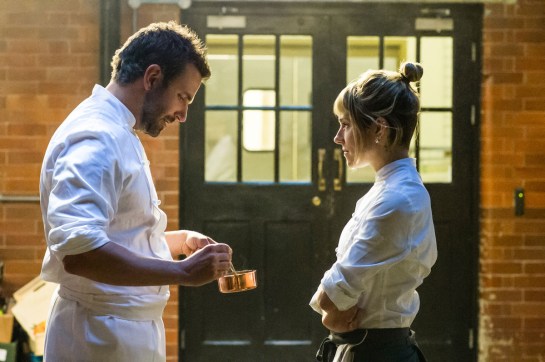
Bradley plays an immensely talented but self-destructive chef named Alan Jones. He once worked for one of the finest restaurants in Paris, but his misbehavior not only brought down the restaurant but his fellow chefs and mentor as well. After a self-imposed penance in New Orleans, Alan heads to London to get back on the proverbial horse again. His ultimate goal is to reestablish himself as a top chef and go for his elusive third Michelin star. To do that will require him to mend some old relationships and repair several burned bridges.

The bulk of the film takes place in London where Alan seeks out an old colleague Tony (Daniel Brühl) who was burned by Alan’s antics in Paris. Tony now runs his father’s luxury hotel and reluctantly gives Alan the keys to his restaurant. Alan encourages a couple of old Paris kitchenmates (played by Omar Sy and Riccardo Scamarcio) to come work for him as well as a rival restaurant’s chef Helene (Sienna Miller). She finds Alan repulsive but she needs the money.

Director John Wells works hard to make the kitchen a stylishly cool place. The cooking scenes are frantically shot with constant quick cuts to buttered pans, simmering sauces, crashing dishes, and Gordon Ramsay patterned tantrums. I couldn’t quite buy into some of it but the cooking scenes are definitely strengths. It’s when the movie ventures outside of the kitchen that the flaws become obvious.
BURNT2

“Burnt” throws several supporting characters at us and puts some very talented people behind them. Unfortunately none of them are given enough to do. Aside from Cooper, it’s Brühl and Miller who get the most attention, but it feels as if huge chunks of their stories are missing. Essentially they and every other supporting character serve as plot plugs for the main character’s story. I can’t help but think that some good dramatic potential was wasted.

Despite all of the beautiful cuisine and energetic kitchen chaos, “Burnt” is simply a half-baked redemption tale. While Bradley Cooper isn’t thoroughly convincing as one of the world’s top chefs, his performance is steady and satisfying. The same could be said for the supporting performances. But all of them are let down by a weightless and conventional story that has its moments. Just not enough original ones to set it apart as something unique.

VERDICT – 2.5 STARS

2.5 stars


REVIEW: “Le Passé” (“The Past”)

PAST poster

Asghar Farhadi is without question one of my favorite working filmmakers. Watching a Farhadi film is unique. He doesn’t make movies intended as escapes. He offers intense examinations filled with truth and reality. Farhadi possesses a sensibility towards the human experience that you rarely sense from other filmmakers. He features a bold and unbridled approach to storytelling that focuses on complex relationships and deep personal narratives.

While his brilliant 2009 picture “About Elly” opened in the United States last year, technically Farhadi hasn’t made a film since 2013’s “The Past”. Like his previous work, “The Past” is a dialogue-rich, plot-driven film focused on the secrets and inner turmoil of its connected characters. The film marked Farhadi’s first cinematic venture outside of Iran. The French language film was shot in Paris but it intentionally strips away any glamorous or romantic view of the city. It is said Farhadi directed through an interpreter since he didn’t speak French. It’s also said that he lived in Paris for two years prior to filming in order to get a better gauge of the French life and the flow of the language.

PAST1

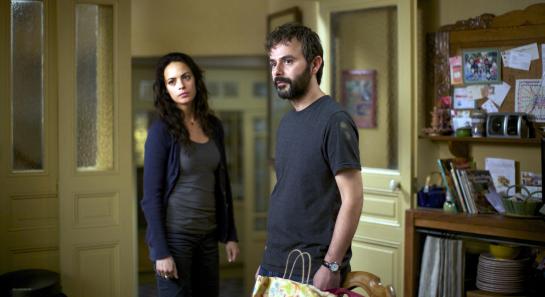
The story begins with an Iranian man Ahmad (Ali Mosaffa) arriving in Paris after a four-year absence to finalize the divorce with his wife Marie (Bérénice Bejo). Marie has two daughters from a prior marriage including the embittered Lucie (Pauline Burlet). Marie and Lucie have a strained relationship mainly due to Marie’s live-in boyfriend Samir (Tahar Rahim). Samir struggles to balance running a cleaning business with raising his discouraged pre-teen son (played with stinging authenticity by young Elyes Aguis). Even more, Samir’s legal wife has been in a coma for eight months following a failed suicide attempt.

Each of these interconnected characters are effected in different ways by ‘the past’. Each are damaged either by their own poor choices or, in the case of the young children, the choices of others. Each are also carrying their own burdensome secrets which Farhadi reveals in small and strategic doses. This great approach allows for the characters to slowing unfold for us over time. And in doing so, the script (written by Farhadi) causes our sympathies to change as we get more information.

Farhadi’s labyrinthine story gives us a lot to navigate and process. It is rich with heavy dialogue and plot that is constantly building upon itself. It takes no ‘feel good’ shortcuts. The piercing reality of its topics and themes leaves an ever-growing cloud of depression and sadness over the characters. But every ounce of it feels earned and natural. Farhadi has a knack for drawing us in and wrapping us up in his characters, their situations, and their moral complexities.

PAST2

“The Past” features several other Farhadi signatures. His use of reaction and expression sometimes tell as much as his dialogue. Also there may be no director as adept and effective at shooting in tight, confined spaces. Farhadi forces his characters together and places us among them. He forces them to deal with each other on a close personal and emotional level. It offers up a unique intimacy but also a boiling intensity. So many scenes in the film employ this technique but not without a point or reason.

As with his other films, Farhadi allows “The Past” to show a social conscience that speaks to greater ills in modern society. At the same time this is a very ground-level story between several damaged yet culpable characters and the young innocent casualties caught in the crossfire. In the beginning everyone is a mystery. Over time we learn alarming secrets. We witness emotionally toxic exchanges. We see one bad decision after another. All of it is linked to the brutal consequences of the past. This is the where the film takes us, and it pulls no punches and gives us no passes. I appreciate that.

VERDICT – 4.5 STARS
4.5 STARS

REVIEW: “The Walk”

WALK POSTER

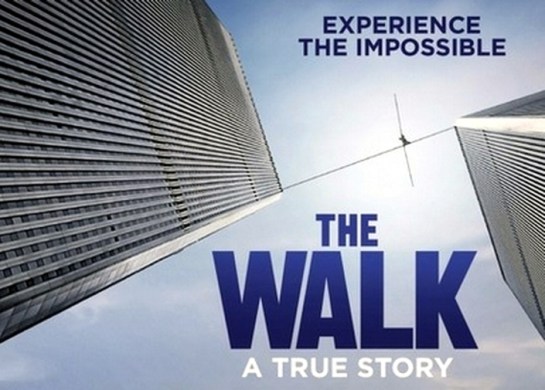
In 2008 a fascinating documentary called “Man on Wire” told the story of French tightrope artist Philippe Petit and his 1974 high-wire walk between the Twin Towers of New York City’s World Trade Center. Petit’s dream walk required an elaborate covert operation to both setup and perform the act. He extended his steel cable from the roof of one tower to the other – 138 feet across and a quarter mile above the ground. He then performed for an astonishing 45 minutes, crossing over eight times, all with no safety harness.

The documentary was based on Petit’s autobiography “To Reach the Clouds”. “The Walk” is taken from the same book but put in a more dramatic form. Robert Zemeckis directs and co-writes this unusual biopic that presents itself as a documentary with flashbacks. Joseph Gordon-Levitt’s boyish charms make him a good fit to play Petit. We spend time with him as a struggling teenage street performer and then later as an ambitious twentysomething staging a death-defying feat.

WALK 1

Zemeckis and co-writer Christopher Browne structure their film almost like a testimonial and motivational speech. Gordon-Levitt’s Petit is basically telling us his story while standing on the torch of the Statue of Liberty with the New York City skyline nestled in the background. Stylistically, it’s an odd choice.

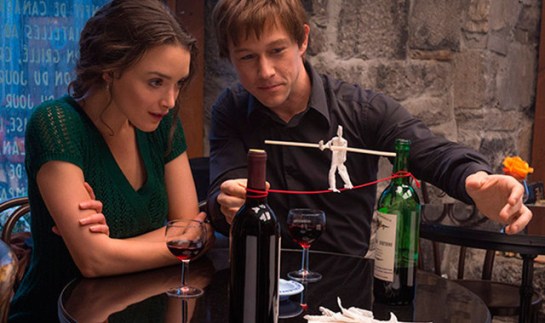
The film spends a lot of time on Petit’s early struggles in Paris. Some of the backstory is interesting such as his prickly relationship with circus leader and future mentor Papa Rudy (Ben Kingsley) as well as his initial efforts to become a high-wire artist. There is also a romance between Petit and a street musician named Annie (Charlotte Le Bon). It’s a bit undercooked, but Gordon-Levitt and Le Bon sell it thanks to a charming chemistry. Other bits of backstory don’t work as well. For example a soured relationship between Petit and his Army pilot father is shoehorned in and is terribly underdeveloped.

Once the story shifts to New York City it takes on a heist film vibe. Petit begins planning his “coup” which requires a host of accomplices. The film spends a fair amount of time putting the group together but few of these people are given much meaningful to do. James Badge Dale, armed with charisma and one funky hairdo, is the most fun of lot. They all work together to set up every detail of the wild and elaborate plan.

WALK2

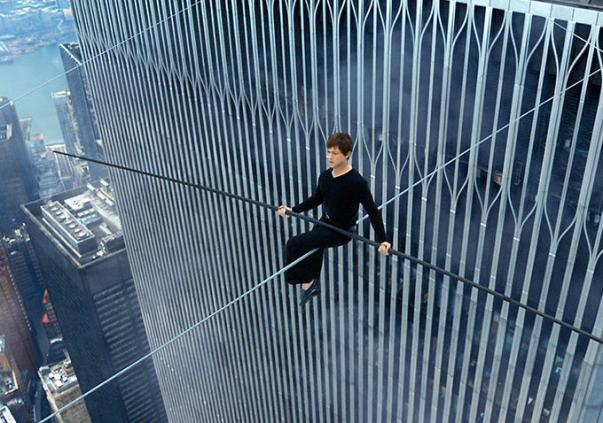
Through all of the character history and careful planning the narrative sometimes sputters in its attempt to maintain a crisp pacing. But once it comes time for the big act “The Walk” is every bit as high-tension and breathtaking as you would expect. I didn’t see the film in big screen 3D or IMAX yet I still felt the amazement, lightheadedness, and nervous energy brought on by the film’s special effects wizardry.

Gordon-Levitt’s performance is pretty remarkable too. Not only did he learn tightrope walking from Philippe Petit himself, he also learned the French language and tirelessly worked on his accent with teachers and several French cast members. He’s incredibly committed and becomes the head salesman in this story of following your dreams no matter how impossible they may seem. There are lulls that hurt that message, but the film’s grand visual finale is an eye-popping treat.

VERDICT – 3 STARS

3 Stars


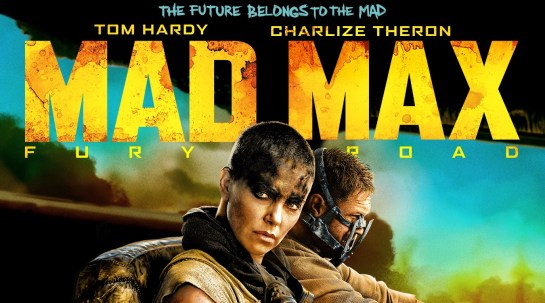
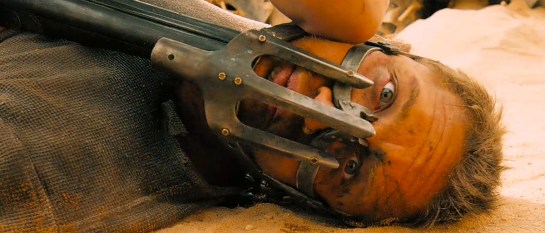
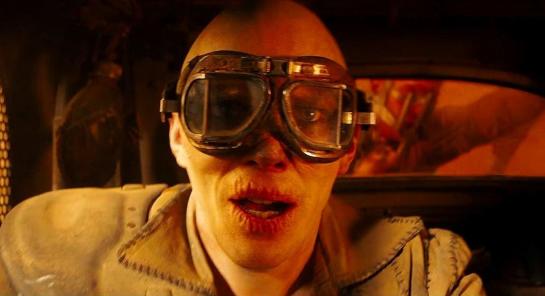
Great Images from Great Movies (4) – “Mad Max: Fury Road”

GREAT Images MAX
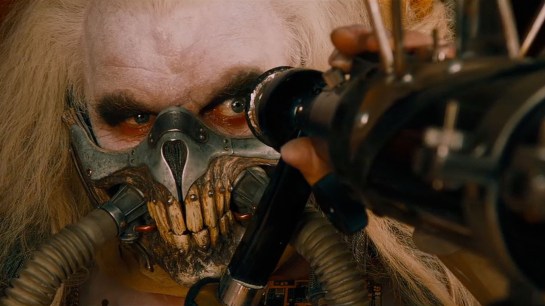
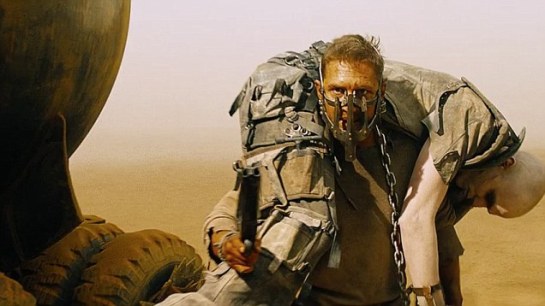
Truly great movies leave indelible marks. It may be through an emotional connection to the story. It may be through a remarkable performance or a signature scene. But it could also be through the brilliant imagery that films carves into your mind. That’s what this feature is all about – highlighting great images from great movies. And it just so happens that we got one of those movies last year.

MAX poster

MAX3

MAX6

MAX1

Max8

MAX17

MAZ11

MAX18

MAX13

MAX19

MAX16

MAX9

MAX4

MAX14

MAX2

MAX10

MAX12

MAX15

MAX7

So what are thoughts on this fantastic action movie from last year? Is there a particular image that stands out to you? There truly are more than a simple post can contain.


REVIEW: “Hail, Caesar!”

CAESAR poster

I have to think it takes a specific sensibility to pull of a Golden Age of cinema parody especially in today’s movie climate. Modern comedies seem content with sticking to tired formulas and they rarely step outside of those boxes. And unfortunately these retreads attract big enough crowds to keep the filmmakers comfortable in the genre’s monotony.

Enter Joel and Ethan Coen, a directing duo who has never played within the conventional or the formulaic. Over the years they have dabbled in a number of genres, never conforming to a popular norm and always putting their own special spin on them. Whether its comedy (“Raising Arizona”), action thrillers (“No Country for Old Men”), westerns (“True Grit”), gangster pictures (“Miller’s Crossing”), or even wild amalgamations of several genres (“Fargo”), the Coen brothers are always approaching things from a unique perspective.

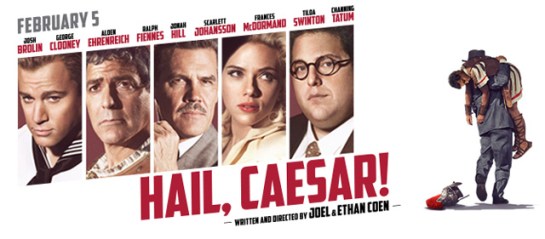
Their latest is “Hail, Caesar!”, a comedy written, produced, edited, and directed by the Coens. The film is set in 1950s Hollywood where big studios still run every facet of moviemaking including their laborers. Josh Brolin plays Eddie Mannix, a real life studio “fixer” represented here with that expected Coen brothers twist.  As a fixer Mannix’s job at Capital Pictures is to protect the images of Hollywood stars by hiding their bad and potentially damaging behavior from the public eye.

CAESAR1

While the trailer shows off a star-studded cast, this is Brolin’s picture and he does a fine job. The film mainly consists of him managing the studio. The supporting cast is seen through bit parts, some of which are nothing more than glorified cameos. Take Scarlett Johansson, Channing Tatum, Jonah Hill, Tilda Swinton. None have noteworthy screen time and we are only teased with storylines involving each. The best appearances come from Ralph Fiennes and Frances McDormand. They are hilarious but we don’t get enough of them.

The bigger of the supporting roles go to George Clooney and Alden Ehrenreich. Clooney, the Coen’s favorite numbskull, hams it up as Capital Pictures’ biggest star who ends up kidnapped by a mysterious group known only as “The Future”. Ehrenreich plays a singing cowboy (think Gene Autry) who ends up terribly miscast in a stuffy period drama. These story angles, just like the many others, are promising but aren’t given much attention. It all goes back to Mannix and his professional and personal struggles. It is a far cry from the impression left by the trailer.

I don’t mean to sound like “Hail, Caesar!” is a bad movie. It’s not. There are so many winks and tips of the hat to the people and the system that made up Old Hollywood. The film is a veritable collage of homage and parody. Much of it is sure to put smiles on the faces of classic cinema fans. We get a big dance number. We shoot scenes on big studio lots. We see the politics behind making a Ben-Hur-ish prestige film. And of course communism rears its ugly head. All of these things are a lot of fun.

CAESAR2

But despite that, there’s something about “Hail, Caesar!” that just doesn’t click. There are so many components to the film that feel underplayed. The Coens have always stuck to their vision, but here their constant wandering from one potential plot point to another gives us several entertaining scenes but not a fully compelling whole. It never can keep a steady momentum and the humor seems to come in a few scattered bursts.

It’s hard to put into words what made the film hard for me to fully embrace. As I said, there are many really good scenes and several specific fun moments that stood out to me. Most feature that signature quirky Coen brothers dialogue that I love. But its hard to find a satisfying narrative thread that brings them together. I can’t help but think that a little less of these out-of-the-blue indulgences and slightly more focus on a central story thread would have helped the film immensely.

Still, a disappointing Coen brothers movie is better than most other comedies of today. That’s one way of looking at it. But that doesn’t cover the one unfortunate fact – “Hail, Caesar!” is still a disappointment. It has its moments (some of them are really great), but its flippant approach to some of the storylines it injects left me feeling a bit slighted.

VERDICT – 3 STARS

3 Stars

REVIEW: “Mistress America”

MISS POSTER

Noah Baumbach has a unique fascination with telling stories of high-strung eccentric chatterboxes who aren’t always the most likable people to be around. Some are airy and naive. Others are astringent and self-absorbed. But despite each of their quirks, annoyances, or repellent personalities, I’ve always found myself fascinated with Baumbach’s strange and often self-destructive creations.

Enter “Mistress America”, an unusual amalgamation of all of the above. It features most of the normal Baumbach signatures – neurotic and/or insecure people, a ton of hip rapid-fire dialogue, and a bustling New York City backdrop. As with every other film of his, a big part of your reaction will be influenced by your opinions of the characters and your tolerance levels for them.

MISS1

Baumbach’s favorite muse and girlfriend Greta Gerwig co-wrote the story and gets top billing, but the film is really about a girl named Tracy struggling to find her niche during her freshman year at college. She’s played by Lola Kirke who was very good in last year’s “Gone Girl”. Tracy feels like an outcast and can’t fit in with any of the typical college groups. Even the nerdy intellectuals pay her no attention except for a fellow writer named Tony (Matthew Shear). But even that relationship isn’t without its complexities.

Sensing her daughter’s melancholy, Tracy’s mom (Kathryn Erbe) encourages her to call up and connect with her soon-to-be stepsister Brooke (Gerwig). Tracy is instantly smitten with Brooke’s panache and lively New York City lifestyle (stating in one scene “I can’t imagine the city without you”). Brooke talks a good game and seems to have her toe dipped in many of the city’s coolest waters. But as with many of these characters, there is reason for us to wonder if her life is truly all sunshine and roses.

MISS2

For the most part “Mistress America” succeeds on the exact same level as most of Baumbach’s pictures. The characters are interesting even in their peculiar states and the story could be called a simple platform for their idiosyncratic philosophizing, witty banter, and self reflections. Dialogue is always a focus and most of it works as quirky intellectual comedy and drama. But this also feeds into a couple of the film’s issues. There are moments where the back-and-forths between characters feel too scripted. Other exchanges work noticeably hard to be intellectually cool. I’m also not sold on some of the comedy angles we get later in the film.

Embracing Noah Baumbach means dealing with certain blemishes and minor frustrations. At the same time his unique characters, rich dialogue, and sharp wit is more than enough to make up for them. This particular dive into the fashionable problems of big city millennials may not measure up with Baumbach’s best. Yet it still manages to capture what I enjoy about his films and the uniqueness of his formula is always satisfying.

VERDICT – 3.5 STARS

3.5 stars