REVIEW: “The Defiant Ones”

Classic Movie Spotlight

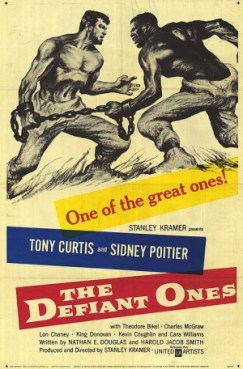
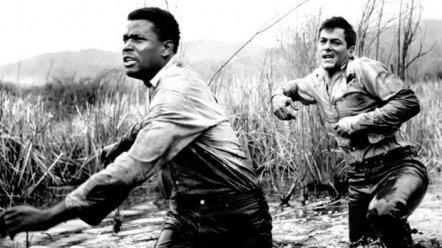
DEFIANTStanley Kramer’s “The Defiant Ones” opens with a prison transport truck on a dark and rainy night. The guards in the cab are distracted by two fighting prisoners which causes them to lose control and roll into the ditch. With a heavy rain falling two men stumble out of the prison truck. They take off running, shackled together arm to arm, a white man and a black man. Each have their own prejudices and each have a hatred towards the other. The question becomes will they escape the law or will they kill themselves first?

Kramer was known for making what some call “message movies”. Throughout his acclaimed career he addressed a number of social and political issues. “The Defiant Ones” takes a candid look at racism through two fascinating characters and a story that allows for a pointed but entertaining approach to the subject. Tony Curtis and Sidney Poitier handle the two lead roles and it doesn’t take long to see that these two men hate each other. Constant insults and unflattering nicknames such as “Colored” and “Joker” make up the bulk their early conversations.
DEFIANT1

The shackles that bind them together serves as an interesting metaphor. I won’t spoil it by going into detail but it was clearly the intent of Kramer and writers Harold Jacob Smith and Nedrick Young (Young had been blacklisted at the time. In fact both writers won Oscars for the film and Young’s award went to his pseudonym Nathan E. Douglas). On one hand the movie is a thriller about two escaped convicts and the manhunt to find them. But the social aspect can’t be ignored and unlike some of the more heavy-handed approaches that we see, “The Defiant Ones” looks at this subject through a smart and effective lens.

Tony Curtis wasn’t the first choice to star in the picture. Kramer insisted that Poitier be his man but conflicts involving Robert Mitchum and Marlon Brando, both in the running to star in the film, made that a problem. Mitchum eventually turned down the role and Kramer maneuvered his filming so that Brando had to drop out due to prior obligations. This opened the door for the casting of Curtis. I’ve always been mixed when it comes to Tony Curtis but he delivers a fantastic performance. His character’s arrogance and unbridled racism is the catalyst for the animosity between the two. Curtis slides into the role and sells it nicely.

DEFIANT2

But Kramer’s main choice Sidney Poitier was the real standout for me. Poitier is often looked at as a pioneer for African-Americans in the film industry. He certainly is that. But he was also a brilliant actor and we see it in this film. Poitier portrays a tough and rugged guy who has clearly been hardened by his experiences. There isn’t an ounce of insincerity from Poitier and I found his character compelling from the start. Both he and Curtis received Best Actor Oscar nominations (both would lose to David Niven for “Separate Tables), but for me Poitier is the highlight of the picture.

“The Defiant Ones” is also a visually stunning film thanks to Sam Leavitt’s Oscar-winning cinematography and Kramer’s sharp direction. A strong supporting cast featuring Theodore Bstraight ikel and Cara Williams (both of whom also received Oscar nominations) add even more quality. This is a smart and crafty movie that manages to be reflective and insightful. But it’s also highly entertaining as a thriller and it rarely takes its foot off the pedal. It hooked me from the opening scene.
VERDICT – 4.5 STARS

REVIEW: “A Streetcar Named Desire”

STREETPOSTER

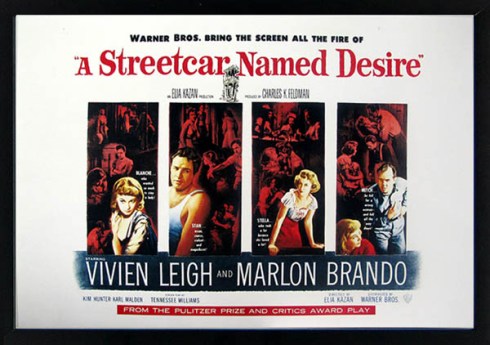
Tennessee Williams first took Broadway by storm in 1947 with his Pulitzer Prize winning stage production “A Streetcar Named Desire”. His dark and dysfunctional story was ripe for a film version and it came in 1951. In order to recapture the success of the play, Warner Brothers brought over several key players from the stage show including Williams to help with the screenplay, the director Elia Kazan, and cast members including Marlon Brando, Kim Hunter, and Karl Malden. The one big change came in the lead role. Jessica Tandy starred in the Broadway show but the studio didn’t consider her a big enough name. Vivien Leigh, who had been working on the London stage version, was brought in to round out the cast.

Leigh plays a southern belle named Blanche DuBois from Auriol, Mississippi. She arrives in New Orleans’ French Quarter to visit her pregnant sister Stella (Hunter) and brother-in-law Stanley (Brando). Stella is happy to see her sister but begins noticing several peculiar things about her. Blanche clings to fantasies of past luxury and prosperity. She still sees herself as a beautiful woman of prominence and stature. But we quickly see it to be a facade that she mixes with heavy drinking in order to deal with deeper buried secrets.

STREETCAR1

Stanley doesn’t like Blanche from the start and suspects her of holding out an inheritance from the sisters’ homeplace which was meant for both of them. He is brutish and his hot-temper often shows itself in fits of rage. His relationship with Stella is volatile and his physical and emotional abuse is startling. Stella just takes the treatment and keeps coming back to him which her sister doesn’t like. But Blanche has problems of her own which are seeded in some deep emotional baggage and psychological scars. The personality clashes and conflicts between these people is the driving force of the story.

In almost every way “Streetcar” is more theatrical than cinematic. Its Broadway roots show themselves in nearly every facet of the production. It’s a very talky picture that focuses heavily on the actors and their performances. The vast majority of the film takes place in and around a cramped apartment building – a confinement that also resembles a stage production. But these parts are integral components to a story that doesn’t require lavish production designs or location shoots. The well conceived Hollywood studio sets are perfect for creating claustrophobic living spaces that force these characters to deal with one another. Add to it Kazan’s sweat-soaked depiction of the New Orleans heat and you have a grimy and uncomfortable environment that fits the narrative.

“A Streetcar Named Desire” was an Academy Award magnet earning twelve Oscar nominations and winning four of them. Most notably three of the wins were in the acting categories, a first at the time. Vivien Leigh won for her twisted and tormented depiction of Blanche. She was the only one of the main cast members who had not worked together on Broadway. Kazan urged her to use that lack of connection in her performance. Kim Hunter and Karl Malden also won Oscars for their supporting performances. Malden plays a unassuming fellow who desperately wants to love Blanche.

STREET2

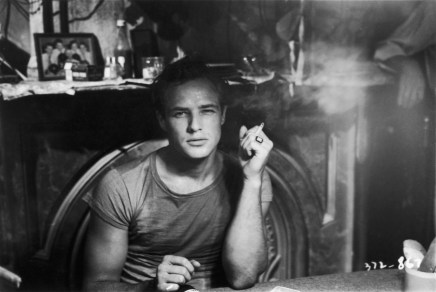
Marlon Brando was nominated for Best Actor but lost out to Humphrey Bogart who won his one and only Oscar for “The African Queen”. What’s interesting is that Brando’s performance is the one that has had the greater impact. This was his second feature film and it introduced his unique and tenacious method acting to a wider audience. Just look at the differences between the acting styles of Brando and Leigh often in the same scene. His performance as Stanley Kowalski displayed an instinctual prowess that would be present throughout his career. He brings such a vivid range of emotions to every scene he’s in. It’s raw but calculated work. Whenever the question is raised about Marlon Brando’s place among the best actors in cinema history, I point people to this performance.

Often heralded as a classic, “A Streetcar Named Deserve” earns its accolades. The Tennessee Williams story mixed with Elia Kazan’s sharp eye and some unforgettable performances cement “Streetcar” as one of the most focused and well made productions you will find. It’s rough, depressing, and unstarched, but it is so potent because of the characters. They are overflowing with energy and life and it is impossible not to be mesmerized by them despite their dysfunction. “Streetcar” made an indelible mark on cinema and it introduced the world to Marlon Brando. How can it not be considered a genuine classic?

VERDICT – 4.5 STARS

REVIEW: “Cat on a Hot Tin Roof”

CAT POSTER

After a relatively slow start to his career, playwright Tennessee Williams struck gold with a series of hits that captivated audiences on both stage and big screen. “Cat on a Hot Tin Roof” is one of those hits. The film adaptation is loaded with Williams’ signature sizzling dialogue and rich, complex characters. A brilliant cast including Elizabeth Taylor, Paul Newman, Burl Ives, and Jack Carson spark this story of fractured relationships, family dysfunction, and the word of the day mendacity. It’s sharp, edgy, and chock full of fiery energy.

Williams’ play first hit Broadway in 1955 and it would go on to win the Pulitzer Prize for Drama. The film opened in 1958 and was a big success. Richard Brooks co-wrote and directed the adaptation which (as was usually the case) slightly dulled the edges of the play in order to adhere to the Motion Picture Code. Williams didn’t like the changes, so much so that he often pointed people away from the film version. Many of his plays took from his own tumultuous and contentious life making them deeply personal but sometimes turgid and overblown. Judging the movie on its own merits, I find Brooks’ version to be overflowing with great scenes, a perfectly captured setting, and dialogue that pierces with shards of realism.

CAT1

With the exception of two brief scenes the entire story takes place on a huge family estate in the Mississippi Delta. It places us with the Pollitt family, an assortment of deeply flawed and sometimes contemptible people each with more emotional baggage than any world traveler. The family patriarch is Big Daddy (Ives) who may be struggling with some life-threatening health issues. His two sons and potential heirs each have their own problems. Brick (Newman) is a raging alcoholic who hobbles around on a crutch after breaking his ankle pulling a drunken stunt. His relationship with his wife Maggie (Taylor) is as stormy as the Deep South weather. The other son Cooper (Carson in what turned out to be his final role) is more interested in his inheritance. Spurred on by his manipulative wife Mae (Madeleine Sherwood), Cooper is the quintessential brown-noser who hopes to be first in line for his daddy’s fortune.

There are so many complicated family dynamics at work. Brick and Maggie have a cold and bitter relationship that stems from harbored anger and pain. There is clear animosity between the brothers which is often fueled by their boisterous wives. There is also a disconnect between a wealthy and success-driven father and the two sons that simply wanted his love. All of these conflicts and others are woven together to create the stinging, vitriolic fabric that makes up the story. Amazingly the various family angles never conflict and there is almost a twisted poetic quality to the various contentions and quarrels.

CAT2

The story is fantastic but it’s the cast who makes it simmer. Elizabeth Taylor was never more beautiful and her sultry natural beauty and Southern charm is ever-present. Paul Newman is perfect as the angry and closed-off Brick. Surprisingly he was not the first choice. Robert Mitchum, Montgomery Clift, and even Elvis Presley all turned down the role. Carson plays a character type that he was well known for and Sherwood is convincing as the hateful and conniving Mae. But I haven’t even mentioned Judith Anderson who plays Big Daddy’s wife Big Mamma (of course). She lives in a delusional bubble where she pretends everything with her family is okay. Anderson is wonderful and many times she is the glue that binds the various fits of dysfunction we see.

Brimming with Southern personality, big but fitting performances, and a script with a bite, “Cat on a Hot Tin Roof” is as mesmerizing today as it was over 50 years ago. Perhaps some of the edge is missing from the Broadway production, but I found it to be a delight. It’s a beautiful cinematic creation that still proudly shows its stage show roots. And it only gets better when you consider the phenomenal cast lead by Elizabeth Taylor and Paul Newman. For some it falls short of a more popular Tennessee Williams adaption “A Streetcar Named Desire”. For me this film stands right there with it.

VERDICT – 4.5 STARS

REVIEW: “Mr. Smith Goes to Washington”

Classic Movie SpotlightSMITH POSTERSome say that 1939 was the greatest year for movies. It’s hard to argue with them. I mean listen to this list of films that came out that year: “Gone with the Wind”, “The Wizard of Oz”, “Ninotchka”, “Stagecoach”, “Wuthering Heights”, “Dark Victory”. Oh, and there was also a little movie called “Mr. Smith Goes to Washington”. This Frank Capra classic was a bit controversial when first released due to its strong look at the American political system. Yet over time it has earned its status as a classic and continues to be remembered as a glorious showcase for the great Jimmy Stewart.


“Mr. Smith Goes to Washington” initially ruffled a few feathers among U.S. Senators and a select few among the Washington press. Numerous complaints were hurled its way including accusations that this film was pro-Communist and anti-American. It was said the film would damage our standing in Europe and in other countries. Others stated it was a shameful distortion of the United States Senate. But others felt the movie was a revelation. They viewed it as one of the first movies to expose a side of the political system never seen before.

The story itself centers around a simple and naive boy scout leader (called Boy Rangers in the film because the Scouts refused to lend their name) who is appointed by the governor to fill in a recently vacated Senate seat. The governor has a crooked political boss named Jim Taylor (Edward Arnold) pressuring him to appoint a controllable stooge while others seek someone who will bring meaningful change to Washington. The governor plays it down the middle and chooses Jefferson Smith (Stewart), an honest and good-hearted bumpkin with strong patriotic beliefs in American exceptionalism.

SMITH3

But the core of the movie deals with Smith’s principled ideals coming face-to-face with the political corruption of a powerful Washington machine. It’s pure ideals versus the thirst for prominence and power. Smith first seeks council from a respected Senator and family friend Joseph Paine (Claude Rains). He also looks for help from his secretary Clarissa Saunders (Jean Arthur). She served Smith’s predecessor and she’s well versed on how things work on Capitol Hill. But Smith quickly learns that trusting people in Washington, whether they are politicians or the press, is a hard thing to do.

Despite its detractors, “Mr. Smith” was nominated for 11 Academy Awards. But due to the crowded field of amazing movies it only took home one statue. Lewis Foster won for Best Original Story, an Oscar that is no longer awarded. Still the recognition of the film and its achievements was warranted. Foster’s story was great but so was Sydney Buchman’s brilliant screenplay. Buchman perfectly creates a political fish-out-of-water story that balances slight doses of humor with compelling and thought-provoking drama. He also gives us the right amount of political jargon and atmosphere that immerses us instead of drowning us. He takes a scalpel and opens up the system and asks us to see a side of the political landscape that at the time had never been seen. This made some squirm but others found it to be wonderful and powerful cinema.

And then there are the performances led by Jimmy Stewart. I swear he’s one of the best actors to ever grace a big screen. This role seems tailor-made for him. Smith is a humble, sincere, and down to earth – all qualities that Stewart has always been able to bring out of his characters with ease. This is called the role that made him a star and his performance earned him his first Academy Award nomination. The film also featured an impeccable supporting cast including Claude Rains and Harry Carey who played the head of the Senate. Both received supporting actor Oscar nominations. We also get Thomas Mitchell, Dick Elliott, Beulah Bondi, and H.B. Warner – all who Capra would later bring back to join Stewart in “It’s a Wonderful Life”.

SMITH2

But I also have to take time to praise Jean Arthur. I think she is fantastic and her performance is one of my favorite things about this film. Arthur began her career as a silent movie star but was able to make the transition to the talkies. Capra had used her prior to “Mr. Smith” so he knew her sharp and unshakable talents. Arthur defines her role by bringing charm, wit, sarcasm, and energy to the character. She has such a natural enthusiasm that bleeds over into the performance which in turn is a real strength of the film.

I could go on and on about the Oscar nominated art direction from Lionel Banks or Joseph Walker’s inspiring cinematography. There is just so much to love about this film. One of the only gripes I’ve had with the movie was with the ending. Capra abruptly pulls the plug and closes up shop leaving several loose ends untied. It’s not a frustrating or unsatisfying ending at all. I just really would have liked to see a bit more considering what has taken place. Aside from that “Mr. Smith Goes to Washington” is a true classic and a testament to the smart and capable filmmaking that we so often lack today. If you haven’t taken time to see this gem, you owe it to yourself. It’s that good.

VERDICT – 4.5 STARS

REVIEW: “Mildred Pierce” (1945)

Classic Movie SpotlightMildred PierceJoan Crawford had an interesting career to say the least. In 1937 she was called “The Queen of the Movies” by Life magazine but she would be called “Box Office Poison” only one year later. A few moderate successes would follow before her 18 year run with MGM studios was ended. Hungry for a new start, Crawford signed with Warner Brothers. One of her first pictures with her new studio was “Mildred Pierce”. The film was a huge success and Crawford would go on to win the Best Actress Oscar. Her performance was rightly recognized and her career was revived.

“Mildred Pierce” was directed by Michael Curtiz. The acclaimed director didn’t want Crawford as his lead but after his first choices bowed out (Bette Davis, Barabara Stanwyck, Olivia de Havilland), she got the job. The film was adapted from James Cain’s edgy 1941 hardboiled novel. Several plot lines from the book couldn’t be included in the picture due to the movie content code restrictions of the time. This allowed for the film’s introduction of the murder angle and several other creative differences.

Speaking of that, the movie opens with a murder. In a wonderful opening scene dripping with noir flavor, a man is shot several times by an unseen assailant who then flees the scene. The police bring in a successful restauranteur named Mildred Pierce (Crawford) for questioning. The murder victim turns out to be Mildred’s second husband Monte Beragon (Zachary Scott) and the cops believe they know who did it. The main plot structure is built around her interrogation. Through flashbacks we are introduced to the main players and we follow Mildred’s rise from a hard working single mother to an owner of multiple restaurants in the Southern California area.

But we are also introduced to a darker side of Mildred’s life. It’s a side featuring two failed marriages, an unthinkable tragedy, and a bitter, contentious relationship with her oldest daughter Veda. It’s Veda who may be Mildred’s biggest failing. We watch her become a selfish and materialistic young girl who is actually a product of Mildred’s own making. Her desire to shower upon her daughter the most lavish things creates a scheming young girl who looks down with great haughtiness on the ‘have-nots’. Ann Blyth plays Veda and she is sublime. Blyth was actually on loan from Universal Studios at the time. Her performance garnered well-deserved praise which culminated in a Best Supporting Actress Oscar nomination. Blyth would make several more films but none as memorable as “Mildred Pierce”. She was only 17 at the time but this performance showed an astuteness and attention usually associated with the greats.

Mildred Pierce1

There is an assortment of other great side characters that help tell Mildred’s story. Bruce Bennett plays her first husband Bert who subverts any good intentions he may have with his carousing and disrespect. Yet you end up wondering if he knows more about Mildred than we first do. Then there is Bert’s real estate partner Wally (Jack Carson) who is never beyond an occasional flirt or a shady business deal. He’s a rather slimy fellow who also has self-centered intentions. Eve Arden gets some wonderful lines as Mildred’s friend and restaurant manager. And Butterfly McQueen has some good moments as Mildred’s maid.

While the film revolves around the murder of Beragon, the life of Mildred Pierce is the centerpiece. Much of the movie’s brilliance is shown in its storytelling style and in the clever ways it depicts Mildred’s changes. She’s an entirely different person by the film’s end. She becomes a woman enslaved by the poisonous relationship she has with her daughter. Things become darker and more twisted as the film moves along which gives “Mildred Pierce” a unique sense. It slices up and mixes portions of film noir, mystery, and romance to form a sordid yet thoroughly compelling whole.

I’m a big fan of “Mildred Pierce” and it’s easily one of my favorite Joan Crawford pictures. She is exceptional here as is her supporting cast, particularly young Ann Blyth. Ranald MacDougall’s adaptation is smart and crafty and it works seamlessly with Michael Curtiz’s style of direction. The film takes a few unavoidable diversions from the novel but they nicely translate cinematically. It all resulted in a spirited film that showcased a still relevant Crawford. It’s also a true classic that still packs a hefty punch today.

VERDICT – 4.5 STARS

REVIEW: “The Graduate”

Classic Movie SpotlightGRADIt could be called a comedy, drama, or romance. But truth be told, “The Graduate” is a little of all of those things. More importantly, it’s a sharply written and beautifully crafted film that ushered in a new approach to filmmaking. It’s touted as a highly influential picture and has grabbed a top 10 spot on AFI’s Top 100 Movies list. While I certainly wouldn’t heap as much praise on the movie as many have, it’s still a really good film with its share of memorable moments.
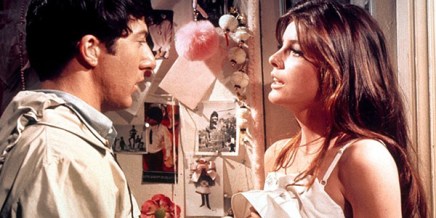
Mike Nichols directed and won an Oscar for the film which is based on a novel by Charles Webb. Dustin Hoffman plays Benjamin Braddock, a disconnected and isolated recent graduate from an east coast college. His parents put together a graduation party but that does nothing to dent his general apathy towards grad school and his uncertainty for the future. He’s such an interesting character who sometimes comes across as an irreverent jerk. But he’s also sad and sympathetic and a bit of a social pariah. He can be flippant and impudent but we find out early on that he has genuine problems understanding what he’s supposed to do during this new stage of his life..

Perhaps all of this is why Benjamin is such easy prey for Mrs. Robinson (Anne Bancroft), a much older friend of the family who married for the wrong reasons and is thoroughly unhappy with her circumstances. She baits Benjamin into an illicit affair which over time adds even more complications to his already muddled life. Some critics have argued that Mrs. Robinson is the most appealing and alive character in the film. They point to her ability to see things as they are and to pursue her own happiness. But I had a much different reaction to Mrs. Robinson. She is shameless, dishonest, and self-absorbed. Most of her circumstances are of her own doing and instead of handling them responsibly, she goes the route of disgraceful self-indulgence with little to no moral conviction. Her maliciousness shows itself even more when Benjamin inadvertently falls in love with her daughter Elaine played by the lovely Katharine Ross.

GRAD YES

Some have said that “The Graduate” hasn’t held up well over time. I disagree. I still see “The Graduate” as very much a late 1960′s film. But I truly believe it has maintained it’s solidity and uniqueness and hasn’t been hurt by the passing of time. It’s moments of humor are still funny, Benjamin is still an engaging character, and the brilliant final shot on the bus is still as mesmerizing as ever. Simon and Garfunkel’s perfectly placed songs still give several scenes an extra emotional punch and the direction from Mike Nichols is still satisfying.

My bigger problem with the film is with the relationship between Benjamin and Elaine. Even though she comes across as simple and passive, their relationship begins on a pretty strong note. But things start to unravel a bit and the relationship falls apart. But soon Benjamin heads to Berkley to find and propose to Elaine. Ross gives a great performance but her character is shortchanged by the material. It’s impossible to understand Elaine’s thinking and her decision making is rash and sometimes out of the blue. A tighter script would have sold the romance better in the second half by opening up the relationship and upping the stakes. I still love and understand the ending. But things get a little clunky before we get to that wonderful final scene.

I still believe “The Graduate” has earned the respect it’s been given. It may not be the most tight-knit script and some key character relationships are underwritten. But anchored by some stellar performances and a great soundtrack, it’s still a lot of fun. Like all really good movies, this has held up well over time for me. Would I put “The Graduate” in my personal Top 10 like AFI did? No, I wouldn’t. But that doesn’t mean this isn’t a really good movie.

VERDICT – 4 STARS