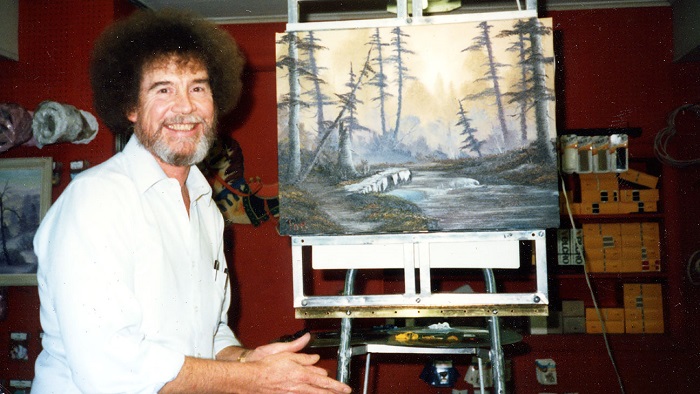
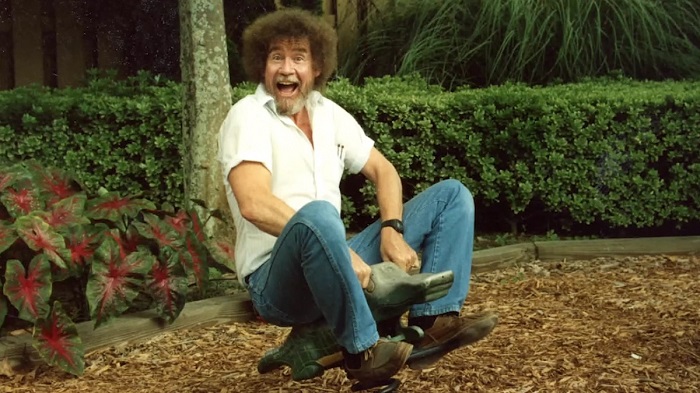
The new Netflix documentary “Bob Ross: Happy Accidents, Betrayal and Greed” will both bring a broad smile to your face and make your blood boil. Director Joshua Rofé tells the story of this soft-spoken television artist, from his humble beginnings as a young oil painter to the disgraceful mass-marketing of his name and likeness following his death in 1995.
Bob Ross was a mind-blowing talent and so many of us remember him from his PBS television show “The Joy of Painting” which ran from 1983 till 1994. During each half-hour episode Ross would use his wet-on-wet technique to paint a gallery-quality landscape. He painted in real-time and with no edits. And as he painted, his calming causal instruction made watching his show almost therapeutic.
Image Courtesy of Netflix
Rofé spends most of his time speaking to those who knew Ross best, namely his son Steve and two of his closest friends and colleagues. Together they give us a picture of a man who loved life, who loved nature and of course who loved to paint. We also hear from art historians and biographers, as well as other television artists who were both friends and inspirations for what Ross would eventually do.
But the film also explores the heartbreaking (and infuriating) side of the Bob Ross story. It tells us about Annette and Walt Kowalski who saw money in Ross. They were instrumental in launching “The Joy of Painting” and building it into such a success.
But they also deviously and shamelessly took control of the Bob Ross name after his death. Against the late artist’s wishes, the Kowalskis stripped Ross’ son Steve of the rights to use his own father’s name. In the meantime, the have turned Bob Ross’ likeness into a multi-million dollar a year corporation. It explains why Bob Ross can now be found on t-shirts, coffee mugs, jigsaw puzzles, plush dolls, bobbleheads and so on.
Image Courtesy of Netflix
To no surprise the Kowalskis chose not to appear in the documentary and Rofé points out that over a dozen people backed out of being interviewed for fear of legal action from the Kowalskis. But some of the film’s most damning allegations comes from those unafraid to appear; those who claim to have experienced the Kowalski’s duplicity first-hand. From selling forged Bob Ross painting to using their power to squeeze out competing artists. It’s not a flattering portrait of the Kowalski family.
“I paint because I can paint the world I want.” You can’t imagine things have ended the way Bob Ross wanted. Still, for most of us Bob Ross will be indelibly etched in our hearts as the quiet unassuming TV painter with a soft soothing voice and funny perm. We’ll always remember his warm smile, welcoming presence and jaw-dropping artistic gifts. Just don’t be surprised if we skip out on the Bob Ross merchandise after watching this film. That DOES sound like something the late artist would want. “Bob Ross: Happy Accidents, Betrayal and Greed” is now streaming on Netflix.
I have to admit, when Clone Force 99 (aka The Bad Batch) were introduced in Season 7 of “The Clone Wars” I thought they were cool but somewhat of a novelty. Five soldiers, each with their own military specialties and each with their own unique personalities. Nothing especially new there. For that reason I had some reservations about giving them their own series. Was there enough to fill a 16-episode season much less a full series?
Well if there’s one thing Star Wars fans have learned it’s to have faith in Dave Filoni. It only took one episode for the creator and showrunner to erase any doubt or hesitation I had. “The Bad Batch” Season One not only proved that the titular group is more than a novelty, it also earned this series a firm spot withing the vast and wonderful Star Wars canon. Fans should be pleased.
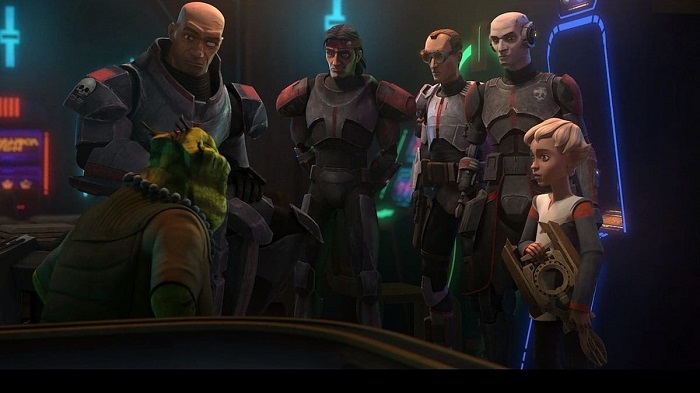
Image Courtesy of Disney+
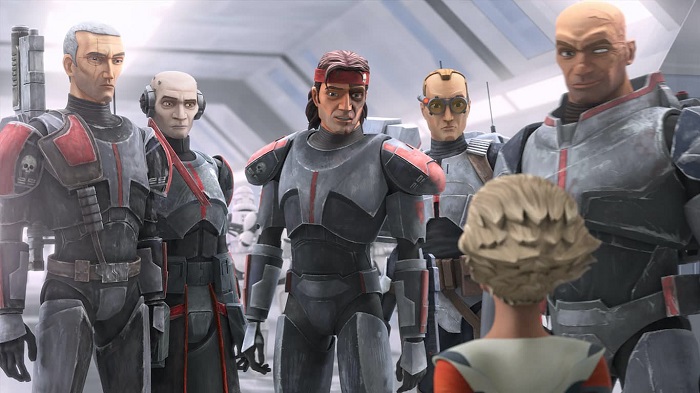
From the very start “The Bad Batch” places itself in a fascinating and underexplored segment of the Star Wars timeline. Order 66 has been executed killing most of the Jedi and giving control to the Galactic Empire. Clone Force 66 (Hunter, Tech, Crosshair and Wrecker and Echo) are genetically enhanced clones with unique mutations. Originally created by George Lucas himself, Clone Force 66 were given special abilities but weren’t super powered. More importantly, their mutations kept them from uncontrollably following Order 66. At least all but one of them.
As the episodes unfold, Filoni, his head writer Jennifer Corbett and supervising director Brad Rau not only build an impressive premise, but they do a great job defining each individual team member – Hunter’s by-the-book leadership, Tech’s dry and elusive sarcasm, the soft-hearted straight-shooting Wrecker, Crosshairs and his cold cynicism. The one member who feels undercooked is Echo. He’s a bit of an outsider by design, but the show rarely gives him any big defining moments of his own.
The one wildcard is also one of the show’s biggest treats – Omega, wonderfully voiced by Michelle Ang. Omega is a young female clone genetically altered on Kamino much like Clone Force 66 which creates a kind of kinship between the group. It only grows when the Bad Batch and Omega find themselves wanted by the Empire. Suddenly this unconventional team of elite troopers and one spunky little girl are on the run against a galactic army, bounty hunters, smugglers and even one of their own.
One of the biggest treats is watching how the series fills in a lot of information about people and most notably places left in the gap between the prequel trilogy and the original trilogy. Several familiar faces pop up not only filling us in on where they’ve been, but also setting up potential storylines that should keep the series interesting for seasons to come.
Image Courtesy of Disney+
And you can’t talk about “The Bad Batch” without mentioning how great it looks. Lucasfilm Animation has taken the same style as “The Clone Wars” but added more polish and detail. It shines most in the incredible vistas and jaw-dropping environments. Season 7 on “The Clone Wars” gave us a good sense of what this series would look like, but the animation team exceeded every expectation.
“The Bad Batch” continues the tradition of strong animated entries into the sprawling Star Wars universe. Like any series some episodes are stronger than others. But you won’t find a single bad one and plenty of great ones. More importantly, it does a great job building and growing its central characters to the point that we genuinely care about their plight. And it’s hard not to be affected by its central theme – the loss of innocence. Omega is the centerpiece; a young girl witnessing and forced to reckon with the ugliness of the galaxy. Her eye-opening journey with her four father-figures has shown to be both harrowing and heart-warming. I can’t wait to see where it goes from here. Season one of “The Bad Batch” is streaming now on Disney+.
The Luca Guadagnino produced “Beckett” has flown under many radars, but after opening the 74th Locarno Film Festival in Switzerland, the Netflix acquired political thriller is set for release on the streaming platform this weekend. The film is directed by Ferdinando Cito Filomarino who worked with Guadagnino on “Call Me By Your Name” and “Suspiria”. With “Beckett” they offer up a much different kind of genre fare that engages its audience on a more unconventional level.
John David Washington plays the title character Beckett, an American tourist vacationing in Greece with his girlfriend April (Oscar winner Alicia Vikander). The first 15 minutes or so is spent listening to the couple’s inconsequential lovebird banter as they visit ancient ruins and play footsy under a cafe table. But these aren’t throwaway scenes. Within them are small nuggets of information, not hints of some vast political conspiracy (that seeps into the story later), but subtle character details that help us better understand Beckett and the transformation he endures.
After getting word of massive political protests planned in Athens, Beckett and April skip their trip to the city and set out across the rural countryside instead. While driving late at night Beckett falls asleep at the wheel sending their car careening off the road, down a hill, and through the stone wall of an old rundown house. Still within the wreckage, a shaken Beckett looks around and gets a glimpse a woman and a red-headed boy who quickly vanish into the shadows. Then he spots April, ejected from the car and laying dead on the house’s concrete floor.
Image Courtesy of Netflix
A heartbroken and guilt-ridden Beckett gets patched up at a nearby hospital and files a report with a local police chief (Panos Koronis). Afterwards he wanders back to the scene of the accident where he sits next to a dried pool of April’s blood and has a private moment of mourning. Then in a terrific deep focus shot, a woman appears in the background and begins shooting. This launches “Beckett” into a man-on-the-run thriller similar to a slow-burning version of “The Fugitive”.
Filomarino crafts his lead character’s journey in a way that resembles a traditional genre movie but with the patience of an art house film. Several story beats ring familiar – a protagonist lost in a foreign country, a series of near-miss escapes, and the timely help from benevolent locals including a political activist played by a really good Vicky Krieps.
Yet through it all Filomarino’s focus remains firmly on Beckett and his fraying psychology. The character maneuvers through the machinations of a mainstream thriller, but at the film’s core is a story of a man unable to forgive himself or see himself worthy of redemption. Filomarino doesn’t spell it out, but it’s there and the grounded authenticity in Washington’s performance helps convey it.
Image Courtesy of Netflix
The “Tenet” star ensures that Beckett isn’t cast in the normal action hero mold. His frantic decisions, his slow reflexes, his willingness to trust strangers on the spot – it all makes sense once we accept that Beckett isn’t a superhero. He isn’t ex-military. He doesn’t have Washington’s football background. He’s a scared tourist and an emotional wreck. He may end up in a different place than where he begins, but there’s no neat and tidy ending for him either psychologically and emotionally.
In addition to his terrific use of locations, Filomarino and his DP Sayombhu Mukdeeprom meld some jaw-dropping scenery into their action set pieces. My favorite is a dizzying overhead camera shot of Beckett high on a cliff, crooked cops closing in behind him and only one way to escape. As he peers into the chasm below the camera hovers above with a slight disorienting sway, looking down on both Beckett and the deep gorge. It’s one of several great shots that (along with composer Ryuichi Sakamoto’s elusively ominous score) creates a nice amount of tension and paranoia.
It’ll be interesting to see how Netflix viewers respond to “Beckett”. If they only stick to a simple surface reading you may see it dismissed as just another manhunt movie. That would be a shame. Filomarino’s film begs for a deeper consideration and asks its audience to look beyond its genre exterior. Its story may be simple to a fault and its themes too subtle for their own good. But there’s more meat on the movie’s bones that it may first appear. It just takes a little effort to get to it. “Beckett” opens this Friday (August 13th) on Netflix.
The Marvel Cinematic Universe has legions of die-hard fans and for a long time I considered myself among them. To be clear I’m still very interested in the sprawling universe and the direction it goes. I grew up with so many of these characters and I’m anxious to see what the creative heads have in store for them (and us). But I’d be lying if I said this new batch of upcoming films had me as excited as I used to be. One of the few exceptions is “Black Widow”, a movie that I expected to have implications for the future of the MCU, but one that felt firmly linked to the previous phase(s).
For years many of us have been clamoring for a Scarlett Johansson led Black Widow movie. She’s a character who has had a prominent place in the MCU yet still was more of a supporting player. We were all set to get “Black Widow” last year but COVID-19 ended up obliterating the movie release schedule. Now her movie has hit theaters and fans finally get that deeper glimpse into the character’s backstory we’ve been hungry for.
Image Courtesy of Walt Disney Studios
While most of the more recent (and upcoming) MCU films have been leaning towards the magical and cosmic, my favorite remains 2014’s “Captain America: The Winter Soldier”. It was certainly spectacular, but it was also more grounded than most of what we’re getting today. That’s the vibe I got from the “Black Widow” trailers and it’s exactly what I hoped director Cate Shortland would deliver. In a nutshell she does. In many ways her film has a very old school MCU feel and fits in much better with the older movies than the new stuff. In fact, outside of a its intriguing end-credits scene, it doesn’t progress any of the current MCU storylines forward. I’m sure some will see that as weakness, but for me its tighter focus was a strength.
“Black Widow” bounces all around the globe giving us big action at every stop. There’s a daring escape in Ohio, a killer fight scene in Norway, an exhilarating chase sequence in Morocco, and a crazy jailbreak in Siberia. And that just scratches the surface. The story (from screenwriter Eric Pearson) follows the events of “Captain America: Civil War” and sees Natasha Romanoff (Johansson) on the run from the US government for violating the controversial Sokovia Accords. She ends up settling off the grid in the mountains of Norway.
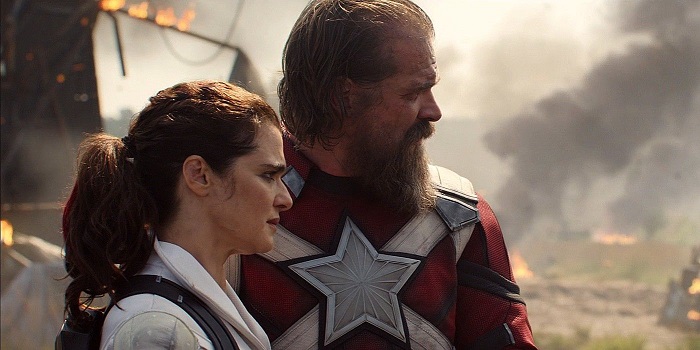
But before we get into all of that Shortland treats us to a compelling prologue set in 1995 Ohio. It’s here that we get a taste of Natasha’s childhood, especially her relationship with her kid sister Yelena. Don’t let their normal looking suburban American life fool you. Their parents Alexei (David Harbour) and Melina (Rachel Weisz) are embedded Russian agents and their “family” is actually an elaborate cover for their spy work. With the feds bearing down on him, Alexei and Melina take the girls and barely escape to Cuba. Once there, Alexei reports to his superiors while his “daughters” are put to sleep and taken away. This opening gives us a good first taste of Natasha’s tumultuous life.
Image Courtesy of Walt Disney Studios
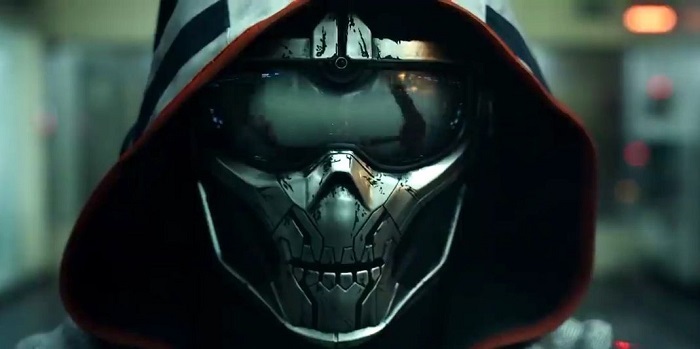
Back to 2016, Natasha narrowly escapes a thrilling encounter with Taskmaster, a deadly assassin sent by Ray Winstone’s General Dreykov to retrieve a case full of vials that Natasha doesn’t even know she has. Turns out the vials were sent to her by her estranged sister Yelena (now played by Florence Pugh), who is holed up in a Budapest safe house after escaping Dreykov’s sinister Red Room program. It’s where young women are brainwashed and turned into “Widows” – killing machines under Dreykov’s control. The chemicals in the vials breaks his mind-controlling hold on the Widows which understandably poses a major threat to his nefarious operation. So Natasha heads to Budapest and has an unceremonious reunion with Yelena. Soon Taskmaster and a team of Dreykov’s Widows are hot on their tail. And later Alexei and Melina reenter the picture.
Sound like a lot? Honestly it’s a surprisingly dense story with lots of moving parts and more layers than I ever expected. Shortland’s ability to bring it all together amid so many action scenes isn’t just impressive, it’s miraculous. She also never loses sight of her central characters, routinely giving them breathers and allowing their relationships to unfold. Of course it starts with Johansson who at this point has made Natasha her own. She’s such a good character and one of her great allures is that she has no superpowers. She’s one of us although cooler and tougher. One the best lines in the movie jokingly speaks to her humanity, “I doubt the god from space has to take an ibuprofen after a fight.”
But it’s Pugh who’s sure to turn the most heads. As the tough-as-nails Yelena she has no trouble bringing out the character’s immeasurable grit and swagger. But through Pugh’s absorbing performance we also get to see Yelena’s tightly guarded vulnerability and her poorly veiled pain. And together with Johansson, she helps bring an emotional heft to their complicated sisterhood that grows more intense with each scene. I also have to give a nod to a terrific David Harbour who brings a light comic touch to his out of shape faux patriarch and former super-soldier who’s still yearning for his glory days as Captain America’s Russian rival. As for Rachel Weisz, at times she seems a bit cold and detached. She’s such a great actress and this is far from a bad performance. But compared to Johansson, Pugh, and Harbour she feels a little shortchanged.
Image Courtesy of Walt Disney Studios
While the vast majority of the action, the storytelling, and the character work is done well, not every decision Shortland and Pearson makes works out. A reoccurring struggle for many superhero movies has been nailing down a good villain. “Black Widow” has some serviceable baddies but they could have been so much more. Winstone’s gravelly snarl brings a certain level of menace to Dreykov but otherwise he’s pretty generic. Taskmaster is the much bigger misfire. Everything about the character’s look is great and the action scenes crackle with an extra burst of energy whenever TM shows up. But without spoiling anything, the filmmakers make an unfortunate choice that feels cheap and completely out of left field. I never bought it for a second and was left thinking about all the better things they could’ve done with the character.
Still, “Black Widow” is exactly the kind of movie to help energize the struggling theater business. Sure it’s available to stream on Disney’s Premier Access, but it shines on the big screen especially during its eye-popping final sequence that can’t possibly be appreciated as much on a television. Part family drama, part Bourne thriller, this is a fun action-fueled blockbuster loaded with kinetic fight scenes and rousing set pieces. At the same time the mostly self-contained story packs a surprising amount of heart and finally gives this long-running MCU character a proper send off. And then there’s Pugh, a great new face in the MCU and one sure to impact things moving forward. “Black Widow” opens today in theaters and on Disney+ Premier Access.
Netflix’s new film “Blue Miracle” is one those ‘based on a true story’ family dramas that never strays from its well-worn formula. Nothing catches you by surprise and from its earliest moments you know exactly how things are going to turn out. Yet, the movie works because it succeeds where it counts the most – it makes us care and from its opening scene we are given characters we can root for.
“Blue Miracle” is directed by Julio Quintana who also co-wrote the script with Chris Dowling. The story is set seven years ago in Cabo San Lucas. Jimmy Gonzales stars as Omar, a former street kid who now runs a orphanage with his wife Becca (Fernanda Urrejola). The affectionately named Casa Hogar houses a dozen or so boys rescued from the streets and is ran on private donations. But times are hard and Omar has recently lost several of his donors putting him behind on his payments to the bank. If he doesn’t come up with $117,000 in thirty days he’ll lose the building and the kids will end up back on the street.
Image Courtesy of Netflix
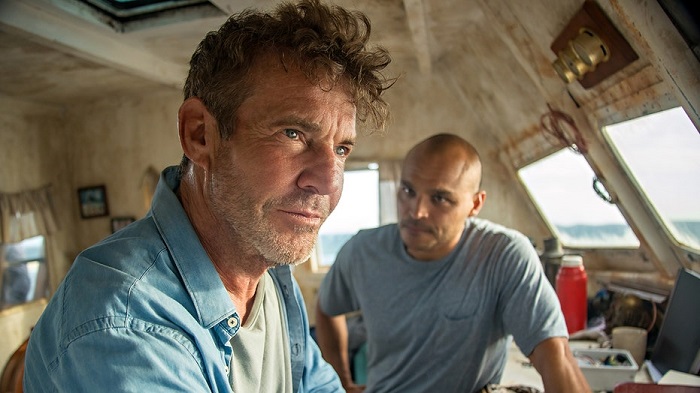
Down at the docks, Dennis Quaid plays a salty gringo fisherman named Wade Malloy. He’s a two-time winner of the renowned Black & Blue Fishing Tournament which kicks off in a few days. The problem is Wade has hit a rough patch of his own and he can’t afford the entry fee. The tourney’s promoter Wayne Bisbee (Bruce McGill) has a soft spot for Omar so he makes a deal with Wade – he’ll waive the entry fee if Wade partners with Omar and some of his boys. It’s a desperate move for Omar, but if they somehow manage to win their share of the prize money should be enough to pay off the bank.
So the crusty captain and his inexperienced crew head out on Wade’s beat-up tub for three days of fishing. Predictably the story plays out to a series of close-calls, conflicts, and the inevitable relationship building. The seasoned gravelly-voiced Quaid is a lot of fun playing a crusty curmudgeon with a lot of personal baggage. But it’s Gonzales who really owns the movie, portraying Omar with heart and integrity. And even with the occasional hokey pep talk his performance remains grounded and honest. The kids offer fresh and energetic young faces but unfortunately play more as types than fleshed out characters.
As you make your way through “Blue Miracle” you can’t help but notice its glaring predictability, the smattering of cheesy dialogue, and the clear-cut formula it borrows from countless other movies of its kind. Yet through it all the feel-good vibe is strong enough and the characters are likable enough to leave you rooting for this ragtag motley crew. It makes for a warm and wholesome underdog story that effectively tugs at your heartstrings even as you see it doing the yanking. “Blue Miracle” is now streaming on Netflix.
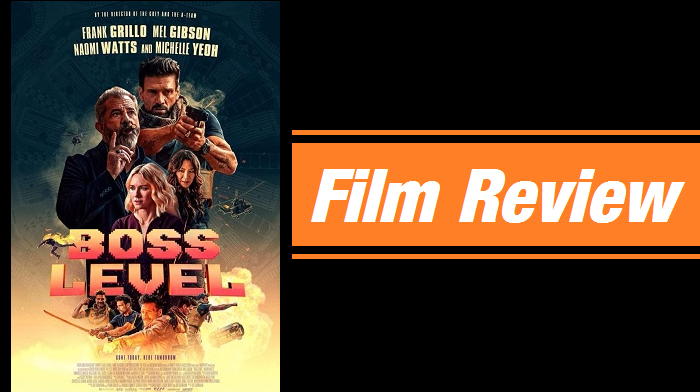
Joe Carnahan first shared his “if Groundhog Day was an action movie” vision back in 2012, but in no time the project seemed dead in the water. Yet only a few short years later it was revived as “Boss Level”. Casting began in 2017, filming started in 2018. Since then Hulu dropped eight-figures to acquire distribution rights and now it is finally set for its proper release. Anchored by a strong cast but constricted by its relentless silliness, “Boss Level” turns out to be a bombastic and self-aware romp that marinates in hyper-violent absurdity. There is the occasional quiet interlude, but this is mostly wall-to-wall action excess.
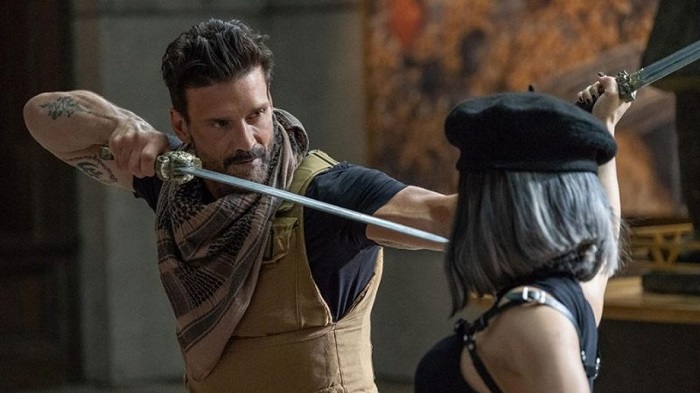
It seems like just a few days ago that I was reviewing another time-loop movie yet here we are again. To Carnahan’s credit, with “Boss Level” he’s going for something a little different. In it Frank Grillo plays Roy, a potty-mouthed former Delta Force Captain with a penchant for heavy narration. He spends a lot of time explaining to us his weird predicament. In a nutshell Roy relives the same day over and over again, dying each time in a variety of gruesome ways – shot with a mini-gun, ran over by an 18-wheeler, blown up with a grenade launcher, beheaded by katana blade, and so on. After being killed he wakes up and repeats.
Image Courtesy of Hulu
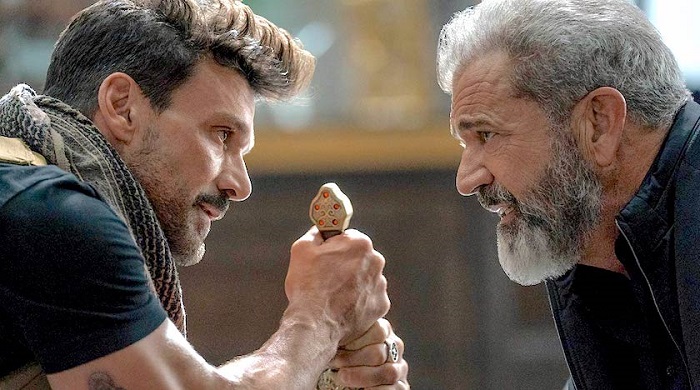
But Roy fights back, learning more details with each reset and then putting that knowledge to use against the eclectic gaggle of assassins out to kill him. He still ends up gruesomely killed each time, but he slowly finds a way to not only live longer but to begin piecing together clues to discover who wants him dead and why. One of the players is Naomi Watts as Roy’s ex-wife Jemma. I’d love to hear what drew her to this movie considering she’s handed a thankless role that sees her as more of a plot device to move Roy’s story forward than a layered character. Jemma is a scientist working for a shady businessman named Colonel Clive Ventor (Mel Gibson). Again not much depth to him either, but he’s made fun by the devilishly good Gibson.
I won’t say much more about the story because frankly there really isn’t a lot more to tell. We do get a side venture where Roy tries to reconnect with his 11-year-old son Joe (played by Grillo’s real-life son Rio). Otherwise it’s all about Roy putting enough pieces together to find who’s trying to knock him off while shooting, chopping, burning, and impaling anyone who gets in his way. And since this is a time-loop movie, we see most of these action scenes over and over and over again. So much so that the repetition gets a little grating. But it helps fill out the 100-minute runtime which would be a heckuva lot shorter without it.
Image Courtesy of Hulu
There are some fun and well-shot action sequences (at least for the first couple of times you see them) and the movie has a pretty good sense of humor. I particularly liked Selina Lo who plays a sword-wielding assassin enamored with her own goofy post-kill catchphrase “I am Guan-Yin, and Guan-Yin has done this!” And Grillo makes for a great action movie lead. Aside from the incessant narration and the steady stream of juvenile profanity (the script’s fault, not his), the chiseled 55-year-old has both the physicality and the snarky humor that nicely fits his character and the film’s wacky tone. And the cigar-chomping, mustache-twirling Gibson makes a paper-thin antagonist entertaining.
With “Boss Level”, Joe Carnahan takes an idea of what video games are, slaps on a hard R-rating, and stomps the accelerator, rarely taking his foot off the gas. But much like a frustrating video game, he forces us to constantly replay the movie’s levels (aka scenes), sometimes to the point of tedium. There is good talent involved, some high-energy action, and a few giggles mashed in with the nagging storytelling issues, ludicrous premise, and half-baked ‘science’ (even the filmmakers give up on making sense out of it). Ultimately your endurance level will probably define your experience. If you can turn off the annoyances and hone in on the strengths, you just might have a good time. But it’s kinda hard in a time-loop movie when those same annoyances continually reset just like Roy’s day. “Boss Level” premieres March 5th on Hulu.