
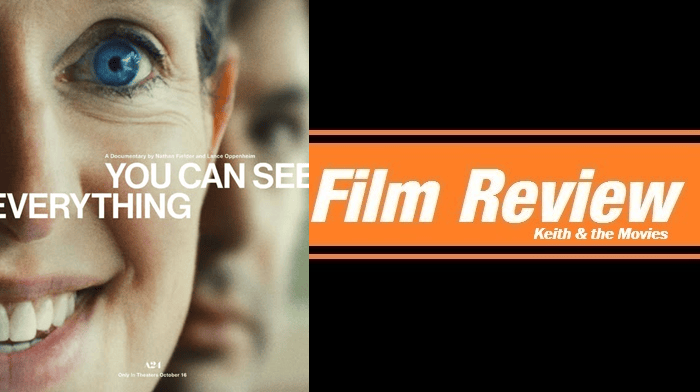
Full admission, I knew nothing about businesswoman and now convicted felon Elizabeth Holmes. It took the help of a critic friend and Wikipedia to give me an idea of who she was, what she had done, and why everyone is buzzing about the new documentary, “You Can See Everything”. I may not be as wildly enthusiastic about the film as most. But there’s no denying co-directors Nathan Fielder and Lance Oppenheim have made something audacious and unique.
For those who don’t know, Elizabeth Holmes was the founder and CEO of the health tech company Theranos. She created a compact medical device capable of running up to 1,000 tests from a drop of blood, quickly, cheaply, and accurately. At least that’s what was claimed. Holmes was able to raise over $700 million from private investors for her heralded invention. By 2015 she had been named America’s youngest and wealthiest self-made female billionaire by Forbes magazine.
But her “iPod of healthcare” was soon revealed to be unreliable with an inordinately high failure rate. Holmes was complicit in concealing the truth from investors and regulators, even going as far as staging phony demonstrations to counter skeptics. But as both journalists and federal investigators dug deeper, Theranos was exposed and Holmes was found guilty of fraud and conspiracy. In 2022 she was sentenced to eleven years in federal prison.

“You Can See Everything” picks up 34 days before Holmes is set to report for her prison sentence. She and her partner, hotel heir Billy Evans, invited Fielder, Oppenheim, and their film crew to live with them and their two children in their rented Del Mar, California beach house. The couple’s idea was to have their lives documented by offering “radical transparency” through unprecedented intimate access. It’s a truly bizarre scenario, made so by the strange motives of the subjects and some equally peculiar choices by the filmmakers.
Fielder takes on the role as interrogator and prodder while Oppenheim stays behind the camera. Fielder’s onscreen presence both helps and hinders the film. He engages in some fascinating conversations with Elizabeth along with some illuminating exchanges with Billy. But Fielder can also come across as a leering creep, peeping around corners and gawking in uncomfortable ways (I’m still trying to understand the random inclusion of Fielder and a cameraman shooting a fully nude Billy in the shower).
It doesn’t take long to see who the film’s true villain is. They make it obvious early on. We see Billy taking more control over Elizabeth and the conversations Fielder attempts to have with her. Plus he routinely runs interference whenever he thinks too much is being revealed. He only gets slimier in the second half. As for Elizabeth, Fielder and company don’t necessarily absolve her of her sins. But they find numerous ways of pointing fingers elsewhere. It’s a far more sympathetic portrayal than the real-life facts might allow.
Throughout the first half we get treated to several memorable moments. Some are subtle yet strikingly revealing, such as a debate on semantics and bickering over Wi-Fi. Others stand out more, like Billy’s aggressive push for Theranos 2.0, a back-and-forth over the famous “Who’s On First” bit from Abbott and Costello, and a scene where Fielder shows the couple Amanda Seyfried’s miniseries about Holmes called “The Dropout”.

But the movie takes an odd turn around the midway mark as Elizabeth heads to prison and Fielder’s attention turns towards Billy and himself. You could argue that Fielder makes himself the main character of the second half which leaves us questioning his overall intent. Further blurring the film’s credibility is its meta twist which comes across as more indulgent than necessary. It gets even more bizarre when Seyfried shows up, joining Fielder as detectives attempting to solve a psychological mystery.
The second half is further obfuscated by Fielder and Seyfried engaging in a series of unnecessary reenactments of conversations the directors weren’t able to get on camera. They add a degree of experimental panache. But they mostly protract the film’s already plump three-hour runtime. Not all of Seyfried’s scenes are frivolous. She poses some intriguing questions about Elizabeth’s relationship with Billy. And she inadvertently finds herself on both sides of an ongoing conversation about creative license.
By the end of “You Can See Everything”, I found myself both compelled and confounded. In many ways it’s a tale of two halves. The first is a mostly daring and provocative probe smothered in psychological gamesmanship and overly aggressive closeups. The second is an exercise in egocentric filmmaking that both indulges and exposes itself. A case could easily be made that it didn’t need to be three hours, and by the end we haven’t learned much new. At the same time, the movie remains a fascinating and at times riveting watch. And with an enormous undertaking like this, that’s saying something.
VERDICT – 3 STARS


I do want to see this although Elizabeth Holmes scares the shit out of me with her crazy-ass eyes.
It’s a tough one. It’s a critical darling for sure but it’s far from flawless. At the same time, it’s bizarrely compelling and it kept me involved for its entire three hours.
I’m giving up 3hr movies unless they’re outstanding, and this one isn’t floating my boat.
Also, lock up Billy too!
Personally, even though I was with it most of the way, I don’t think it earns its three-hour runtime.
The problem with you continually saying “overly aggressive closeups” is it makes it sound like you don’t understand why those closeups were so important and powerful for the millions of people watching this for whom the closeups were so central to what made this so compelling. Then it makes me question whether I can trust your reviews for any subject like this, since you don’t seem to have empathy for folks like me who found those so essential. Word of this movie is spreading like wildfire for a reason, and it’s clear this review doesn’t get it
So since you and I disagree on the heavy use of closeups in this one movie, it makes you question whether you can trust my reviews? That seems…rigid.
Looking at her picture here and listening to you describe it, I get a cult-y feel to it. I’m not interested in her story or understanding why she made the choices she did. She knowingly promoted a bogus medical device and enriched herself. I hope she has to pay back all of that money she bilked people out of.
I’m watching a short series on HULU right now that focuses on individuals that bilked people or municipalities out of 10s and more millions of dollars. In the 2 I’ve seen so far, both were women and both served very little time in prison. In one they auctioned off all of the opulent properties and gave it back to the municipality. In the other nothing was paid back. Don’t they know that is where they give the big pinch to these slimeballs? Restitution should be ordered and the order enforced.
:p to the troll.
That sounds interesting. What’s it called?
Scam Goddess https://www.hulu.com/series/scam-goddess-9b6dbb88-4789-4069-bedb-3dfd3a084f23