REVIEW: “Black Hawk Down”

BHD BANNER

I’ve never once tried to hide my appreciation for Ridley Scott. He’s one of my favorite directors and even when his material may not be its strongest, the sheer visual presentation and keen eye that he possesses has always blown me away. More often times than not Scott has given me a truly amazing motion picture experience. Gritty crime thrillers, ambitious science fiction spectacles, marvelous period pieces, and one particular modern military picture that I think is one of the greatest war films of all time – “Black Hawk Down”.

In 2001 Scott took on a project chronicling the events of the Battle of Mogadishu. The 1993 bungled operation to capture the brutal Somali warlord Mohamed Farrah Aidid revealed an ineptitude in the U.S. government and the true and unwavering bravery of the American military. It’s an amazing story adapted from Mark Bowden’s 1999 book. “Black Hawk Down” doesn’t cater to any political perspective and like many modern war films it doesn’t lose its effectiveness in a heavy-handed message. The movie sets things up and then puts its focus on the ground and the troops involved.

BHD1

“Black Hawk Down” features a wonderful cast, each feeling perfectly at home in their roles. Eric Bana, Sam Sheppard, Josh Hartnett, William Fichtner, Ewan McGregor, Tom Hardy, Tom Sizemore, Jason Isaacs, Orlando Bloom, Nikolaj Coster-Waldau, Glen Morshower and others bring this gritty and intense war story to life. Much of the movie’s potency is due to the ability of these actors to draw us to the characters and truly invest in their dire circumstances. A lot of this is also due to Ken Nolan and company’s strong screenplay. The well versed military dialogue and strategies seem anchored in realism making the story itself all the more compelling.

But for me the movie’s success always comes back to Ridley Scott and his spectacular vision. His tension-soaked pacing keeps you locked in from when the first American boot touches ground. His cameras move through the Moroccan urban locations creating an unsettling and dangerous close-quartered environment. The vehicles, helicopters, weaponry, and uniforms all feel extremely authentic. All of this contributes to something that is essential for a film like this – high stakes. Scott does a tremendous job of raising the stakes as the soldiers try to survive amid such violent chaos.

BHD2

And of course there are the brilliant action sequences. Loud echoing gunfire, heavy machine guns and RPGs, strikingly real chopper crashes, projected dirt and rock from grenade explosions and bullet rounds. It’s fierce and furious but again it carries with it a sharp tinge of realism. That’s what make it so powerful. I swear, every time I watch “Black Hawk Down” I find myself consumed by it. Scott’s eye for action is impeccable and here he always keeps it lodged in the story’s context.

“Black Hawk Down” is an intense, visceral experience. It’s gritty action one minute and deeply moving the next. But it never loses sight of its main focus – the soldiers. Scott has done a lot of unique stuff throughout his career and many of his films are true favorites of mine. Well let me just say this is one of his best and coming from a big fan like me, that’s high praise!

VERDICT – 5 STARS

5 STARSs

5STAR K&M

REVIEW: “Before Midnight”

BEFORE POSTER

It’s hard to believe that its been almost 20 years since we first met Jesse (Ethan Hawke) and Cèline (Julie Delpy) on that train from Budapest to Paris. The two hopped off in Vienna which spawned one of the most engaging romances ever to grace the big screen. Nearly 10 years would pass before the two would meet again in “Before Sunset”, a smart and enthralling sequel that only caused audiences to fall for these two and their story even more.

Now jump ahead another 9 years. Director Richard Linklater again teams up with Hawke and Delpy to show us where Jesse and Cèline’s lives have taken them. Fans of this series understand that the less you know going in the better so I’m staying far away from details. But to set things up the film starts with Jesse putting his son Hank on a plane back to his mother after spending the summer together. Jesse and Hank’s mother have divorced and their relationship is strained at best. Hank’s departure leaves Jesse with a torrid whirlwind of emotions that swirl throughout the entire film and serve some pretty key plot points later in the film.

As Jesse leaves the airport we see Cèline standing by a car waiting along with two lovely little girls. We find out the two have been together since the last film and, along with Hank, they all have spent several weeks together on the Greek Peloponnese peninsula. We learn all of this in the first few minutes of the film and I’m not going any further than that. As I mentioned, this is a story best appreciated with little to no knowledge of where its going. It uses many of the same familiar narrative structures of the previous films while also making a few pretty big departures. At times it’s just as captivating as the previous films and these two characters are still fascinating. Yet with those things being true, there is still a sense that this is a film deeply connected to the other films but somehow lacking in key areas.

Before 2

First the good. We get to spend more time with Jesse and Cèline. I swear I could listen to these two talk for hours. And there is a lot of talking. Where big-budget movies move from one large action set piece to another, the “Before” pictures move from one long conversation to another. But fans know these conversations are simply absorbing. Nothing has changed here. Another fluid and sharp script is put together and the rich, natural performances from Hawke and Delpy make the exchanges between these two work brilliantly. We are cleverly told of how their lives have transpired and we watch as they take some difficult turns. The conversations feature different tones that we haven’t seen before but they remain utterly enthralling.

Another big plus is how well connected it is with the previous two films. That may sound like simple praise but this trilogy is unique in that it’s impossible to separate them from one another. In fact, that’s the big thing that makes this a hard movie to review. It’s so deeply rooted in the other two movies that it’s difficult to judge it as a standalone film. But that connectedness is also what makes it so alive and vibrant. I was so anxious to see these characters again because of their past and my investment in it. I also genuinely care for them and watching some of the things play out in “Before Midnight” is crushing yet I couldn’t take my eyes off of it.

Yet while I was hooked on every exchange between Jesse and Cèline and their story was of great interest to me, there were a few things that set this film apart but not always for the better. For me the intimacy and romance I was so fond of wasn’t as powerful here. Now understand I’m not saying it’s nonexistent. We certainly get it in doses. It’s just in a different stage. I realize that the specific story directions understandably soak up some of the romance. But some of it is missing and I found myself longing for it.

BEFORE 1

There also seems to be a constant preoccupation with sex in nearly every conversation. The characters seem fixated on it and they kept beating that same drum throughout the entire film. Unlike the other movies where the dialogue seamlessly and gracefully flowed with no feeling whatsoever that it was scripted, here the constant sex jabber felt so contrived. I also missed the sense of location that permeated “Before Sunrise” and “Before Sunset”. Vienna and Paris were used subtly in those films but to great effect. Here we get brief looks at the Greek locations but nothing of any value. To be fair, Linklater isn’t trying to make a large visual impression with his camera but I still missed that component.

While this series has been called “The Before Trilogy” by some I hope that’s not the case. The ending isn’t nearly satisfying enough to end a trilogy but more importantly I want to see Jesse and Cèline again. I know I’ve voiced some frustrations with this film but it’s far from being bad. In fact there are several scenes that I absolutely adored. But I can’t shake some of my issues with it – issues that don’t make it a poor film, but they do make it a lesser chapter in this overall captivating love story. But true love can hit a few rough patches doesn’t it? Perhaps that’s what we get here.

VERDICT – 3.5 STARS

REVIEW: “Badlands”

Classic Movie SpotlightBADLANDSTerrence Malick’s directing career has spanned four decades. Now that can be a bit misleading since he’s only made six films during that time. Still, that small body of work has been enough to make him one of my favorite directors. For me, a Malick movie is an experience. He’s an auteur who plays by no other rules other than his own and the quality of his films are always at a high level. There are also several thematic and visual distinctions that course through every Terrence Malick picture, stylistically and narratively differentiating them from most other movies.
It all started in 1973 with the release of “Badlands”. Malick was inspired by the real-life story of Clarence Starkweather, also known as the ‘Mad Dog Killer’. He and his girlfriend Caril Ann Fugate went on a killing spree through the midwest in the late 1950’s, murdering 11 people including her parents and her 2-year old sister. But the similarities between the film and the true story are few. “Badlands” does focus on an ill-founded young romance and the terrible events that follow but it looks at them through a much different lens than the true story would allow.

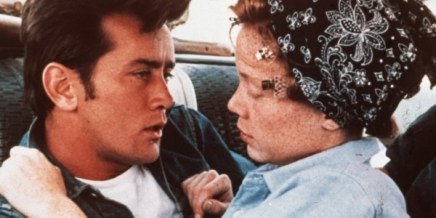
“Badlands” stars a 33-year old Martin Sheen who looked a lot younger than he was. He’s intentionally given a James Dean look with his white t-shirt with rolled up sleeves, blue jeans, dangling cigarette, and rebel-styled hair. He plays Kit, a rudderless ship with seemingly no direction or aspirations for his life. He’s just quit his job as a garbage collector and you get the sense that he has no idea what’s next.

Badlands 2

While walking through the streets of a small South Dakota town, Kit comes across 15-year old Holly (Sissy Spacek) twirling her baton in her front yard. Spacek was almost 10 years older than the part but you would never guess it from her performance. She immediately comes across as an innocent and naïve young girl with a very veiled perception of the world. She lives alone with her father ever since her mother died a few years earlier. I got the sense that that loss had deeply affected her life. Holly falls victim to Kit’s charm and a romance follows, against the wishes of her father. From there, as with most of Malick’s movies, the story takes an idyllic idea and carries it through to a sad and violent conclusion.

In “Badlands” there are several things that Malick doesn’t reveal and several questions he doesn’t explore. For example we know practically nothing about Kit’s past. We also never get a clear idea as to the root of his violence. Personally I think it’s all found in his and Holly’s quest to find where they belong in the world. Malick gives us two characters who you could say create their own twisted fairy tale of existence. They romanticize their lives on the run and never seem to count the consequences or consider the damage the do. They live in a fantasy world of their own making. This evident from several scenes and conversations they have. We also sense it from Holly’s narration which we hear scattered throughout the movie.

badlands1

In “Badlands” you’ll also see the genesis of Malick’s concentration on nature. Even then his camera seems to gravitate towards beautiful shots of the sun breaking through a leafy canopy, glistening dew on a flower petal, or the lively flow of water in a stream. It’s certainly not as profound as in his more recent pictures but it’s undeniably there. And throughout the film there seems to be a contrast between the beauty and peacefulness of nature and the skewed fantasy world the characters have invented.this subtle dichotomy is never more vivid than in the movie’s well-known tree house scene. I’ll leave it at that for those who haven’t seen it, but it’s a fascinating sequence.

Let me build on that last sentence. “Badlands” is a pretty fascinating movie and it’s a strong directorial debut for one of our best directors. It’s a well written tale of two lost souls dancing between idyllic naiveté and sociopathic violence. I couldn’t take my eyes off of it. Again, “Badlands” is an obvious birthplace of Malick’s particular and personal style of cinematic storytelling and that in itself is worth seeing. But there are also more unsettling stories of lost innocence and tragedy from Malick’s pen that are just as vital to making this a great film.

VERDICT – 4.5 STARS

REVIEW: “Before Sunset”

BEFORE POSTERIn 1995 writer and director Richard Linklater introduced us to Jesse and Celine, two young twentysomethings who – by one spontaneous act – end up spending one night together roaming the streets of Vienna. The two open themselves up to each other and fall in love. The movie ends with Jesse heading to the airport to catch his flight back to the United States and Celine catching her train to Paris. Both agree to meet back at the same station on a set day five years later but as they go their separate ways they, and we, wonder if they will ever see each other again. That movie was “Before Sunrise”. That’s brings us to 2004 and “Before Sunset”, a sequel directed, produced, and co-written by Linklater that tells us what happened to these two fascinating characters.
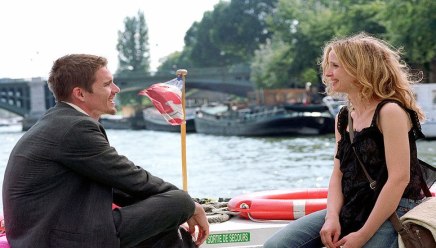
Ethan Hawke returns as Jesse and we find him at Shakespeare & Company in Paris doing a signing for his new book. Jesse seems successful. His book has taken off and Paris is the last stop on his European promotional blitz before heading back home in the states to his wife and child. While being interviewed we discover that his new book is based on his romance in Vienna 9 years earlier. We also see in the corner of the bookstore Celine (Julie Delpy). Celine, now living in Paris, had come across the promotion of Jesse’s appearance. After finishing his last interview Jesse sees Celine in the corner and the two meet again. Jesse has a few hours before his flight so they slip out and walk through Paris, catching up, reconnecting, tapping into old feelings, and second guessing their life choices.

“Before Sunset” pretty much follows the same formula as the first film. It’s an extremely talky movie and the two main characters are the centerpiece. We see the awkwardness of them first meeting again and their reflections on their night together and the reunion that was to take place five years afterwards. But it doesn’t take long before we see evidence of the same chemistry that had drawn them so close together before. The conversations flow naturally – at first as if getting to know each other again then later like two soul mates pouring their hearts out – and we never doubt that there is a real connection between these two characters.

BEFORE1

In the first film both were young, energetic, and open. But as the movie moved along we found they each had their own worries and insecurities. Jesse took solace in seeing himself as not belonging which in turn gave him a sense of freedom. Nine years later, even with his success as a writer and a wife and child, Jesse still feels as if he doesn’t belong but the byproduct that he once saw as freedom has now become a stranglehold. In the first film Celine was witty, optimistic, and open-minded but yet with her own reservations about things. Nine years later her optimism has turned to pessimism; her open-mindedness has become cynicism and distrust. While she’s still as witty as ever, she has changed the most of the two and it’s clear that she’s wrestling with some overwhelming inner feelings. She’s bitter and forlorn and even a bit neurotic when her emotions get the best of her.

“Before Sunset” isn’t as romantic as “Before Sunrise” but in a very real way it gives the first film a more forceful emotional punch. Their decisions, particularly at the end of the first movie, became life altering choices. Even smaller decisions such as not exchanging phone numbers turned out having monumental effects on the courses of both their lives. This gives the audience several good lessons and points to ponder and Linklater feeds those ideas throughout this film. And while the first film focused on the blossoming of love, this film showed the endurance of love, albeit a now unattainable love. We also see both Jesse and Celine shackled with their own personal and emotional baggage.

There’s a lot to like about this film but like it’s predecessor, the writing is really what makes this movie so special. Linklater once again worked with Kim Krizen to develop the story and Hawke and Delpy both contributed a lot to the screenplay. Like before, you can clearly see the collaborative effort of the four writers in not only creating two fascinating characters but in presenting a large amount of dialogue that we the audience never lose interest in. A lot of that is also due to Hawke and Delpy’s incredible performances. Both are extremely comfortable with the characters and the material and their own influence into the story translates strongly on screen. Also impressive is their ability to handle these long dialogue-soaked takes. There’s an enviable skill in being able to nail a long take. These two performers do it over and over again.

Before 2

In “Before Sunset” Linklater uses Paris instead of Vienna but uses it in a slightly better way. The beauty of Paris isn’t thrown in our faces. Instead it playfully lingers in the background injecting itself at just the right moments (as only the City of Light could do) giving the movie a more romantic feel. It’s not forceful or overdone. The movie was filmed in just 15 days and the very few locations used around the city were perfectly appropriate for the long tracking shots and framed still shots that Linklater incorporates. Another fun and interesting production note – Delpy also wrote and performed three songs for the film.

This is a movie that might not be for everyone. Those unable to withstand long sequences of just two people talking are going to struggle with this picture. But they’re also going to miss out on a fabulous film. The more I think on it, the more I view it and the first movie as inseparable. “Before Sunrise” clearly made the sequel possible but the sequel gave the first movie a real feeling of consequence. These two didn’t just go their separate ways from Vienna. They changed the courses of their lives forever and not necessarily for the better. It doesn’t have the romance of the first film and it’s ending left a little to be desired. But I still find these characters mesmerizing and easy to invest in. Now bring on the third film!

VERDICT – 4.5 STARS

REVIEW: “The Big Picture”

THE BIG PICTURE poster

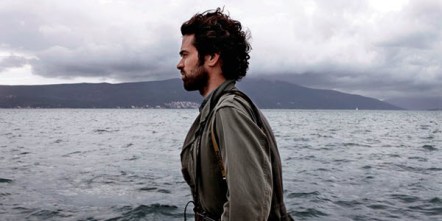
In the recent French film “The Big Picture” Romain Duris plays a man who seems to have the perfect life. He’s a successful lawyer practicing in one Paris’ most prestigious law firms. He has a pretty wife and two adorable young children. He’s financially set, has a nice home, and can even afford the most modern equipment for his side passion – photography. Looking at his life you would have to wonder how it could get any better. In “The Big Picture” co-writer and director Eric Lartigau shows us that the perfect life can easily be misleading and the doors that open to a new life can appear unexpectedly.

Duris’ plays Paul Exben and we quickly begin to notice blemishes in his seemingly spotless life. He finds out that his boss and dear family friend is terminally ill and wants him to take over the law firm. Even worse his burned out writer wife Sarah (Marina Foïs) feels smothered by motherhood and she begins to distance herself from Paul and their children. He soon suspects her of having an affair with a jerky photographer named Grégoire (Eric Ruf). Confrontations and eventual violence follows which forces Paul into an unexpected but potentially better new direction. But there are always consequences and Paul finds that the struggle between new life and old can be unbearable.

Duris is a fantastic actor who has shown a wide range throughout his career. Here he gives an emotional but measured performance. His ability to stay within the bounds of director Lartigau’s vision is phenomenal. Lartigau wants us no know the pain and inner conflict Paul is feeling but he never overplays it. Instead of throwing out contrived scenarios to draw out emotion he allows us to step back and watch Paul – to observe his emptiness and solemnity. Duris does the rest, often telling us his character’s feelings through his melancholy eyes or scraggly appearance. Its a brilliant performance that’s essential for making the film work as a whole.

BIG PICTURE

There’s a lot more I’d like to talk about but I won’t in order to avoid spoiling it but let’s just say the movie ends at a very different place than it starts. The film is loosely adapted from the 1997 Douglas Kennedy novel that was set in suburban Connecticut. Here things are moved overseas and the story goes from Paris, France to Montenegro. But the book’s main focus is still intact. It’s still about a struggling man trying to put a proper identity to his life. The French title for the film, “L’Homme qui voulait vivre sa vie”, better captures that. It’s translated “The Man Who Wanted to Live His Life”. But the real drama is found in the conflict.

Paul is given that rare opportunity at a new life. But he’s not a scoundrel. He knows there are consequences and dangers to this new life. There is a cloud of uncertainty and nervousness that hovers over him. There are responsibilities and needs connected to his old life. Paul wrestles with all of this and for me that’s when “The Big Picture” is the most fascinating. Even though things seem to look up and a new page is turned, Paul remains burdened by reality which keeps him from moving on. I’m trying to be very cryptic here and dance around the greater story. But these intriguing themes are the lifeblood of this movie.

“The Big Picture” dabbles is several genres. At different times it feels like a domestic drama, a crime story, or an intense thriller. Lartigau beautifully weaves all of this together and he keeps us glued to the screen with his crisp and fluid pacing. Everything moves and flows nicely right up to the final 10 minutes. The movie takes a jarring turn in what comes across as an abrupt and contrived conclusion. There is still a message to glean from the final moments, but considering how well connected the narrative had been up to that point, the ending did feel strangely out of place. But it doesn’t completely undo the story that “The Big Picture” is telling. It remains a stirring and thought-provoking picture driven by a brilliant performance from Romain Duris. It asks more questions than it answers and allows the audience to wrestle with the rights and wrongs. I like that.

VERDICT – 4 STARS

REVIEW: “Brave” (2012)

BRAVE POSTER

Does anyone even question the amazing filmmaking that comes out of Pixar Studios anymore? Well, “Cars 2” didn’t do them any favors, but still Pixar has evolved into one of the most impressive filmmaking teams in cinema. Me, I’m not the biggest animated movie guy. But even I can appreciate their amazing knack for good quality storytelling. That knack is once again on display with “Brave”. Once again Pixar gives us another solid animated feature mainly by following their proven formula. They take meatier subject matter and cover it with a beautiful and playful animated wrapping. They hire the perfect voice talent, create beautiful visuals, and throw in some fantastic music. This tried and true formula once again really pays off here even for a tepid animation guy like me.

“Brave”starts off with the perfect approach. The first thing it does is give us a true sense of location via some of the greatest uses of scenery and surroundings I have seen. Even though I knew it was animated, I was amazed by the huge, sprawling, panoramic shots of the Scottish Highlands. The film creates a breathtaking natural canvas that quickly places us within the story’s location and environment. Tall trees, grassy meadows, jagged mountains, and beautiful streams grab us and submerge us into this beautiful land. This gorgeous landscape is the home of a young princess-to-be named Merida who lives with her brave but playful father King Fergus and her stern and often times overbearing mother Queen Elinor.

Merida is an adventurous free spirit who loves archery and riding her horse through the countryside with her long, bright red locks of hair flowing in the wind. But her mother has quite a different vision for her. Queen Eleanor is infatuated with tradition and feels she knows what’s best for a young princess. A strong tension develops between the mother and daughter and it all boils over during a customary competition between three awkward princes from other clans vying for Merida’s hand in marriage. Merida wants no part of it so she hops on her horse and takes off. This infuriates the queen and sets in motion the events of the rest of the film.

BRAVE1

The tension soaked relationship between mother and daughter is at the heart of the story. Something takes place later in the film, and I don’t want to give away what it is, that causes both of them to reevaluate their relationship. This is one place where I give Pixar a lot of credit. This isn’t shallow stuff. This is pretty real and heavy subject matter and they tackle it with sensitivity and smarts. And once again they’re able to walk that line between being faithful to the weighty material and keeping it within the bounds of a fun animated family feature.

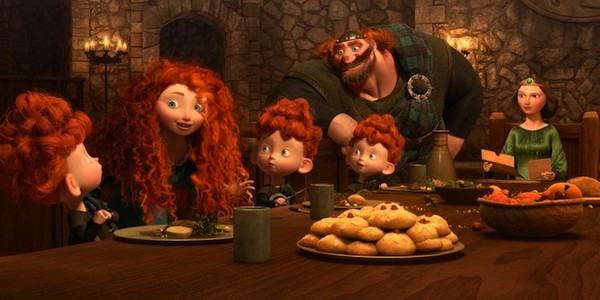
But it’s not like this is a drab and overly serious film. This is a Pixar movie which means there’s a lot of fun and playfulness. King Fergus’ ‘typical male’ personality is a lot of fun. Even funnier are Merida’s rambunctious and mischievous little brothers – three little red-headed terrors who are always getting into something. I also loved the three Clan’s leaders and their sons. Talk about wacky! This peculiar bunch offered up some if the movie’s funniest moments. All of this worked for me but I have to admit that the heavy dose of slapstick silliness near the middle of the film began to wear me down. It seemed a bit monotonous and was pretty typical stuff. But this is a small part of the movie and things pick up on its way to its tender and rather satisfying ending.

“Brave” is another winner from Pixar Studios. It’s a powerful and relevant story wrapped up in gorgeous animation and one of the best soundtracks of the year. The characters come to life through great voice work particularly from Kelly MacDonald, Billy Connolly, and Emma Thompson. All of these components come together to form an entertaining whole and even though it does contain some of the standard cartoony moments, its impossible to watch this movie and not have a great time. This isn’t the best Pixar film but it’s certainly a very good one.

VERDICT – 3.5 STARS