
REVIEW: “Consecration” (2023)

(CLICK HERE for my full review in the Arkansas Democrat-Gazette)

The latest entry into horror’s possession sub-genre is “Consecration”, a new chiller that plays more like a supernatural mystery than a straight up horror movie. Looking at it that way works in the film’s favor considering there isn’t a single scare to be found in the movie’s lean 85-minute runtime. Unfortunately the mystery itself is never that compelling, and sticking with the story as we wait for the eventual payoff ends up being a test of patience.

What’s frustrating is that there are several cool ideas baked into “Consecration” that simply don’t come together like they could have. Directed by Christopher Smith from a script he co-wrote with producer Laurie Cook, the movie borrows all sorts of religious liturgy, symbolism, and vernacular to create its familiar yet believable sectarian setting. And Scotland’s atmospheric Isle of Skye offers some fittingly spooky yet gorgeous locations.

Image Courtesy of IFC Films

But “Consecration” lacks the engaging storyline to hold it all together. It’s bookended by a promising premise that both starts and ends in a interesting place. But it’s the sluggish middle that may have enough going on to hold your attention, but that never takes the story (or the audience for that matter) in any exciting directions. Instead it mostly sits in idle, slowing building up but ultimately teasing much more than it delivers.

Malone plays the ironically named Grace, an embittered atheist who more or less embodies the movie’s mostly cynical view of religion. A series of clunky flashbacks hint at a traumatic childhood. One marked by physical and mental abuse stemming from her father’s religious zealotry. These days she’s an eye doctor from the States who has worked hard to put her troubling past behind her. But being this is a horror movie, that proves to be easier said than done.

Grace is devastated after hearing that her brother Michael (Steffan Cennydd) has been found dead at a convent in Scotland. Michael, we learn, was a Catholic priest who was part of a devoutly rigid yet vaguely defined sect. Local police, led by DCI Harris (Thoren Ferguson), are investigating his death as a murder-suicide. They believe that Michael killed a fellow priest before taking his own life. But Grace isn’t buying it. So she flies to Scotland to identify her brother’s body and do a little investigating herself.

At the convent Grace meets the gruff and evasive Mother Superior (Janet Suzman) who claims Michael “fell into darkness”. She believes he killed himself fighting off a demon which a skeptical Grace immediately dismisses as nonsense. Then there’s Father Romero (Danny Huston) who is assigned by the Vatican to investigate the death and consecrate the convent of any residual evil. To Grace’s surprise, Father Romero pledges his full cooperation and support. Huston is such a good actor, and he craftily sells nobility while still leaving us suspicious of his character’s motives.

Image Courtesy of IFC Films

Unfortunately, he (like much of the movie) is left hanging by a script that simply doesn’t have the depth it needs. It tries to build on Grace’s backstory through the aforementioned flashbacks and a handful of semi-chilling visions that she experiences every so often. There’s also a revelation about some powerful mystical relic that the sect is after. And we get some hard to decipher references to a cult (I think) with connections (again, I think) to the ruins of an old chapel on a cliff. But again, none of that stuff gets the attention or the detail needed for us to really care.

Some of this may be easy to look past if the movie was remotely scary. Sadly, it’s not. It takes a few cheap swings, but none of it is chilling or unsettling which only highlights the film’s more glaring issues. Thankfully, Smith keeps things short and sweet. But actually, this is a movie that could have used another 20 minutes or so. Maybe with a little more time spent on fleshing out its story, “Consecration” could have been the movie it teases rather than the movie it ends up being. “Consecration” opens in theaters today (February 10th).

VERDICT – 2 STARS

REVIEW: “Corsage” (2022)

(CLICK HERE to read my full review in the Arkansas Democrat-Gazette)

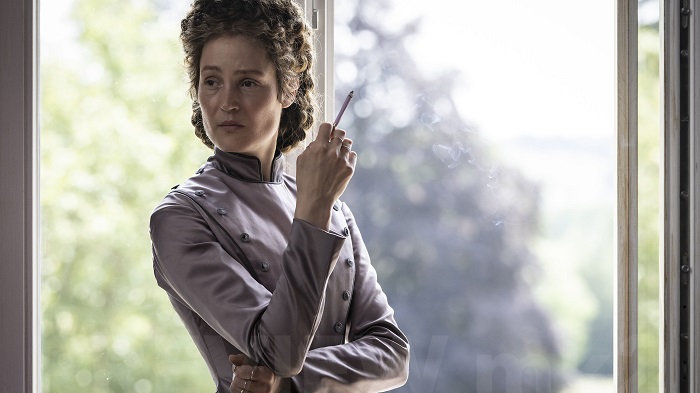
With “Corsage”, writer and director Marie Kreutzer has taken a scalpel to the standard biopic formula and made a witty, irreverent, and openly fictionalized take on the life of Empress Elisabeth of Austria (known more affectionately throughout Europe as Sissi). It’s a gutsy reimagining that reshapes a well documented life in such a way that we’re never quite sure where it’s going. Yet it never goes so far as to lose the tug of history, even during its completely invented ending – one that’s still tragic, yet in a more fitting way.

Born in 1837, Duchess Elisabeth Amalie Eugenie of Bavaria married Emperor Franz Joseph I when she was only 16. Elisabeth was immediately thrust into a life she wasn’t initially fond of or prepared for. Her struggles were compounded by tragedies including the death of her infant daughter, the murder-suicide of her only son and his mistress, and the death of her sister in a fire at a Paris charity event. Elisabeth was assassinated by an Italian anarchist while visiting Geneva, Switzerland in 1898. She was 60-years-old.

Empress Elizabeth was an emotionally complex individual. She was an introvert who was obsessed with maintaining her renowned beauty and notably slender figure. She had a rigorous physical regimen and barely ate. Overwhelmed by the demands and rigidity of court life, she often retreated to Hungary, England, or Greece, bypassing many of her “duties” and seeing less of her husband. It sparked rumors of affairs, yet no evidence proved their validity.

Image Courtesy of IFC Films

Kreutzer uses all of these real-life strokes in her portrait of Empress Elizabeth. She paints a recalcitrant monarch who routinely bucks the expectations associated with nobility much to the chagrin of her family and fellow aristocrats. It isn’t a showy or in-our-face defiance. In fact, Kreutzer puts a lot of effort into grounding her story in the humanity of the character. It’s a tough sweet-spot to hit, and I can see some thinking it goes too far while others are left wishing it had gone further.

The movie’s ace in the hole is its star, Vicky Krieps. The 39-year-old had her breakthrough in Paul Thomas Anderson’s 2017 drama “Phantom Thread” and has appeared in a number of interesting films since. But this is easily her meatiest material since that PTA gem. She gives a fierce and layered performance, holding the screen while dodging the many traps that can come with a role like this one. She’s brings both heartfelt empathy and jolts of playful energy.

Beginning in December of 1877, “Corsage” follows roughly a year in Elisabeth’s life. We first meet her in Vienna, a few days before her 40th birthday. But it’s hardly a joyous occasion for the melancholy Empress. “At the age of 40 a person begins to disperse and fade, darkening like a cloud,” she laments. Her disaffection isn’t helped by her controlling husband, Emperor Franz Joseph I (Florian Teichtmeister) who’s quick to let her know her place in the Royal order. At one point, he bluntly informs her that he is the one called to make decisions. She is “merely to represent“.

Image Courtesy of IFC Films

But there’s a narcissistic side to Elisabeth as well. She demands loyalty and obedience from her small cadre of servants, even coldly denying her closest handmaid the chance to marry. On several occasions she seems to bask in the compliments on her beauty. And after some lively flirting, she even tells one smitten hopeful lover, “I like looking at you when you look at me” before promptly cutting ties. Her behavior gets even more erratic as her tolerance of oppressive court life dwindles, leading to plenty of gossip and even more tension with her family.

We do get some borderline cliché moments where Kreutzer attempts to poke fun at the stuffy and stately costume drama tropes. We get chamber versions of contemporary songs and a handful of crude modern gestures – choices that grasp for attention rather than add anything meaningful. And I’m not sure its lightly episodic structure always works.

But I do like how Kreutzer doesn’t bind herself or her film with the usual biopic constraints. There’s a sense of freedom in her direction, in her storytelling, and in the capturing of her setting (exquisitely shot by DP Judith Kaufmann). Together with the sublime Vicky Krieps, Kreutzer has made a messy but alluring anti-biopic that both critiques history and puts its own unique spin on it. “Corsage” is now showing in select theaters.

VERDICT – 3 STARS

REVIEW: “Causeway” (2022)

Fans of Jennifer Lawrence’s more intimate and subdued work (i.e. “Winters Bone”) will probably love her latest film “Causeway”, a moving low-key drama that offers an honest and unvarnished look at working through trauma. It’s a remarkable feature film debut from director Lila Neugebauer who ushers this soulful character study along with a confident control. Yet she also knows when to simply be still, step back, and lean on her terrific actors. The results are pretty great.

Working from a script by co-writers Elizabeth Sanders, Luke Goebel, and Ottessa Moshfegh, Neugebauer navigates the film’s themes of trauma, guilt, remorse, loneliness, and the struggle to cope through two seemingly rudderless characters, each marked by their own painful tragedies. While their story maintains a serious tone, Neugebauer doesn’t wallow in their misery. Instead she unpacks it, not by force, but through the unlikely yet revealing friendship that blossoms on screen.

Image Courtesy of Apple TV+

Lawrence plays Lynsey, an American soldier who suffers a serious brain injury during her tour in Afghanistan. She returns to the States, but before going home to New Orleans she’ll have to undergo rehab. She’s looked after by a home health worker named Sharon (a wonderful Jayne Houdyshell) who helps her with once simple tasks such as standing on her own, taking off her jacket, brushing her teeth, or writing her name. Add to it severe headaches, memory loss, and sudden panic attacks. Lynsey is in a bad way.

But over time she begins to get her strength back and is eventually allowed to go home to continue her recovery. But for Lynsey, returning home comes with its own trauma. And against the better judgement of those around her, all she wants is to be redeployed. “I need to get back to work,” she says with an unconvincing confidence. But that will require her New Orleans neurologist, Dr. Lucas (the always great Stephen McKinley Henderson) to sign a waiver which isn’t something he’s in a hurry to do.

At home Lynsey has a cold relationship with her mother Gloria (Linda Emond), who at first seems selfish and insensitive, but who we later learn isn’t quite as prickly. There’s clearly some thorny family history, but we only get allusions to it, a choice that at different times works both for and against the story. In one sense, it keeps the movie very much in the moment by not wandering off into loads of backstory. In another way, it shortchanges one of the film’s key relationships and left me wanting to know more about the mother and daughter tension.

To help pass the time (and stay away from home), Lynsey takes a job cleaning pools. On her way to work one day, her old 1985 Chevy Scottsdale pickup blows a gasket. She ends up taking it to a local mechanic named James (Brian Tyree Henry), a fellow wounded soul bearing the weight of his own painful past. The majority of the movie centers on the unexpected friendship that develops between these two struggling individuals. Over time they discover they have a lot in common, and they find spending time together to be mutually therapeutic.

Image Courtesy of Apple TV+

Rather than being plot-driven, “Causeway” is all about the characters and the healing that can come from having someone to spend time with who understands your pain. For that reason, the performances are crucial, and what we get from Jennifer Lawrence and Brian Tyree Henry is staggering. Both deliver textured and nuanced work that conveys vulnerability and quiet anguish. For Lawrence it’s a naturalistic return to form, while Henry continues to define himself as a skilled and strikingly versatile actor.

How you react to “Causeway” may come down to how much you care about the characters. There’s no story hook that grabs you. There’s no big dramatic climax. There’s no surprise twist at the end. Instead, we simply follow this young woman who masks her pain but finds the strength to deal with it through the empathy of another. “I’m going to be fine,” Lynsey says at one point. By the end we still don’t know if she’s right. But the film offers us hope. And as someone who did care for Lynsey and James, that’s all I was hoping for. “Causeway” is now streaming on Apple TV+.

VERDICT – 4 STARS

REVIEW: “Confess, Fletch” (2022)

(CLICK HERE to read my full review in the Arkansas Democrat-Gazette)

Now here’s an series reboot I never saw coming. In fact, I can’t imagine anyone did. “Fletch” (1985) and “Fletch Lives” (1989) were moderately popular Chevy Chase vehicles, neither of which I would call comedy classics. Yet they did have some memorably funny moments in large part thanks to Chase’s madcap comic energy. The Fletch-verse (my snarky title; not a real thing) expands with “Confess, Fletch”, a well-meaning misfire that never captures the zaniness of the 80’s films.

“Confess, Fletch” (directed by Greg Mottola from a screenplay he wrote with Zev Borow) starts with promise, and for a while it had me rethinking what seemed like peculiar casting of Jon Hamm in the Chevy Chase role. But over time the snark gets old, the gags run dry, and no matter how hard Hamm tries, he can’t make his version of Irwin M. “Fletch” Fletcher interesting. Tack on a murder mystery that grows more tedious by the minute, and you’re left with a reboot that probably should have stayed on the shelf.

Image Courtesy of Paramount Pictures

Hamm brings the occasional quick wit, goofy aliases, and signature Los Angeles Lakers ball cap that Chase brought to the Fletch character. But gone are the wacky disguises and the even wackier encounters they would lead to (perhaps that brand of 80s silliness doesn’t screen as well today). And while the story plucks plot points from the previous movies, it doesn’t add much to them. So ultimately we’re left with a film that doesn’t do much with the older material and has nothing noteworthy to add of its own.

The Fletch we get here is a freelance writer who has spent the last two years traveling Europe and writing about art for in-flight magazines. After a month in Rome he returns to the States, stopping in Boston where he rents a swanky townhouse from a free-spirit named Owen (John Behlmann). But upon arriving at his two-week ‘home away from home’, Fletch makes an alarming discovery – the body of a dead woman, face-down in the townhouse’s living room floor.

The police arrive on the scene and the investigation is headed by the ever-sleepy Detective Monroe (Roy Wood Jr.). He’s the father of a newborn who keeps him up all night, leading to a running joke that (like much of the movie) eventually runs out of gas. Monroe and his partner in training, Griz (Ayden Mayeri) eventually tag Fletch as their prime suspect. But our sardonic protagonist sets out to solve the case himself, relying on his credentials of once being an investigative journalist “of some repute“.

Meanwhile there’s this side story (which may or may not be linked to the murder) involving Fletch’s wealthy Italian girlfriend Angela de Grassi (Lorenza Izzo) and her abducted father. His kidnappers want the de Grassi’s priceless Picasso painting as ransom, but someone has recently stolen it along with several other pieces from the family’s collection. Fletch has traced the recent sell of one of the paintings to Boston which is why he’s in Beantown.

Image Courtesy of Paramount Pictures

As these two story paths inevitably converge, we’re introduced to a handful of other mildly interesting characters who may or may not be involved with the murder. There is a germophobic art maven named Horan (Kyle MacLachlan) who is the middle-man in a number of Boston area art dealings. There’s the gossipy stoner Eve (Annie Mumolo) who lives next door to the townhouse Fletch is renting. Then there’s Countess de Grassi (Marcia Gay Harden), Angela’s stepmother who may or may not be heartbroken over her husband’s kidnapping. They even throw in Hamm’s fellow “Mad Men” alum John Slattery as Fletch’s foul-mouthed and disgruntled former boss who now works for a struggling Boston rag. Sadly, with the exception of a stray laugh or two, none of the supporting players bring much to the story.

So we’re left with Fletch and Mottola’s new spin on the character. Hamm puts in the effort, and early on it looks like he just might pull it off. But his act loses steam, the jokes grow repetitive, and nothing that we’re given feels like a worthy reason for an update. Chase’s version of the character was goofy enough to make his two movies fun (to varying degrees). Hamm can’t make the same claim. But it’s hard to put the blame on him, especially when the material he’s asked to sell has no lasting value. “Confess, Fletch” is now showing in theaters.

VERDICT – 2 STARS

REVIEW: “Carter” (2022)

We critics often throw out the phrase “non-stop action” when describing a movie. It’s almost always an exaggeration because of course there are pauses here and there for storytelling and some degree of drama. But the new South Korean action-thriller “Carter” may be the closest thing you’ll find to actual non-stop action. Yes, we get brief interludes stuffed with exposition and information drops. But for the most part this thing is fists-swinging, guns-blazing, bones-cracking, and blood-splattering all the way through.

“Carter” is both ridiculous and extraordinary. It’s a fast-paced, ultra-violent action spectacle unlike anything I’ve ever scene. The goal was to frame the entire film as one single long take. There are numerous cleverly concealed cuts and they aren’t too hard to find. But ultimately the film sets out to give audiences an adrenaline-jacked experience where their eyes are never taken off the action. It’s undeniably impressive, and I’m still not sure how director Jung Byung-gil managed to pull some of his scenes off.

Image Courtesy of Netflix

But while it’s unquestionably bold, there is a downside to this style of relentless full-throttle filmmaking. It can be exhausting and even suffocating at times. And I say that as someone who truly loves big action. It’s a lot for one sitting, and there were times when I just wanted to catch my breath. It’s made even tougher by its hefty 132-minute runtime. By the time “Carter” reaches its big finale, I was a bit worn down and felt like I had already seen the best action it had to offer.

To no surprise, the story is the biggest casualty in such an action-focused movie. Joo Won plays a mystery man who wakes up in a blood-soaked hotel bed with no memory of who he is or how he got there. From there it’s a frantic race to regain his identity and figure out who he can trust. Throughout the small pockets of plot we learn about a fatal DMZ virus that after thirteen days turns people into feral zombie-like killers. We learn our protagonist has a daughter who’s infected and that his mission is to retrieve a young girl and take her to a lab North Korea where her father is using an antibody in her blood to create a vaccine. Without the vaccine, our hero can’t save his own little girl.

All of that sounds like at interesting enough premise. But the problem is most of it is simply conveyed through brief info dumps. We don’t get to watch it play out or have any real dramatic moments of consequence. We get these short bits of story and then it’s off to the next action scene. This lack of attention also leaves the plot murky. For example, there’s this whole friction between North Korea, South Korea, and the CIA that is introduced early but that gets harder to follow as the movie goes on. To be honest, I quite trying.

But let’s be realistic, the huge extravagant action sequences are the movie’s bread and butter. “Carter” is an action junkie’s fantasy, and I found myself rewinding and watching some of the scenes again out of sheer amazement. The constant motion of Jung Byung-gil’s camera can be disorienting at times. But the way he captures and combines the hand-to-hand combat, the John Wick styled gunfights, and the sprawling vehicle chases is truly incredible.

Image Courtesy of Netflix

And then there’s Joo Won whose physicality is mind-blowing. He may not be given a lot to do dramatically, but the steely intimidating hero more than delivers with the action. There is both a fluidity and an unbridled ferocity to his fighting which the movie utilizes to near perfection.

“Carter” is an audacious concoction that is sure to land differently for a lot of viewers. I can see some being exhilarated by the action and all-in on the movie’s grand ambition. I can see others checking out after being worn down by the unrelenting pace and incalculable body count. Me? I see both ways. I was let down by the storytelling and tired by the end. But I can’t deny the kinetic sensation brought on by action sequences and the sheer craftsmanship behind them. They are something to behold, and I would be up for more. But maybe in 90-minute form next time. “Carter” is now streaming on Netflix.

VERDICT – 3 STARS

REVIEW: “Code Name Banshee” (2022)

Antonio Banderas has that special something. Sure he’s a great actor with an incredible range. Yes he’s a natural at drama, comedy, action, you name it. But there’s something about him that always grabs my attention. He’s effortlessly suave and charismatic and it’s hard not to be drawn to his characters, even in smaller movies like his latest, “Code Name Banshee”. But despite his special sauce, Banderas can’t save every movie. Such is the case for this decent yet unremarkable action thriller.

Despite its rather bland title, the Jon Keeyes directed “Code Name Banshee” has its high points. There’s some well-shot action and that above-mentioned Banderas allure is certainly present. But the whole thing is extremely straightforward. There are no twists, no turns, no surprises. The story just plays out exactly as it tells us it will. Even the “big” final act showdown (because we have to have a final act showdown) lacks pizzazz. And the movie dips whenever Banderas is off screen, which is more often than I expected.

Image Courtesy of Screen Media Films

Storywise, the main character is Banshee (Jaime King), an assassin who works high-paying contracts with the help of her computer hacker friend and veritable ‘eyes and ears’, Kronos (Aleksander Vayshelboym). She’s your typical movie assassin type – quiet, lethal, and laser-focused on the job at hand. She never asks questions about her targets, “I’m the executioner, not the judge.”

I an a roundabout way we learn that Banshee’s father and his best friend and black ops partner Caleb (Banderas) have been branded traitors by the CIA. Caleb has vanished off the grid. Banshee’s father is believed to be dead, killed by a ruthless mercenary named Anthony Green (Tommy Flanagan).

Banshee and Green have a face-to-face when he beats her to one of her contracts. Green informs her that Caleb has a $10 million bounty on his head and he intends to collect it. Green offers her $1 million if she’ll give up Caleb’s whereabouts. Rather than accept, she blasts through Green’s goons and sets out to warn her former mentor and maybe recruit him to help her kill the man who may have axed her father.

Image Courtesy of Screen Media Films

For someone described as a “ghost”, Caleb turns out to be hilariously easy to find. These days he’s a bar owner in New Jersey who lives with his daughter, Hailey (Catherine Davis). With the help of Kronos, Banshee pinpoints Caleb’s location and pays him a surprise visit. After reassuring him she’s not there to kill him, Banshee tells Caleb that Green and his henchman are on their way. After dealing with some old baggage, the two realize that they have a chance to take out their mutual enemy. But it’ll take putting aside their past differences and a lot of bullets.

To no one’s surprise, there is quite a bit of John Wick-inspired gunplay. Some of it is pretty fun with headshots galore, each accompanied by a computer-generated spray of blood. There’s also some pretty good fight choreography, the best involving Banderas. King has a splashy scene or two, particularly in the early moments of the film. But it’s all things we’ve seen before. And the movie’s ultimate inability to maintain its energy makes it a hard one to latch onto. “Code Name Banshee” is out now in select theaters and on VOD.

VERDICT – 2 STARS