REVIEW: “Drive”

DRIVE poster

The opening scene of “Drive” is a slick and stylistic introduction to what the rest of the film aims to be – a tense yet deliberate car driving action picture. The opening scene happens to be one of the film’s best and its one of the few scenes that could be called memorable. But that’s not saying “Drive” is a bad movie. It has several things going for it. But underneath the crafty and stylish surface lies a fairly simple and conventional action thriller. From its lead character to the story development, everything moves along at a pretty measured pace with a straightforward narrative. Yet in the end I never connected with it like many others have.

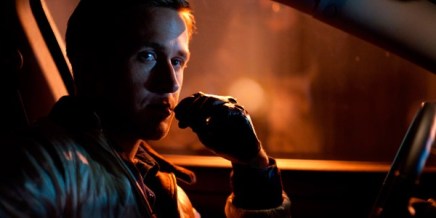
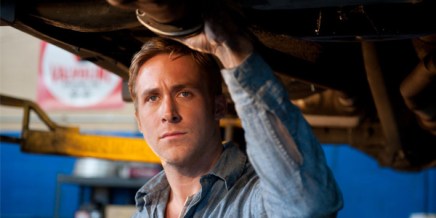
Ryan Gosling plays a movie stunt driver who moonlights as a getaway wheelman for an assortment of shady characters. He’s only refered to as “the driver” or “the kid”. Gosling’s dialogue is sparse and he is required to reveal his character mainly through expressions and actions. We never get any background information on him and his character really isn’t fleshed out all that well. But in a way I liked that. I liked drawing my own conclusions based on his associations, occasional turns towards violence, and his compassion for Irene (Carey Mulligan), a neighbor from his apartment building with whom he begins a relationship. Their relationship consists of several scenes of the two looking and grinning at each other along with the occasional afternoon drive. Irene is raising her young son while her husband is away in prison and the driver is instantly attached to them both.

Drive1

Mood lighting + a toothpick = The Goz

Their growing relationship hits a speed bump when her husband Standard (Oscar Isaac) gets out of prison. Standard genuinely wants to turn his life around but some old debts make that a little hard. The driver agrees to help Standard mainly due to his affection for Irene and her son. Albert Brooks is good as mob guy Bernie Rose who, along with his partner Nino (Ron Perlman), are tied into Shannon (Bryan Cranston), a garage owner who supplies the driver with getaway jobs. Brooks’ character is the prototypical mob “bad guy” but with his own idiosyncrasies. He provides some fantastic scenes but unfortunately he all but disappears through the middle of the film. That’s a shame because I would love to see him get a little more screen time.

As I mentioned, “Drive” and its story are pretty straightforward. There’s not much that broadsides you nor is there anything that calls for your extra attention. There’s nothing especially unique and there aren’t any big surprises with the exception of a couple of brutally violent scenes that can be quite jarring. Speaking of the violence, it’s implementation into the movie is actually quite strange. The more graphic scenes of violence tend to involve lower level characters but what should be the more important scenes seem to be depicted through shadows, quick cut-aways, or far off camera shots. I feel this was obviously a stylistic choice but I found it more puzzling than engaging.

DRIVE2

A look we see about 150 times in “Drive”

Speaking of style, “Drive” looks fantastic. Director Nicolas Winding Refn cleverly uses light and camera angles to give the picture its own unique look. The driving scenes from inside the car look great with Refn transitioning from one camera angle to another with an artistic flare. And yet with all he’s trying to do, he never loses control of his camera whether in a high-speed car chase or a conversation at the dinner table. I also loved his use of sound. Many times he cuts the music and just let’s the natural sound effects carry the scene. “Drive” is just an all-around technically impressive picture.

While it seems I’ve been a little hard on “Drive” and it’s almost run-of-the-mill action movie storyline, I was drawn to many things in the picture. The opening scene does an amazing job grabbing its audience and immediately getting them involved. And while the story may lack a real feel of originality, I see it more as an homage to not only several particular films but to a specific style of movies. I also found myself interested and invested throughout. I think the performances are uniformly strong. Gosling is given the most restrictions but he manages to do a nice job. Carey Mulligan is wonderful as always and Brooks, Cranston, and Isaac are particularly good. Like I said, there’s plenty to like about “Drive”.

VERDICT – 3.5 STARS

REVIEW: “Duck Soup”

Classic Movie Spotlight

duck_soup posterI think it would be safe to say that the Marx Brothers had a brand of humor that was uniquely their own. In a variety of ways Groucho, Harpo, Chico, and Zeppo Marx influenced the comedy genre like no others. Their chaotic and anarchic comedy is centered around rapid-fire quips and ingenious slapstick that’s as well choreographed as any fine dance or ballet. Some of today’s audiences haven’t had the same appreciation for the Marx Brothers and many moviegoers raised by modern cinema may be tempted to dismiss their style of humor. But I stand with the many who believe that the brothers were some of the greatest comic geniuses ever to grace the big screen.

Many believe “Duck Soup” to be the Marx Brothers’ greatest film. While my affection for several of their other movies keeps me from emphatically agreeing, I don’t mind saying that “Duck Soup” is right there in the conversation. The movie features two significant finales for the brothers. This was their last movie to include Zeppo Marx and it was their last production for Paramount Pictures. Many consider the Paramount days to be the best for Marx Brothers movies. But serious contract disputes sunk the relationship between the two sides and after “Duck Soup”, the final movie of a five picture contract, the brothers moved to MGM.

As with most of the Marx Brothers movies, summarizing the plot of “Duck Soup” can be an exercise in futility. There’s no dense or intricate narrative in the film. It’s simply a basic story that allows Groucho, Harpo, and Chico to showcase their comedic chaos. Groucho plays Rufus T. Firefly, the appointed leader of a small country named Freedonia. Freedonia is in a vulnerable position due to economic hardships and poor leadership. Why anyone would expect things to change with Firefly in charge is beyond me! Groucho is exactly as you would expect. He hurls sarcasm and insults at Mach 5 speed and his idiocy when it comes to running a country only makes things worse for Freedonia. But what’s worse for them is hilarious for the audience. Groucho is in top form and its a challenge just to keep up with his humor.

DUCK SOUP 1

The neighboring rival country of Sylvania sees blood in water and they believe the time to take control of Freedonia has come. Their ambassador Trentino (Louis Calhern) sends two spies Chicolini (Chico) and Pinky (Harpo) to infiltrate Firefly’s regime. Another dumb move. Obviously the two numbskulls botch the operation and turn things upside down. Before long the two countries have declared war and things go completely insane. In other words, its exactly what you would expect from an effective Marx Brothers picture.

Zeppo appears as Firefly’s secretary chief, Bob Roland. After playing his usual straight man role in the first five Marx Brothers films, he would quit acting after “Duck Soup” to make his fortune in engineering. Also a Marx Brothers favorite Margaret Dumont plays her familiar wealthy, aristocratic widow role. As always she plays the straight face in the middle of the brothers’ madness and she takes the brunt of Groucho’s jabs and insults. Dumont is certainly a supporting character but her roles are always vital to making much of the comedy work. That’s definitely the case in “Duck Soup”.

The film has several signature scenes none more well known than the mirror sequence. In it Harpo, decked out as Groucho, pretends to be his reflection in a busted out mirror. He matches Groucho’s every movement and expression in a scene featuring some mind-blowing choreography. There’s also a fantastic sequence where Chico and Harpo fight it out with a lemonade vendor battling them for sidewalk business. It’s a sequence that could be construed as Marx Brothers cruelty. In fact I’ve heard that argument but I think that’s taking the scene way to seriously. It’s a hysterical part of the film. Then there is Harpo’s penchant for clipping things with his scissors. Whether it’s tuxedo tales or feathered pens, he clips anything he gets a chance to.

I could go on and on about the numerous funny lines and hilarious gags. “Duck Soup” may have more Marx Brothers zaniness than any of their other pictures. For anyone not familiar with these early comic legends this is a great entry point. Just be prepared. The humor is relentless but it keeps me laughing from the opening to the closing credits. The boys made some fantastic films after “Duck Soup” but here they’re at their peak. And for me this 1933 comedy succeeds where the vast majority of modern attempts fail. It’s incredibly funny and it carves out for itself a spot as a true classic.

VERDICT – 5 STARS

5 STARSs

5STAR K&M

“The Da Vinci Code” – 1 STAR

DA VINCI POSTER

For the sake of full disclosure, it took two sittings for me to get through Ron Howard’s “The Da Vinci Code” and I felt that was an accomplishment. I was never interested in seeing this movie but finally caught up with it over a three day span. There were several things that pushed me away from it from Tom Hanks’ hideous hairdo too much more glaring flaws. As you can probably guess, the Hanks mop is the least of the film’s unforgivable vices. “The Da Vinci Code” is a sloppy, lazy, and amateurish production from a director that should know better.

“The Da Vinci Code” was based on Dan Brown’s wildly popular 2003 novel of the same name. It reportedly cost $6 million to obtain the rights for the film with Howard signed to direct and Academy Award winning writer Akiva Goldsmith handling the screenplay. Goldsmith is hard to figure out. He’s done some brilliant work including “A Beautiful Mind” and “Cinderella Man” but he’s also written some real stinkers. But even with some questionable work on his resume, I wasn’t expecting the lazy and amateurish results that we get here.

DA VINCI 1

Hanks plays a noted religious symbology professor named Robert Langdon who is doing a series of lectures in Paris, France. He finds himself the prime suspect in a grisly murder inside the Louvre museum. He’s asked to come to the crime scene by a suspicious police captain (Jean Reno). While there Langdon discovers that he has been left a message from the victim that points him towards a mysterious cryptex, a device containing a message that could hold world-changing secrets. He’s joined by Sophie Neveu (Audrey Tautou), a French cryptologist and granddaughter of the victim. The two find themselves in the crosshairs of the French police and a mysterious religious sect, both trying to get their hands on the cryptex.

The big revelation turns out to be a possible death blow to Christianity and the Catholic Church. It’s told through a swirl of long-winded religious conspiracy theories, absurd revisionist history, and anti-Christian nonsense that serves as nothing more than insulting shock value. Most of this is revealed to Robert and Sophie by Leigh Teabing (Ian McKellen), an old acquaintance of Robert’s and a Holy Grail enthusiast. He believes many of the secrets are hidden in Leonardo Da Vinci’s “The Last Supper”, secrets that the cryptex can corroborate. Blah, blah, blah. Honestly it’s all so bloated, preposterous, and boring.

Goldsmith’s script is simply terrible. There’s not an ounce of creativity or subtlety in his storytelling. Everything is so contrived and by the books. There are numerous scenes of tedious exposition meant for nothing more but to fill in the audience on certain bits of information. There’s nothing wrong with that except for the fact they’re so poorly written and we know what they’re there for. This is also a movie loaded with ridiculous conveniences. So many times the story is advanced by a simple convenience that allows our heroes to either escape or find the next clue. Some of them are so lame that I found myself laughing out loud.

da vinci 2

I could go on about the writing but I can’t let Ron Howard off the hook either. This thing is an utter mess. It’s a thriller without thrills. The action sequences have no pop whatsoever. The dialogue is as stale and lifeless as you’ll find. His movement from scene to scene feels more like an assembly line production. And his dull and dank color palette gives the movie a dark and unattractive look. I mean neither Paris or London have ever looked worse on screen. Howard has shown in the past he knows how to direct a picture. I have no idea what happened here but a lot of the movie’s problems can be put on him.

I still can’t imagine how “The Da Vinci Code” made over $750 million at the box office. That’s something that boggles my mind. Maybe it was the controversial label that it received and deservedly so. Whatever the reason, it wasn’t because this is a good film. Even without its eye-rolling, anti-Christian shock value, “The Da Vinci Code” is a movie filled with cheap shortcuts, head-shakingly bad dialogue, and poor visual decisions throughout. It’s a shame it turned out this way because there was a good cast in place. But this just shows that you can have a good cast but if you throw them crap the result is going to be crap. Such is “The Da Vinci Code”.

REVIEW: “Delicacy”

delicacy-movie-posterOver the past several days I’ve been catching up on movies I’ve wanted to see in an effort to close out the 2012 movie year. I was finally able I catch up with the French romantic comedy / drama “Delicacy”. What a shame it took me so long to get to it. “Delicacy” is such a sweet and witty little film whose cleverness works hand-in-hand with its simplicity. When watching this movie it won’t take long to recognize a fairly familiar premise. But that doesn’t matter especially when the material is this well-written and sure-footed. It offers nothing necessarily groundbreaking but it certainly worked for me.

The movie stars the perky and petite Audrey Tautou, the lead from 2001’s quirky yet brilliant “Amélie”. Tautou plays Nathalie and the film opens with her strolling into a small Paris restaurant. Sitting inside is François (Pio Marmaï). He watches Nathalie walk in and take a seat in the corner. He seems enamoured by her and begins trying to guess what she will order to drink. Is she a coffee or juice person? He makes a deal with himself. If she orders apricot juice he’ll talk to her. Strangely enough she orders apricot juice. He follows her out as she leaves and the two kiss outside the restaurant. In this lovely and playful scene we learn that the two are a couple and this was the restaurant where they first met. We get a good sense of this young couple’s relationship which eventually leads to marriage.

Nathalie and François are a perfect couple with great chemistry and big plans for the future. But that all changes in the blink of an eye on a seemingly normal afternoon. François is hit by a car and killed while jogging. This sends Nathalie into solitude where she tries to cope with her grief. The movie doesn’t cheapen her emotions but it also doesn’t overplay them. In fact I was struck by how well the film presents her grief while never feeling forced or manipulative. It was some of the truest bits of cinema I’ve seen all year. We watch her struggle with the reality of her shattered future plans. We also see how every detail of a loved one can haunt you. Whether it be memories of that favorite restaurant or a simple bottle of aftershave.

DELICACY

While Nathalie initially shuts herself off from the outside world, she eventually determines not to let her grief destroy her life. She forces herself back to work and opens herself back up to her family and best friend. But the opportunity for true healing may lie in an awkward, balding, middle-aged co-worker named Markus (François Damiens). The two seem the most unlikeliest of pairs. She is an attractive and radiant woman while he is an unattractive slob. But both have their fair share of baggage. Of course she is struggling with the loss of her husband and he hasn’t one shred of self-confidence. It’s these personal barriers that may keep them from finding a deeper relationship that they both need.

This really sets the table for most of the movie. We watch these two clumsily try to manage and figure out this budding relationship that they both seem to want. Yet their own inner conflicts are constantly warring against it. And then there are the superficial judgments of their coworkers and of Nathalie’s friends which never go beyond Markus’ exterior. But this is also where the movie takes on a much lighter tone. And while there is a more deeply emotional undercurrent, there are some very funny moments throughout the rest of the picture. Markus is both a sympathetic and funny character. A lot of the laughs come from his awkwardness. But he’s not a shallow guy at all and that’s what makes him such a good character.

“Delicacy” is a movie that could easily be dismissed as slight or fluff. But I think there’s a lot more going on under the surface that sets this movie apart. It’s well-written, well constructed, and well acted. It also has an undeniable genuineness to it and a competency in both the handling of the characters and with the narrative. Yes, variations of this story has been done many times before. But I love the sincerity, the humor, and the heart that permeates this entire picture. It’s a true delight and is head and shoulders above most of the romantic comedies you’ll find today.

VERDICT – 4 STARS

REVIEW: “Dream House” (2012)

Don’t you hate it when you buy a new house only to find out it was the scene of some grisly murders? Such is the case with Jim Sheridan’s schizophrenic psychological thriller “Dream House” – well, kinda. This is a movie featuring loads of talent and at its core a familiar but fairly interesting story. But it’s also a movie plagued with amateurish writing and an off-the-rails ending that undermines everything the movie tries to do.

The film starts with the standard yet pretty interesting haunted house treatment. Will (Daniel Craig) has quit his job as a successful editor to spend more time with his wife Libby (Rachel Weisz) and his two daughters in their new suburban home. As always things seem lovely at first. But through several discoveries they find out that five years earlier some horrible murders had taking place in their home. Their weird-acting neighbors and the uncooperative Police Department sends Will on an investigation of his own.

It’s here that the movie offers a big twist, and then another twist, and then another twist. Now I’ve always appreciated when a movie tries to shake things up. But here it’s done in a hamfisted and clunky way. The first big reveal does offer promise although it doesn’t necessarily take things in a better direction. From there the story launches into several different directions mimicking everything from “Shutter Island” to “The Shining”. This wouldn’t be a problem except everything feels fractured and manufactured and the constant shifts in tone are jarring. It just keeps throwing things at you right up to its ludicrous and off-the-wall ending. I mean the finale is so poorly conceived, so under developed, and utterly preposterous.

A lot of what does work can be contributed to the committed performances from Craig and Weisz. While the material is all over the place the two do inject some energy and spark into the script and I enjoyed them on screen. On the flip side, the usually good Naomi Watts seems bored playing a neighbor who knows more than she’s letting on. And then you have an equally flat performance from Marton Csokas as her jerk ex-husband. He ends up having a fairly important role in the movie but he’s without a doubt the worst written character in the entire film.

“Dream House” is ambitious and it starts on a pretty good note. But all of its ambition ends up being its undoing. Yet while critics have universally panned it, there are certainly worse thrillers out there. In fact, “Dream House” is a very watchable movie and it’s easy to digest. But it’s also an easy movie to forget and unfortunately it’s plagued with too many faults to forgive. And the biggest bummer is that all of this great talent simply goes to waste.

VERDICT – 2 STARS

“The Descent” – 4 STARS

When it comes to horror movies, we’ve seen it all. Whether it be haunted houses, possessions, zombies, vampires – Hollywood has explored them all in a variety of different ways. I think that’s one reason “The Descent” works so well. This is a fresh and original horror movie concept that also has its share on genuine scares. Writer and director Neil Marshall brushes with several unique strokes in crafting a film that bucks many of the genre’s trends while never running away from what makes the genre great. “The Descent” is a fairly simple piece of survival horror but don’t let the straightforward narrative fool you. It’s also a gruesome edge-of-your-seat nail-biter that will remind you of just how entertaining a well conceived horror movie can be.

One of Marshall’s touches that I really liked was his decision to make this a predominantly female story. It couldn’t have played out any better. Its been a year since Sarah (Shauna Macdonald) lost her husband and daughter in a tragic car accident. Five of her adventurous friends plan a caving trip that they hope will help Sarah who is still struggling with her loss. There’s a fun and playful dynamic established between the girls and we get a brief introduction to each of them during their overnight stay in some mountain cabins. Juno (Natalie Mendoza) is the ring leader who organized the entire outing. Early the next morning she leads the girls out to a remote cave entrance and they begin their adventure. As they make their way deeper into the caves, Sarah is nearly killed during a cave-in that blocks their way out. It’s here that Juno reveals that she has taken them to a set of caves not recognized in the guide book and that no one knows where they are. Alone and scared, the group sets out to try to find a way out.

The movie does a fantastic job of making the cave the women’s first big enemy. They’re forced to manuever tiny crawlspaces, deep chasms, and jagged ledges all hidden in the pitch-black darkness. Marshall’s camera puts the audience in the same dark and claustrophobic conditions as the characters. He also masterfully manipulates light and sound to give the caves a greater sense of danger. The women use helmet-mounted lights, flares, and light sticks which offer the only illumination amid the darkness and clouds of dust. He also heavily uses sound to help create a tenser ambiance. There are the cavernous echos, the clanging metal of the climbing gear, crumbling rock, and water drips. This is perfectly realized and intense environment really drew me in.

But the cave isn’t the only enemy. As they are forced deeper underground, they cross paths with a pack of vicious and carnivorous creatures. This is where “The Descent” moves from suspenseful survival to full-blown horror and let me say that it’s mighty effective. It’s basically a “lets see who makes it out alive” story but it’s hard not to be hooked. The intensity really amps up and the scares are authentic. I rarely jump even while watching my favorite horror movies. But “The Descent” got me on several occasions and not with the cheap, conventional tricks that we see so often. The creatures are frightening and when you throw them into the already established dark and creepy environment, you have a wonderful horror mixture.

“The Descent” is a fine horror movie but it isn’t perfect. While I was able to stay interested in the six main characters, I couldn’t help but want a little more character development before diving straight into the caves. The performances are solid and the characters are interesting. But it felt as if there was information left out that would have given the women and their relationships more depth. In fact, there are hints at an underlying tension between Sarah and Juno prior to their adventure (and I’ll leave it at that) but we only get small tastes of that. I would have liked to see more. And then there are some head-scratching questions that the story doesn’t seem to anticipate. One thing we see after the creatures make their appearance are bones, lots and lots of bones. Some are from animals but there are tons of human bones. I couldn’t help but wonder how that hundreds of people could have been killed in that area and it not be noticed? Wouldn’t it be well-known that people were disappearing in that neck of the woods?

While those negatives did stand out to me, they certainly didn’t ruin the movie. “The Descent” was a welcomed change from the traditional horror film formula. It incorporates several familiar techniques that we’ve seen in everything from psychological to slasher horror. But they’re used in a unique and fresh environment and I was hooked from the moment they entered the cave. This isn’t a movie for the faint at heart. Things get pretty gory as we get further into the picture. But for old-school horror fans, it’s a perfect fit and when you toss in some genuine scares and a superb cast you have a nicely packaged modern horror film.