

If you looked at a list of movies made about World War 2 it would probably stun you. Hundreds of films have been made worldwide that have examined and portrayed the global conflict from a variety of different perspectives. Many have focused on the combat, particular battles, or even well-known officers. Others have looked at different aspects of the war including the horrors of the Holocaust and the resistance movements that rose against the Nazi aggression. In 2006 director Clint Eastwood released “Flags of our Fathers” and it’s sequel/companion piece “Letters from Iwo Jima”. It was an ambitious undertaking as both films attempted to look at the brutal and bloody battle of Iwo Jima, one through the eyes of the Americans and the other through the eyes of the Japanese.
“Flags of Our Fathers” was adapted from the James Bradley and Ron Powers book of the same name. It’s story centers around the six soldiers who raised the American flag on top of Mount Suribachi. The flag raising was captured on camera on February 23, 1945 by Pulitzer Prize winner Joe Rosenthal and is considered by many to be one of recognized photographs from the war. The story is told through a series of flashbacks that are at first tough to navigate though. Eastwood sets up the battle of Iwo Jima and introduces us to the main characters early on. We see the landing, scenes involving the intense and rugged fighting, and the eventual flag raising.

But it’s all being told through the flashbacks of three of the soldiers who raised the flag, Navy Corpsman John “Doc” Bradley (Ryan Phillipe), Private Rene Gagnon (Jesse Bradford), and Private Ira Hayes (Adam Beach). After the photograph is released in the states, the three are called back to participate in a war bond tour to raise much-needed money for the war effort. But what’s being promoted isn’t exactly how things happened and the soldiers have a hard time reconciling the importance of the war bond campaign with their painful memories of the bloody battle they took part in.
Staying with Eastwood’s film can be a bit challenging and I found it at times be a little clunky in its transitions from the stateside scenes to the battlefield flashbacks. But that’s not saying the story is bad. It packs a lot of emotion and sincerity and Eastwood clearly wants to tell the stories of not just the soldiers at war but the people back home as well. He nicely portrays the battlefield camaraderie that goes well beyond the trenches and he also puts great effort and detail into presenting the United States and it’s mood during that pressing time. Everything looks and feels just right. The problem is that the attempt at clever storytelling does more to hurt the flow of the movie than to help it.
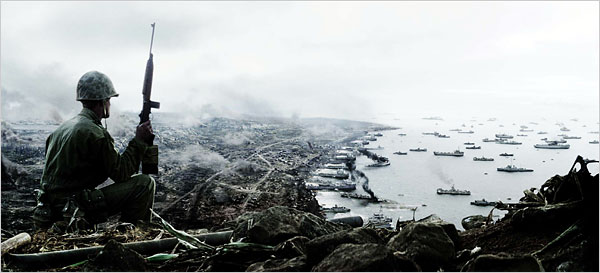
I was also a little mixed on Eastwood’s battle scenes. The visuals are at their best during the wide shots of the battlefield or the Naval fleet around the island. There are also a few really cool scenes involving airplanes attacking Japanese hillside fortifications. But the ground combat seemed to be missing something. There certainly are moments of intensity but as a whole things looked plain and with the exception of a few standout scenes, the combat feels a bit repetitive. I’ve thought that maybe I’ve seen too many war films and maybe the combat in movies doesn’t pack the same punch that it used to. But I don’t think that’s the case here. Eastwood is trying to create the same atmosphere that those soldiers faced back in 1945 but it’s the actors that relay that more than the visuals.
The performances are strong and the big cast of quality actors add a lot to the film. Phillippe is really good both on the battlefield and during that stateside scenes. I also enjoyed Beach’s performance as the Native American soldier who fighting more than just one war. There are several other good performances from the likes of John Slattery, Barry Pepper, and Neal McDonough.
“Flags of Our Fathers” ends with a poignant reminder of just how much this war effected our country and our people. In many ways it’s the final 15 or 20 minutes that helped bring everything together for me. I was really mixed during several parts of the film but after seeing it through, I get a better idea of what Eastwood is conveying. It’s a story of patriotism, sacrifice, and brotherhood. But it’s also a film about desperation, vulnerability, and exploitation. It does become a little melodramatic but never to the point of drowning us. Instead the bigger problems centered around the movie’s structure and it’s so-so combat scenes. But I still find “Flags of Our Fathers” as an easy movie to recommend and it certainly looks at the war with sincerity and care.


