REVIEW: “Hercules”

HERCULES POSTER

If you would have told me ten years ago that WWE wrestler-turned-actor Dwayne “The Rock” Johnson would become the highest paid actor and busiest man in Hollywood I would call you insane. But that’s exactly what has happened. It seems like his face pops up everywhere. Case in point – last year alone he appeared in five different films. But as any halfway discerning movie fan knows, not all of Rock’s films have been gems and I can’t say I was expecting much from his latest flick “Hercules”.

But there is something surprisingly effective about “Hercules” that makes it easily watchable despite its glaring flaws. Brett Ratner directs which threw up all kinds of warning signs for me. I’ve disliked my share of his past films, but this one is actually fun in large part thanks to its charismatic and likable lead and the fun assortment of supporting talent. But I give Ratner credit, he doesn’t derail the film’s momentum and he keeps it within a nice, tidy 98 minutes.

HERCULES1

This isn’t the normal Hercules story you’ve read about or even seen in the rather misleading movie trailer. This is based off a graphic novel titled “Hercules: The Thracian Wars”. At first we hear the legend of Hercules – the demigod son of the mighty Zeus. In reality he’s just a mortal who has a ton of muscles, great battlefield skills, and a pearly white smile. He leads a colorful band of mercenaries that includes prophet (Ian McShane) who is always wrongly predicting his own death, an Amazonian archer (Ingrid Bolsø Berdal) with endless supply of arrows, his knife-slinging childhood friend (Rufus Sewell), a hatchet-wielding warrior from Thebes (Aksel Hennie), and his nephew (Reece Ritchie) whose main job is to build the legend of Hercules through his exaggerated stories.

Hercules and his crew are approached by Princess Ergenia (Rebecca Ferguson) and offered a ton a gold to help defeat a murderous warlord who is burning villages and killing innocents. Herc agrees to meet with Lord Cotys (John Hurt) and the two strike a deal. Hercules will train the makeshift army of farmers and lead them into battle defeating the evil warlord and bringing peace across the lands. Oh please, you know things aren’t that simple.

Actually things really aren’t that simple and I’m thankful for that. The story does start out cliched and incredibly formulaic. So much of the dialogue, narrative structure, and plot maneuvers are things we’ve seen in so many other fantasy films. But the story does have a couple of twists that shake things up and keep it interesting. There is also an enormous amount of action, much of which pushes the PG-13 violence boundaries. People are skewed, impaled, burned, and sliced in rapid succession and it’s quite amazing the film avoided an R rating. The action sequences, much like portions if the plot, do sometimes feel lifted from other films. But they’re also a lot of fun mainly because Ratner keeps them energetic and embraces the absurdity of it all.

HERCULES2

Now I have to admit, at times I found it hard to buy into The Rock as Hercules. It has nothing to do with his performance (he is surprisingly good here and continues to get better as an actor) and he certainly has the look. But the above mentioned charisma that he naturally possesses kept bringing visions of The Rock and not Hercules. But he has a lot of fun with the role and which made it fun for me. It also helps to have really good actors like Hurt and McShane having a blast with their characters.

It’s impossible to call “Hercules” a great movie mainly because it lacks originality and borrows too much from too many other films. From its plot and dialogue all the way to its use of its score, “Hercules” feels way too familiar. But it is easy to call the film fun and it is definitely a pleasant surprise. It’s a ‘kick your feet up’ action movie and never makes the mistake of taking itself too seriously. It may be a ‘one and done’ popcorn flick, but I have to admit it is an enjoyable escape.

VERDICT – 2.5 STARS

REVIEW: “Hateship, Loveship”

HATESHIP POSTER

It’s always interesting to watch actors or actresses who make their living in comedy tackle dramatic material. Many comedians have a natural impulse to draw attention to themselves. It’s the nature of their humor. That’s why certain dramatic roles are so difficult for them. I think that’s what makes Kristen Wiig’s performance in “Hateship, Loveship” so compelling. There’s nothing showy or attention-grabbing about it, and for a comedian that could be hard hurdle to clear.

I’ve always found Wiig to be funny, but here she has to dial it back and put away any hint of flash or swagger. She plays the quiet and withdrawn Johanna Parry. As the film opens we see her as the caretaker for an elderly woman. It’s something she has done since she was 15 years old. At first glance Johanna’s clothes give the illusion that we are watching a period piece. At one point in the film she is called “Little House on the Prairie”. But actually her world has revolved around her caretaking and she’s has had practically no social life whatsoever.

HATESHIP1

The elderly lady dies which frees Johanna in a variety of ways. She immediately lands a job in small town Iowa as a housekeeper for Mr. McCauley (Nick Nolte) and his teenage granddaughter Sabitha (Hailee Steinfeld). Sabitha lives with her grandfather because her mom was killed in a car wreck and her dad Ken (Guy Pearce) is an unreliable come-and-go father with a drug problem. A resentful Sabitha and her best friend Edith (Sami Gayle) play a cruel joke on Johanna making her think that Ken is attracted to her through a series of fraudulent emails. This causes Johanna to make some spontaneous but earnest decisions which shifts the movie into an entirely new direction.

Many of the movie’s later plot turns may seem a bit implausible but writer Mark Poirier wisely keeps his focus on the characters and director Liza Johnson allows them the room to breathe and grow. This is important because “Hateship, Loveship” is all about relationships – fractured relationships, rekindled relationships, potential relationships. There is no magic formula to what makes this a good movie. It’s simply a collaboration between filmmakers and performers who know how to tell a smart and focused story.

Guy Pearce and Kristen Wiig in Hateship Loveship (2013).

The cast sparkles and everyone is given some level of character complexity. As mentioned, Wiig is fantastic. Her dowdy, naive, and socially awkward Johanna is the emotional centerpiece. It’s a beautifully reserved performance and it takes some time to truly appreciate what she’s doing. The always reliable Pearce has no problem revealing the multiple sides of Ken. In one scene you feel sympathy for him. The next scene he does something utterly shameless. And I do love Steinfeld. She’s a great young actress with a long career ahead of her. Veteran actor Nolte is absolutely perfect and Gayle is shockingly vile. And then there is the small but lovely performance from Christine Lahti.

“Hateship, Loveship” is a modest but compelling character study – a film that is most interested in people and the relationships they share both good and bad. There are a couple of twists that you just have to go along with, but I had no problem doing it. That’s because I cared about these characters. They aren’t paper-thin caricatures or boring, lifeless clichés. Johnson’s direction and Poirier’s script doesn’t allow them to be and because of that “Hateship, Loveship” is a pleasure to watch.

VERDICT – 4 STARS

REVIEW: “The Hobbit: The Battle of the Five Armies”

HOBBIT POSTER

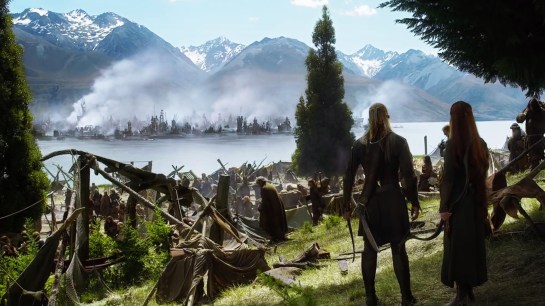
The biggest question swirling around Peter Jackson’s “The Hobbit” trilogy has been centered around the amount of content. Is there enough of it in J.R.R. Tolkien’s book to warrant three Jackson-sized films? That question has lingered in the back of my mind as I’ve watched each of the ‘Hobbit’ movies. The first two films sometimes struggled to suitably fill their time yet they managed to keep me engaged. Now we have Peter Jackson’s third ‘Hobbit’ film and final trip to Middle Earth. It’s “The Battle of the Five Armies” and I can see where people would say it is stretched too thin.

But to the question – Could “The Hobbit” have been adapted into two movies instead of three? I think the essential material could have definitely been covered in two installments. But at the same time “The Battle of the Five Armies” actually manages its time better than the previous films. Essentially it’s the trilogy’s big action-packed ending. The vast majority of the film is spent building up the climactic battle and then letting go with an epic-sized blow out. I had fun with it and it was far from the snoozefest I feared it would be.

HOBBIT2

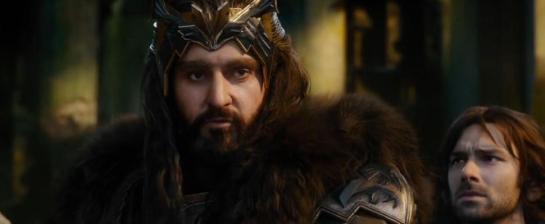
The film picks up exactly where the last one left off. There is no time jump. There is no setup. Smaug the dragon is loose and attacks Laketown. Bard (Luke Evans) guides the displaced people to safety and becomes their de facto leader. Thorin (Richard Armitage) and his band of dwarves have taken back The Lonely Mountain and its immense deposits of gold and riches. Problem is Thorin has gone mad with what is called “Dragon Sickness” and refuses to share his new-found wealth with Bard so that the people of Laketown can rebuild.

Then you have Thranduil (Lee Pace) and his elf army who come to the mountain to claim a white diamond necklace from the treasure. A blinded Thorin refuses and would rather fight than give up one piece of the mountain’s riches. With war about to break out between elves, dwarves, and humans, Gandolf arrives bearing news of a massive Orc army coming to take the mountain. The question becomes can they put aside their differences and come together to fight a much bigger and more deadly threat?

It’s hard to call this film a standard sequel considering the way it’s structured. It is much more of a direct continuation and I simply can’t objectively look at it as a stand-alone movie. It’s impossible to separate it from the previous film, and anyone watching this one without seeing part two will undoubtedly have a lesser experience. But as a follower of the series I think the film does a good job of picking up the story and bringing it to a conclusion. The performances are strong and steady and the effects are simply incredible. The action-fueled final hour features some great sword play and a cool host of creatures.

HOBBIT1

But let’s face it, the series has several things working against it. It’s almost impossible to keep from comparing it to the superior “The Lord of the Rings”. First let’s take the characters. I love Bilbo, Thorin, and Gandalf, but the secondary characters, while good, aren’t up to those in LotR. Then you have the big conclusion itself. This big sprawling final battle is extremely cool, but it carries almost no connection to the previous two films. In LotR the buildup to the big finale started in the first film. Everything worked towards that epic point. In this film the battle doesn’t carry near as much weight, and I wasn’t left feeling quite as satisfied. But is it really fair to compare this film to LotR? I don’t have a good answer to that.

I do think this is a stronger film than some give it credit for. It’s a tighter and more focused movie and runs 20 minutes shorter than either of the first two Hobbit films. More importantly it feels in tune with the previous movies and offers us an exciting and fitting conclusion filled with great action and emotion. Could the series have been better as a whole? It probably could. But I find it hard to point a finger at this film as the reason for that. Narratively speaking this may be the best film of the three. It just had the difficult task of also wrapping everything up. It certainly did that well enough for me.

VERDICT – 4 STARS

REVIEW: “The Heiress”

HEIRESS POSTER

At times William Wyler’s “The Heiress” comes across as an extravagant stage production. That makes sense since it was adapted from the popular 1947 Broadway play. But the original story actually came from the the 1880 novel “Washington Square” by Henry James. Husband and wife playwrights Augustus and Ruth Goetz brought James’ book to the stage and were later convinced to write the film’s screenplay. Their familiarity with the material and their mellifluous writing style mixed perfectly with Wyler’s perfectionism. The result was a highly acclaimed that still garnered critical praise and several Academy Awards.

In many ways the film’s star Olivia de Havilland can be thanked for making the movie happen. She went to see the play based on a recommendation and before it was even finished she was making calls. She first convinced the wonderful William Wyler to direct the film. He was instrumental in getting studio support and in convincing Augustus and Ruth Goetz to write the script. Montgomery Clift added another popular face to the production and the wonderful Ralph Richardson, who had taken part in a London stage version, was also cast.

Heiress2

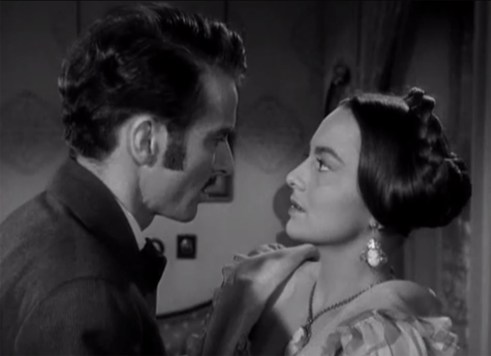
The story is set in 19th century New York City and focuses on a plain and reserved young woman (de Havilland) from the upper-class Washington Square neighborhood. She lives with her wealthy and proper father (Richardson) who does a poor job of hiding his disappointment. Her shyness and naivety draws her father’s insults and disenchantment and her feelings of self-worth are practically nonexistent. But their relationship takes a worse turn when she starts a relationship with a charming young man named Morris (Montgomery Clift). Her father thinks Morris is after her inheritance and he certainly doesn’t believe she’s capable of attracting a decent man. This three-way conflict makes up the core of this story.

“The Heiress” is unquestionably talky, but when the script is so fluid and its placed in the hands of such great performers, it’s easy to get lost in it. The Goetzs have no problem moving the story from stage to screen and Wyler’s directorial fingerprints are everywhere. His calculated long takes and his precise attention to detail are just some of the things you’ll notice. The film moves at a wonderful pace and it always keeps its focus. It also takes some pretty heavy subjects and treats them with respect.

HEIRESS1

And then again you have the marvelous performances. Olivia de Havilland is nothing short of fabulous and she would go on to win her second Academy Award for her performance. Ralph Richardson is simply perfect as the arrogant aristocratic father. His well-spoken eloquence and tinge of snobbery is exactly what the role demanded. And then we have Montgomery Clift who I think does marvelous work. Apparently he didn’t think so. It’s said that Clift disliked his performance so much that he left the premiere before the film ended. That is definitely a case of being your own worst critic because I thought he was excellent.

“The Heiress” is a true motion picture classic and it is crafted by the talents of some of the best filmmakers and performers to ever work in the business. It has a very stagey feel and rightfully so. But it’s great drama that dissects and exposes its characters while telling a dense and emotional story. This film may not draw the attention of some modern moviegoers but it should. If you love movies, treat yourself by seeing “The Heiress”.

VERDICT – 4.5 STARS

REVIEW: “The Hunger Games: Catching Fire”

HUNGER POSTER

The 2012 film “The Hunger Games” launched a new movie franchise to the tune of almost $700 million at the box office. It was based on Suzanne Collins’ equally popular book series – one that I had never heard of prior to the film’s announcement. The story is dystopian science fiction and it examines themes such a class disparity, oppression, and the infatuation with reality television. It wasn’t a perfect movie but it stood head and shoulders above other popular film franchises aimed at this age group. With a good cast locked in and the groundwork laid for a fairly interesting premise, the inevitable sequel had a lot of potential and expectations.

“The Hunger Games: Catching Fire” hit theaters with even bigger fanfare than the first film. It raked in over $860 million and received hearty praise from critics. Personally I felt there was room to improve from the first film, but I didn’t expect to find a significantly better movie. I really enjoyed “Catching Fire” and I was impressed at how many trappings it avoided. So often movies of this type and sequels in general make the same mistakes which more often than not lowers the quality of the film. “Catching Fire” does several things better this time around and it starts with the story.

CATCHING1

This film begins shortly after Katniss (Jennifer Lawrence) and Peeta (Josh Hutcherson) have won the 74th Annual Hunger Games. The two have returned to District 12 where Katniss has convinced her local boyfriend Gale (Liam Hemsworth) that her “love” for Peeta was just an act to survive the games. She is paid a surprise visit by President Snow (Donald Sutherland) who informs her that she and Peeta will be going on a victors tour to the other districts. He also expresses displeasure in her defiant actions during the games which have fueled a rising underground rebellion against his Capitol. He intends to use the tour to influence public opinion but in secret he feels the only way to solve his problem is to kill Katniss.

Woody Harrelson returns as the goodhearted boozer Haymitch and Elizabeth Banks is back as Effie, the queen of gaudy fashion overkill. The two clearly have affections for Katniss and Peeta and they both understand the danger and intensity of their situation. They try to prepare the two victors for the tightrope they must walk between energizing the revolution and bringing the wrath of President Snow to their home district. Director Francis Lawrence does a great job of ratcheting up the tension during this part of the story and the stakes are raised particularly when some of the tour stops to oppressed districts don’t go as planned.

CATCHIN2

The story then takes a sharp turn with the out-of-the-blue announcement of the Third Quarter Quell. Basically ever 25 years the Hunger Games are “celebrated” with a special set of rules that normally serves the Capitol’s interests. President Snow decides that the 75th games will consist only of past winners. Since Katniss is the only female to win from District 12 she is automatically put into the games which Snow hopes will take care of his little problem. For me this is where the movie does spin its wheels a little. In what felt like a slight retread from the first film, we go back through the glitzy chariot presentations of the players, their appearances on Stanley Tucci’s whacky talk show, and the showcase of their skills before the bigwigs. It doesn’t play out as long as it did in the first film but I did find myself anxious for things to movie along.

But once the games do start the film gets right back on track. There are a number of interesting twists and angles that come from a variety of different directions. That is what provides the film with its own identity. “Catching Fire” maintains the grand scope and ominous threat of the first film, but it magnifies it and then takes it into its own place. A lot of it has to do with the progression of Collins’ story, but I give a lot of credit to Francis Lawrence’s direction and the screenplay from Simon Beaufoy and Michael duBruyn.

CATCHING3

It also helps that the acting takes a step up. Lawrence is fabulous and I would take this performance over her good but generic work in “American Hustle”. She is the heart and soul of the film and her abilities to sell her character both emotionally and physically are vital. I also think Josh Hutcherson make significant strides. His acting was a weakness in the first film but both he and Liam Hemsworth make obvious improvements. It was also great seeing some new characters played by really talented actors. Philip Seymour Hoffman (in what is one of his final roles) shows up as Snow’s new Gamemaker. I also really liked Jeffrey Wright as a studious fellow games participant.

I enjoyed the first film of this popular franchise even though I didn’t think it was great. That alone was enough to make me curious about “Catching Fire”. What I didn’t expect was to be completely enthralled in it from start to finish. “Catching Fire” is a big budget franchise entry that manages itself well and pulls off what many are incapable of doing. It not only adds to the groundwork laid by its predecessor, but it improves on it in nearly every area. And perhaps this movie’s biggest trick was to make ME thoroughly interested in what happens next. That of itself was a major accomplishment.

VERDICT – 4.5 STARS

REVIEW: “Her”

HER POSTER

In the not too distant future of Spike Jonze’s “Her” technology has made major leaps, fashion senses have eroded, and Hollywood’s cynical views of relationships have remained the same. Loaded with ambition and lauded by many as the best movie of 2013, “Her” incorporates a familiar science-fiction concept into what is more or less a love story and relational study. But it’s far from conventional or cliché. That said, it isn’t a film free of problems which (for me) ultimately keep it from being the modern day masterpiece that some are touting it as.

The story revolves around Theodore Twombley (Joaquin Phoenix), a nerdy introvert who works as a letter writer for people who have a hard time sharing their feeling. Theodore is a lonely soul. He’s currently involved in divorce proceedings from his first wife Catherine (Rooney Mara) and he hasn’t been able to get out of his ever-present state of melancholy. He has practically no social life and outside of his longtime friend Aimee (Amy Adams), there is no significant person in his life.

HER2

Theodore’s life takes a strange and unexpected turn when he purchases a new operating system for his computer. But this is no Windows XP. It is an adaptive artificial intelligence that evolves and takes on its own personality. The OS (voiced by Scarlett Johansson) goes by the name Samantha and soon develops a very personal and intimate relationship with Theodore. Samantha begins to fill the lonely void in Theodore’s life while he becomes her window to a new and exciting world. But the reality that she is an operating system causes him to wrestle with the legitimacy of their relationship.

The science-fiction mainly serves as a subtle backdrop with the exception of the familiar idea of computers becoming sentient. But Jonze deserves credit. He’s really doing a lot more here than first looks might reveal. He takes an interesting look at our infatuation with our gadgets and where that could perceivably lead us in the future. There is also a strong focus on communication or lack thereof. The film shows us several relationships that struggle due to the poor abilities to communicate. And speaking of struggles, prepare for a lot of them. In Jonze’s gloomy view of love, nearly every relationship struggles and has a rare hope for survival.

Her3

On the other hand, it’s the rich and unbridled conversations between Theodore and Samantha that causes their relationship to flourish. There are so many scenes of them just talking about simple things that may seem inconsequential but that are vital to making a relationship work. Phoenix is amazing and completely wraps himself up in his character. He displays an enormous range of feelings with such realistic fervor. And Johansson shows why voice work is deserving of more attention than it’s given. Her voice is sultry and sexy but it’s also warm and vulnerable. These two show a deep and growing attraction, yet even here we see Jonze use a little bait and switch.

But while I really appreciate Jonze’s originality and I love being challenged by deeper thought-provoking approaches, there were a handful of things that kept me from fully embracing this as a great film. First there is the movie’s glacial pacing specifically in the second half. The aforementioned conversations between Theodore and Samantha are good at first, but they reach a point where they no longer move the story along. The countless closeup shots of Phoenix laying on a pillow talking to Samantha well after their love has been established grew a bit tiresome. This only slowed things down for a movie that already had a calculated and deliberate pace.

HER1

The film also contains some unneeded scenes that added little to the movie. Olivia Wilde pops up as Theodore’s blind date. While her presence had a purpose, she was a very flimsy, throwaway character. There is also a weird scene where Samantha calls on a surrogate to serve as her physical body in order to be intimate with Theodore. It’s an intentionally uncomfortable scene laced with a touch of dark humor. But as it plays out things get sloppy especially with the surrogate character herself. And then there are these occasional odd tone-shattering attempts at humor. One involves a lewd act with a dead cat’s tail and the other features a cartoony video game character who suddenly spews a river of obscenities. This silly juvenile humor came across as cheap and both scenes felt completely out of place.

I wish I could toss aside those complaints because “Her” does many things right. It asks some great questions and it certainly allows for a variety of interpretations. For example take the ending. Depending on your interpretation it could be a very light and hopeful ending or a very dark and depressing one. I liked that. I love the work we get from Phoenix and Johansson and Rooney Mara’s character added a deeper emotional twist that I really responded to. But the film’s cynicism, the constant lingering of the second half, and some questionable script choices hurt my experience. It’s one of the few movies that captivated me yet had me checking my watch before it was done. Ultimately that’s a disappointing combination that pushed me away a bit.

VERDICT – 3 STARS