As many do, I often look forward to giving specific films a second look. There are certain instances where a movie simply doesn’t click for me. It may be a movie that I originally approached with ridiculously high and unobtainable expectations. It may be from filmmakers with a track record for creating movies I truly love. Everything I just said fits perfectly with my first experience with “Hail, Caesar!”. But what a shift following a second look. For that reason I feel compelled to dust off the old review and offer up some pretty dramatic revisions.
I have to think it takes a specific sensibility to pull of a Golden Age of cinema parody especially in today’s movie climate. Modern comedies seem content with sticking to tired formulas and they rarely step outside of those boxes. And unfortunately these retreads attract big enough crowds to keep the filmmakers comfortable in the genre’s monotony.
Enter Joel and Ethan Coen, a directing duo who has never played within the conventional or the formulaic. Over the years they have dabbled in a number of genres, never conforming to a popular norm and always putting their own special spin on them. Whether its comedy (“Raising Arizona”), action thrillers (“No Country for Old Men”), westerns (“True Grit”), gangster pictures (“Miller’s Crossing”), or even wild amalgamations of several genres (“Fargo”), the Coen brothers are always approaching things from a unique perspective.
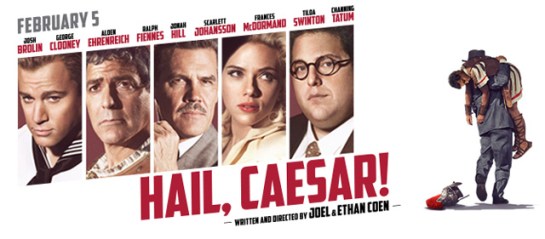
Their latest is “Hail, Caesar!”, a comedy written, produced, edited, and directed by the Coens. The film is set in 1950s Hollywood where big studios still run every facet of moviemaking including their laborers. Josh Brolin plays Eddie Mannix, a real life studio “fixer” represented here with that expected Coen brothers twist. As a fixer Mannix’s job at Capital Pictures is to protect the images of Hollywood stars by hiding their bad and potentially damaging behavior from the public eye.

While the trailer shows off a star-studded cast, this is Brolin’s picture and he does a fine job. The film centers itself around the various ins and outs of his studio management. The supporting cast is mostly seen through bit parts, some of which are nothing more than glorified cameos – Scarlett Johansson, Channing Tatum, Jonah Hill, Tilda Swinton. The best appearances come from Ralph Fiennes and Frances McDormand. Fiennes is particularly great in channeling the same sharp comedic timing he showed in Wes Anderson’s “The Grand Budapest Hotel”.
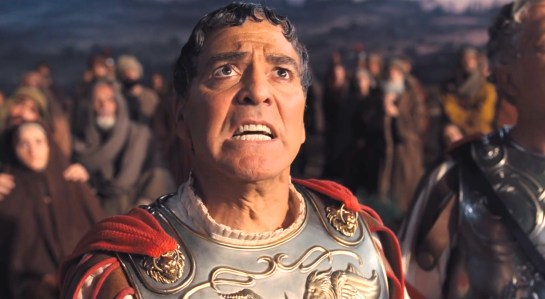
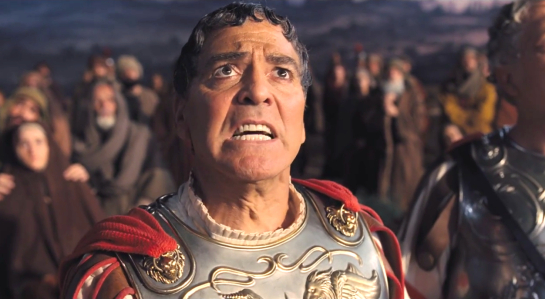
The bigger of the supporting roles go to George Clooney and Alden Ehrenreich. Clooney, the Coen’s favorite numbskull, hams it up as Capital Pictures’ biggest star who ends up kidnapped by a mysterious group known only as “The Future”. Ehrenreich plays a singing cowboy (think Gene Autry) who ends up terribly miscast in a stuffy period drama. He may be the biggest highlight offering up some of the film’s biggest straight-faced laughs.
The Coens throw out so many winks and tips of the hat to the people and the system of ‘Old Hollywood’. The film is a veritable collage of homage and parody. Much of it is sure to put smiles on the faces of classic cinema fans. We get a big dance number. We see scenes shooting on big studio lots. We see the politics behind making a Ben-Hur-ish prestige film. And of course communism rears its ugly ominous head. All of these things are a ton of fun and are laced with the Coens signature off-beat humor.

I think an argument can be made that this film lacks a satisfying narrative thread to bring together all of its quirky elements. Perhaps more focus on a central story would help. But the Coen brothers never restrict themselves to formulas and aren’t afraid to work with a ton of moving parts. “Hail, Caesar!” certainly has many moving parts. But unlike my first viewing which was clouded with irrationally high expectations, this time I was able to connect the dots and better define the Coens’ vision for the film.
“Hail, Caesar!” is very much an homage to classic moviemaking. It’s a wacky missing person caper. It’s a story of a man navigating personal and spiritual crises. It’s all of those things plus some. If you try to view it through a linear lens you’ll probably come away disappointed. This time my expectations were tempered, my focus was broader, and my experience was profoundly better.
VERDICT – 4.5 STARS