“How the Grinch Stole Christmas” – 2 STARS

GRINCHAs audacious as filmmakers can sometimes be, their finished products don’t always match their ambition. Such is the case with the normally reliable Ron Howard’s “How the Grinch Stole Christmas”. When I first saw this film, I left the theater with a pretty gnarly opinion of it. My dislike has eased up after a recent viewing, this time in the presence of my two children. They thoroughly enjoyed the picture and watching their pleasure naturally effected my experience. But while I have a slightly more favorable opinion of the film now, it can only go so far, and I still can’t call this a good movie.

Howard certainly had his work cut out for him. First, making a feature-length film out of a 26 minute animated short was a challenge. The script makes some required additions, some that work and more that don’t, and gives its star Jim Carrey many scenes by himself to just do his thing, this time in full green Grinch attire. When first seeing him, you’ll wonder how you’ll ever take the Grinch getup seriously, but the truth is it’s a pretty amazing transformation (Rick Baker and Gail Ryan won the Oscar for Best Makeup). But his shtick grows tiresome after a while and you almost feel like you’re watching a standup routine instead of a full-length movie. The film also creates storylines involving the Whos to try to stretch things out. But honestly, other than the expansion of the ‘cute as a button’ Cindy Lou character (played nicely by current hard rocker Taylor Momsen), the Whoville storylines are flat and utterly forgettable.

The second big challenge was visually capturing this unique world created by the pen of Dr. Suess in 1957 and the classic animation of Chuck Jones in 1966. I have to say the film looks pretty incredible. The scenery and background environments are nothing short of gorgeous and certainly capture the location created in the original material. Whoville is a busy and colorful assortment of visual splendor which makes watching these Christmas loving locals go about their frantic lives a bit easier in spite of Howard’s roughshod directing. On the other hand I didn’t remember the Whos looking quite so freakish. Their protruding front teeth, wolf-like noses, and peculiar hairdos more closely resembled small woodland rodents. To be honest, they were pretty silly looking and a bit distracting.

grinch photo

But for me this movie’s biggest transgression lies in its overall lack of charm that made the original short so great. Now to be fair, Howard does try to inject some feeling into the storyline. He does try to give it some heart. But these few instances of emotion are smothered by the film’s overall dependency on in-your-face slapstick and bathroom humor which sometimes makes it feel more like a dark comedy than a spirited Christmas film. The main story of the original is still intact and there are several clever nods that fans of the original will appreciate. But unfortunately it’s missing too much of the key component that made 1966 short so special – heart and soul. Carrey gives it his all, but Howard pushes too far.

“How the Grinch Stole Christmas” would be tough for any filmmaker to transform into a feature-length film. But here Ron Howard shows us enough to know that it can be done. But he, along with a sometimes grinding script, undermine everything they get right. Yet I still have to say that my reaction to the film now isn’t as vitriolic as it initially was. In fact, I can appreciate what the film does well a lot more especially after watching it with my children. But even with all of its aspirations and risk-taking, it still falls short of being the really fun movie that it could have been. With a little more polish and a lot more restraint this could have been a holiday treat. Instead it’s a repetitive and sometimes laborious exercise that just doesn’t pack the emotional punch that it should. That’s a shame.

REVIEW: “House on Haunted Hill” (1959)

I’ve recently spent a lot of time concentrating my movie watching on the horror and science fiction movies of the 1950s. This has proven to be a wonderfully entertaining project that’s allowed me to revisit movies I haven’t seen since I was a child as well as see new films that have been a joy to discover. Such was the case with William Castle’s “House on Haunted Hill”, a movie that I had heard of but never had the opportunity to catch up with. Now after finally seeing it, I can honestly say that I was thoroughly entertained. It’s a solid mixture of eerie tension and classic camp presented through a simple yet effective story.

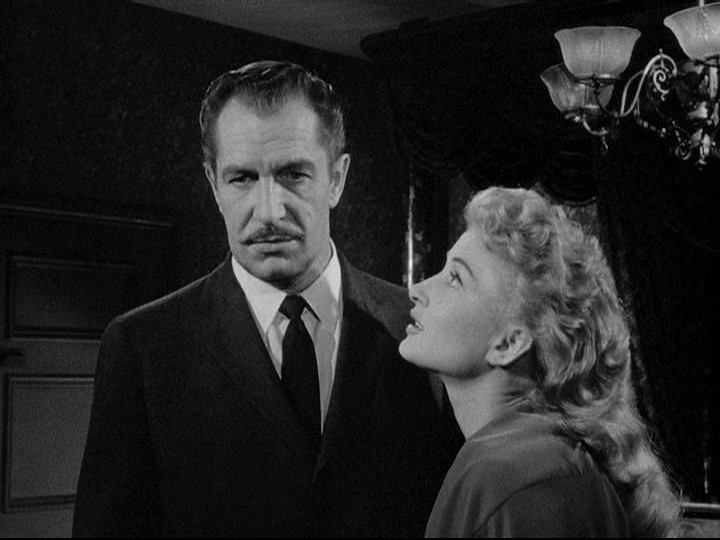
The great Vincent Price stars as a mysterious millionaire named Frederick Loren. Imagine that, Price playing a mysterious character. Loren has rented a house with a very violent history and has invited five individuals to spend the night there. He bribes each with the possibility of making $10,000 each. All they have to do is live through the night. The entire thing is painted to be some type of twisted party for his wife Annabelle (Carol Ohmart). But soon the guests are terrorized by several unexplained occurrences and they begin to question whether or not the house is haunted or if they are in the middle of something much more sinister.

Of course we ask ourselves why these people would ever agree to come to such a creepy place to begin with. But in the opening of the movie, as the five are each brought to the house in their own hearse, we learn that each has their own important need for the money. As the story unfolds, I found myself being suspicious of several of the people while never being able to finger any of them. That’s a mark of good, suspenseful storytelling. Now I have to admit, as with many of these movies I kept thinking of better methods the group could use to ensure their survival. But that’s nitpicking. Afterall, wouldn’t things be really boring if they all used their brains?

The movie has several creepy effects that I must admit were quite gruesome considering the time the movie was released. Admittedly there were also some dated special effects that I couldn’t help smile at, but that were also part of the charm of watching these classic horror pictures. Castle’s inventive techniques were quite clever despite the small budget he had to work with. The atmosphere is pitch perfect and I found it easy to get lost in the spooky old house where the entire movie takes place.

Castle was known for his affection for horror and his numerous low-budget B-movies became a fixture in 1950s cinema. One thing that audiences often times experienced when watching one of Castle’s pictures was some type of theater gimmick. When “House on Haunted Hill” was released, moviegoers were treated to a floating skeleton that floated across the theater during a certain moment in the film. While we don’t get to experience that type of old-school fun when we watch the film, it’s still a highly entertaining piece of classic horror filmmaking wrapped up in a tight, compact 75 minute package.

“House on Haunted Hill” is a great example of how much fun the horror films of that period could be. Sure there’s some cheesy, stilted dialogue, the story is simple, and the effects aren’t going to satisfy someone expecting the best. But it’s a lesson in classic horror led by the master himself, Vincent Price. And considering much of the so-called “horror” that we get today, this was even more refreshing.

VERDICT – 4 STARS

REVISITING “THE HUNGER GAMES” – 3.5 STARS

With this week’s release of the incredibly popular “The Hunger Games” on DVD and Blu-Ray, I had a chance to see it for a second time. I thought it would be fun to share my review of the movie again for those who may be newer to my blog. What are your thoughts on this much talked about picture? Were the odds ever in your favor as you sat down to see what all the hype was about? Here’s my take.

It’s been called the next big thing at the movies. It’s projections point to an opening weekend of around $150 million. Fans are filling theaters with anticipation. With such hype and expectations, how is it that I had never heard of “The Hunger Games” before seeing its first movie trailer? Expected to be the first in a profitable series, “The Hunger Games” is based on a series of novels written by Suzanne Collins. It’s a dystopian science fiction film that’s based on a preposterous premise yet it manages to be strikingly entertaining.

With the “Twilight” series mercifully set to end later this year, “The Hunger Games” is looked at as the next big franchise and has even drawn some misguided comparisons to the romantic vampire versus werewolf films. But there are several things that separate “The Hunger Games” from the “Twilight” series. First, this film opens itself up to a much broader audience. The movie embraces several good sci-fi and action elements that should appeal to a wider variety of moviegoers. “Twilight” made millions but had a much more restricted target audience. Also “The Hunger Games” made a point to bring in quality performers and it really shows in the finished product. The acting is head and shoulders above the teeth gnashing performances in “Twilight”. In other words, “The Hunger Games” has more to offer than many of the other popular multi-million dollar series.

The movie takes place in Panem, a nation broken up into 12 districts. It’s a futuristic world that features a capital city filled with advanced technology surrounded by landscapes that resemble the Ozark or Smokey Mountains. The power and affluence are confined to the Capitol while the outer districts are filled with poverty-stricken villages struggling to survive.  We learn that years ago there was an uprising in the districts that resulted in a strong militaristic response from the Capitol. After quenching the uprising, The Capitol instituted “The Hunger Games”, an annual competition that required each district to provide one boy and one girl between the ages of 12 and 18 to compete against each other in a survival fight to the death. There would be only one winner and that winner would receive fame and glory. The games were intended to serve as a lifelong punishment for the district’s uprising and to show the twisted view of mercy and forgiveness of the Capitol.

To add yet another warped component to the story, The Hunger Games have become a Super Bowl like event. Much like 1987’s “The Running Man”, citizen’s throughout the capital city watch and cheer the games like they would a major sporting event. Special events and talk shows centered around the participants and leading up to the games are soaked up by the heartless and blood-thirsty Capitol crowds. In contrast, those watching in the outer districts do so not out of sport but out of concern for their loved ones. The movie goes all out to show a stark economic and moral difference between the wealthy city people and the poor district citizens. It’s a contrast that looks to play a bigger role in the future films.

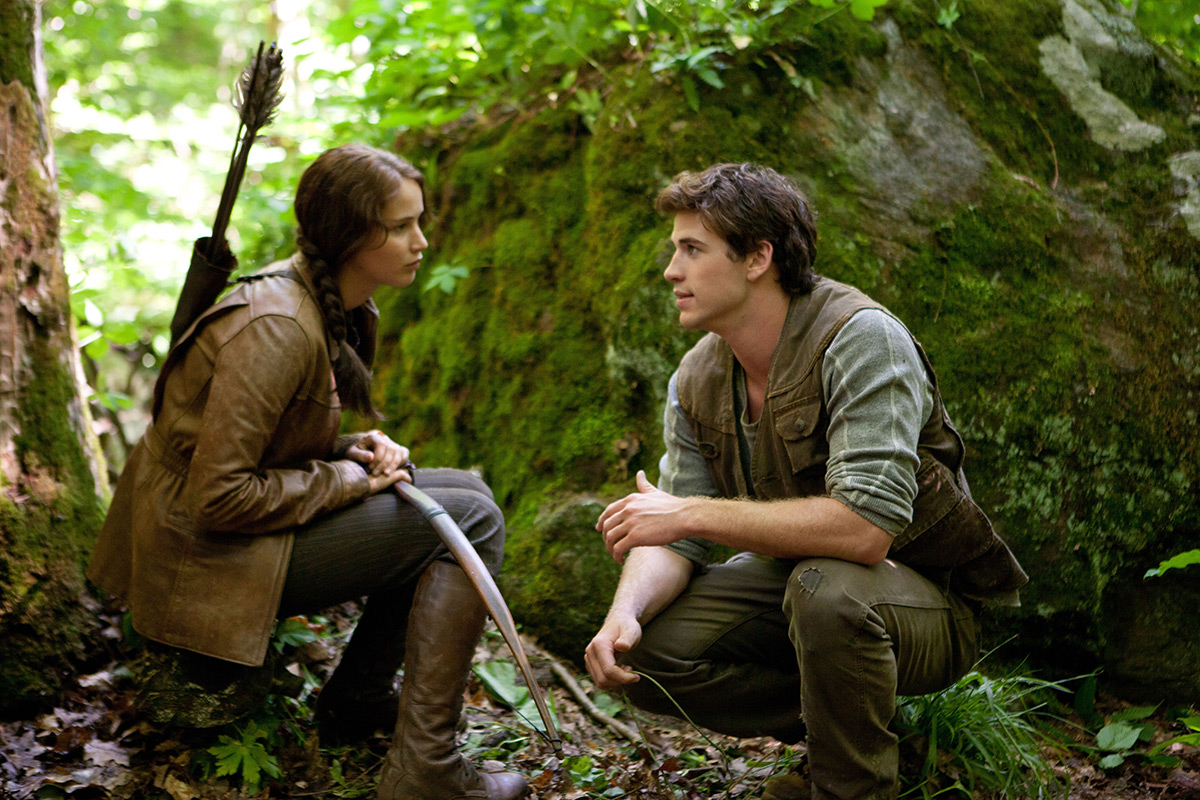
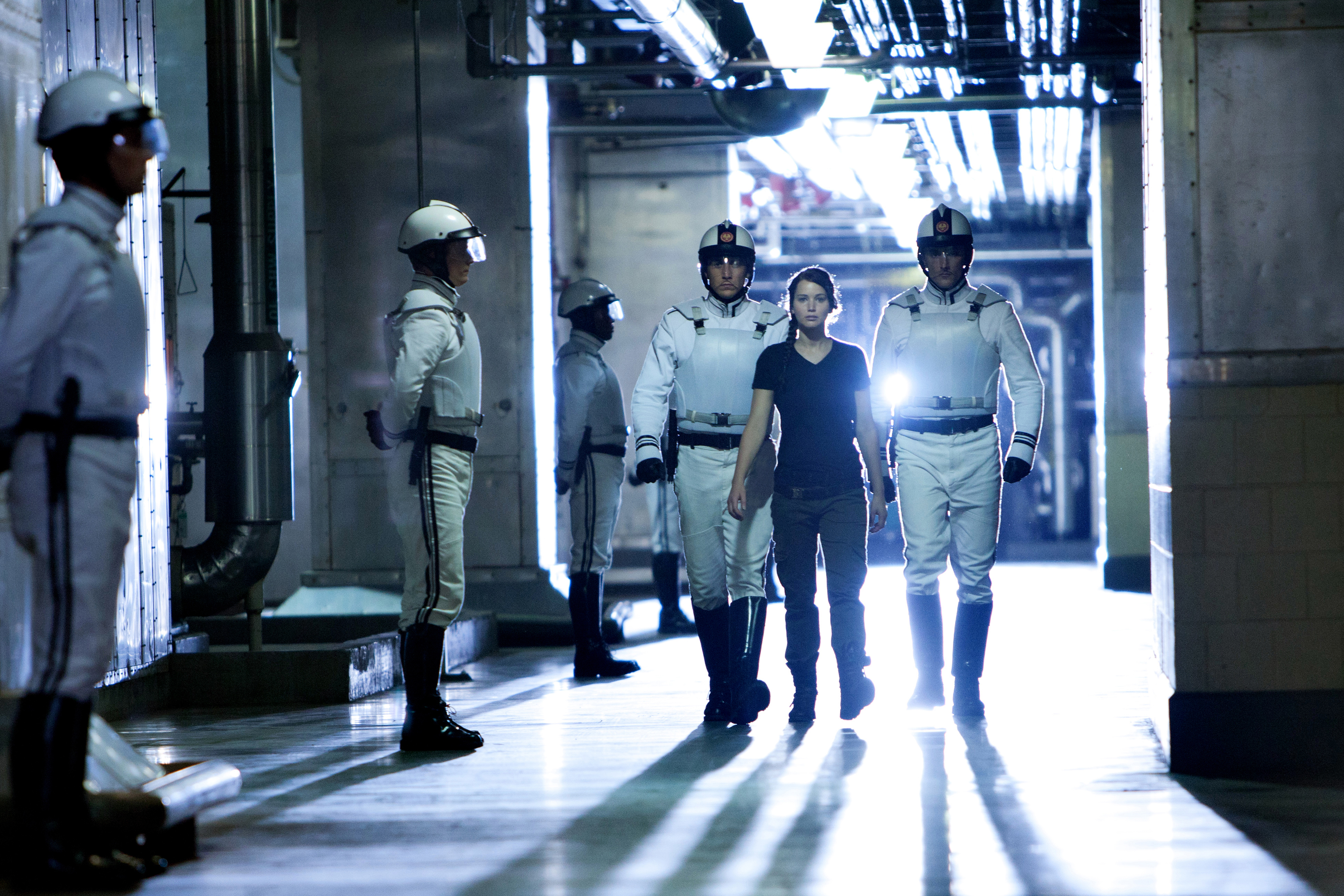
The movie starts inside the very poor District 12. Jennifer Lawrence plays Katniss Everdeen, a tough 16-year old girl forced to take care of her mother and little sister Prim (Willow Shields) after the death of her father. The sisters gather together with the other kids from their district for what’s called “The Reaping”, a random drawing to find out who will represent the district as “tribute” in the year’s games. When a terrified Prim is chosen, Katniss steps in and volunteers in her sister’s place. Joining Katniss from District 12 is a baker’s son named Peeta (Josh Hutcherson). The two are shuttled to the Capitol where they are prepped and paraded around until the day for the games is upon them.

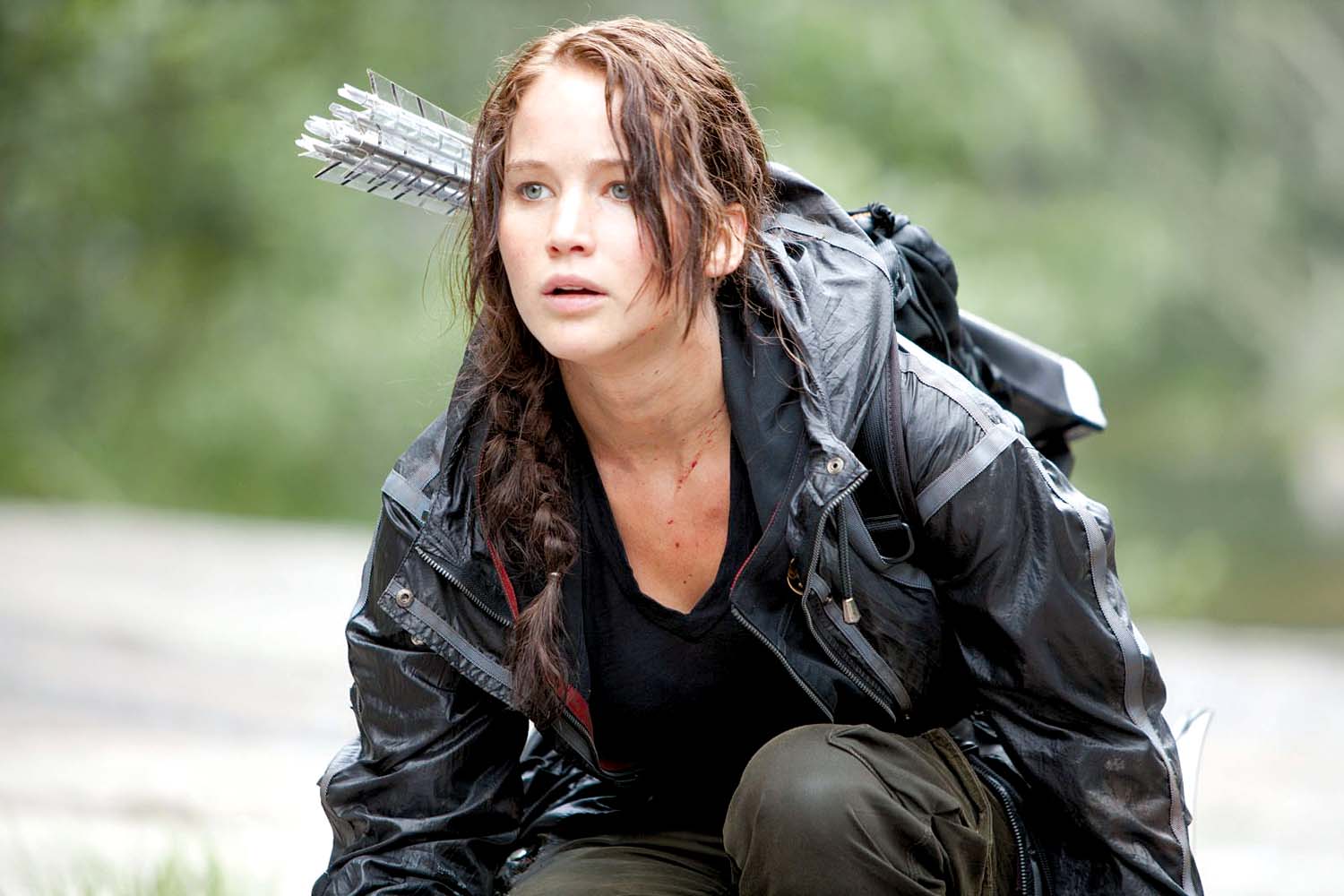
You can’t talk about “The Hunger Games” without talking about Jennifer Lawrence’s performance. A lot of great young actresses tried out for the role including Saoirse Ronan, Chloe Moretz, Hailee Steinfeld, and Shailene Woodley. But Lawrence was chosen and she was the perfect choice. Since I first saw her in her Oscar nominated role in “Winter’s Bone”, she’s been one of my favorite young actresses. Here she gives a strong and committed performance that feels true and authentic. In fact, she often times rises above the material and when the story goes a little off-track she manages to elevate it and carry it on her shoulders. It’s a brilliant performance and she fleshes out every quality of her character that you would expect.

Lawrence is joined by a nice supporting cast including Woody Harrelson as Haymitch, a bumbling boozer who is the only survivor to ever come out of District 12. Stanley Tucci is great as Caesar, the voice of The Hunger Games. He hams it up with his wild blue hair and huge grin but he’s also a bit slimy and disturbing. Elizabeth Banks plays Effie, a Capitol liaison to District 12 and Lenny Kravitz plays a stylist who has the job of making Katniss and Peeta make a good impression. We even get Donald Sutherland delivering his signature overly dramatic but perfectly effective lines as the sinister President Snow. While these supporting performances are quite good, some of the younger actor’s work doesn’t quite measure up.

The story itself captures a lot of what makes for good science fiction. It also does a nice job building up the tension leading up to the start of the games. I also saw myself emotionally caught up in several of the movie’s more heart-felt scenes. The action sequences aren’t as plentiful as some have advertised and the violence is strategically edited to ensure the PG-13 rating. But I did find watching teenagers hack each other up, some with pretty flippant attitudes, to be a bit uncomfortable. I also felt the tributes (the Hunger Games participants) to be inconsistently written. Several are introduced in a way that makes you think they are significant but they meet their demise in fairly meaningless fashion. Better writing could have made the tributes (aside from a small handful) feel more important therefore giving the games themselves a lot more weight.

There were also a few head-scratching moments in the story. Throughout the preparation leading up to the games, everything seemed to focus on making a good impression in order to gain sponsors needed for survival. The wardrobes, the introductions, the interviews – everything was for the purpose of sponsors. But during the games, sponsorship didn’t have much of an impact at all which made all the posturing seem pointless. I also couldn’t help but wonder what a society would find entertaining about kids having a survival fight to the death. Look, I understand that they were sick and morally bankrupt people. But a 12-year old little girl in a competition to the death shouldn’t be that interesting even to the most twisted and perverse individuals.

But even with a story’s occasional clunkiness, there’s something that drew me into the world of “The Hunger Games”. From the very start, I found the film created a futuristic society and sociopolitical environment that was surprisingly realistic even though it’s science fiction. I also felt the film’s fluid pacing helped create several moments of genuine tension that had me on the proverbial edge of my seat. There are also several heart-wrenching and emotional scenes that never felt fake or manufactured. And while the ending was a little underwhelming, it puts in place several intriguing possibilities for the next film. “The Hunger Games” is a movie that could have been better with a little more polished and thought-out script. But it’s also a film that puts together a disturbing yet enthralling world that I was totally caught up in. Combine that with an amazing performance from Jennifer Lawrence and some strong supporting work and you have the groundwork for a very satisfying franchise. May the odds ever be in our favor as this series moves forward.

“HANNA” – 4 STARS

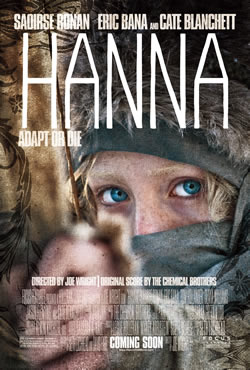
In “Hanna” Saoirse Ronan plays the title character who lives in isolation with her father Erik (Eric Bana) in the snow-covered forests of Finland. While there, he’s instructs her in methods of survival and trains her in hand-to-hand combat which immediately let’s you know there is more going on under the surface. Hanna finds out she has been trained to kill Marissa Wiegler (Cate Blanchett), a corrupt CIA agent who has a history with Erik. But after setting out on her mission things go wrong and Hanna finds herself running for her life while trying to piece together who she really is and where she came from.

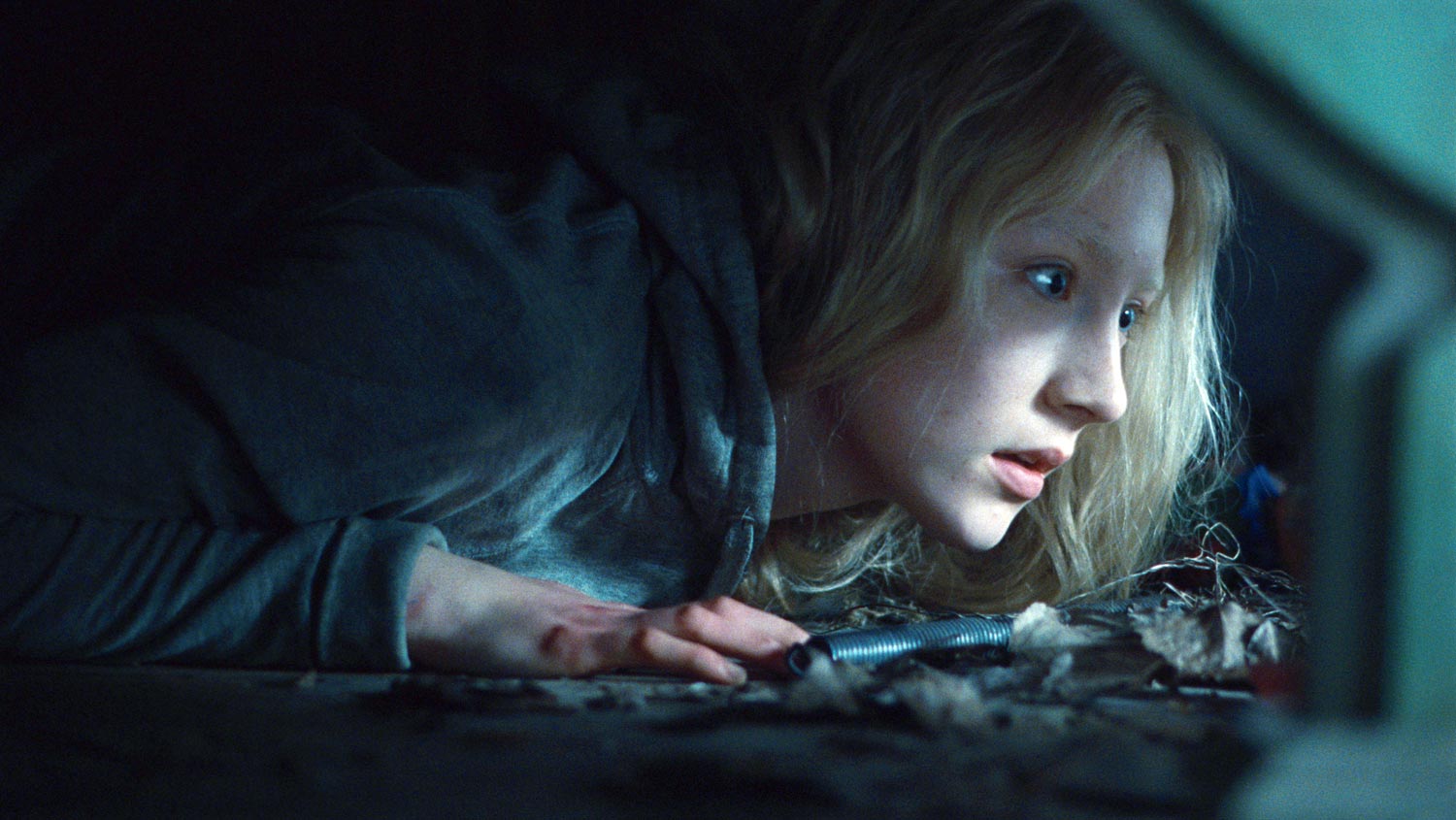
Ronan again proves she is one of the top young acting talents in film today. She’s simply magnificent as the sheltered but lethal Hanna. She captures the conflict within Hanna through some tender scenes that show her innocent curiosity and some intense action sequences that show the violent nature of her training. Hanna hasn’t experienced any of the modern conveniences or technologies of today and it truly feels as if you are watching her enter a whole new world. It’s also great to see Eric Bana giving a good performance in a very nice role for him. But the usually solid Cate Blanchett is surprisingly inconsistent as C.I.A. agent Wiegler. She sometimes comes across as unconvincing and her odd southern accent seems to come and go. But overall this is Ronan’s show and she is fantastic.

Director Joe Wright starts the film with a bang and keeps it moving at a break-neck pace. It never loses it’s frantic energy or momentum. The gritty techno soundtrack by The Chemical Brothers isn’t overused and, along with the quick camera cuts and sharp angles, contributes to the overall feel of the picture. “Hanna” moves from one country to another and is filmed in some beautiful locations including Finland, Germany, and Morocco. There’s also a unique style to the way “Hanna” is made. At times it has an almost fantasy feel to it due to the way it’s shot and edited. Other times it shows some pretty standard elements from other action/revenge thrillers.

But the film does have a few issues. Throughout the picture you feel there is more to the story than there really is. The abrupt ending is satisfying in one sense but it’s also conventional and predictable. The tension that nicely builds up seems a little hollow as the film reveals itself to be nothing more than a high-octane action/chase picture. Now don’t get me wrong, I love a good action/chase picture. But “Hanna” seemed to be breaking away from the traditional action movie formula. Unfortunately it doesn’t see it through to the end.

The few gripes aside, “Hanna” is a fun and stylish movie as well as a showcase for young Saoirse Ronan. I can’t say enough about her performance. And while Blanchett’s performance is a little distracting and the ending may be somewhat of a letdown, it doesn’t kill the film. There’s many other things to like about “Hanna” and many things that separates it from most action thrillers. So sit down, buckle up, and enjoy the ride. I know I did.

REVIEW: “The Hunger Games”

With this week’s release of the incredibly popular “The Hunger Games” on DVD and Blu-Ray, I had a chance to see it for a second time. I thought it would be fun to share my review of the movie again for those who may be newer to my blog. What are your thoughts on this much talked about picture? Were the odds ever in your favor as you sat down to see what all the hype was about? Here’s my take.

It’s been called the next big thing at the movies. It’s projections point to an opening weekend of around $150 million. Fans are filling theaters with anticipation. With such hype and expectations, how is it that I had never heard of “The Hunger Games” before seeing its first movie trailer? Expected to be the first in a profitable series, “The Hunger Games” is based on a series of novels written by Suzanne Collins. It’s a dystopian science fiction film that’s based on a preposterous premise yet it manages to be strikingly entertaining.

With the “Twilight” series mercifully set to end later this year, “The Hunger Games” is looked at as the next big franchise and has even drawn some misguided comparisons to the romantic vampire versus werewolf films. But there are several things that separate “The Hunger Games” from the “Twilight” series. First, this film opens itself up to a much broader audience. The movie embraces several good sci-fi and action elements that should appeal to a wider variety of moviegoers. ”Twilight” made millions but had a much more restricted target audience. Also “The Hunger Games” made a point to bring in quality performers and it really shows in the finished product. The acting is head and shoulders above the teeth gnashing performances in “Twilight”. In other words, “The Hunger Games” has more to offer than many of the other popular multi-million dollar series.

The movie takes place in Panem, a nation broken up into 12 districts. It’s a futuristic world that features a capital city filled with advanced technology surrounded by landscapes that resemble the Ozark or Smokey Mountains. The power and affluence are confined to the Capitol while the outer districts are filled with poverty-stricken villages struggling to survive.  We learn that years ago there was an uprising in the districts that resulted in a strong militaristic response from the Capitol. After quenching the uprising, The Capitol instituted “The Hunger Games”, an annual competition that required each district to provide one boy and one girl between the ages of 12 and 18 to compete against each other in a survival fight to the death. There would be only one winner and that winner would receive fame and glory. The games were intended to serve as a lifelong punishment for the district’s uprising and to show the twisted view of mercy and forgiveness of the Capitol.

To add yet another warped component to the story, The Hunger Games have become a Super Bowl like event. Much like 1987′s “The Running Man”, citizen’s throughout the capital city watch and cheer the games like they would a major sporting event. Special events and talk shows centered around the participants and leading up to the games are soaked up by the heartless and blood-thirsty Capitol crowds. In contrast, those watching in the outer districts do so not out of sport but out of concern for their loved ones. The movie goes all out to show a stark economic and moral difference between the wealthy city people and the poor district citizens. It’s a contrast that looks to play a bigger role in the future films.

The movie starts inside the very poor District 12. Jennifer Lawrence plays Katniss Everdeen, a tough 16-year old girl forced to take care of her mother and little sister Prim (Willow Shields) after the death of her father. The sisters gather together with the other kids from their district for what’s called “The Reaping”, a random drawing to find out who will represent the district as “tribute” in the year’s games. When a terrified Prim is chosen, Katniss steps in and volunteers in her sister’s place. Joining Katniss from District 12 is a baker’s son named Peeta (Josh Hutcherson). The two are shuttled to the Capitol where they are prepped and paraded around until the day for the games is upon them.

You can’t talk about “The Hunger Games” without talking about Jennifer Lawrence’s performance. A lot of great young actresses tried out for the role including Saoirse Ronan, Chloe Moretz, Hailee Steinfeld, and Shailene Woodley. But Lawrence was chosen and she was the perfect choice. Since I first saw her in her Oscar nominated role in “Winter’s Bone”, she’s been one of my favorite young actresses. Here she gives a strong and committed performance that feels true and authentic. In fact, she often times rises above the material and when the story goes a little off-track she manages to elevate it and carry it on her shoulders. It’s a brilliant performance and she fleshes out every quality of her character that you would expect.

Lawrence is joined by a nice supporting cast including Woody Harrelson as Haymitch, a bumbling boozer who is the only survivor to ever come out of District 12. Stanley Tucci is great as Caesar, the voice of The Hunger Games. He hams it up with his wild blue hair and huge grin but he’s also a bit slimy and disturbing. Elizabeth Banks plays Effie, a Capitol liaison to District 12 and Lenny Kravitz plays a stylist who has the job of making Katniss and Peeta make a good impression. We even get Donald Sutherland delivering his signature overly dramatic but perfectly effective lines as the sinister President Snow. While these supporting performances are quite good, some of the younger actor’s work doesn’t quite measure up.

The story itself captures a lot of what makes for good science fiction. It also does a nice job building up the tension leading up to the start of the games. I also saw myself emotionally caught up in several of the movie’s more heart-felt scenes. The action sequences aren’t as plentiful as some have advertised and the violence is strategically edited to ensure the PG-13 rating. But I did find watching teenagers hack each other up, some with pretty flippant attitudes, to be a bit uncomfortable. I also felt the tributes (the Hunger Games participants) to be inconsistently written. Several are introduced in a way that makes you think they are significant but they meet their demise in fairly meaningless fashion. Better writing could have made the tributes (aside from a small handful) feel more important therefore giving the games themselves a lot more weight.

There were also a few head-scratching moments in the story. Throughout the preparation leading up to the games, everything seemed to focus on making a good impression in order to gain sponsors needed for survival. The wardrobes, the introductions, the interviews – everything was for the purpose of sponsors. But during the games, sponsorship didn’t have much of an impact at all which made all the posturing seem pointless. I also couldn’t help but wonder what a society would find entertaining about kids having a survival fight to the death. Look, I understand that they were sick and morally bankrupt people. But a 12-year old little girl in a competition to the death shouldn’t be that interesting even to the most twisted and perverse individuals.

But even with a story’s occasional clunkiness, there’s something that drew me into the world of “The Hunger Games”. From the very start, I found the film created a futuristic society and sociopolitical environment that was surprisingly realistic even though it’s science fiction. I also felt the film’s fluid pacing helped create several moments of genuine tension that had me on the proverbial edge of my seat. There are also several heart-wrenching and emotional scenes that never felt fake or manufactured. And while the ending was a little underwhelming, it puts in place several intriguing possibilities for the next film. “The Hunger Games” is a movie that could have been better with a little more polished and thought-out script. But it’s also a film that puts together a disturbing yet enthralling world that I was totally caught up in. Combine that with an amazing performance from Jennifer Lawrence and some strong supporting work and you have the groundwork for a very satisfying franchise. May the odds ever be in our favor as this series moves forward.

VERDICT – 3.5 STARS

REVIEW: “Higher Ground”

Vera Farmiga has proven herself to be one of the most gifted and proficient actresses in Hollywood. In “Higher Ground” she once again shows off her acting chops but it also marks her directorial debut. It’s a thoughtful and sometimes challenging film that takes a more candid look at spirituality and how life’s difficulties make true faith seem out of reach. It’s also a story of decisions and the consequences that follow. It tackles some weighty religious issues but also looks at social troubles such as drug use, infidelity, and divorce. But at it’s heart, “Higher Ground” is the story of one woman’s conflict between the faith she envies and the lack of faith she feels.

Farmiga plays Corinne, a married mother of two who has watched her life take several drastic changes in direction. She was raised in church but was led away by her rebellion. After some poor choices lead to a premature pregnancy and marriage, she’s brought back to God by a near tragic accident. The family dedicates themselves to a small local church and we watch as Corinne grows in her personal relationship with God. But an inner conflict grows within as she struggles to see God’s hand in some truly difficult circumstances. She asks tough questions with genuine motivations and most of the picture focuses on her search for clarity. Corinne is a very earnest woman and Farmiga makes her believable and relatable regardless of your religious convictions. It’s a beautiful performance that drives the entire film and never shortchanges the character.

When it comes down to it, “Higher Ground” plays it pretty safe. It’s constructed in a way that different people can take away different conclusions largely based on their personal beliefs on Christianity and faith. The story certainly doesn’t target Christianity but neither does it shy away from asking some fairly provocative questions.  While at times it tries to paint faith into a corner and make Christians seem naive and disconnected, it also shows the deception and disloyalty of the faithless world. It may dabble in the occasional stereotype, but overall it stays on an even course which should allow it to speak to different people.

Farmiga’s direction is subtle and steady. She lets the story unfold without any overwrought theatrics or emotional gimmickry. The film looks and feels grounded in reality and Farmiga maintains a steady, natural tone. There are a couple of instances where it abruptly shifts to a new scene, but otherwise it moves at a smooth pace. The Christians are often times depicted well but at other times I couldn’t help notice how much they resembled a group of hippies from Woodstock. There are also several attempts at humor that are actually quite funny, but there are others that feel terribly out-of-place in the picture. One example is Corinne’s close friend explaining her method of keeping her marriage fresh. It’s not particularly funny and I found it pulled me out of the film.

There’s a lot to like about “Higher Ground”. Farmiga shows that she is certainly capable behind the camera even though the movie has it’s shortcomings. It’s a little clunky in some areas and it’s characterizations aren’t always consistent. But it is a careful and sincere picture that I bought into from the start. It clearly wants to speak to both sides of the faith issue but it does so without delegitimizing either position. It’s an intelligent and thought-provoking picture that may not be the best film of the year, but it certainly works on many levels.

VERDICT – 3.5 STARS