REVIEW: “The Legacy of a Whitetail Deer Hunter”

Deerposter

In one very specific way I felt a lot like Josh Brolin’s Buck Ferguson. Where he was looking for the elusive monster whitetail deep in the Appalachians, I was looking for the untapped potential in his movie. I looked everywhere, waited patiently, and after 83 minutes it never came. Well, not completely.

As that bad metaphor falls apart in your mind, let me put it a bit clearer. “The Legacy of a Whitetail Deer Hunter” has so much potential. Pieces are there for a rib-splitting indie classic (and that’s no overstatement). Unfortunately it never quite gets out of first gear. It’s also trapped in a swirling vortex of ideas and identities. Is it a full-blown comedy? Is it a moving character study? Is it a coming-of-age story? A movie can certainly be all of the above, but central to its success is that they work in harmony, at least in some capacity. That just isn’t the case at all here.
Deer1

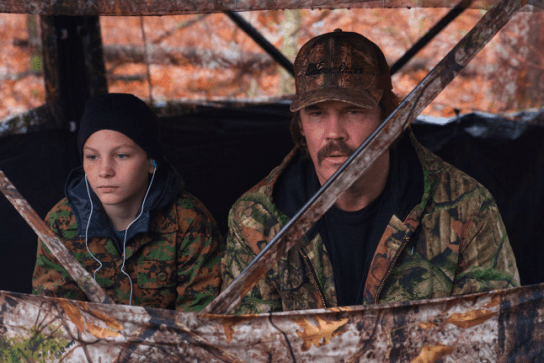
The architects are Jody Hill and Danny McBride of HBO’s “Eastbound & Down” fame. They co-write the script along with John Carcieri, Hill directs, and McBride plays a supporting role. Fans may have a good idea of what to expect, but as someone with little connection to their collaborations, they weren’t the biggest draw for me. Instead it was Josh Brolin and his seemingly perfect fit as Buck Ferguson, a whitetail enthusiast who makes VHS quality deer hunting videos for a living (believe it or not, for a time those things were fairly popular).

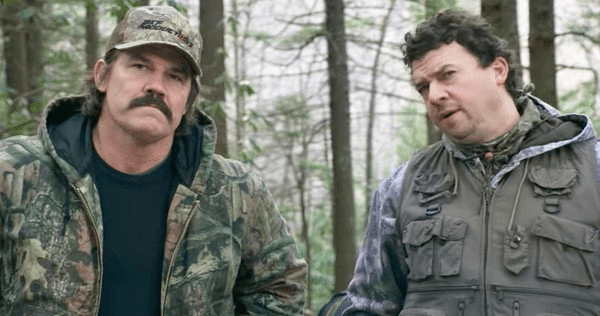
Fresh off of a divorce Buck envisions a whitetail deer hunt as an opportunity to mend his relationship with his 12-year-old son Jaden (Montana Jordan). For Buck, killing your first Whitetail is like a rite of passage and he has grown deeply concerned that if his son doesn’t “take to it now he might not ever”. With his loyal cameraman Don (McBride) in tow, the three venture deep into the beautiful Appalachian Mountains in search of what Buck calls the monster “non-typical” (for the uninitiated that mean a huge whitetail deer).

The problem is Jaden has no real interest in deer hunting or being in the woods with his father. He’s much more into Wi-Fi signals, Panini, and checking in with his girlfriend Caroline back home. This not only stymies Buck’s hopes of bonding, but also his plans to shoot a father-and-son episode for his “Buck Fever” series. So again I mention the pieces are here for a ‘good ol’ boy’ southern-fried comedy.
DEER2

Unfortunately “Whitetail” is only an occasionally funny satire. I kind of see what Hill and McBride are shooting for (no pun intended), but it’s never silly enough, never thoughtful enough, or even clever enough to land with much conviction. And the character treatments aren’t much better. Take McBride’s wildly inconsistent Don character. One minute he is a loyal and sympathetic sidekick only to act disgusting two scenes later. I’m sure giving a 12-year-old drags off his cigarette and showing him pornographic Polaroids will be funny for some. I found it to be jarring both with the tone of movie and the character himself. Young Montana Jordan fares a little better although he is never as funny as the movie wants him to be.

Thankfully we get Josh Brolin, so superbly cast to play this ‘type’. Without a hint of parody and a ton of sincerity, Brolin is firm enough in his conviction to make Buck easily the movie’s funniest character. There is no winking at the camera, only commitment which is exactly what the character needs. He’s perfectly positioned for an off-the-rails wacky comedy but Hill never really goes for it. Ultimately Brolin can’t save the movie from spinning its wheels and feeling like a terribly missed opportunity. Not a horrible film, but a needlessly bland one.

VERDICT – 2.5 STARS

2-5-stars

REVIEW: “Leave No Trace” (2018)

LeavePoster

It’s hard to believe it has been eight years since director Debra Granik’s last narrative feature. That movie was “Winter’s Bone” and it portrayed a distinct slice of America as foreign to most people as a distant alien planet. Her latest is “Leave No Trace” and while not nearly as grim as her previous film, it’s a movie that once again explores a segment of our population on the fringes.

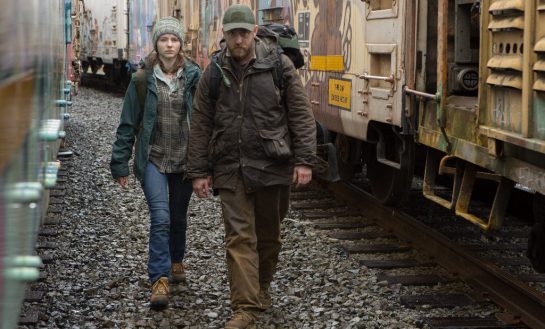
Granik and co-writer Anne Rosellini base their script on Peter Rock’s 2009 novel “My Abandonment”. It tells the story of a father and daughter living off the grid in a National Forest outside Portland, Oregon (beautifully visualized through Michael McDonough’s camera). Ben Foster gives the performance of his career as Will, a beaten-down veteran and father to his 13-year-old daughter Tom. She’s played by New Zealander Thomasin McKenzie, a relatively fresh new face who matches Foster’s brilliance scene for scene.

Leave1

With the exception of necessary trips into the city for supplies and to pick up Will’s check from the VA, the pair survive off the land. By nearly every societal standard they are homeless (as a case worker later explains “It’s not a crime to be unhoused, but it’s illegal to live on public land”), but for Will living on their own provides his only sense of freedom. Foster is known for playing intense characters on the edge, but here he so naturally falls into the role with a quietness and restraint that conveys a surprising amount of insight into his character.

Take Will’s struggles with PTSD. He’s haunted by nightmares and flashbacks but we never see any of them, only the effects. Ultimately it’s up to Foster to show the weight of the trauma. It’s a tricky role that the seasoned actor nails.

The story takes a significant shift when Will and Tom are discovered and taken into custody. They are met with compassion and given a place to stay. For Tom this opens up the possibility for stability, to make friends, and to be part of a community (something Granik has a true knack for portraying). Will attempts to adapt but ultimately feels smothered in society’s cage. For the rest of the way the film wrestles with the idea of ‘home’ and what that means to both Will and Tom.

I’ve read some comparisons, but this is no “Captain Fantastic” scenario. If you remember, in that film Viggo Mortensen raises his family to the wilderness as a hippie’s statement against the evils of modern culture. “Stick it to the man!” was their battle cry. There is none of that in “Leave No Trace”. Will has no idealistic stand he’s making. He loves his daughter and is raising her the best way he knows how. The movie makes no harsh judgements on him, but Tom is our conduit and her experience brings us to some inevitable conclusions. She loves her father and wants to be with him. But she’s also becoming her own person. In one of the film’s most powerful scenes Tom lovingly tells her father “The same thing that’s wrong with you isn’t wrong with me.”

Leave2

Much like she did for Vera Farmiga in 2004 (“Down to the Bone”) and Jennifer Lawrence in 2010 (“Winter’s Bone”), Debra Granik has developed a star-making role for Thomasin McKenzie. The young actress is such a vital piece of the movie – gentle and earnest but with a quiet strength. And you won’t catch a false line in her entire performance. Every soft-spoken word comes from a place of pure sincerity. She’s really good and this is a name you’ll be hearing a lot of.

“Leave No Trace” struck a chord with me early and I could feel its emotional tug all the way till the end. It’s not a movie deeply concerned with plot. Instead it is all about character. Granik’s biggest investment is in creating two people we can care about and can connect with. Maybe not with their specific circumstances but on a deeper human level (while subtly opening some eyes along the way). It certainly worked for me.

VERDICT – 4.5 STARS

4-5-stars

REVIEW: “Logan Lucky”

LOGANPOSTER

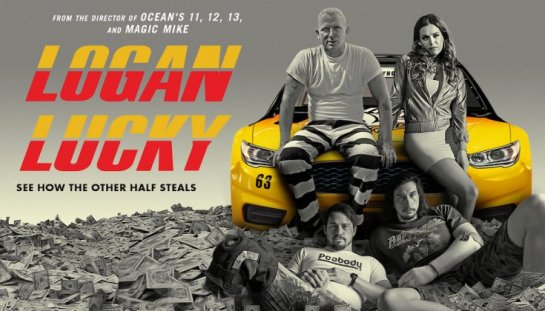
You could argue that Steven Soderbergh is the architect of the modern heist film. Look no further than his hit movie “Ocean’s Eleven”. In that 2001 remake Soderbergh pretty much wrote his own set of rules for a heist flick and would follow them through two sequels. Now years later he returns with “Logan Lucky”, a working class version of the “Ocean’s” formula, less focused on being cool and more on straight southern-fried humor.

Channing Tatum (an actor I have steadily warmed up to) plays Jimmy Logan, a down-on-his-luck blue collar construction worker who loses his job at Charlotte Motor Speedway. Soon after, Jimmy learns that his ex-wife Bobbie Jo (Katie Holmes) and her slug of a husband Moody (played with just the right amount of macho slime by David Denman) plan to move to Lynchburg making it harder for Jimmy to see his daughter Sadie (Farrah Mackenzie).

LOGAN1

Tatum’s performance is funny in a number of ways. One is in how he reacts to all of his bad luck (referenced several times in the film as the ‘Logan Hex’). He takes everything in stride, never getting worked up. But he doesn’t sit around and take it. You could say he’s a man of action. So needing money in order to stay closer to Sadie, Jimmy concocts an elaborate plan to rob the speedway. But he’s going to need a crew.

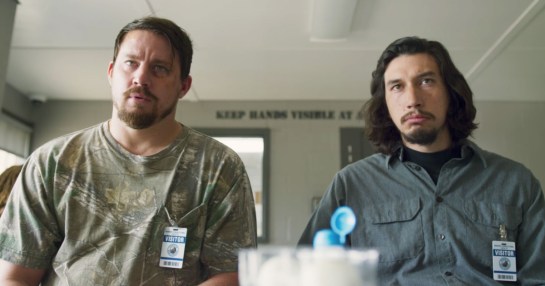
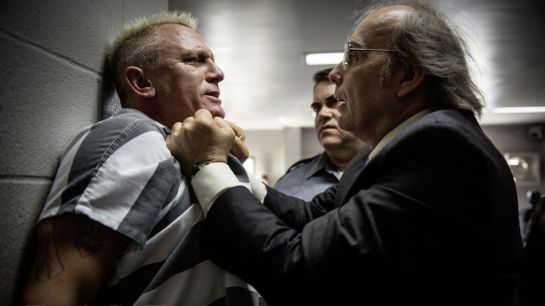
First he recruits his brother Clyde (Adam Driver), an Iraq war veteran and bartender with a prosthetic hand, and his hairdresser sister Mellie (Riley Keough). Needing someone experienced with vaults they contact the currently in-car-cer-ated Joe Bang. He’s played by Daniel Craig channeling something far different than his dapper James Bond persona. Joe’s two numbskull brothers (Brian Gleeson and Jack Quaid) join in to fill out the wacky team.

Several other names round off the cast – Sebastian Stan, Dwight Yoakam, Katherine Waterston. And then there are a couple who don’t quite fit. Seth MacFarlane plays a scumbag NASCAR team owner with a bad British accent and an even worse wig. Not sure what he’s going for but it doesn’t work. And then there is Hillary Swank as a not so hot on the trail FBI agent. Swank’s performance is hard to interpret and feels out of tune with the rest of the film. Thankfully both are smaller roles and are easy to look past, but they do stand out.

LOGAN2

This zany bunch of country folk is a far cry from Danny Ocean’s good-looking and snazzy dressed band of burglars. That’s part of the fun. In many ways Soderbergh is spoofing his own “Ocean’s” trilogy and has a lot of fun doing it. You can’t help but notice similarities in the two story structures, but “Logan Lucky” adds its own unique twist and is by far the broader comedy.

Out of the blue newcomer Rebecca Blunt is credited with the screenplay but there is a catch. Many say Rebecca Blunt doesn’t exist. No one can seem to find her. Some believe it’s a pseudonym for Soderbergh himself. Others have speculated that Soderbergh’s wife, former E! personality Jules Asner, is the real screenwriter. This weird little mystery surrounding Rebecca Blunt seems only fitting for such weird little movie. Whoever wrote it deserves some attention for dishing out a fun madcap caper with big personalities and even bigger laughs. Toss in that Soderbergh flavor and an all-in cast and you have one of last year’s funniest movies.

VERDICT – 4 STARS

4-stars

REVIEW: “Logan”

LOGAN POSTER

It could be argued that Hugh Jackman as Wolverine has been the best bit of superhero casting since this wave of comic book movies started in 2000. Not only does Jackman keenly capture the adamantium-clawed mutant’s look and personality, but he’s been incredibly committed to fleshing out the character through the good movies and even the rotten ones.

“Logan” is the tenth actual X-Men movie and the third Wolverine solo adventure behind 2009’s abysmal “X-Men Origins: Wolverine” and 2013’s surprisingly good “The Wolverine” directed by James Mangold. Mangold returns to direct “Logan” based on a story he began writing following the previous film. After some rather cryptic messaging it was confirmed that “Logan” would be Jackman’s final turn as Wolverine. The star worked closely in development even taking a pay cut to ensure an R-rating, something he and Mangold felt was imperative to the character’s final violent chapter.

LOGAN2

“Logan” could easily be categorized as a superhero western and the influences are everywhere. “Shane” and “Unforgiven” instantly came to mind and readers of the original “Old Man Logan” comic book series will see a handful of similarities.

The film is set in 2029 and there have been no new mutants in 25 years. Logan has been off the grid, making money as a limo driver in El Paso, Texas. He has aged and his body is showing it. The claws don’t pop like they used to, his eye sight is failing, and his healing factor isn’t as effective. Essentially the adamantium inside of him is taking its toll.

He uses the money he makes to take care of his old friend and mentor Charles Xavier (Patrick Stewart) who is kept hidden in an old dilapidated factory just across the US/Mexico border. The ailing Charles is suffering from a form of Alzheimer’s which causes devastating psychic seizures if left unmedicated. Caliban (Stephen Merchant), an albino mutant tracker, helps as a caretaker for Charles while Logan is away.

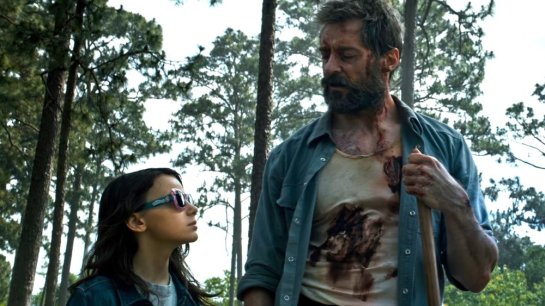
While on the job Logan is approached by a woman beseeching him to take 11 year-old Laura (a fabulous Dafne Keen) away. She tells him of Transigen, an illegal bioengineering lab doing mutant experiments on children. Laura is one of many children set free by nurses but now being tracked for extermination by Transigen. Logan wants no part of it but when events bring Laura and her trackers to his hideout in Mexico a violent exchange ensues and he sees first-hand why Laura is so ‘special’. With Xavier’s prodding they take off with Laura, Transigen not far behind.

LOGAN3

“Logan” is an interesting stew. Fans of the character will find plenty to like as he is let off the proverbial leash in terms of violence. The feral nature of it is fitting in most cases, but there are times when the movie seems to be saying “Look, we’re doing an R-Rated Wolverine picture.” And I would be lying if I didn’t mention a conflict in the handling of the violence. There is an interesting theme on the nature of violence that runs throughout the film. Logan wants no part of it. He tries to abstain from it. His body is breaking down because of it. He’s shown to be mentally scarred from it. He warns Laura away from it even saying “Don’t be what they made you to be.” But while offering this compelling angle on violence, the movie sometimes relishes in its depiction of it. It’s not a big problem but it does mute the film’s message a bit.

You could say “Logan” becomes a road trip movie and along the way we learn that this isn’t a traditional superhero tale. It isn’t as profoundly fresh as its press would lead you to believe, but it does tell a good story. There are no punchy jokes or one-liners. There are no colorful, larger than life characters. Mangold’s tone remains intensely serious and his characters are broken and struggling. Laura represents a glimmer of life – a reminder to Logan and Charles of what they once fought for. It’s an interesting take on the genre. And then there is Jackman who has played Wolverine for 17 years. His passion for the character is undeniable and he ends his run in a fitting and satisfying way. And Mangold’s final shot – it couldn’t be a more perfect ending.

VERDICT – 3.5 STARS

3-5-stars

REVIEW: “Last Men in Aleppo”

ALEPPOposter

In early 2012 a series of bombings triggered the brutal Syrian Civil War. Some of the fiercest fighting and severest human rights violations took place in Aleppo. Over the next several years the city was decimated, its civilian death toll skyrocketed, and over 500,000 refugees fled the violence. It was once Syria’s largest city, but the war has had a dramatic effect on its standing.

Several documentaries have offered sobering insight to the Syrian Civil War. The latest (and arguably best) is Firas Fayyad’s “Last Men in Aleppo”, recently nominated for an Academy Award for Best Documentary. The film’s follows a handful of men, particularly Khalid, Mahmoud, and Subhi. The three men are leaders of the White Helmets, a group of volunteers who serve as first responders to bombings and civilian evacuations across the city.

ALEPPO1

Fayyad’s film splits its focus between the bravery these men exhibit daily and their inner conflict between staying in Aleppo or getting out with their families. It’s a struggle that we see in some of the film’s quieter moments where Fayyad stills his camera and simply observes the heartfelt conversations these men share. Can they supply a life of normalcy for their family in Aleppo? Can they keep their family safe?

One scene potently captures these questions. Khalid takes his family to a playground where a large group has gathered for an afternoon of fun. It’s a tender reprieve from the bombings and one of the few bright moments we get. But the distant scream of a Russian jet and a radio warning of a potential attack cuts the day short. Khalid scrambles to get his family in their van and away since we learn that bigger groups of people (even civilians) are often targeted. It’s a sobering sequence.

aleppo2

Then you have the intense scenes showing Khalid, Mahmoud and Subhi rushing into the chaos of fresh bombings. They lead their teams in search and rescue attempts, sifting through rubble and ash looking to save anyone they can. Fayyad’s images are raw and unflinching, highlighting the unvarnished ugliness of the attacks and the horrible civilian cost. Some of their efforts end in relief, other times horror.

The film ends with a startling reminder of the perpetual danger the city’s citizens live in and the immense sacrifice of the White Helmet volunteers. Obviously subject matter like this is hard viewing and Fayyad doesn’t cut any corners. Some sequences will leave you speechless and the final moments with undoubtedly stick with you.  There aforementioned rawness of “Last Men in Aleppo” leaves the film a little rough around the edges, but it also keeps it grounded in reality and delivers a truly eye-opening experience.

VERDICT – 4 STARS

4-stars

REVIEW: “Love in the Afternoon”

2017blindspot

Gary Cooper and Audrey Hepburn. Folks, that’s all I needed to hear to be interested in 1957’s “Love in the Afternoon”. And as if I needed any more prodding, this romantic comedy was directed, produced, and co-written by the great Billy Wilder. And then to add even more personal intrigue, “Love in the Afternoon” is set in the magical city of Paris. So you have an unlikely love story filled with good humor, some really strong central performances and the City of Lights. Sounds good.

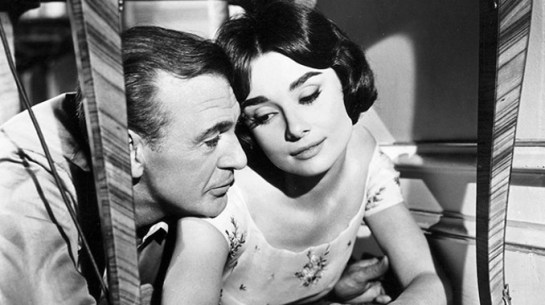
One of the first things you’ll notice when watching the film is the dramatic age difference between Cooper and Hepburn. Cooper was 55 years old at the time and there were some people who had a problem with his casting. Hepburn plays a beautiful (and much younger) girl named Ariane. She lives in Paris with her father Claude (brilliantly played by Maurice Chevalier) who works out of their home as a private investigator. Watching Hepburn and Chevalier is pure joy. They have an adorable father/daughter chemistry which shows itself in her playful curiosity about his work and his father-like encouragement of her cello playing.

LOVE1

One day Ariane eavesdrops as her father reveals to a client that his wife is having a fling with a wealthy American named Frank Flannagan (Cooper). She hears the trysts are taking place in Flannagan’s hotel room and that the husband plans to kill him. The curious and adventurous Ariane decides to go warn Flannagan of his upcoming demise. In doing so she finds herself smitten by the millionaire playboy’s charm. Her innocence and inexperience with love creates new feelings within her. On the other hand Ariane is initially just another victim of Flannagan’s globetrotting womanizing. But she leaves him in the dark about many things including her name and her far-fetched tales of her many boyfriends intrigues him. But is that enough to cure him of his playboy ways?

Wilder does a great job of getting us to love Hepburn and her character. She instantly comes off as pure and sweet and her childlike curiosity is adorable. That’s one reason we dislike Gary Cooper and his Flannagan character. We see that she is enamored with him but he sees her as just another toy. We genuinely worry for her as this unusual story plays out. But Wilder also shows that she’s not just a child with a bout of puppy love. She’s clever and, as Flannagan finds out, she can be abstruse. All of this is key to developing what is a well conceived love story.

This was the first of many screenplay collaborations between Wilder and I.A.L. Diamond. As you would expect from anything that Wilder has a hand in writing, the dialogue is slick and smart and his two lead actors handle it nicely. Hepburn was Wilder’s one and only choice to play Ariane but he wanted Cary Grant to play Flannagan. Grant turned down the role (as he did with several other Wilder offerings) which opened the door for Cooper. I admit, Cooper was an unusual choice and at first I wondered if he was going to fit. But as things move along, I think he captures what the role calls for.

LOVE2

The film also features some good bits of humor. The dialogue itself can be quite funny and there are several running gags that become pretty outrageous. There’s a hilarious reoccurring bit with gypsy musicians who Flannagan pays to play for him whenever he has a woman over. But we later see them popping up in some of the most absurd locations. It’s very funny. I also have to again mention the fun moments between Hepburn and Chevalier. She is her usual peppy and sprightly self. But Chevalier is a real scene stealer and for me some of the best moments featured him on screen.

“Love in the Afternoon” is a movie I’m glad I finally caught up with. This is another energetic and intelligent Wilder film that hits the romance and humor it shoots for. “Love in the Afternoon” may not be up there with the great romantic comedies of its time, but it’s still a solid film featuring a wonderful cast, beautiful Paris locations, and a smart director who has no problem putting all of his pieces together.

VERDICT – 4 STARS

4-stars