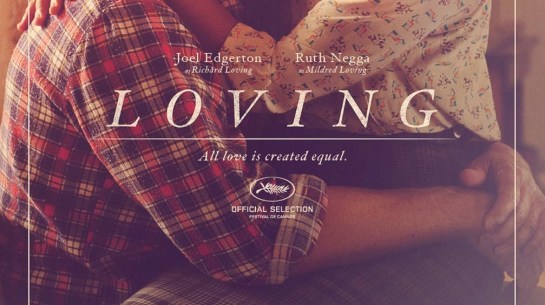
“Loving”, the fifth film (and second of 2016) from writer/director Jeff Nichols, continues the Arkansas-born filmmaker’s impressive streak of well-received movies. Through his films Nichols has revealed a unique and refreshing cinematic voice and has emerged as a true rural America storyteller. The Mark Twain influences are undeniable.
“Loving” examines the 1967 U.S. Supreme Court case that abolished state laws prohibiting interracial marriage. But the film does so not by stressing the court room. Instead it focuses on the love between Richard and Mildred Loving. Nichols trusts the potency of their story enough to keep his approach admirably subdued. It’s sometimes a bit too low-key, but there is no denying the film’s subtle power.
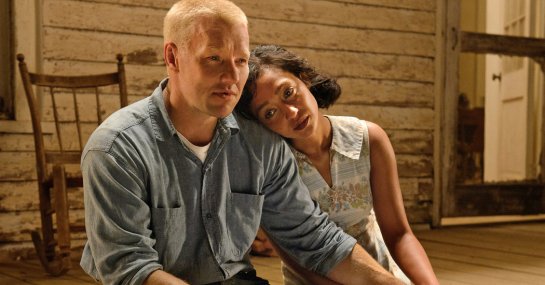
The performances from Joel Edgerton and Ruth Negga are superb. Edgerton’s Richard is a simple but devoted man who wants to love and take care of his wife. Negga portrays Mildred with a quiet grace and dignity. She’s both sweet and gentle, but she’s also Richard’s emotional anchor. The Lovings saw their lives turned upside down in the summer of 1958. In the dark of night the Caroline County sheriff (here played by Marton Csokas) and his deputies stormed their home and arrested the newlywed couple for breaking Virginia’s laws on interracial marriage.
What followed was a series of arrests and court appearances until their case finally reached the U.S. Supreme Court. Nichols doesn’t spend much time with the legal wranglings. He sets them up but mostly shows their effects. It’s a wise choice since they are when the film is at its weakest. Contributing to this is the odd casting of Nick Kroll as a young, green ACLU lawyer who takes the Lovings’ case. It’s a strangely stiff performance with Kroll routinely looking as if he’s holding in laughter. John Bass doesn’t fair much better as a constitutional law expert helping with the case.
There are some fantastic supporting turns though. Nichols favorite Michael Shannon has a small but fun role as a LIFE magazine photographer profiling the Lovings and their case. And I adored Sharon Blackwood’s performance as Richard’s straight-shooting midwife mother.

Perhaps my favorite thing about “Loving” is this – Richard and Mildred aren’t activists. They aren’t vocal, aggressive crusaders for a cause. They don’t seek the attention. They don’t want the press. The Lovings just want to live their lives together. That simple innocent desire highlights the despicable nature of the Virginia law far more effectively than if this had been a more pointed activism film. Through this emotionally detailed couple we learn all we need to know about the true rights and wrongs of the story and it invests us on a much more intimate level.
While it can be a bit slow at times and the approach may not be abrasive enough for some people, “Loving” gracefully and truthfully tackles an issue by putting its focus on the human element. Nichols’ delicate portrayal is slyly potent and speaks volumes about its subject without leaning on layers of dialogue. Instead Nichols asks his audience to watch, observe, and feel a closeness with his two central characters. If you do that the power of the message will be unavoidable.
VERDICT – 4 STARS