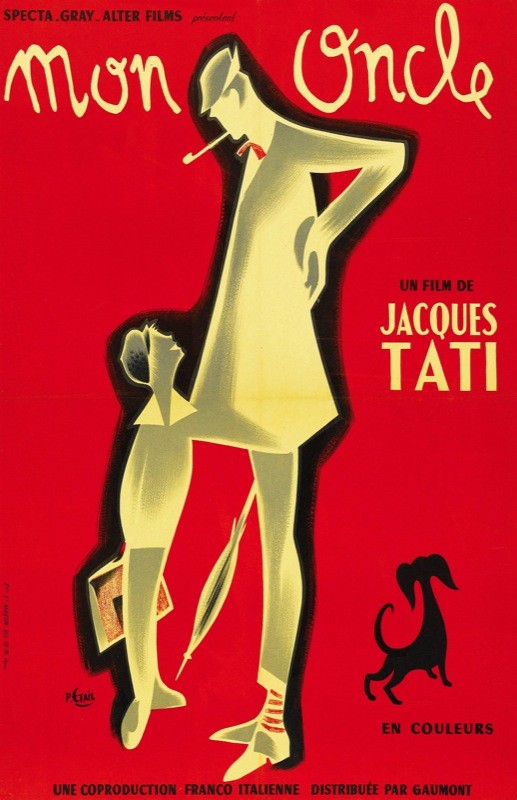
REVIEW: “Mon Oncle”

mon_oncle poster“Mon Oncle” Is French filmmaker Jacques Tati’s 1958 comedy and his second of four films featuring his Monsieur Hulot character. The acclaimed director only had six feature-length films to his credit and this was his first in color. It’s also a widely appreciated picture that earned Tati an Academy Award for Best Foreign Language Film. There are several themes that Tati plays with in what’s an otherwise playful comedy. He satirizes materialism and the lust for things. And he shows the sterile and artificial relationships of those absorbed with social status. These and other things are certainly interwoven within the story, but for me the movie is more effective as a fun and often times charming comedy.

Tati not only directed, produced, and co-wrote “Mon Oncle”, he starred in it as well. His Monsieur Hulot character is as lovable as he is inept. He’s an awkward and almost child-like character who views life with a smile, a bow, and a tip of his hat. Hulot lives in an energetic working class neighborhood in Paris filled with older buildings and busy streets. For me the very best part of this film is the time we spend in this close-knit community. Tati does a wonderful job of familiarizing us with the places and the people who make up Hulot’s lively neighborhood. There’s the lovely young girl from his building who always greets him with a smile and sometimes sweets. There’s the short cranky produce man whose tools fall out of his truck whenever he opens his door. There’s the friendly street sweeper who spends more time talking than sweeping. There’s the group of men who spend most of their time at the Chez Margot cafe. These are just a few of the people who give this community its beautiful life and character.

In stark contrast you have the wealthy upscale suburb which is where Hulet’s sister and brother-in-law Monsieur and Madame Arpel live. Their modern, high-tech home is as cold and sterile as an operating room, a description that also fits their relationship. Their true joy is in showing off their house to their more important visitors. There is a reoccurring joke that has Madame Arpel running to turn on a hideous metallic fish fountain in their front garden whenever a truly important guest shows up. It’s all about appearance and self-importance with the Arpel’s.

MON ONCLE

But their young son Gerard feels trapped inside the monotonous walls of the Arpel estate. That’s why he loves it when his Uncle Hulot comes to visit. Gerard loves going back to Hulot’s neighborhood to enjoy the vibrant atmosphere and especially to play with his mischievous friends. Some of the film’s funniest moments involve these little pranksters pulling all sorts of practical jokes on passersby. Hulot, in many ways a child himself, really doesn’t try to control them. He just reacts to them as he does everything else – no harm, no foul. Gerard’s affection for his uncle doesn’t make Monsieur Arpel very happy. He is jealous of the relationship even though he doesn’t invest any time in Gerard. He also looks down on Hulot as his inferior. Madame Arpel believes she can change all of that by introducing Hulot to their social circle, an idea that’s doomed (and hilarious) right from the start.

For the most part “Mon Oncle” is a visual comedy with very little understandable dialogue. Often times we hear the unintelligible voices of the people but it’s plenty to let us know what’s happening. The dialogue that is there is strategically placed and works perfectly within the confines of the story. The bulk of the story is told through nods, gestures, and mannerisms and the humor depends more on slick and subtle sight gags than normal straightforward jokes. All of this contributes to the sheer genius of this movie. Tati incorporates some methods taken from the great silent films both is his direction but especially in his acting.

I adore the Monsieur Hulot character. I love watching him tip his fedora and tap his pipe on the bottom of his shoe. I love his happiness and contentment that is ever-present even though he lacks the material possessions that others crave. I love his innocent naivety about the modern world and I love his playful relationship with his nephew. He’s such an endearing character and he’s the perfect model for Tati’s ‘man versus modern technological’ concern.

It’s not just the good humor and great characters that make this movie so good. There’s also Tati’s amazing visual technique. He uses the camera like a pair of eyes just watching and taking in what his characters are doing. This is what gives “Mon Oncle” it’s undeniable life and vibrancy. Tati never shortchanges any detail and as a result I felt I was right there walking through the neighborhood square and watching the same five little dogs pop up throughout the movie. This is made all the sweeter after getting a taste of the Arpel’s cold and impersonal home. The contrast is huge but it’s that kind of connection that makes the characters so dear and the humor so effective. And that’s what makes “Mon Oncle” such a classic.

VERDICT – 4.5 STARS

REVIEW: “Mama”

MAMA POSTER

If there’s one thing that modern horror movies love to use it’s creepy little girls and we get a big dose of them in “Mama”, the new horror picture from executive producer Guillermo del Toro and first time director Andres Muschietti. “Mama” steers clear of the cheap and often used blood and gore and instead goes the eerie ghost story route. But while it may stay away from one set of conventional, hackneyed horror movie gimmicks it fully embraces others. But that’s okay. There’s enough here to make “Mama” feel fresh. More importantly, it has it’s fair share of creepy moments.

Jessica Chastain gets her first movie of 2013 under her belt by playing a role that shows her incredible and impressive range. Here she dons a short black wig and fake tattoos to play Annabel, the bass player in a punk rock garage band. No, I’m serious! Her boyfriend Lucas (Nicolaj Coster-Waldau) has exhausted his resources in a 5-year search for his twin brother and two young nieces. His brother snapped, killed several co-workers and his estranged wife, then disappeared with the girls. We learn all of this in the opening sequence and it’s pretty effective table setting.

MAMA 2

Lucas’ final search team stumbles across the wrecked car of his brother which leads to an old abandoned cabin. Inside they find Victoria and her younger sister Lilly. The two are nothing more than wild animals. They immediately go under the care of Dr. Dreyfuss (Daniel Kash) who is able to make progress with Victoria through the small bit of English she remembers. He ends up sending them home with Annabel and Lucas with hopes that the familiarity and love will help their progress. I shouldn’t need to tell you that something else comes home with them, something the girls simply refer to as “Mama”.

Now it won’t take you long to notice almost every familiar ghost story gimmick. There are flickering lights, mysterious slamming doors, eerie voices, terrifying dreams, loud bursts of music, and even a spooky closet and a “what’s under my bed?” scene. And of course horror movies can’t feature smart characters. Everybody does some pretty dumb yet standard stuff. I mean at what point do these people finally realize that walking towards the creepy screams, moans, and gurgling sounds IS NOT A GOOD IDEA!

MAMA 1

But let’s be honest, these things are a given when it comes to modern horror pictures so you have to accept it. And despite these predictable devices, “Mama” still manages to deliver a ghostly good time. Like any good PG-13 horror flick, the scares in “Mama” generate in your head with director Muschietti often using what the audience doesn’t see. He works heavily in mood and tone and his skillful use of sound is one of his key instruments. But he also has a keen eye for visuals and I noticed several classic techniques taken from Hitchcock and other accomplished directors. All of this makes the movie a little unnerving when it needs to be and creepy throughout. It’s never ‘jump out of your seat’ scary but it doesn’t need to be.

Then there’s the way the story plays with the deep love of a mother for their child. Two opposite approaches to this collide head-on. I won’t go into spoiler territory but I found it to be pretty clever. In fact “Mama” as a whole is pretty clever. Yes, horror movie cliches abound and the ending may leave you scratching your head, but this is still a satisfying endeavor filled with strong performances and made by a director who knows what he’s doing. This may not break new ground or take the genre in new directions, but it’s a lot of fun and ultimately satisfying. That’s how movies should be.

VERDICT – 3.5 STARS

REVIEW: “Miracle on 34th Street”

MIRACLE POSTER

While there have been two serviceable remakes, neither come close to the magic of the original “Miracle on 34th Street”. This 1947 Christmas picture has become a stalwart for Christmas movie watchers each and every year. But while most modern Christmas movies are cheap and gimmicky, “Miracle on 34th Street” rightfully holds its place as a true Christmas classic as well as an incredibly well-made film. It’s also one of the few seasonal pictures to get recognition from the Academy Awards. It won four Oscars, was nominated for Best Picture, and is a movie that deserves the accolades and treasured status it has received.

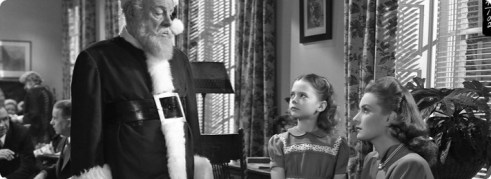
George Seaton directed and wrote the script which begins on Thanksgiving day. The beautiful Maureen O’Hara plays Doris, a cynical single mother who works for Macy’s and is in charge of their Thanksgiving Day Parade. As she frantically works to get the parade under way, she discovers that her Santa Claus is drunk off his feet. Desperate to find a replacement for the big finale of the parade, she convinces a passerby named Kris (Edmund Gwenn), who strikingly looks the part, to fill in. His convincing work eventually earns him a spot as Macy’s department store Santa. His only quirk? He claims to be the real Santa. But Doris’ bosses overlook that after seeing their customers positive reaction to him.

MIRACLE

But the core of the story and the most satisfying component of it revolves around the relationship between Kris, Doris, and her young daughter Susan (Natalie Wood). Susan is just like her mother, cynical and skeptical about all sorts of things, most notably the existence of Santa Claus. Kris sets out to not only convince Susan that he is Santa Claus but to convince Doris that there are many things in life worth believing it. Helping him along the way is Fred Gailey (John Payne), a struggling attorney who is also attracted to Doris. Fred uses the crafty old technique of getting close to the daughter in order to get close to the mother. He and Doris eventually hit it off even though his willingness to believe in things sometimes clashes with her stubbornness.

I really like the chemistry between O’Hara and Payne. Their developing relationship is easy to buy into especially thanks to O’Hara’s cautious confidence and Payne’s witty self-deprecating humor. Both give spot-on performances. Also, young Natalie Wood is fantastic. She wonderfully portrays Susan and her childlike innocence combined with her inherited skepticism. And then there is Edmund Gwenn who is still the most convincing Santa Claus I’ve seen on film. His undeniable sincerity and infectious charm flows from every scene he’s in and his Oscar was well deserved. The movie also gives us great supporting roles such as Porter Hall as Macy’s psych evaluator and the movie’s chief antagonist, James Seay as a nursing home doctor and friend to Kris, and Jerome Cowan as a district attorney given an certain impossible task. The cast is fantastic from start to finish.

“Miracle on 34th Street” is a nice mix of holiday sentimentality (in a good way) and genuine feel-goodness. But it’s also a wonderfully written story that’s flawlessly realized through sharp direction and the perfect cast. It’s easy for some to dismiss Christmas movies as shallow seasonal escapism. But there are those special gems that are simply great movies. They show us that sense of style and craft that remind us of how good movies can be. This is one of those films.

VERDICT – 4.5 STARS

REVIEW: “The Master” (2012)

The last time we saw acclaimed director Paul Thomas Anderson was in 2007 with his sensational drama “There Will Be Blood”. With it he solidified his position as a film critic favorite. Now he’s back with his next movie, “The Master”. As with every other feature film Anderson has made, he both wrote and directed this audacious drama that bounces between captivating and utterly frustrating. There are some award-worthy performances and loads of ambition, just as you would expect from a PTA feature. But while there were moments where I couldn’t take my eyes off the screen, there are others where the story bogs down in the deliberate pacing and slight self-indulgence. Nonetheless Anderson presses all the right critic’s buttons so this will has a good chance to be an awards season contender.

No one can deny Anderson’s filmmaking skills. “The Master” looks every bit of an epic, landmark film. There are a number of scenes that stand out due to their framing and camera work alone. Anderson uses several amazing tracking shots, sometimes shifting focus three or four times while still maintaining a single fluid shot. He also uses several fantastic locations which he captures through his stylish and precise lensing. I also have to mention the way he recreates America in 1950 both narratively and visually. The wardrobes, hairstyles, furnishings, etc. all fit perfectly, right down to the smallest details. Anderson takes no shortcuts on selling the audience on the period and that’s one of the reasons it’s so easy to connect with the story.

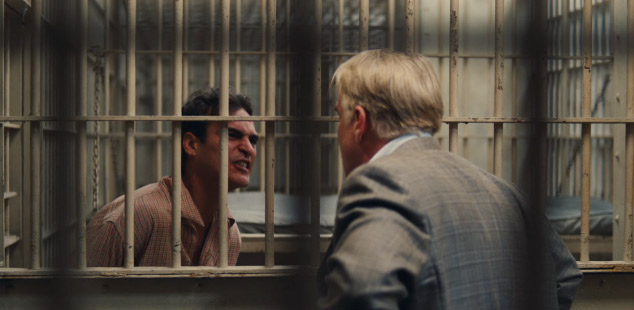
It’s in this 1950 America that we are introduced to Freddie Quell. He’s played by Joaquin Phoenix who gives the performance of his career. While not as breathtaking as Daniel Day-Lewis in “There Will Be Blood”, Phoenix is magnetic portraying a man emotionally scarred from his time in World War 2, or at least that’s what I presume. Freddie’s life is in shambles. He’s a raging alcoholic who resorts to drinking his own concoctions made from paint thinner and any other chemical he can get his hands own. He also has a twisted sex disorder that pops up here and there. His alcoholism is destroying his life and ends up playing an important part in the film. On the other hand, his sex addiction felt terribly underwritten and is only explored by adding a handful of uncomfortable scenes that quite frankly I could have done without. But as I said, Phoenix is brilliant and should be in prime position for an Oscar nomination.

Freddie ends up crossing paths with the charismatic leader of a group called “The Cause” named Lancaster Dodd (wonderfully played by Philip Seymour-Hoffman). Dodd is a self-proclaimed philosopher and intellectual with a steady and devoted group of followers. He also has a way with words which draws Freddie to him and his movement. Dodd takes a special liking to Freddie, at one point calling him his guinea pig but clearly growing more fond of him. Dodd is able to suppress Freddie’s mental issues to the point where Freddie begins to buy into his teachings. But his inner turmoil resurfaces on several occasions making him more and more conflicted.

The story often moves with an amazing rhythm and Phoenix and Hoffman share some mesmerizing scenes together. But for such a hyped picture, I was surprised to see the overall lack of plot. “The Master” features some of the best scenes you’ll see in the theaters this year, but honestly, there’s not a lot that happens within the film’s long running time. But a bigger problem with “The Master” is that for the entire film Anderson keeps the audience at arm’s length from what we are seeing. We’re never allowed to fully get to know the characters who truly are the driving forces behind the entire story. Anderson wants us to do a lot of guesswork and come to our own conclusions. But for me, a little less ambiguity and more intimacy with the characters would have been a big plus.

Overall there is a lot to like about “The Master”. Anderson’s style of filmmaking is about as good as you will find and it really stands out here. The movie looks and feels right at home in post-World War 2 1950 and the cinematography will blow you away. The film is also helped by tremendous performances from Phoenix and Hoffman and I didn’t even talk about Amy Adams’ strong work. Expect to hear all of their names when the Oscar nominations are announced. But while Anderson’s story is good, it doesn’t pack the punch that it’s going for. While it’s fascinating to watch these characters, I couldn’t help but want more. That, combined with a few pacing issues and a couple of scenes it could have done without, keep this from being the Best Picture frontrunner many are touting it as.

VERDICT – 3 STARS

REVIEW: “Moonrise Kingdom”

Going into a Wes Anderson film there are several things you know to expect: a healthy dose of dry and sometimes offbeat humor, a unique visual style, and familiar aesthetics that permeate each of his movies. “Moonrise Kingdom” is no different from other Anderson efforts in terms of it’s storytelling style and visual presentation.  This is his first film since 2009’s Oscar winner “Fantastic Mr. Fox” but it’s clear from the opening credits that his dedication to his style of filmmaking is still as strong as ever.

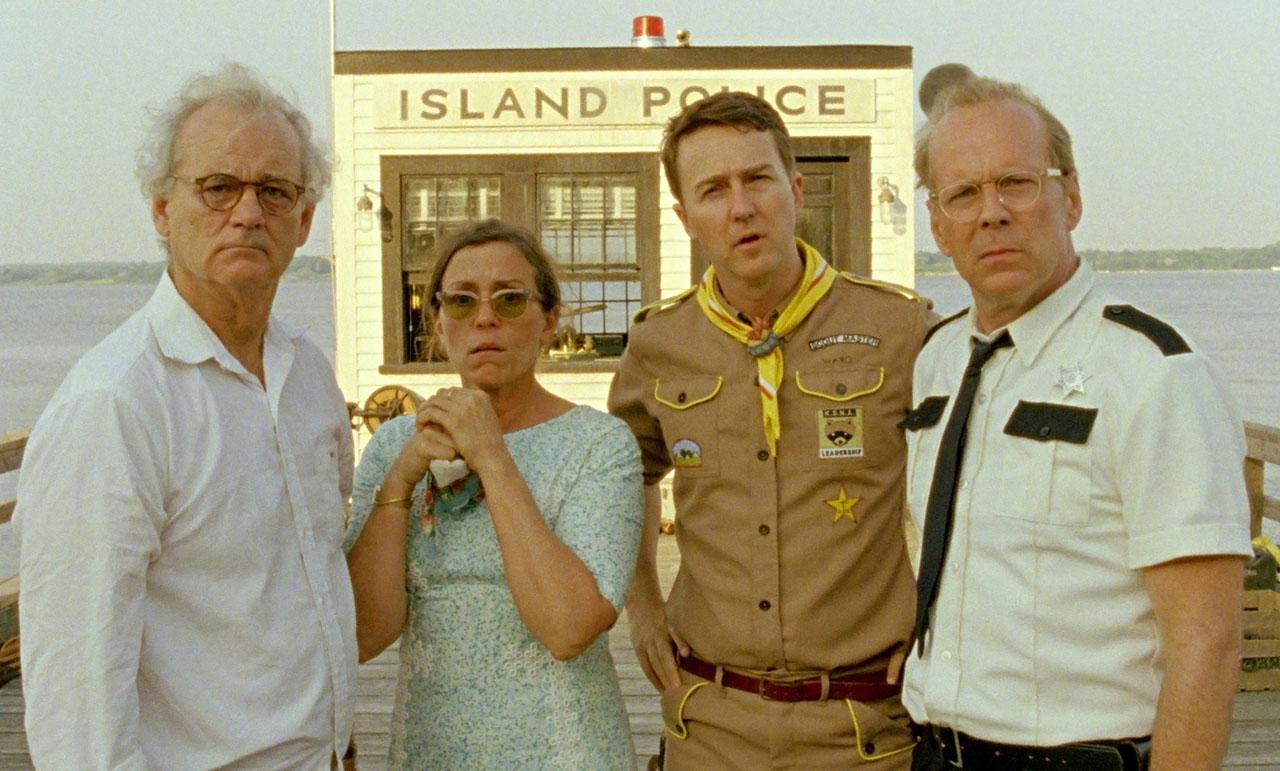
“Moonrise Kingdom” takes place in a small community on a New England island in 1965. A very Wes Andersonish  narrator sets the table for us and we meet several of the community folks including Scout Master Ward (Edward Norton) the leader of the island’s branch of the Khaki Scouts. While doing morning inspections, he discovers that 12 year-old Sam (Jared Gilman), a picked on, eccentric young boy has run away from the camp. Elsewhere on the island young Suzy Bishop (Kara Hayward) lives at Summer’s End, her home shared with her parents and three young brothers. Suzy is a reserved introvert who has no friends and finds refuge by retreating into her fantasy novels and looking through her binoculars – something that she pretends gives her super powers. It’s through her binoculars that she discovers her mother Laura (Frances McDormand) meeting secretly with the community policeman Captain Sharp (Bruce Willis). Her father Walt (Bill Murray) is impervious to the signs of his wife’s secret fling mainly due to their fractured relationship.

Suzy ends up running away from home and through a flashback we learn that it’s something she and Sam had been planning since they first met at a local church play the year before. The two meet in a meadow then set out on a journey together through the rugged and rainy island terrain. Sam flexes his extensive outdoor knowledge before Suzy by pitching tents, building fires, and catching and cooking fish. Meanwhile, after discovering the kids are gone, the dysfunctional community sets out to find them.

Anderson has several interesting dynamics at work, the first being the relationship between the two kids. It’s easy to see why they are drawn to each other. Both feel detached and out-of-place. There’s a void in their lives and they find solace in the fact that they no longer feel alone in the world. Both Gilman and Hayward are stunningly good especially considering this is the first feature film for both. Anderson’s childlike deadpan dialogue flows naturally from the two characters and he really gives them a believable foundation for the budding adolescent romance. Some have argued that the romance between the two was lacking and never provided the spark to drive the relationship. I argue that there’s no huge passionate spark mainly due to the children’s age and the newness of love and romance. I feel that their attraction to each other is based more on their personal, emotional, and social similitude. Being in each other’s presence fills a substantial emptiness in their lives and let’s them know they aren’t alone. A form of love sprouts up from that and Anderson depicts it with tenderness even amid the laugh out loud moments and the hilarious, straight-faced dialogue.

My biggest problem with the way Anderson handles the children’s relationship is the way he handles his child actors in one particular scene. Intended to show a sexual curiosity and almost unwanted compulsion, there is a brief scene where Gilman and Hayward are asked to engage in something that I have no problem saying I was uncomfortable with. At the time of filming, both actors were 12-years old and the willingness of Anderson to shoot this particular scene is disappointing. It’s certainly not graphic but it’s also not appropriate and that fact that it’s used more for comic effect is even more frustrating.

But while the story of Sam and Suzy drives the main narrative, perhaps the biggest microscope is put on the community and the fact that they are each flawed individuals forced to make important and sometimes redemptive decisions. As you look at each character you see situations unfold that bring them to the point of either doing the right thing and changing the direction of their lives or watching as things crumble in around them. In a very real sense, the disappearance of Sam and Suzy is the catalyst for some pretty real and important character transformations in Captain Sharp, Scout Master Ward, Laura, and Walt. Even Sam’s fellow Khaki Scouts are faced with their own moment of truth.

I talked about Gilman and Hayward’s performances but they’re surrounded by some equally strong work. I was particularly drawn to Bruce Willis who delivers some great laughs but through a very controlled performance that’s perfectly fitting for Wes Anderson material. Willis occasionally gets to show his acting range and this is a good Oscar caliber example of that. And I have to say, as someone who isn’t the biggest Edward Norton fan, that he was a lot of fun here. He’s goofy, nerdy, and his delusion of control that’s evident in some of the early scenes results in some of the films funnier moments. Frances McDormand is perfectly cast and Bill Murray is funny as always. I also thought Anderson favorite Jason Schwartzman was funny running around in full Khaki Scout attire.

“Moonrise Kingdom” is another Wes Anderson picture that’s a side-splitter to some but a head-scratcher to others. I laughed a lot through the film but I was also touched by its tenderness and care in addressing struggling children with feelings of isolation and insecurity. Anderson does get careless and I feel irresponsible in one brief scene but there are still several undercurrents that touch on important themes without fully diving into them. We not only see it with the children but in the community and it really worked for me. “Moonrise Kingdom” may not be for everyone but I loved its full package and stylish presentation. It’s a breath of fresh air in a comedy genre filled with raunchy movies and lazy humor. I’ll take this over them any day.

VERDICT – 4.5 STARS

“MAN ON A LEDGE” – 2 1/2 STARS

Some movies can take a pretty preposterous concept and still make a fun and entertaining film out of it. There’s no denying that “Man on a Ledge” has a pretty preposterous concept. The question is, is “Man on a Ledge” a fun and entertaining movie? Well…kinda. Underneath the surface the movie has a fairly interesting premise. But it gets bogged down in it’s occasionally lame dialogue, it’s run-of-the-mill characters, and some truly head-scratching moments.

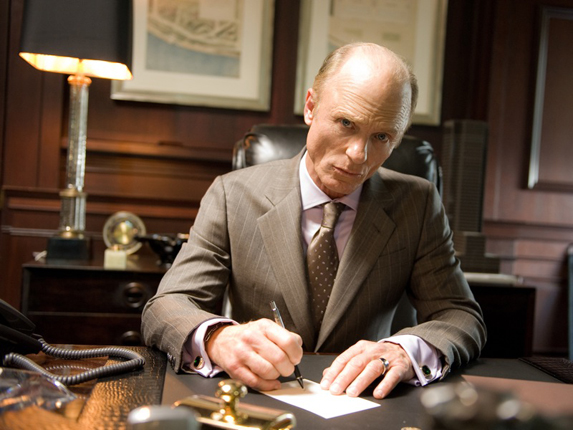
Sam Worthington plays Nick Cassady, an ex-New York City Policeman who is serving a 25-year prison sentence for stealing a $40 million diamond from a shrewd and unscrupulous businessman named Dave Englander (played by an alarmingly thin Ed Harris). After being notified of his father’s death, Nick is allowed to attend the funeral where he evades the guards and sets out to prove his innocence. His plan? To check into the Roosevelt Hotel, have a final meal, then climb out on the ledge of the building prepared to jump. It’s certainly not the normal approach one would take in trying to prove their innocence. Officer Marcus (Titus Welliver) arrives and takes charge of the scene and, at the request of Nick, calls in negotiator Lydia Mercer (Elizabeth Banks).

Now it’s clear that there is more going on than just a man about to jump to his death. Nick has a bigger plan in motion that hinges on Lydia’s cooperation, the craftiness of his brother Joey (Jaimie Bell) and Joey’s girlfriend Angie (Genesis Rodriguez), and the rabid crowd that has gathered below. The story takes several different turns and throws a few twists at the audience, but it’s hard to fully invest in them. Things get a little outlandish and it’s pretty hard to believe at times. Now in the defense of director Asger Leth, he’s well aware that he’s working with some wild material. He keep things moving at a crisp pace and he doesn’t drag the movie out longer that it needs to be. Also, Leth really uses the camera well and I had read where they filmed several scenes with Worthington actually out on the ledge. Unfortunately the good looks of the film isn’t enough to save it from it’s glaring flaws.

There are numerous instances where the writing left me scratching my head. Some scenes will leave the audience asking themselves “Can the NYPD really be this inept?” and “Is the movie making fun of New Yorkers or are we really to believe that 99% of them are bloodthirsty animals?”. There are also several cheesy exchanges between characters that either feel out-of-place or are just plain goofy. The film also features some of the same character types that we’ve seen in so many other movies. We have the wicked, wealthy corporate businessman. We get the typical corrupt cop. We even have the self-serving reporter who is more interested in getting the story that public safety. We’ve seen them all before.

You have to be impressed just looking at the movie’s strong cast. I like Sam Worthington even though he’s yet to really show much range in his performances. He’s actually quite good here even though the role doesn’t require as much from him as you might think. His New York accent does give way to his natural Australian accent in some scenes but he still gives a solid performance. Banks is also pretty good as is Edward Burns as a fellow negotiator. But the biggest problem is none of these performers can truly rise above the material which lets them down on numerous occasions. The always strong Ed Harris and Anthony Mackie as Nick’s former partner are terribly underused and should have been given more to do.

If you can put aside the flaws and suspend disbelief, there is some enjoyment to be found in “Man on a Ledge”. It’s impossible to take seriously and I have no doubt you’ll be shaking your head more than once. But “Man on a Ledge” is a harmless film with some cool action and fun moments. And while it’s a decent little afternoon diversion, it’s an action thriller that’s ultimately forgettable. Check it out if you have some free time. Otherwise, you can probably find something better to watch.