REVIEW: “The Shallows”

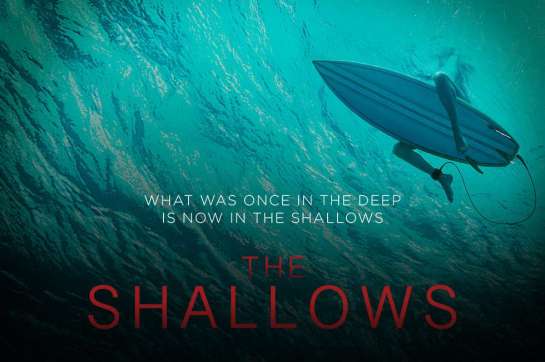
SHALLOWSPOSTER

One the surface “The Shallows” isn’t a film that would normally catch my eye. Neither Blake Lively in the lead role nor frequent Liam Neeson collaborator Jaume Collet-Serra directing was enough to draw my interest. But it’s amazing how a slick, compelling trailer can change your perspective.

In the Neeson thriller “Non-Stop” Collet-Serra played within the small confined space of a Boeing 767. Here he does the same, trading in the tight spaces of a jet plane for a remote Mexican beach. The bulk of the story takes place in a small isolated lagoon. It’s here that Lively’s character Nancy ends her emotional pilgrimage to find a favorite surfing spot of her recently deceased mother.

Shallows2

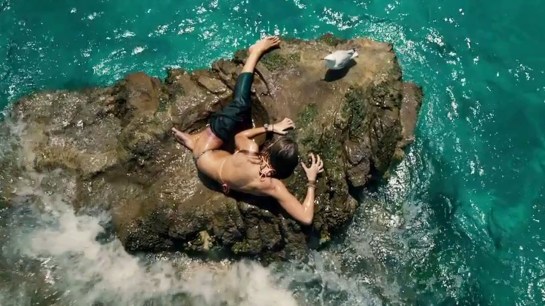
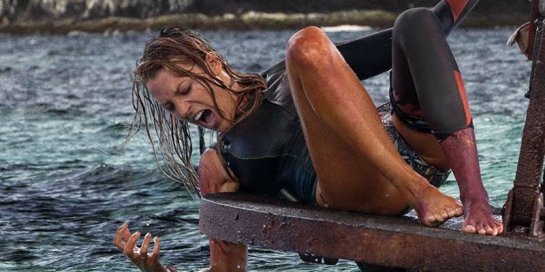
The simplicity of the story is actually a strength. We are fed small chunks of backstory that are a bit on the nose, but still brief enough to add context without distracting. The bulk of the story focuses on Nancy’s experience on the beach and what an experience it is. Her emotional release soon becomes a fight for survival after she is attacked by a shark and left stranded on a small reef.

“The Shallows” ultimately becomes an ocean water survival thriller mixed with shark horror in a tone reminiscent of “Jaws”. It works for a number of reasons namely that Collet-Serra and company never lose their lean and simple focus. It maintains its course steadily building up tension and offering up a handful of legitimate scares. It also works thanks to some fantastic cinematography featuring some great overhead shots and even better underwater photography.

shallows1

While all of that is important to the film’s success,  Blake Lively is the anchor. I have to admit, I was surprised by her strong and gutsy performance. For the most part she carries the movie on her shoulders and she puts it all out there both physically and emotionally. It is a demanding role which Lively is more than capable of handling.

Those unable to put aside an overly critical eye could dwell on a cheesy scene or two. They could point out a couple of preposterous things that happen in the final act. But I find it hard to imagine that someone wouldn’t find this to be a fun and entertaining ride especially considering the deluge of mediocre films so far this summer. “The Shallows” wisely stays true to its central concept. Its hook could easily wear thin if it extended itself too far, but the compact 80 minute running time keeps the tension high and the story moving forward. It keeps its bite and, unlike that pesky shark, it never overstays its welcome.

VERDICT – 4 STARS

4 Stars

REVIEW: “Steve Jobs”

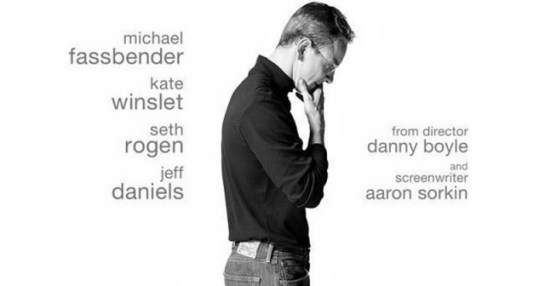
JOBS poster

Michael Fassbender may be the busiest man making movies. The guy is always working. To give you an idea, he appeared in three movies last year and has a whopping five movies slated for a 2016 release. But here’s the great thing – whether he is starring in a huge superhero franchise or smaller independent cinema, Fassbender always delivers rock solid performances. “Steve Jobs” adds to that reputation.

This is the second Steve Jobs biopic within a three year span and the upgrades we get in this film are significant.  Fassbender takes the lead role. Danny Boyle directs. Word wizard Aaron Sorkin writes the screenplay. The story is adapted from Walter Isaacson’s authorized biography and mixes in information gathered from Sorkin’s numerous interviews with Jobs’ associates.

The film wisely steers clear of being an exhaustive biopic. Instead it functions in a three chapter structure, each coinciding with a new product launch from the Apple co-founder. First is the Macintosh launch of 1984. Second is his NeXt computer of 1988. The last chapter jumps to 1998 with the unveiling of the iMac. Between these three pivotal moments in his life, Steve Jobs is faced with a number of professional and personal hurdles. Boyle and Sorkin manage to weave together so many narrative threads most of which rely on relationships that grow (or in many cases fester) as the film moves forward.

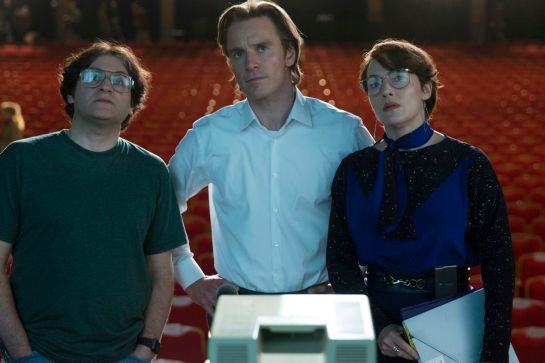
JOBS1

Much like with “The Social Network”, Sorkin doesn’t coddle his subject. He paints Jobs as the creative visionary he was, but our backstage access also shows an insufferable, insecure bully obsessed with total control. He constantly badgers his underlings and can’t bring himself to give anyone else the slightest bit of credit or consideration. The person who has an inside communication line with him is Joanna Hoffman (Kate Winslet), a marketing executive who is the only person besides himself he seems to depend on. It is a key relationship with Fassbender and Winslet each bringing needed levels of intensity.

Other relationships suffer at the hands of Jobs’ ego. Seth Rogen, an actor whose performances I generally find repellent, steps out of his norm and is great playing Steve Wozniak, Jobs’ old friend and Apple co-founder. I also enjoyed every scene featuring the naturally subdued Michael Stuhlbarg. He plays Andy Hertzfeld, an original Mac team member and “family friend” of Jobs. Jeff Daniels is really good as John Sculley, the CEO of Apple. All three chapters show each of these relationships in various stages of disrepair.

Perhaps the most damning scenes feature Jobs with his daughter Lisa. We first meet her at five years-old and she serves as a small window into Jobs’ private life. Jobs shamelessly denies he is her father and, despite his net worth, leaves her and her mother (Katherine Waterston) living on welfare. While Lisa showcases the more despicable side of Jobs, she also offers the one thin chance at redemption.

Boyle’s high-energy direction is a nice compliment to Sorkin’s dialogue. Boyle is known for pulling all sorts of visual tricks out of his hat. Here he shoots the 1984 segment in grainy 16mm, 1988 in 35mm, and 1998 in full digital. It’s such a cool way of distinguishing the time periods aside from the standard new haircuts and age-worn faces. Other than that Boyle doesn’t go overboard. We still get a few of those signature showy strokes, but otherwise he keeps everything nicely situated within the script’s theatrical boundaries.

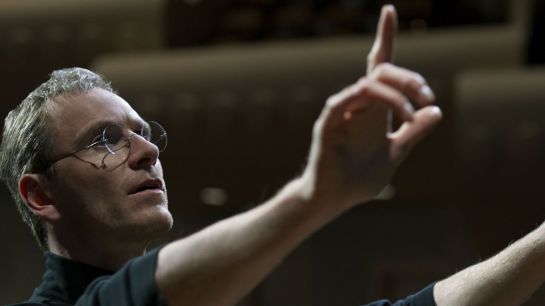
JOBS2

And then we come back to Fassbender, critically praised and with an Oscar nomination to match. He handles Sorkin’s thick, tricky dialogue with profound surety. It’s a commanding performance that manages to make you admire him in one scene and detest him in the next. And aside from his great delivery, Fassbender channels his character’s complexities through every insecure smirk, every cut of the eyes, and every defiant stare.

There are a few things that left me curious. As with “The Social Network” Sorkin takes some enormous liberties depicting Steve Jobs all for the sake of drama. While Sorkin is never one to shy away from that fact, its understandable how some might take issue. And is it that common for everyone to have their meltdowns and emotional face-offs 30 minutes prior to every major technology presentation? That is certainly the case in all three chapters of “Steve Jobs”.

Aside from that “Steve Jobs” got its hooks in me right off the bat and kept me captivated for the duration. Despite the questions I had, it is so satisfying to watch good actors work with a whip-smart script and under very assured direction. All of these pieces do their parts in making “Steve Jobs” an usual but thoroughly entertaining biopic.

VERDICT – 4 STARS

REVIEW: “Sinister 2”

Sinister2 posater

2012’s “Sinister” was a rare surprise. While it did depend on a number of common, run-of-the-mill gimmicks, “Sinister” had enough smarts behind it to succeed where many modern horror movies fail. It slowly built a compelling story. It never went overboard. It had some unsettling but satisfying twists. It was a huge hit meaning a sequel was inevitable in this money-starved movie climate. Unfortunately “Sinister 2” has none of the ingredients that made the first film enjoyable.

C. Robert Cargill and Scott Derrickson return as co-writers but you certainly can’t tell. I don’t know if they used up all their tricks in the first film, but “Sinister 2” is a flat and uninspired retread that feels like one big cash grab. Nothing about it sets it apart as uniquely its own and nothing comes close to living up to its predecessor.

IL1A7110.CR2

James Ransone is back but his character has turned in his deputy’s badge after the gruesome events of the first film. Now he works as a private detective investigating a series of murders each connected to the monstrous Bughuul (aka The Boogieman). His research leads him to a single mother named Courtney (Shannyn Sossamon) who is on the run from her abusive husband along with her two young sons. They’ve taken up residence in an isolated farmhouse, but the detective isn’t the only one to find them. Bughuul and his band of macabre kiddies have a special connection there which isn’t a good thing.

I will give the story a little credit. It does try to expand on the premise created in the first film. But literally nothing in the sequel sparks any interest or has the same creepy effect as before. The scares are nonexistent. The film can’t create any legitimate tension. There isn’t an interesting character in the entire thing. And by the time we get to the end it has flown completely off the rails.

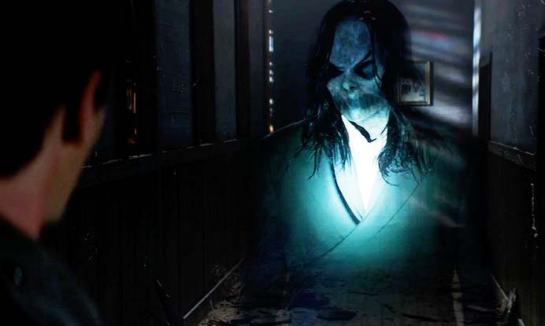
Sinister2

And then there are the performances. I hate to be too critical but James Ransone left me dumbfounded. I have absolutely no idea what he is going for, but he gives one of the most unsure and tone-deaf performances I’ve seen in a long time. He seems completely out of tune with his character and doesn’t show confidence in conveying any of his character’s emotions. It doesn’t help that all of the child performances are wobbly and Lea Coco is especially awful as the over-the-top abusive father and husband.

So basically what I’m saying is “Sinister 2” is a profound mess of a movie. It stumbles around in a constant state of lethargy failing in every category that the first film nailed. Sadly the movie made money well above its budget which means we could get another one of these. But after this sloppy cash-in I can’t see me wasting my time on it.

VERDICT – 1.5 STARS

REVIEW: “Son of Saul”

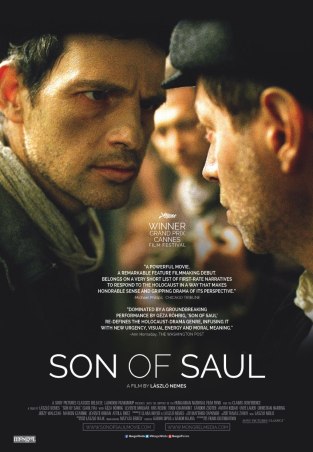
SAUL POSTEROne of the most highly praised films of 2015 came from 39 year-old Hungarian filmmaker László Nemes. He wrote and directed “Son of Saul”, a Holocaust drama set within the walls of the Auschwitz concentration camp. This certainly isn’t a new topic, but critics praised Nemes for his unique, honest, and unsentimental approach to it. The film has also won a slew of awards including several big prizes at Cannes, a Golden Globe, and it is the front runner for the Best Foreign Language Oscar. The great thing is “Son of Saul” is worthy of its praise.

Doing a film about the Holocaust requires a certain level of responsibility because reactions will undoubtedly vary depending on how you approach the subject matter. I remember criticisms surrounding 1997’s “Life is Beautiful”. Some took offense perceiving the film as too jokey and whimsical. While I completely disagree with that sentiment, it goes to show the range of reactions audiences often have even towards to most earnest of efforts.

Nemes doesn’t dodge these potential obstacles and he doesn’t take shortcuts. He firmly tackles the Holocaust with confidence both in the pull of his story and in the truth in his depiction. Nemes was inspired by a book titled “The Scrolls of Auschwitz”. It was a collection of true stories about Sonderkommandos – Jewish prisoners in concentration camps who were forced to dispose of those murdered in gas chambers and then executed themselves after a few months of work. Nemes and co-writer Clara Royer worked for five years on the script collaborating with historians and struggling to find financiers.

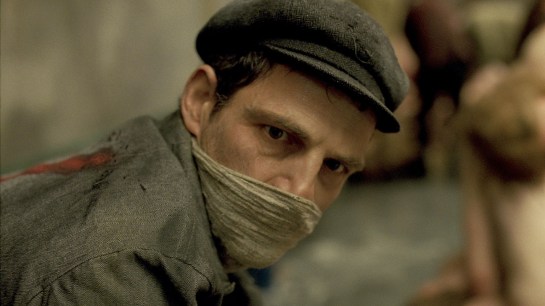
saul1

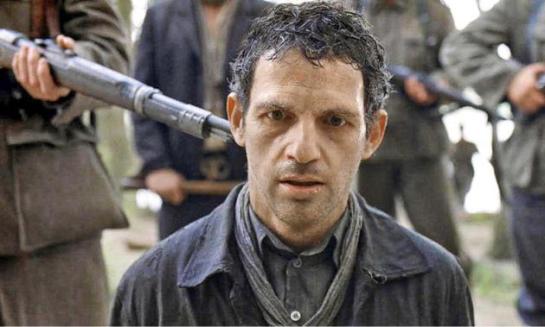
Hungarian poet Géza Röhrig (who had not acted since television 25 years ago) plays the lead character Saul Ausländer. It’s 1944 where Saul works as a Sonderkommando in Auschwitz. While clearing out gassed bodies of fellow Jews he discovers his son among the murdered. Nazi doctors designate the boy’s body for autopsy, but Saul wants a proper Jewish burial for his son. Obvious obstacles make that difficult. There is the brutal authority of his Nazi captors which is constantly in the background. He’s also caught in the middle of a brewing uprising which makes finding help among fellow prisoners difficult.

Röhrig’s performance is quiet but powerful. We know little about his character. No time is give to his history or backstory. But we do see Saul as a shell of a man. He is someone who has seen the very worst and it has left him emotionally cauterized. It is the sight of his son that stirs up something of his former self. It is that devastating discovery that reveals a small spark of life.

Nemes takes us along with Saul in a near moment-to-moment telling of his story. There is rarely a time lapse. His visual technique is clever, but it isn’t the easiest to get comfortable with. We spend the vast majority of the film looking at things through an over-the-shoulder third person perspective. We are literally right behind Saul. The camera will occasionally rotate around to focus in Röhrig’s intensely expressive face. We also get a few shots that zoom in to spotlight something that has grabbed Saul’s attention. But for the most part we are right on his back peering over his shoulder. It can offer some truly harrowing perspectives, but it can also be terribly disorienting especially when scenes intensify. This is clearly by design, but there were instances where I wanted the camera to just be still.

saul3

Thankfully the strengths of the visual presentation heavily outweigh the weaknesses. For example our vision is often hindered by our position. And since our line of sight is often strictly joined to Saul’s, we are often spared clear looks at the gruesome horrors taking place around us.

Nemes and cinematographer Matyas Erdely sometimes blur the outside boundaries of the shot which represent our unfocused view from the corners of our eyes. There is also a heavy dependence on sound. Tamás Zányi’s sound design is impeccable and plays a crucial part in deciphering what is going on around us. These techniques require our senses to play a major role in interpretation. We take the glimpses and sounds and paint our own mental depictions which can be challenging but also uniquely rewarding.

The approach the film uses frees it from many labels often cast upon Holocaust movies. It doesn’t sadistically wallow in misery. It doesn’t bludgeon the audience to death with the grisly horrors of the atrocities. At the same time it doesn’t soften its emotional punch in the slightest. “Son of Saul” is a difficult, harrowing, and exhausting film to endure – claustrophobic and psychological. But it’s also an intimate and gripping experience and an extraordinary feature film debut from László Nemes. What he has created is breathtaking and you won’t shake off its effects anytime soon.

VERDICT – 4.5 STARS

4.5 STARS

2015 Blind Spot Series: “Sweet Smell of Success”

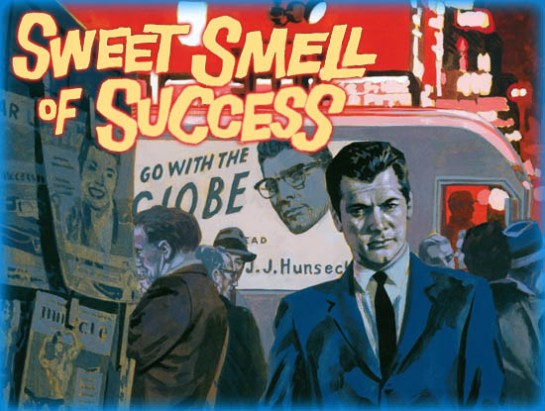
SWEET POSTER

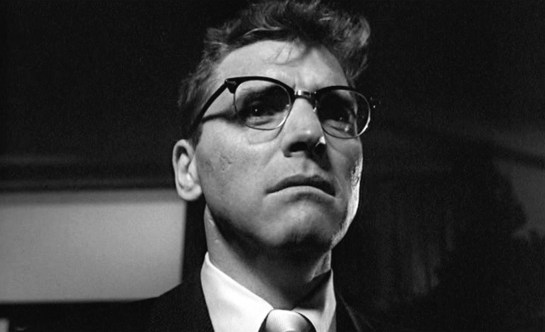
Lying at the cold calloused heart of “Sweet Smell of Success” is an acidic but thoroughly intriguing relationship. There are a number of things that set this film apart and distinguish it as something special. I’m talking in front of and behind the camera. But the driving force and its lasting aftertaste comes from the pungent and destructive relationship between a powerful New York newspaper columnist and a smarmy press agent.

The film is based on a story by Ernest Lehman that first appeared in Cosmopolitan magazine. Film rights were acquired by Burt Lancaster’s production company and Alexander Mackendrick was brought in to direct. By that time Lancaster had a lot of pull in the film industry and was considered an intimidating presence. Lehman had turned down an offer to direct the picture because of Lancaster. Even Mackendrick found filming to be stressful.

Lancaster plays J.J. Hunsecker. The character is said to be inspired by renowned syndicated columnist Walter Winchell. The film came out while Winchell still held considerable persuasive power. His daily columns were read by over 50 million people and were carried by over 2,000 newspapers. But Lancaster also had clout and wasn’t afraid to push the project. The film unquestionably stresses the bad side of Winchell by giving us a character so intensely self-centered and morally repugnant. 

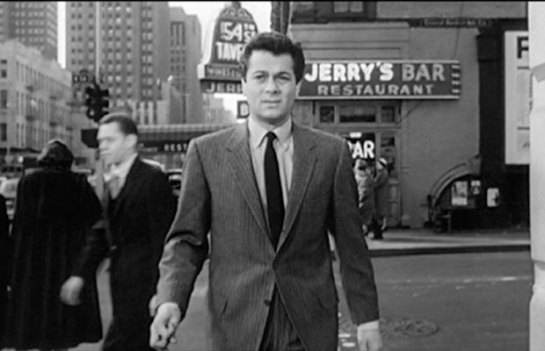
SWEET1

Tony Curtis plays Sidney Falco, a small-time struggling press agent who basically lives on whatever scraps Hunsecker feeds him. In Hunsecker eyes Falco is an expendable source for information; a desperate and disposable puppet. Hunsecker knows that Falco isn’t above shady deals or unethical practices and he uses that to his advantage. Falco looks at Hunsecker as his meal ticket. At times he shows what looks like puppy dog admiration, but in reality Falco is just as devious, just as opportunistic, and just as unlikable.

As the film starts Falco is upset because Hunsecker has left him out in the cold and refuses to take his calls. We learn that Hunsecker’s sister Susan (Susan Harrison) has fallen in love with a local jazz guitarist Steve Dallas (played by Martin Milner). Falco has been tasked with breaking up the relationship but so far has failed. Hunsecker has refused to promote Falco’s clients in his column until Dallas is out of the picture. This simple thread of plot makes up the main story, but the true focus is on the relationship between two repugnant individuals.

Lehman and Clifford Odets wrote the screenplay which is as brilliant as it is toxic. The dialogue is rich with razor-sharp discourse and verbal jousting. The characters talk with a twisted poetic flow especially Hunsecker. He constantly speaks as he writes – in cruel and piercing metaphors. Lancaster gives us so many memorable lines my favorite being “I’d hate to take a bite outta you. You’re a cookie full of arsenic.”

sweet2

This was a big film for both Curtis and Lancaster. Up to that point Curtis had made his way as a Hollywood pretty-boy. He fought hard for the role of Falco in hopes that it would earn him respect as a dramatic actor. That’s exactly what happened. Lancaster’s films had given him the reputation of a true all-American boy. “Sweet Smell of Success” was a striking departure much like Henry Fonda’s vile, villainous turn in “Once Upon a Time in the West”. It left audiences shocked.

Watching the film you notice so many impressive touches and striking details. It was shot by James Wong Howe who utilizes the city in a variety of ways. Howe incorporates strategic lighting, clever camera tricks, and an amazing visualization hectic New York City life. Much was shot on location during extremely busy times and also at night which adds to tone the story is shooting for.

There is nothing pretty or uplifting about the story “Sweet Smell of Success” is telling. There is nothing redeeming and respectable about its cruel and shameless lead characters. But in terms of wickedly smart and thoroughly compelling filmmaking “Sweet Smell” is top of the line. Even more impressive, the film is nearing 60 years-old yet it’s still as potent today as it was then. The performances, the direction, the cinematography, the script – they all still sparkle which is a testament to the film’s greatness.

VERDICT – 4.5 STARS 

4.5 STARS

REVIEW: “Star Wars: The Force Awakens”

STAR WARS POSTER

Caution, concern, skepticism, uncertainty. These are just a few words to describe my feelings after hearing a new Star Wars movie was on the way. After all, we aren’t talking about making any old thing. J.J. Abrams was taking what is arguably the most popular brand of any entertainment form and bringing it back to the big screen. He was tinkering with a property known for having the most passionate, the most protective, the most dedicated, and the most outspoken fan base. He was tackling a franchise viewed as more than a simple series of movies by millions of people from practically every demographic. Abrams was making a new Star Wars movie. No pressure.

Let’s be honest, when Disney acquired the Star Wars brand from George Lucas for $4.06 billion there was reason for Star Wars junkies like myself to at least be cautious. The Disney-fication (my new word) of Star Wars worried me. Then J.J. Abrams was given the keys to the new film. Abrams, a guy I have always seen as hit-or-miss, is best known for rebooting the Star Trek film series. But he didn’t only reboot Star Trek. He completely altered the structure, tone, and feeling of the Star Trek universe replacing it with a hip new Hollywood version. That’s the last thing I want in a new Star Wars picture.

Starwars1

Abrams, a self-admitted Star Wars fanboy, has said all the right things when talking about the new film. He directs, co-writes, and co-produces “The Force Awakens”, which is essentially Episode VII. It is a film positioned as a conduit connecting the old to the new as well as an injection of fresh energy for a new generation. That sounds good, but can it deliver? Can this new era of Star Wars suck me in like the previous efforts. An answer was hinted at once John Williams’ score struck that glorious and familiar opening note.

I was able to avoid spoilers and all story details which made my viewing experience all the better. For that reason I’ll stay away from any semblance of a plot synopsis. But let’s just say the film starts with a bang and we are quickly introduced to the franchise’s new players. Abrams wants us to make early connections with these folks because they are clearly set to be key ingredients in this film and the franchise in general.

Star Wars3

On one side we meet the resourceful scavenger Rey (Daisy Ridley). She’s the highlight of the new bunch – a strong independent sparkplug who is remarkably resourceful yet burdened by her past. We get the jittery, disillusioned Finn (John Boyega). He’s the film’s cowardly lion – a man with a conscience but who is too afraid to follow it. Boyega goes full throttle in every scene which isn’t always the best acting choice. And then there is Poe Dameron (Oscar Isaac), the best pilot in the galaxy. He’s a cool, rousing Han Solo type but with Luke Skywalker’s unwavering devotion to his cause. And then there is the little droid BB-8, an example of a cutesy character done right.


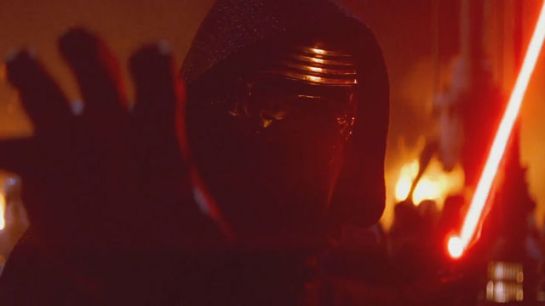
In the other corner we have The First Order, an evil Third Reich-ish force risen from the ashes of the Empire. They are led (or are they) by the volatile and dangerous Kylo Ren (Adam Driver). He is driven by an almost maniacal obsession to be the most feared person in the galaxy. There is the smug opportunist General Hux (Domhnall Gleeson) whose lust for power rivals that of Kylo Ren. He operates a Nazi-like military force and flexes his murderous muscles at will. But there is also the shadowy enigmatic Supreme Leader Snoke (Andy Serkis) who we only see in a familiar grainy hologram form.

Star wars2

And then you have the classic characters who Star Wars fans love. It has been roughly 30 years since the events of “Return of the Jedi” and names like Han, Luke, and Leia are spoken of by many in near mythical terms. Harrison Ford returns as Han and he gets the bigger chunk of screen time. He’s slower, grayer, but ever the cool space pirate. He and his howling compadre Chewbacca feel as if they haven’t missed a beat. Leia (Carrie Fisher) is focused on leading the resistance movement against The First Order. Luke (Mark Hamill) has disappeared after a particularly troubling event. And of course there is C3PO and R2D2. Seeing these characters again is exciting for any true fanboy. I do think there are moments between them that deserved a little more attention, but I’ll leave that one alone for now.

The real trick for Abrams is juggling all of these characters both old and new. To help he brought in writers Michael Arndt and Lawrence Kasdan (who also worked on the scripts for “The Empire Strikes Back” and “Return of the Jedi”). The script works mainly because the characters never get lost in a deluge of special effects. Each are given their own moments particularly the new faces who are well-developed and left with enough questions to be intriguing.

Speaking of the effects, there is a ton of CGI yet it never looks overused or blatantly obvious.  As good as the prequels often looked there were many instances where Lucas would visually overload his screen. Not here. Regardless of how fantastical things get, the special effects work to promote the setting, the characters, or the story. The new weapons, vehicles, and technology are fun, much of it based on blueprints from the original trilogy. Star Wars has always been known for its top-notch sound design. Here is no different. And Williams’ score is perfect sometimes feeling plucked right out the earliest films.
star wars 4

Seasoned Star Wars fans will notice several nostalgic throwbacks, entertaining Easter eggs, and cool bits of fan service, but in a sense this contributes one of the film’s few problems. It plays it too safe specifically in the final act. Don’t get me wrong, I love the fan service. It struck a strong chord with me. But at the same time it kept the big ending on a relatively short leash. It was way too familiar down to certain details. Not bad by any means, but very familiar. It could be that Abrams feared alienating the tough-minded and vocal fan base. I can respect that. Now that he has expressed himself as a Star Wars loyalist I’m hoping the next installments will take us into some newer directions.

But enough of that. I am so happy to be able to stand up and tip my hat to J.J. Abrams. Talk about a bold and pressure-filled undertaking. Taking the reigns of the biggest entertainment franchise in the world was gutsy and the pressures to deliver a new yet faithful sequel were intense. But he does it. “The Force Awakens” is a fun, action-packed tablesetter for a new era of Star Wars. It has heart, emotion, and a childlike exuberance that should spark a flicker of excitement in even the most hardened person’s heart. But most importantly it FEELS LIKE a Star Wars movie. That may sound a bit silly to the more casual audience, but Star Wars fans know exactly what I mean and that may be J.J. Abrams’ single greatest accomplishment with this film.

VERDICT – 4.5 STARS

4.5 STARS