“Sinister” – 3.5 STARS

Tis the season for horror movies and this year Hollywood has already given us several underwhelming entries into the genre. So along comes “Sinister”, a new supernatural horror thriller that may not break any new ground but fills the need for a fun horror movie experience during the Halloween season. “Sinister” is a small and relatively straightforward horror picture that uses several familiar devices yet is able to keep you a little uneasy in your seat. And even though I was hoping for more I’ve seen a lot worse efforts than this.

It was a nice surprise to see Ethan Hawke starring in this type of picture. He plays the role of a true-crime author named Ellison who moves his family into a new house in a small rural area. We quickly learn that the family who last owned the home were brutally murdered there. We also learn that one child from the family was never found. The murders were unsolved which serve as Ellison’s inspiration for what he hopes will be a can’t-miss best seller. I love how Hawke handles his character. There are several layers to Ellison. He’s deeply concerned that his 15 minutes of fame is up yet he refuses to accept it. His bullheaded insistence on finishing the book blinds him to the toll it’s taking on his children and marriage even as things begin to get really weird around the house.

The weirdness really begins when Ellison finds a box filled with several reels of Super 8 films and a projector in his attic. The films feature several brutal murders of different families in different years including the family killed in his new home. Ellison begins investigating the murders, connecting them In hopes of making a big discovery that would make his book I sure-fire hit. Of course it wouldn’t be a horror movie if everything went as planned. Ellison begins seeing visions, hearing bumps, and grows increasingly unnerved by his findings. But if the current trend in modern horror movies has shown us anything, it’s that you can never assume that things are as they seem.
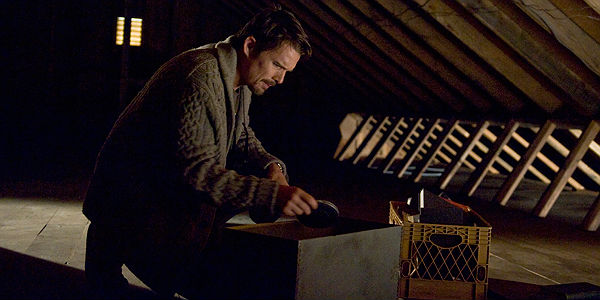
“Sinister” plays in the sandbox of both psychological and supernatural horror. Even though the trailer gives away too much, there are moments where you wonder if Ellison’s mind is playing tricks on him or if he has unleashed an incredible force of evil. The movie establishes and then keeps the tension amped up as its mystery unfolds. It deals with some tough subject matter and throws some pretty haunting imagery at the audience. Speaking of the imagery, some of the films creepier moments are when Ellison is sitting alone in his home office watching these old films. The darkness, the steady sound of the projector, and the grisly images he’s seeing create a delightfully eerie atmosphere. But this also opens the movie up to some of it’s more conventional approaches.

You can’t help but notice some all-to-familiar devices that “Sinister” milks dry. There are plenty of cheap scares via sudden bursts of loud noises or music. We get the bumps in the attic, the slow walks down long, dark halls, and the very in-fashion creepy kids scenes. In fact, while watching this movie I could’ve kept a checklist of all the things horror fans have seen before. Creepy house with a haunted past? Check! A sometimes head-scratchingly dumb main character? Check! Slamming doors, power outages, a well-timed storm? Check!

But here’s the good news. Despite the well-worn formulas and clichés, “Sinister” still manages to be an entertaining and eventually disturbing horror picture. A large part of it’s success is due to Ethan Hawke’s strong performance and compelling character (despite his sometimes bonehead decisions). I bought into the conflict between his love for his family and his desire to write another bestseller as well as the repercussions that his clouded judgment brings on them all. But more importantly “Sinister” works because there is a genuine sense of unease to everything you’re seeing. And while it does require the audience to wait a while for things to unfold, the ending is frighteningly satisfying.

As I mentioned earlier, “Sinister” doesn’t break any new ground in the horror genre. It depends on several of the same techniques that we’ve seen over and over. But there is some meat to its story and as you get deeper into the film the tension gets higher all the way to the finale which is perfectly fitting for a good horror picture. “Sinister” won’t make anyone’s horror top 10 list. But it maintains its moodiness and delivers in the end. That’s more than I can say about some of Hollywood’s more recent horror efforts.
REVIEW: “Shadow of a Doubt”

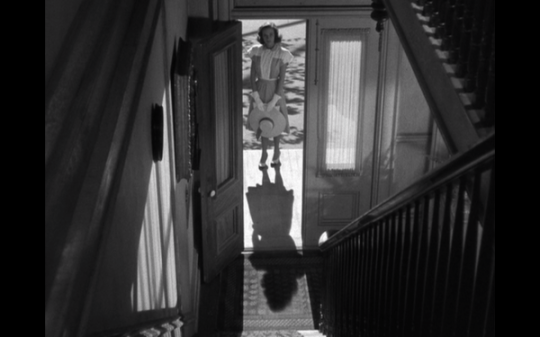
Alfred Hitchcock gets a lot of praise for his classic films such as “Vertigo”, “Psycho”, “Rear Window”, and “The Birds” and rightly so. But for those who aren’t familiar with the director’s full body of work, “Shadow of a Doubt” is one of his movies that may be easily overlooked. But to miss out on this wonderful early Hitchcock classic would be to miss out on one of his very best movies. This 1943 thriller has all of trademarks of a Hitchcock film and one of the strongest stories that he has brought to film.

“Shadow of a Doubt” was shot and set in Santa Rosa, California, a location picked for its picture of small town America. Charlie Oakley (Joseph Cotten) arrives in Santa Rosa to pay a visit to his sister Emma (Patricia Collinge) and her family. He hasn’t seen them in years and they receive him with open arms, especially his niece Charley (Teresa Wright) who was named after him. Charley has become bored with her life in her small town and the arrival of her uncle gives her a spark. But her uncle’s visit isn’t without purpose and Charley soon finds out that he is far from the wonderful man she thinks him to be.

The opening scenes let us know that there’s something mysterious going on with Charlie. Later he arrives in Santa Rosa and is doted on by his enamored family. He also draws the attention of and captivates many of the locals from bankers to widows. But he’s also hiding a very dark secret that eventually becomes a key driving force behind the film. In fact, Hitchcock gives us a compelling look at the dark reality of the real world infecting the innocent, idyllic life of a small town. Young Charley soon learns that the world can be a dangerous place and watching Teresa Wright portray Charley and her emotional transformation is a joy. Wright is brilliant. She’s lovely in her innocence and naivity and heart-breaking as we watch her face terrible things and bear huge burdens. I’m being vague and don’t want to spoil things for those who haven’t seen the film, but Charley is a wonderful character and Wright nails the performance.

I also loved Joseph Cotten as her Uncle Charlie. At first we love him just as much as the family does. He’s like that distant uncle who you haven’t seen in forever but you still think he hung the moon. But the problem is that you haven’t seen him therefore you really don’t know him. I bought into Charlie, the nice compassionate man, and was unnerved as he evolved into an entirely different person. This is due to how wonderfully he is written and to Cotten’s brilliant performance.

The movie also works due to what has come to be recognized as Hitchcock’s unique visual style. As with every Hitchcock picture, the camera is extremely important to his storytelling. We are treated to some slick camera angles and tricks as well as some clever use of lighting and shadows which helps inject the movie with moments of tension and suspense. Some of the best scenes involve moving cameras or perfectly timed close up shots and overall the visual style is vintage Hitchcock.

“Shadow of a Doubt” is an exceptional thriller built upon a very good story, some pitch-perfect performances, and slick direction. It’s not as well-known as some of Hitchcock’s bigger films but it’s just as good as them and it has certainly earned its spot as a true classic. The story moves at a great pace and it keeps you involved all the way to its startling ending. I really like “Shadow of a Doubt” and its one of those movies that I could watch again and again.

VERDICT – 4.5 STARS

“SEEKING JUSTICE” – 3 STARS

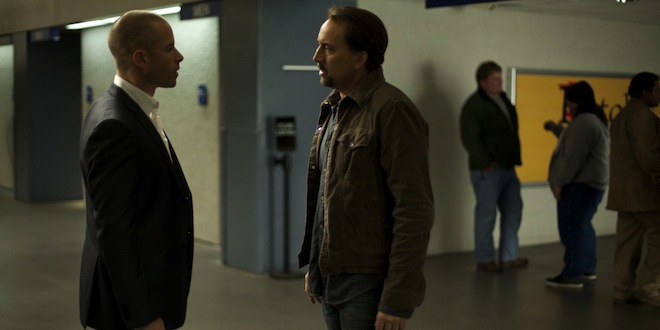
Nicolas Cage’s career has been amazing to watch and I don’t necessarily mean that positively. The once promising actor and Academy Award winner is now known more for his current long streak of bad movies. But yet Cage continues to pump out these pictures every year. That brings us to “Seeking Justice”, his latest film co-starring Guy Pearce and January Jones. This action thriller isn’t the sharpest movie you’ll find nor is it one that will stick with you long after watching it. But I found it to be a fairly entertaining picture and definitely better that Cage’s most recent efforts.

Cage plays Will Gerard, a high school English and literature teacher in New Orleans. He has a great life. He loves his job and he just recently celebrated his wedding anniversary with his lovely wife Laura (Jones). One night as Will is hanging out with his best friend Jimmy (Harold Perrineau), Laura is attacked and raped while walking to her car from a concert. Later, as Will is sitting in the hospital waiting room, he is approached by a mysterious man named Simon (Pearce). Simon tells him he works for an organization that knows who raped Laura and can take care of the rapist in ways the police can’t. In return, Will has to promise to do the organization a small favor at a later date. Will struggles with the decision but ends up saying yes which catapults him into a mess he never anticipated.

The idea behind the story isn’t a bad one and I found myself interested in the whole grief-stricken husband seeking justice from a secret organization thing. Cage actually gives a fairly solid performance as a very ‘anti-action hero’ hero. January Jones is also good individually as his wife. The problem is they have no real chemistry whatsoever and I had a hard time believing in their relationship. Putting that aside, their relationship takes some interesting turns as she copes with her life after such a violent crime and he deals with the decision he made regarding her assailant. Unfortunately these and several other key plot points are never fleshed out. For example, there’s one point in the movie where Laura is just magically over the trauma of her rape. It’s as if the film just decided to drop it altogether. Another example is when Laura finally finds out what Will did. We never see them wrestle over his decision that has put them in such danger. There are several things like this that feel terribly short-changed.

Another issue I had was with the abrupt and almost jarring jumps the movie makes in the first half. This too is related to what feels like shortcuts in the storytelling. There are mammoth emotional holes where the movie skips from one moment to another. And it’s unfortunate because the movie is never boring. There is some good tension and there are some cool twists even though none of them are particularly that surprising. And even though the film ends up taking a pretty conventional path, I still found it kept my interest despite the shortcomings of the script.

I’ve talked about Cage and Jones. Guy Pearce, who is always great, has a lot of fun with his shady Simon character. When I first saw him he reminded me of Paul Newman’s character early on in “The Verdict”. Newman was checking the newspapers for car accident fatalities then attending their funerals where he shamelessly slipped his lawyer business card to the grieving family. Simon hits up Will at the most vulnerable time – an almost predatory approach. Pearce slithers in and out of his scenes and he was the best part of the film even though his character doesn’t have as much mystery behind him as he first leads you to believe.

“Seeking Justice” isn’t a bad movie. In fact it’s a considerable step up for Cage. But is that really saying anything? There are clear issues with the plot and tone and the story ends up with the traditional loud, action-driven finale. But it’s hard to really rail against a movie that did keep my interest throughout and had some really solid moments. Plus Pearce is Pearce which is always a good thing. As I mentioned earlier, “Seeking Justice” isn’t a movie that will stay with you very long, but it does manage to entertain.

REVIEW: “Shotgun Stories”

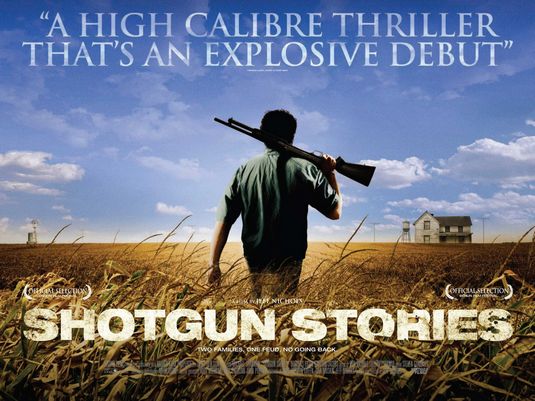
I was a huge fan of the 2011 movie “Take Shelter”. In fact, it was easily one of my top five favorite movies of the year and it featured two of the very best performances of the year. “Take Shelter” was written and directed by Arkansas filmmaker Jeff Nichols and it was only his second feature film. Since I loved the movie so much, I thought it would be worth it to check out Nichols’ first film “Shotgun Stories”. Boy am I glad that I did.  Like “Take Shelter”, “Shotgun Stories” stars Michael Shannon, an actor who is perfect for the type of rural, working class movies that Nichols is drawn to making. It also shows the amazing writing ability of a director who is clearly passionate about his material.

“Shotgun Stories” is set in the small rural town of England, Arkansas. It’s a part of the country that Nichols obviously knows well and that familiarity really shows itself on screen. Michael Shannon plays Son Hayes, a husband, father, and the oldest of three brothers. Son works at a local fish farm with his youngest brother Kid (Barlow Jacobs). Kid has no house or vehicle and lives in a tent in Son’s backyard. Having her fill of Kid’s presence and of Son’s gambling, his wife Annie (wonderfully played by Glenda Pannell) leaves with their young son and moves in with her mother. While she’s gone, Son has his other brother Boy (Douglas Ligon) temporarily move in to give him a break from living in his van. We quickly are introduced to the three brothers and Nichols does a fantastic job of showing us each of their personalities, shortcomings, and quirks.

One day while the brothers are hanging out at Son’s house, their estranged mother shows up to notify them that their estranged father has died. We learn that when they were young their father left them to be raised by a mother who Son described as “hateful”. Their father remarried and started a new family completely leaving Son, Boy, and Kid behind. The boys crash their father’s graveside funeral service which infuriates their half brothers, especially Mark (Travis Smith), the oldest. Mark swears payback and this sets off a series of encounters, some violent, between the two sets of brothers.

“Shotgun Stories” has a pretty drastic change of tone close to half way into the picture. But where many movies have handled it in a clunky and jarring fashion, Jeff Nichols makes a near flawless transition. During the first part of the film there are some genuinely funny, laugh out loud moments. Nichols’ region-specific dialogue is perfectly done with a clever mix of humor that would work for those completely foreign to the rural Arkansas area or to those who are very familiar with the local nuances that Nichols plays with. The movie generates several understated laughs through the brother’s southern banter and peculiar circumstances. I found it to be quite funny at times.

By the tone changes when we see the friction between the two sets of brothers. Nichols shows us a deep-seated resentment that’s been hidden in the hearts of the brothers, especially Son. “Shotgun Stories” really builds a sense of tension and suspense and as you watch you just expect the pot to boil over at any second. The change in tone feels natural and appropriate and I was completely caught up in Nichols’ cleverly structured story which revolves around Michael Shannon’s performance. While some of the supporting performers aren’t all that good, Shannon is nothing short of brilliant and much like in “Take Shelter”, I was blown away by what he was doing on the screen.

With “Shotgun Stories”, Jeff Nichols shows that with the right skills in writing and filmmaking and with a phenomenal lead actor, you can make a strong movie even with a minuscule budget. This may be a movie that many have missed and some may not have even heard of it. But it, combined with “Take Shelter”, solidifies my position as a bonafide fan of Nichols and Shannon. “Shotgun Stories” is wonderfully written, brilliantly conceived, and cleverly crafted. Is that enough overused adjectives to prove that I really liked this film? You should check it out.

VERDICT – 4.5 Stars

REVIEW: “SCHINDLER’S LIST”

Many movies have looked at the Jewish Holocaust from a variety of different angles. There have been films that examined it through the eyes of children, those that have focused on specific regions, and others that show individuals who went to great lengths to help the persecuted Jews. A well done movie on the subject always has a strong effect on me. It’s not just the terrible things and disturbing images that filmmakers are showing us, but it’s the fact that they are dealing with a very real and devastating time in our world’s history. The Nazi slaughter of 6 million Jews marks one of the world’s darkest times. But it’s also a period that should never be forgotten and there are several films that help us remember.

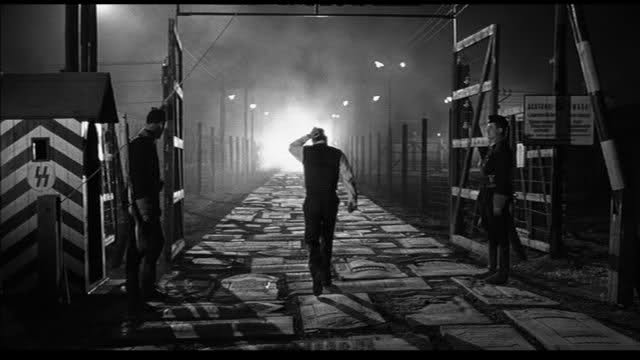
While many movies have done an excellent job responsibly depicting events surrounding the Holocaust, Steven Spielberg’s 1993 movie “Schindler’s List” is the one that has had the strongest impact on me personally. I recently had an opportunity to revisit the film. It had been several years since I had last saw it and with good reason. It’s not an easy movie to watch. It features some of the most realistic and graphic depictions of Nazi violence and mistreatment of the Jews and doesn’t shy away from presenting it in a crushing and penetrating way. From their initial relocation to Krakow’s Jewish Ghetto to their brutal and deadly time spent in the Nazi extermination camps, we see the Jews experience all forms of cruelty and brutality made more disturbing by its roots in reality.

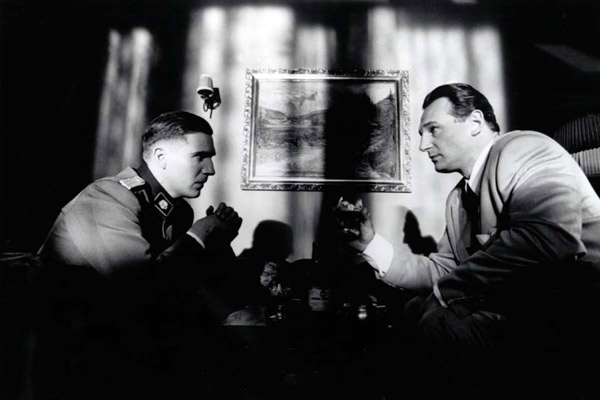
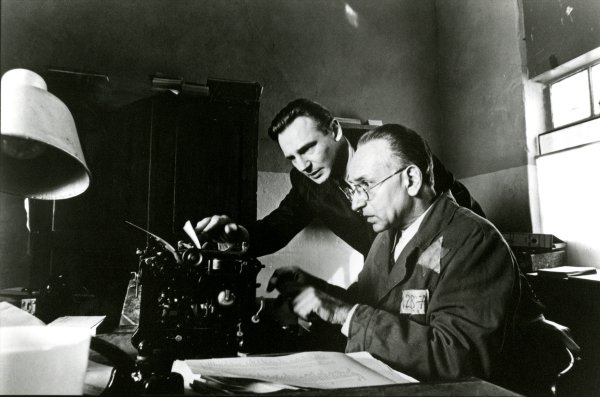
The Jewish plight is brilliantly and cleverly shown through the true story of Oskar Schindler. Schindler, played wonderfully by Liam Neeson, is a German businessman who arrives in occupied Krakow in hopes of making a load of money exploiting the war. At first, Schindler is a self-absorbed, money-hungry man who quickly finds acceptance by kissing up to an assortment of high-ranking German SS officers. Through bribes and his Nazi Party membership, Schindler obtains several contracts to make metal pots and pans for the German soldiers in the field. To secure even more money for himself, he brings in a Jewish workforce who work considerably cheaper than the local Catholic Poles. To keep his fledgling company up and going, he hires Itzhak Stern (Ben Kingsley), an accomplished Jewish accountant and highly regarded member of the Jewish community. It’s through this relationship that Schindler begins to see his perceptions change.

Coinciding with SS Officer Amon Goeth’s (Ralph Fiennes) arrival at the Plaszow concentration camp, the Germans raid and empty the Krakow Ghetto, shipping Jews to the camp and slaughtering almost 2,000 in the streets. As Schindler witnesses the atrocities taking place, he’s deeply troubled and an internal conflict begins between his desire for a money-making business and his growing affection for his Jewish workers. He struggles with the temptation to take his money and leave the city. Instead he sets out to use his fortune to try to save his workers and as many other Jews as he can. To do so requires him to get close to high-ranking Nazi’s like Goeth making it all the more difficult.

The story of Oskar Schindler and his personal transformation is quite moving and Liam Neeson is nothing short of brilliant in his portrayal. Neeson’s Schindler is a confident and looming opportunist. Even Spielberg’s camera makes him stand head and shoulders about so many of the people he is in contact with. That’s just one reason the ending is so stirring (I’ll leave it at that for those who haven’t seen the film). I was particularly enamored with the relationship between Schindler and Stern. You initially see the two on a strictly business level. Neither really like or trust the other. But as mentioned, it’s this growing friendship that plays a key role in Schindler’s transformation. I talked about the fantastic work of Neeson. Let me just say Kingsley is equally good and I still view this as his very best performance.

I also have to take time to praise Ralph Fiennes and his incredible work as Goeth, easily one of the most detestable villains on film. Fiennes visually captures this sick and twisted personification of evil. While Schindler does find ways to manipulate Goeth, his ingrained wickedness never goes away and we see it on display through some of the movie’s more disturbing scenes. What makes the character more frightening is that the movie doesn’t stray that far in its portrayal of the real Amon Goeth. He was a sadistic cold-hearted murderer who is said to have killed close to 550 Jews himself. That’s not counting the thousands he sent to be executed. Spielberg included several scenes that show Goeth’s murderous tendencies including his penchant for sniping Jewish workers in the camp from the terrace of his château on the hill. This sick bit of reality only makes the character more despicable and Fiennes sell it perfectly.

“Schindler’s List” is also a technical achievement. Spielberg’s decision to shoot it in black and white was perfect. It gives the movie an added feel of authenticity and when mixed with the frequent hand-held camera work and strategically placed wide angled shots, it makes you believe you’re watching a documentary. The clever style of several scenes almost resemble old film footage of the actual events. It’s that convincing. The movie was shot in a way that resembled a more classic style of filmmaking but yet never shied away from the harsh reality it was depicting. The movie was helped by being filmed on or near the locations of the actual events. Spielberg’s desire for realism really pays off and the locations were a big part of it. But that same desire for realism also made filming difficult for the director. It’s been said he cried repeatedly during the filming and there were certain scenes he literally couldn’t watch.

While “Schindler’s List” is a great film, it can also be a difficult movie for audiences to watch. It’s a movie that’s sometimes painful and emotionally draining. But it’s also a film of immense power and the deepest sincerity. It’s a visually stunning war picture that makes you feel as though you are witnessing these horrific events first-hand. It’s also a story of incredible personal transformation in the middle of some of our world’s darkest moments. The performances are outstanding and Spielberg’s direction bypasses most of the other work on his resume. It’s a stirring historical drama that reminds me of the power movies have to entertain us, to move us, and inform us. It’s also a reflection on a time that we should never forget and events we should never repeat.

VERDICT – 5 STARS

5 STARSs

5STAR K&M

“SAFE” – 3 1/2 STARS

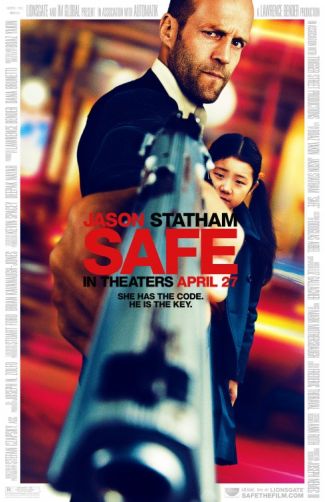
While not all of Jason Statham’s action pictures have been good, you can’t deny that he has an almost infectious tough guy charisma. He’s a believable action movie star even in the middle of some pretty far-fetched action sequences. In “Safe”, Statham shoots, kicks, and punches through some pretty familiar territory. But it’s also a sharply directed action picture that builds on a really strong performance from Statham all the way to its bullet-ridden finale.

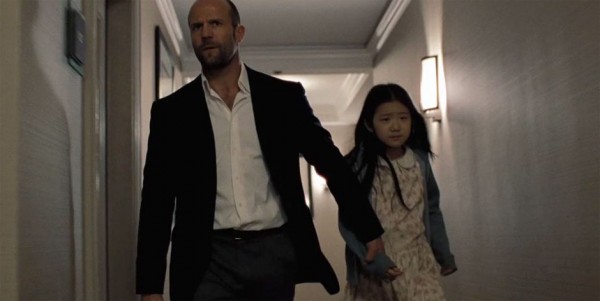
Statham plays Luke Wright, an ex-NYPD special agent who has hit rock bottom. We learn that Luke has resorted to cage fighting, something he hasn’t done well at. After winning a fight he was supposed to lose and costing the Russian Mafia a load of money, his life is utterly shattered by the orders of the mob’s leader. Homeless and at the end of his rope, he sees a young Chinese girl being chased by the same Russians. He intervenes to save the girl who he quickly finds is also being hunted by the Chinese Triads and some corrupt NYPD cops. Luke finds himself in the middle of an all out war in the New York City streets as he tries to protect the girl and the long list of numbers she holds in her memory.

Several things make “Safe” stand out from some of Statham’s other movies.  For one thing, the Luke Wright character shows more humanity than we see in some of his other roles. Statham absolutely has the athletic, tough-as-nails, butt-kicker persona down perfectly. But I was really surprised to see how well he brought genuine emotion to several scenes that called for it. The movie also benefits from a pretty tight and well structured story. It’s fast-paced and adrenaline filled but it’s also cleverly layed out. But that doesn’t mean the story is flawless. There’s nothing that happens that you won’t see coming from a mile away. The only exception is the very end which really didn’t work for me. I’m not going any further because I don’t want to spoil anything, but let’s just say the big finale was a head-scratcher.

But “Safe” is an action movie first and foremost and it delivers plenty of it. There’s plenty of gunfire and bone breaking and the frantic herky-jerky camera work actually works better here than in many other films that employ the technique. Director Boaz Yakin knows Statham’s strengths and he rides them. Statham’s martial arts background fuels some really slick fight sequences and he’s not bad with a pistol either. And while there is plenty violence, Yakin portrays it without buckets of blood. It’s gritty and edgy but it maintains the feel without the unneccessary gore. The action is the movie’s bread and butter and I was sold on it.

This certainly isn’t a movie for everyone and it isn’t a film that will garner a lot of critical praise. But it’s a fun, no-nonsense action picture that I enjoyed. Statham really brings it both physically and with a performance that shows he has some acting chops. The movie is fairly predictable and it’s supposed twist at the end isn’t all that impressive. But will anyone be going to see “Safe” other than to see Statham kick, punch, and shoot his way through waves of bad guys? That’s one of the reasons I went to see it and I definitely got what I paid for.